Wall-Mounted Pot Filler Styles: Traditional vs Modern Designs
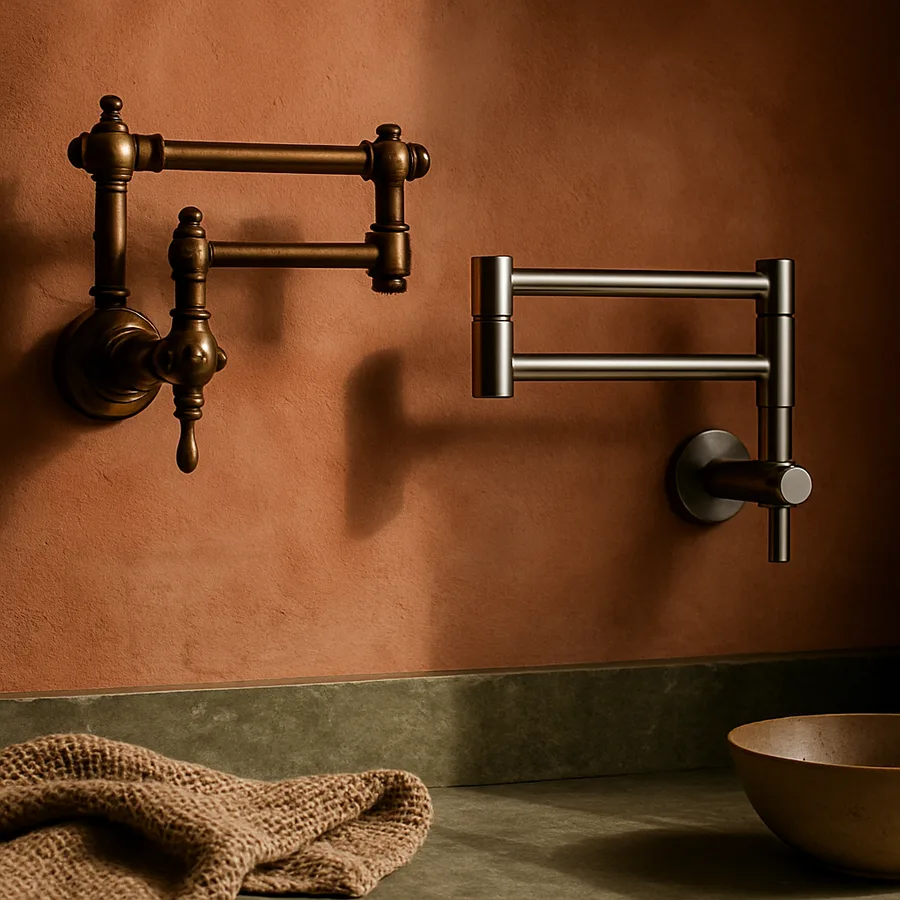
Choosing a wall-mounted pot filler involves far more than simply picking a water delivery method for your stove. The style of your pot filler sets a visual tone that either harmonizes with or disrupts the design language of your entire kitchen. According to a survey conducted by the National Kitchen and Bath Association (NKBA), fixtures and hardware are the third most noticed design element in a kitchen after cabinetry and countertops, which means your pot filler choice carries real aesthetic weight. The divide between traditional and modern pot filler designs represents two fundamentally different approaches to kitchen style, and understanding what distinguishes them helps you make a selection that will feel right for years rather than becoming a design regret.
Traditional pot fillers draw on classic plumbing aesthetics with ornamental details, cross-shaped handles, and warm metallic finishes that evoke a sense of permanence and craftsmanship. Modern pot fillers strip away ornamentation in favor of clean geometric lines, single-lever operation, and contemporary finishes that prioritize visual simplicity. Both categories contain a wide range of quality levels and price points, so the choice is genuinely about design preference rather than being forced by budget constraints. A high-end traditional pot filler from a manufacturer like Rohl or Waterstone can cost as much as or more than a premium modern model from Kohler or Brizo.
This article examines both style categories in detail, breaking down the visual characteristics, functional differences, and kitchen design contexts where each excels. You will find specific guidance on matching your pot filler style to your overall kitchen aesthetic, along with examples of how each style interacts with different backsplash materials, cabinet finishes, and hardware selections. Whether your kitchen leans toward farmhouse warmth or urban minimalism, this guide will help you identify the pot filler style that completes your vision.
Defining Characteristics of Traditional Pot Fillers
Traditional pot fillers are distinguished by their architectural detail and ornamental complexity. The most recognizable feature is the cross handle, which consists of four spokes radiating from a central hub and requires a quarter-turn to open and close the water flow. Cross handles have been a fixture in plumbing design since the Victorian era, and their continued presence on traditional pot fillers connects the kitchen to a longer history of craft and domestic design. The handle shape is not purely decorative either, as cross handles provide excellent grip leverage even with wet or greasy hands, which is a practical advantage in a working kitchen environment.
The body and arm construction of traditional pot fillers tends to feature visible joint details and stepped transitions between sections. Where a modern pot filler might have a smooth, continuous tube from wall to spout, a traditional model often includes decorative collars, beaded accents, and graduated diameter changes that create visual rhythm along the arm. These details add manufacturing complexity, which is one reason why traditional pot fillers from premium brands carry higher price tags. The craftsmanship required to produce consistently proportioned ornamental details across hundreds of units demands tighter tolerances and more finishing steps than simpler geometric forms.
Finish options for traditional pot fillers lean heavily toward warm metals. Oil-rubbed bronze, antique brass, polished nickel, and unlacquered brass are the most popular choices in the traditional category. Unlacquered brass is particularly prized in traditional kitchens because it develops a natural patina over time, and that aging process gives the fixture a lived-in quality that synthetic finishes cannot replicate. The Brass and Bronze Guild notes that unlacquered brass fixtures can take anywhere from six months to two years to develop their full patina depending on humidity, usage frequency, and exposure to cooking vapors, making each fixture genuinely unique over time.
The spout design on traditional pot fillers is often a gooseneck or shepherd's crook shape that curves gracefully downward from the arm. This curved spout is both a visual signature and a functional feature, as the curve directs water flow into a natural downward stream that reduces splashing when filling pots. Some traditional models also feature an aerator at the spout tip that introduces air into the water stream, creating a softer flow that is less likely to splash out of shallow pans. The overall impression of a traditional pot filler is one of substance, intentionality, and enduring style that does not chase trends.
Defining Characteristics of Modern Pot Fillers
Modern pot fillers prioritize clean lines, geometric simplicity, and a visual lightness that makes them appear almost structural rather than decorative. The handle mechanism on most modern pot fillers is a single lever that controls water flow with a simple lift-and-lower motion, eliminating the rotational action required by traditional cross handles. This single-lever design reduces the visual mass of the fixture and creates a streamlined profile that aligns with contemporary kitchen aesthetics where simplicity signals sophistication. Some modern pot fillers take minimalism even further by integrating the handle flush with the body so that the entire fixture reads as a single continuous form.
The arm geometry of modern pot fillers is typically angular and tubular, with uniform-diameter tubes joined at precise 90-degree or 45-degree angles. This geometric precision creates a mechanical, almost industrial quality that pairs well with modern kitchen elements like flat-panel cabinetry, quartz waterfall countertops, and integrated appliance panels. The joints between arm sections on a modern pot filler are designed to be as inconspicuous as possible, with flush transitions that maintain the visual continuity of the tube. Some high-end modern models use concealed spring mechanisms at the joints that provide a satisfying resistance when folding and unfolding the arm, adding a tactile quality that reinforces the sense of engineering precision.
Finish selections for modern pot fillers favor cool-toned and matte options. Matte black, brushed stainless steel, polished chrome, and gunmetal are the dominant choices in this category. Matte black has emerged as the defining finish of the modern kitchen movement, with the American Society of Interior Designers (ASID) identifying it as the most specified fixture finish in contemporary kitchen projects for four consecutive years. The matte surface absorbs light rather than reflecting it, which reduces visual clutter in kitchens that are designed around calm, uncluttered sightlines. Brushed finishes are also popular in the modern category because they hide fingerprints and water spots better than polished surfaces, which aligns with the low-maintenance philosophy that underpins modern design.
The spout on a modern pot filler is typically a straight or gently angled tube that terminates in a flat or cylindrical tip without the curved flourishes of traditional gooseneck designs. This straight-line spout creates a more direct water delivery path and reinforces the geometric language of the fixture. Some modern models feature a swivel spout that rotates independently of the arm, providing additional positioning flexibility without adding visual complexity. The overall impression of a modern pot filler is one of purposeful restraint, where every element earns its place through function rather than decoration.
Matching Pot Filler Style to Kitchen Design Language
The most important principle in selecting between a traditional and modern pot filler is consistency with your kitchen's overall design language. A traditional pot filler in a sleek, handleless modern kitchen creates a jarring visual disconnect that makes the fixture look like an afterthought rather than an intentional design choice. Similarly, a minimalist modern pot filler in a richly detailed traditional kitchen can feel cold and out of place against ornate cabinetry and decorative moldings. The pot filler should feel like it belongs to the same design family as the rest of your kitchen fixtures, and that means matching not just the finish but the degree of ornamentation and the geometric vocabulary.
For farmhouse and country kitchens, traditional pot fillers are the natural choice. The warmth of oil-rubbed bronze or antique brass complements the painted wood cabinetry, apron-front sinks, and open shelving that define this style. Cross handles echo the hardware on vintage-inspired cabinet knobs and drawer pulls, creating a cohesive thread of detail throughout the kitchen. The Houzz Kitchen Trends Study found that 74 percent of homeowners completing a farmhouse-style kitchen renovation selected traditional-style fixtures, confirming that this pairing resonates with the market broadly and not just with design purists.
For contemporary and transitional kitchens, the choice depends on how far your design leans toward either end of the spectrum. True contemporary kitchens with flat-panel cabinets, integrated appliances, and monochromatic color palettes call for modern pot fillers that maintain the clean visual plane. Transitional kitchens, which blend elements of both traditional and modern design, offer more flexibility. A pot filler with a modern silhouette but a warm finish like brushed gold or satin nickel can bridge the gap between the two styles effectively. Transitional pot fillers have become their own subcategory, featuring simplified handles that are not quite as ornate as cross handles but retain more visual weight than a single lever.
Industrial-style kitchens, with their exposed brick, concrete countertops, and metal shelving, work well with commercial-inspired pot fillers that blur the line between modern and utilitarian. These models often feature a semi-professional appearance with heavy-duty construction, spring-loaded arms, and finishes like rough iron or matte stainless that feel at home alongside restaurant-grade ranges and butcher block surfaces. The key is to match the ruggedness of the pot filler to the ruggedness of the surrounding materials, so a delicate polished chrome model would feel out of place in the same way that a heavy industrial fixture would overwhelm a refined Shaker kitchen.
Functional Differences Between Traditional and Modern Mechanisms
Beyond aesthetics, there are meaningful functional differences between traditional and modern pot filler mechanisms that can influence your decision. Traditional cross-handle pot fillers typically use a compression valve mechanism, where turning the handle compresses a rubber washer against a valve seat to stop water flow. This mechanism is simple, reliable, and has been used in plumbing for over a century. However, compression valves do wear over time, and the rubber washers eventually need replacement, which is a straightforward maintenance task that most homeowners can perform with basic tools. The gradual wear on compression valves can also lead to a slow drip if the washers are not replaced promptly, which is a concern with pot fillers because any drip falls directly onto the stove rather than into a sink drain.
Modern single-lever pot fillers typically use a ceramic disc cartridge instead of a compression valve. Ceramic disc cartridges consist of two precisely ground ceramic plates that slide against each other to control water flow. This mechanism requires less turning force, provides smoother operation, and is generally more durable than compression valves because ceramic does not degrade the way rubber does. The trade-off is that if a ceramic disc cartridge does fail, the replacement cartridge is a proprietary part that must be sourced from the specific manufacturer, whereas rubber washers for compression valves are universally available at any hardware store. This distinction matters more for pot fillers than for sink faucets because pot fillers are used less frequently, which means a failed cartridge might not be noticed until you need the fixture and discover it does not work properly.
The number of handles also affects daily operation. Traditional pot fillers with two cross handles, one at the wall and one at the spout, offer a redundant shut-off capability that some homeowners find reassuring. If the spout handle develops a drip, the wall handle serves as a backup shut-off. Modern single-lever models typically have only one control point, which simplifies operation but eliminates the backup shut-off. Some modern designs address this by including a quarter-turn ball valve at the wall connection point that serves as a secondary shut-off, though it is designed for maintenance access rather than daily use and may be concealed behind the escutcheon plate.
Water flow rate is generally consistent between traditional and modern pot fillers of the same pipe diameter, typically delivering around two to four gallons per minute. However, some modern models incorporate a flow restrictor that limits output to conserve water, which can increase the time needed to fill large pots. If filling speed is a priority for you, check the flow rate specification before purchasing and confirm whether the flow restrictor is removable. Traditional models rarely include flow restrictors, which means they tend to deliver water at the full capacity of the supply line, though this is a feature difference rather than a fundamental advantage of one style over the other.
Price Ranges and Value Considerations Across Both Styles
The price spectrum for wall-mounted pot fillers spans from approximately 150 dollars for basic builder-grade models to over 2,000 dollars for premium artisan fixtures, and both traditional and modern styles are represented at every price level. At the entry level, traditional pot fillers tend to be slightly more expensive than modern equivalents because the ornamental details require more manufacturing steps. A basic traditional pot filler with chrome plating and simple cross handles typically starts around 200 dollars, while a comparable modern model with a single lever in polished chrome can be found for 150 to 180 dollars. However, at the mid-range and premium levels, pricing depends more on the brand, finish, and build quality than on whether the style is traditional or modern.
The mid-range category between 400 and 800 dollars is where most homeowners find the best balance of quality and value in both styles. At this price point, you can expect solid brass construction rather than zinc alloy, ceramic disc cartridges regardless of style, and a wider selection of finishes including brushed gold, matte black, and satin nickel. Brands like Delta, Moen, and Kingston Brass offer well-regarded models in this range that carry solid warranties and have readily available replacement parts. Spending less than 300 dollars on a pot filler often means accepting lighter construction and limited finish options, while spending more than 800 dollars enters the premium territory where you are paying for brand prestige, specialty finishes, and artisan craftsmanship.
Premium pot fillers from luxury brands like Waterstone, Rohl, and California Faucets can exceed 1,500 dollars and offer features like hand-applied finishes, custom patina options, and made-to-order configurations. These fixtures are typically specified by kitchen designers for high-end projects where every detail is curated, and the cost is justified by the uniqueness and longevity of the product. A Waterstone traditional pot filler with an unlacquered brass finish, for example, is hand-assembled in the United States and comes with a lifetime warranty that covers both the finish and the mechanical components, a level of commitment that mass-produced models cannot match.
When evaluating value, consider the total cost of ownership rather than just the purchase price. A cheaper pot filler that requires cartridge replacement every few years, or one with a finish that chips or tarnishes prematurely, may end up costing more over a decade than a higher-quality model that remains trouble-free. The finish durability is particularly important for pot fillers because they are exposed to steam, cooking vapors, and occasional splashes of acidic liquids like tomato sauce, all of which can accelerate finish degradation on lower-quality coatings. Reading reviews from homeowners who have had their pot filler installed for several years provides more useful quality insight than reviews written immediately after installation.
Conclusion
The choice between a traditional and modern pot filler ultimately reflects your broader kitchen design philosophy and the visual story you want your space to tell. Traditional pot fillers bring warmth, historical resonance, and artisan detail that anchors a kitchen in a sense of place and permanence. Modern pot fillers offer geometric clarity, visual restraint, and a contemporary sophistication that lets other kitchen elements take center stage. Neither style is inherently superior; each serves its design context faithfully when selected with intention and installed with care.
Functionally, both styles deliver the same core benefit of convenient water at the stove. The mechanical differences between compression valves and ceramic disc cartridges, between cross handles and single levers, are meaningful but secondary to the aesthetic decision for most homeowners. Matching your pot filler's finish, ornamentation level, and geometric language to the rest of your kitchen hardware creates a cohesive design that looks professional and deliberate rather than piecemeal and accidental.
What style direction is your kitchen heading, and have you compared your pot filler options against your existing cabinet hardware and sink faucet? Have you visited a plumbing showroom to see both traditional and modern models in person before making your final selection?
Take the time to hold and operate both styles at a showroom before committing to a purchase. The tactile experience of turning a cross handle versus lifting a single lever, and seeing how each style looks against a sample of your backsplash material, provides clarity that no amount of online browsing can replicate. Your pot filler will be a visible presence in your kitchen for decades, so choosing the right style is worth the effort of hands-on comparison.
More Articles You May Like



Comments
Post a Comment