Under-Stair Wine Storage Racks for Small Home Collections
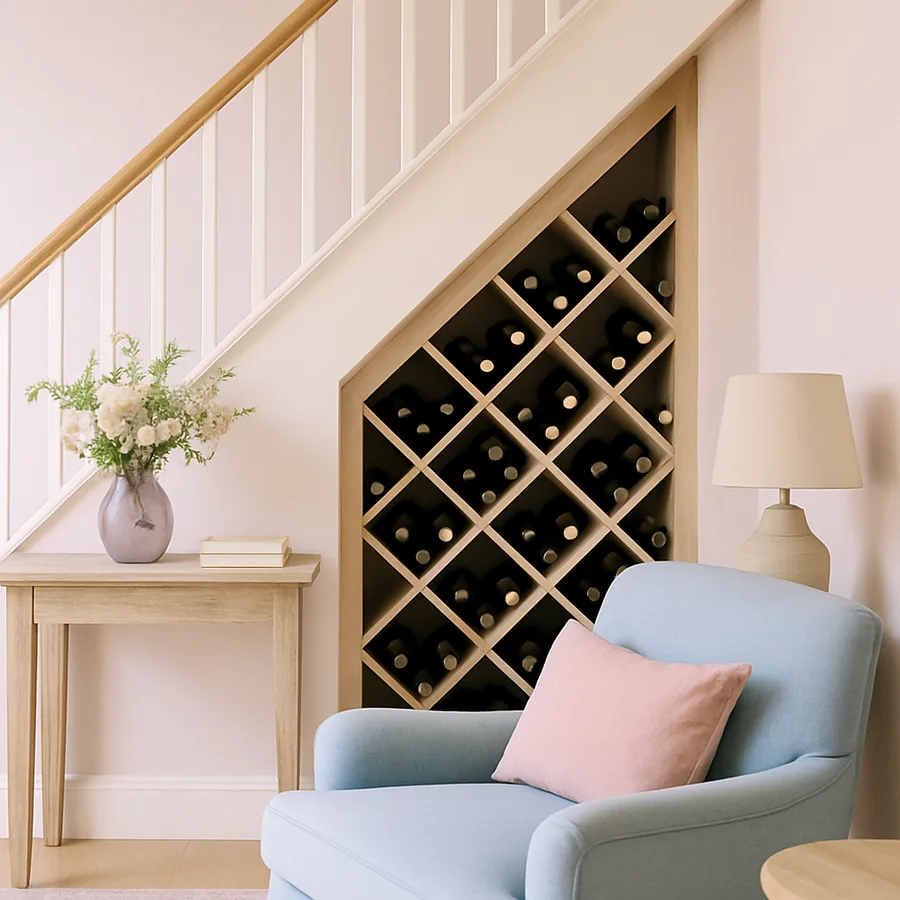
The space under a staircase is one of the most underused volumes in a typical American home, and for wine lovers with collections of 50 to 300 bottles, it is also one of the most promising locations for purpose-built storage. A 2022 survey by the National Association of Home Builders (NAHB) found that 68% of new single-family homes include at least one staircase with usable volume beneath it, and yet the vast majority of that square footage becomes cluttered storage, awkward closets, or the infamous "harry potter cupboard" that serves no one. Converting that volume into dedicated wine racking transforms dead space into a genuine amenity that elevates the entire home.
Evaluating Your Under-Stair Space
Before any design work begins, the under-stair volume needs a thorough evaluation, because the peculiar geometry of staircase undersides creates both opportunities and constraints that generic storage advice will miss. The first measurement is the vertical clearance at the tallest point, which is typically right against the first riser, and the second is the horizontal depth from the face of the staircase to the back wall. Most single-run staircases in American homes provide between 8 and 11 feet of horizontal run and peak heights between 7 and 9 feet, which is more than enough for a meaningful cellar.
The sloping ceiling created by the underside of the stairs is the defining characteristic of the space, and rack design must account for this slope from the first sketch. Fixed-height commercial racks cannot be used in this geometry, which is why custom millwork or modular systems with cut-to-fit columns are almost universally required. Kevin Boyd, a cellar designer profiled by Wine Spectator, has noted that the triangular volume nearest the staircase landing, often assumed to be unusable, is ideal for large-format bottle storage including magnums and jeroboams that do not fit in standard racks anyway.
Structural considerations matter too. The staircase above is almost always load-bearing, and any work within the under-stair cavity must preserve the stringers, risers, and any structural posts that tie the staircase to the floor system. The International Residential Code (IRC) Section R311 governs residential staircase construction and provides the reference framework for what can and cannot be modified. For any project that involves cutting into an existing stair stringer or relocating a support post, consultation with a structural engineer is essential, and in most jurisdictions a permit is required.
Rack Styles for Irregular Geometry
Rack style is the decision that most affects both bottle capacity and visual impact, and under-stair cellars favor a different mix of rack types than traditional rectangular cellars. Individual bottle racks, where each bottle sits in its own diamond or rectangular cell, deliver the most visual impact and work beautifully along the tallest portion of the space. Bulk storage bins, which cradle multiple bottles in a single open compartment, are ideal for the lower-ceiling triangular areas where individual racking becomes awkward.
Diamond bins deserve special mention because they solve the under-stair geometry problem elegantly. A diamond bin is a square frame rotated 45 degrees, creating a diamond-shaped opening that holds roughly 15 to 20 bottles cradled against each other. Stacked in a grid, diamond bins can follow the staircase slope in a stepped pattern, with taller diamonds at the peak and shorter ones near the landing. The result feels architectural rather than utilitarian, and because diamond bins are simple to build from stock lumber, they remain an accessible DIY option for builders comfortable with basic millwork.
Horizontal display racks, sometimes called label-out racks, present each bottle with the label facing forward, which is the preferred style for bottles you actively rotate and pour. These racks work well along the tallest portion of the under-stair cellar where vertical clearance allows, typically reserving the top row for showpiece bottles. For a typical 150-bottle under-stair cellar, a mix of roughly 60% individual racking, 25% bulk bin storage, and 15% label-out display balances capacity against visual appeal, though the exact ratios should follow how you actually drink rather than any formula.
Materials: Wood Species, Metal, and Hybrid Systems
Material selection for under-stair wine storage is driven by the same humidity and aesthetic concerns as any cellar, but the smaller volume amplifies the importance of getting it right. Redwood, mahogany, and pine dominate residential wine racking for good reasons. All three resist mold and mildew in high-humidity environments, they machine cleanly for the tight tolerances required by bottle cradles, and they age gracefully over decades. Redwood has been the traditional cellar standard because its natural tannins resist decay, though mahogany is increasingly specified for its deeper color and uniform grain.
Pine is the budget-friendly alternative and works well when finished with a clear penetrating oil rather than a film-forming polyurethane. Film finishes tend to trap humidity against the wood and can peel in cellar environments, while penetrating oils allow the wood to breathe naturally. The Forest Stewardship Council (FSC) certifies sustainable sources for all three species, and specifying FSC-certified lumber is a reasonable ethical standard for a project that will last decades. For homeowners in areas with limited lumber selection, online specialty suppliers like Kessick and VintageView ship FSC-certified cellar racking nationally.
Metal racking systems, particularly those using powder-coated steel rods, offer a contemporary alternative to traditional wood. Systems like VintageView mount bottles horizontally with the label showing, and their minimal silhouette disappears visually in a way that wood racking cannot match. Hybrid systems that combine a steel frame with wood accent panels have become popular in modern homes, because they deliver the clean aesthetic of metal with the warmth of wood at specific focal points. Have you considered how the rack material will read against the rest of the home? If the nearby hallway is painted in warm tones with wood flooring, steel racking creates visual tension that can be either striking or jarring depending on execution.
Climate Control in Small Under-Stair Cellars
Under-stair cellars present unique climate-control challenges because the space is typically integrated into the conditioned envelope of the home, which means the wine is exposed to whatever temperature and humidity the HVAC system delivers. For passive storage of everyday drinking wines consumed within two to three years of purchase, this is often acceptable, and many successful under-stair installations function as climate-passive display cellars rather than true aging cellars. For collectible bottles intended for long-term storage, however, active climate control is essential.
The American Society of Heating, Refrigerating and Air-Conditioning Engineers (ASHRAE) recommends a wine storage temperature of 55 to 58 degrees Fahrenheit, which is well below typical indoor comfort temperatures of 68 to 72 degrees. Delivering those cellar conditions within an under-stair volume requires either a dedicated cooling unit or careful acceptance that the space will run warmer than ideal. Small through-wall cooling units from brands like Breezaire and CellarCool are sized for volumes as small as 60 cubic feet, and they can be mounted in the back wall of the under-stair cavity with the rejection side venting into an adjacent utility room or unconditioned garage.
Insulation is the bigger lever for climate performance, and most under-stair cellars are under-insulated when first built because the space was designed as a closet rather than as thermal storage. Retrofitting rigid foam insulation against the underside of the stairs, the side walls, and the back wall, combined with a continuous vapor barrier and a weatherstripped door, transforms the space thermally. A well-insulated under-stair cellar with a small dedicated cooling unit holds cellar temperatures within plus or minus 2 degrees year-round, which meets the performance of much larger dedicated cellars at a fraction of the cost.
Lighting and Display in a Narrow Space
Lighting transforms an under-stair cellar from a storage closet into a design feature, and because the space is inherently narrow and dramatic, it rewards careful attention to light placement and color temperature. The Illuminating Engineering Society (IES) recommends warm color temperatures in the 2700K to 3000K range for residential display applications, and wine labels in particular read as they were designed to look under those warmer tones. Cool white light flattens label artwork and makes amber wines read greenish, neither of which serves the collection.
LED strip lighting mounted under each shelf edge provides the most flattering illumination for wine display, and the strips should be low-voltage 12 or 24 volt DC with a driver tucked into a service cabinet below the lowest rack. Point lighting at specific showcase bottles, typically the most visually striking or collectible in the cellar, adds depth and hierarchy to the display. The best under-stair cellars treat the bottles as a curated collection, with lighting that directs the eye the way a museum uses track lighting to guide visitors through an exhibit.
Glass doors amplify the lighting effect dramatically and are almost universal in high-end under-stair installations. A glass door transforms the cellar from a hidden closet into a visible architectural element, and when the cellar is positioned along a primary hallway or living room, it becomes a conversation piece that announces the home's character. Wood-framed glass doors with tempered or laminated safety glass meet IRC requirements for residential doors, and the frame itself can be detailed to match trim and millwork elsewhere in the home.
Planning, Building, and Maintaining the Cellar
Planning an under-stair wine cellar benefits enormously from drawing the space at full scale before any construction begins, and the time invested in layout paper saves far more time than it costs. Sketch the stair profile accurately, then overlay rack modules to confirm that the slope transitions work without awkward gaps. Leave at least 3 inches of clearance at the top of each rack column so bottles can be removed without striking the sloped ceiling, and plan a walkway width of at least 30 inches if the cellar is a walk-in rather than a reach-in installation.
Construction should begin with the envelope: insulation, vapor barrier, and door before any racking is installed. The North American Insulation Manufacturers Association (NAIMA) publishes residential insulation specifications that apply equally to wine cellars, and for an under-stair application, a target of R-19 in the walls and R-30 in the sloped ceiling performs well. Rack installation follows once the envelope is complete, typically starting at the tallest wall and working toward the landing, with each rack column shimmed and screwed into blocking behind the drywall or wood paneling. Have you thought about how you will access the highest bottles? A small library ladder or a single step stool tucked into the cellar becomes surprisingly important when the peak shelves are seven feet above the floor.
Maintenance for under-stair cellars is minimal but not zero. Annual inspection of rack fasteners, a humidity and temperature log reviewed every few weeks during the first year, and a visual check of labels for moisture damage, all catch small problems before they become large ones. Rotating bottles a quarter turn every twelve months, a practice recommended by the Institute of Masters of Wine for sediment management in aging reds, is an easy ritual that keeps the collection in touch with its owner and surfaces any bottles that have been forgotten in the back of a bin.
Conclusion
Under-stair wine storage is one of the highest-value home improvement projects for homeowners who love wine, because it converts dead space into a genuine amenity without expanding the footprint of the home. The geometric constraints that make the space awkward for conventional storage are precisely what make it visually striking for wine display, and the smaller volume actually works to the homeowner's advantage when it comes to climate control costs and insulation performance.
The keys to a successful under-stair cellar are thoughtful envelope construction, material selections that respect both humidity and aesthetics, and a rack layout that mixes individual bottle cells with bulk storage to match how the collection is actually used. Climate control adds cost but transforms the cellar from a display case into a true aging environment, and for any collection that includes bottles meant to sleep for five years or more, that upgrade pencils out quickly in wine value preserved.
Finally, the cellar should reflect the household that uses it. A wine-forward family that entertains weekly will want easy access, generous display, and capacity for rotation, while a long-term collector building a library of investment-grade bottles will prioritize tight climate control and organized bulk storage over visual drama. The best under-stair cellars honor their owners' actual relationship with wine, and they reward that honesty every time a bottle is chosen, poured, and enjoyed.
Ready to plan your own under-stair cellar? Measure your space this week, sketch a rough layout on graph paper, and decide whether your collection calls for passive storage or active climate control. The dead space under your staircase is waiting to become the most interesting room in your home.
Authority resources: National Association of Home Builders, ASHRAE, and Wine Spectator.
More Articles You May Like



Comments
Post a Comment