Hidden Under-Stair Playroom Nooks for Small Family Homes
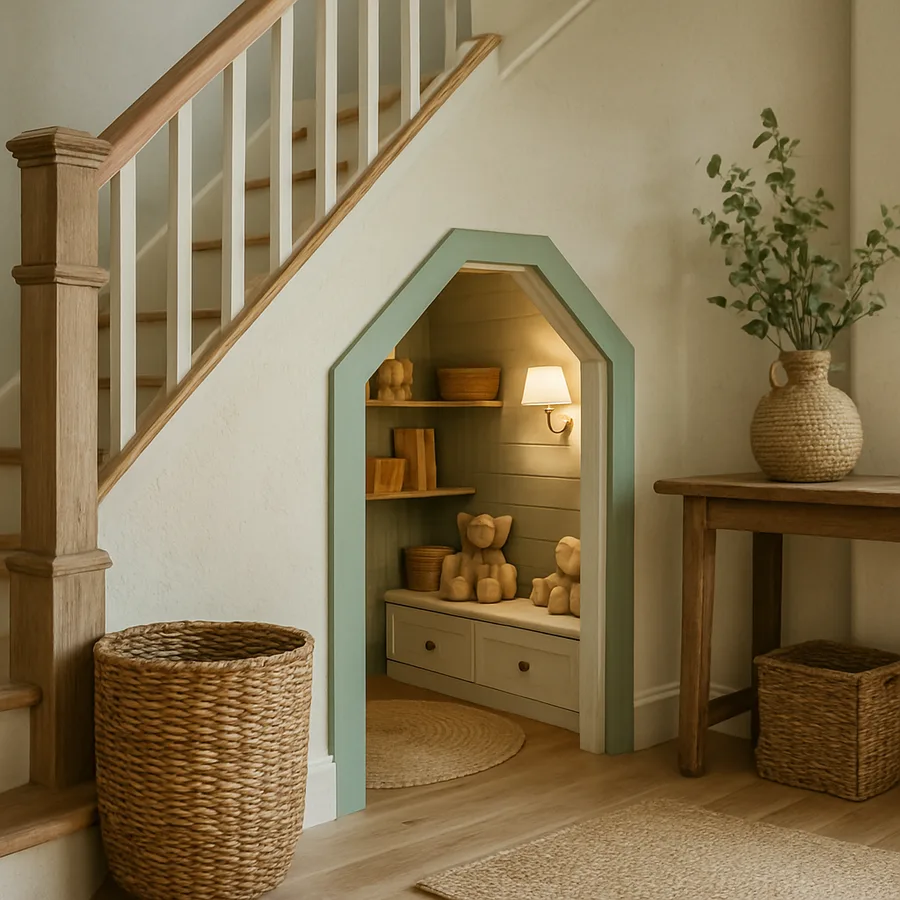
For families crammed into homes that do not include the dedicated bonus rooms shown in glossy magazine spreads, the area beneath the staircase represents one of the most emotionally rewarding square footages in the house. A well-designed hidden playroom nook tucked under the stairs gives children a sense of ownership and adventure that no corner of a living room can match, while keeping toys and chaos visually contained. The American Society of Interior Designers (ASID) reported in its 2025 Trends Outlook that 47% of family-focused renovations in homes under 1,800 square feet now include some form of dedicated child zone, even if that zone is only 20 or 30 square feet. The under-stair cavity is the most common location chosen for these compact retreats because it is naturally enclosed, naturally cozy, and almost always wasted before conversion.
What separates a hidden playroom nook that stays loved for years from one that gets abandoned within months is design discipline rather than budget. The smallest, simplest nooks in real homes consistently outperform elaborate built-ins because they fit the actual scale and developmental needs of the children using them. This article covers the practical decisions parents and designers face: how to size the opening, what flooring and wall finishes hold up to daily abuse, how to layer storage so cleanup is realistic for kids, lighting strategies that work for both daytime quiet play and evening reading, and the safety details that pediatric and remodeling experts repeatedly flag.
Why the Under-Stair Nook Wins for Small Homes
Small family homes face a brutal storage and zoning math problem. Toys explode across living rooms, hallways become obstacle courses, and parents spend a startling number of hours per week reshuffling clutter. The National Association of Home Builders (NAHB) tracked median new-construction home sizes in its 2024 builder survey and found that townhouse and starter-home formats have shrunk back toward early-2000s footprints, even as families have not. That squeeze is exactly the conditions where the under-stair cavity earns its keep.
A nook serves a different function than a playroom. A playroom is a destination where parents corral children for an hour. A nook is a refuge children retreat to on their own initiative. That distinction matters because nooks succeed when they feel discovered rather than assigned. Have you ever noticed how a child will abandon an expensive playhouse in the backyard within weeks but defend a bedsheet fort in the living room for months? The under-stair nook taps the same psychology, with the bonus that it is built in and never has to be dismantled at dinnertime.
The cavity also self-limits the toy population. A 25-square-foot nook simply cannot hold more than a curated selection of books, soft toys, and one or two activity stations, which forces the kind of toy rotation that child development researchers have associated with longer engagement times and reduced overstimulation. Better Homes and Gardens (BHG) covered this trend in a 2024 feature that cited family therapists endorsing smaller, cozier play spaces over sprawling playrooms for children under age eight.
Sizing the Opening and Choosing the Door Style
The access opening defines the entire experience. A standard 30-inch by 80-inch interior door cut into the under-stair wall feels institutional and oversized, and it telegraphs that the space is just a closet with toys in it. The most successful nooks use shorter, narrower openings sized for children rather than adults. A 48-inch tall arched opening with a 24-inch width reads as a magical portal and still allows a parent to crouch through for cleanup.
Door style is where personality lives. Painted plywood arched doors with a small porthole window or a barn-style sliding panel are popular because they hide the contents when closed but invite curiosity. Curtained openings using heavy fabric on a tension rod cost almost nothing and let very young children come and go without struggling with hardware. Some families skip the door entirely and frame the opening with millwork that reads as an architectural feature, which works particularly well when the nook is visible from a main living area and needs to look intentional.
Hardware choice matters for safety. Avoid magnetic catches that can trap small fingers and never install a lock that a child could engage from the inside. The U.S. Consumer Product Safety Commission (CPSC) has published guidance for residential play spaces emphasizing that any enclosed area used by children should have an exit that an adult can open from outside without tools, and the door should not seal so tightly that ventilation is compromised. A simple roller catch or a friction hinge meets both requirements without introducing pinch hazards.
Floor, Wall, and Ceiling Finishes That Survive Children
Children punish surfaces in ways adults do not anticipate. Crayons find their way onto every wall within reach, juice spills happen weekly, and the floor becomes a hard surface for toy cars one minute and a soft surface for napping the next. Plan finishes accordingly. The most successful under-stair nooks use wipeable matte paint in a satin or eggshell sheen, applied over a primer that resists staining. A washable paint product rated for high-scrub applications will let you erase art projects with a damp cloth rather than repainting annually.
Flooring deserves more thought than it usually gets. Hard flooring transferred from the surrounding hallway is durable but cold and uncomfortable for floor play. The fix is a layered approach: a base of luxury vinyl plank or sealed engineered wood for spill resistance, topped with a low-pile washable rug or a foam puzzle mat for comfort. A removable rug is the right call because it can be hauled outside for a deep clean every few months, which is genuinely needed in heavy-use nooks.
The sloped ceiling is your decorating opportunity. Children love spaces that feel different from the rest of the house, and the under-stair slope already delivers that feeling. Lean into it with a painted constellation, removable wallpaper in a forest or galaxy pattern, or a single accent color that contrasts the surrounding rooms. The Houzz photo library is full of converted nooks where the ceiling treatment carries most of the design impact while the walls and floor stay neutral.
Storage That Children Will Actually Use
The single most common failure mode in playroom nooks is storage designed for how parents think kids should organize, not how they actually do. Children do not sort by category. They grab, they dump, and they move on. Storage that works with this reality uses open low bins that allow drop-in cleanup, fixed shelves for books at child eye level, and a single hidden compartment for the small parts that need parental supervision.
The National Association of the Remodeling Industry (NARI) has noted in member guidance that built-in storage along the back wall of an under-stair nook should be capped at a height children can reach independently, typically 36 to 42 inches for early elementary ages. Anything higher becomes parental storage that defeats the autonomy of the nook. Reserve the high cavity behind the slope for adult-controlled storage of seasonal items, holiday decorations, or off-rotation toys, accessed from outside the nook through a separate panel if possible.
Labels help, especially for pre-readers. Picture labels on bins, color coding for shelf zones, and a single visible cleanup checklist taped to the inside of the door support the autonomy that makes nooks succeed. What does your child actually reach for at home right now? Inventory the favorites, then build storage that puts those items in the easiest-to-access positions and relegates everything else to higher or deeper zones.
Lighting That Works for Reading, Play, and Hiding
A nook lit by a single overhead fixture feels like an interrogation room. The right lighting layers three sources: a soft ambient wash, task lighting for reading or building, and a low-glow option for cozy hiding. Battery-operated puck lights mounted to the ceiling give you control without running new wiring, and modern rechargeable models have eliminated the constant battery replacement that plagued earlier versions.
String lights and fairy lights remain the most popular ambient source in under-stair nooks for good reason. They draw negligible power, install in minutes with adhesive clips, and create the magical glow that children associate with special spaces. Choose UL-listed indoor sets and never use lights with exposed bulbs that get hot to the touch. A separate USB-rechargeable book light clipped to a shelf gives older kids the dedicated reading source they need without illuminating the whole space.
For homes wiring the nook from scratch, a single dimmable LED downlight on its own switch outside the nook gives parents control and lets the space transition from bright cleanup mode to dim quiet time. The American Lighting Association recommends color temperatures in the 2700K to 3000K range for residential play spaces, which produces the warm, inviting glow children associate with safety and rest. Avoid the cool-white commercial lighting common in big-box fixtures.
Safety, Ventilation, and Long-Term Use
Safety in an enclosed child space comes down to three things: ventilation, electrical, and exit. The cavity must breathe, especially if it is being used for naps or extended play. Cut a passive vent at the top of the door and another low on the back wall, both screened against insects and dust. If the back wall is shared with an HVAC chase or a garage, do not introduce any new penetrations without sealing them properly to prevent contaminated air from entering the play space.
Electrical work inside a nook should be minimal and tamper-resistant. Any outlets must be the modern tamper-resistant receptacles required by the National Electrical Code for residential occupancies, and any low-voltage lighting transformers should be mounted outside the nook itself with only the lighting strip entering. The CPSC strongly discourages extension cords as permanent wiring in any child-accessible space, so plan a single proper outlet during construction rather than retrofitting later.
Long-term use is the dimension parents underestimate. The four-year-old who loves the nook today will be a seven-year-old who finds it cramped tomorrow and a twelve-year-old who turns it into a homework hideout. Design with that arc in mind. Modular storage that can swap from toy bins to book shelves to charging stations extends the useful life of the conversion by a decade. ASID member designers have written about this principle as designing for the household trajectory rather than the present moment, and it applies particularly well to children's spaces where the user changes faster than the architecture.
Conclusion
A hidden under-stair playroom nook is one of the most rewarding small-footprint projects a family can take on, both because of how children respond to it and because of how dramatically it improves the rest of the home by absorbing scattered toys into a single bounded zone. The keys to success are not budget but design discipline: scale the opening for children rather than adults, choose surfaces that survive real abuse, layer storage that supports autonomous cleanup, and light the space so it transitions from playful to peaceful with a single switch. Get those decisions right and the nook becomes the most used 25 square feet in the house.
The most common mistake parents make is treating the project as a one-time build rather than a living space that evolves with the children. Plan for the modular swap from toddler bins to elementary book shelves to tween charging cubbies before you ever cut the opening. Reuse and resilience are what turn a cute nook into a piece of family infrastructure that supports your kids for a decade. Avoid the magazine-perfect over-build that locks the space into a single use case at a single age.
Safety considerations should sit at the top of every plan, not the bottom. Pinch-free hardware, proper ventilation, code-compliant electrical, and an exit any adult can open from outside are non-negotiable, and they cost almost nothing to incorporate from the start while being expensive and disruptive to retrofit later. A short consultation with a licensed contractor familiar with residential code in your jurisdiction is the single best investment you can make before swinging a hammer.
Ready to start? Spend an evening watching your child play in the existing house and notice where they naturally gravitate, what scale of space they choose, and what objects come with them. That observation will tell you more about how to design the nook than any Pinterest board. Then sketch a simple plan, share it with one trusted designer or contractor for feedback, and start small with a curtained opening and a few cushions before committing to permanent millwork. For deeper reading and inspiration galleries, the Better Homes and Gardens archives include real-family case studies with floor plans, the Houzz photo library lets you filter by age group and style, and the ASID consumer resources cover the broader principles of designing residential spaces for children of every age.
More Articles You May Like



Comments
Post a Comment