Staining Existing Hardwood Floors a Darker Color at Home
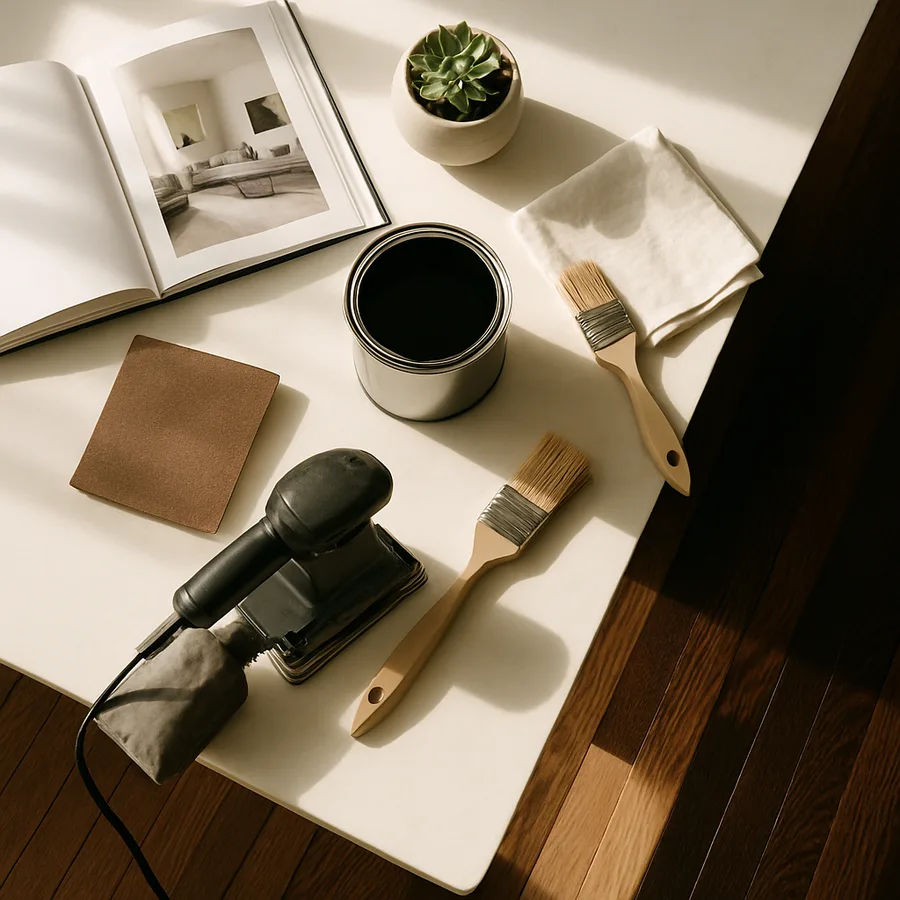
Changing the color of existing hardwood floors to a darker stain is one of the most transformative renovations a homeowner can undertake without replacing any materials. A floor that currently reads as dated honey oak, pale maple, or washed-out pine can be sanded down to raw wood and restained in espresso, ebony, dark walnut, or Jacobean tones that bring an entirely different character to the room. The transformation is dramatic, and the project is within reach of homeowners with moderate DIY skills, physical stamina, and a willingness to follow a precise sequence of steps. It is not, however, a casual weekend project. Staining hardwood floors darker requires thorough preparation, careful product selection, methodical application, and patience during the curing process that stands between the final coat and the moment you can move furniture back into the room.
According to the National Wood Flooring Association (NWFA), refinishing and staining existing hardwood floors costs 60 to 75 percent less than installing new hardwood of equivalent quality, making it one of the highest-value home improvement projects available. A professional refinishing job typically costs $3 to $8 per square foot, while a DIY approach using rented equipment brings the cost down to $1 to $3 per square foot for materials and equipment rental. The savings are substantial for a typical 500-square-foot project, and the result, when executed properly, is indistinguishable from a professionally done floor.
This guide walks through the complete process from initial assessment through final topcoat application, with specific attention to the challenges that are unique to dark stain applications. Darker stains are less forgiving than lighter ones because they amplify every inconsistency in the sanding job: swirl marks, uneven grit patterns, missed spots, and cross-grain scratches all become more visible under dark pigment than they would under a lighter stain or a natural finish. Understanding why dark stains are more demanding, and preparing accordingly, is the difference between a professional-quality result and a floor that advertises its amateur origins every time light hits it at a low angle.
Before diving into the process, ask yourself two qualifying questions. First, is your hardwood solid or engineered? Solid hardwood can be sanded and restained multiple times. Engineered hardwood has a thin veneer layer, typically 1 to 4 millimeters, that limits sanding to one or two light passes, and aggressive sanding can cut through the veneer and ruin the floor. Second, how dark do you want to go? Moving from a medium brown to a slightly darker brown is straightforward. Moving from light natural wood to near-black ebony requires multiple stain coats, water-popping the wood grain, and accepting that the wood's natural figure will be largely obscured by pigment. Both outcomes are achievable, but they require different approaches and different expectations.
Assessing Your Floors and Planning the Project
The first step is a thorough assessment of the existing floor condition. Walk every room with the floors you plan to stain and identify areas of damage, wear, deep scratches, staining from pet urine or water, and any boards that are warped, cupped, or loose. Deep gouges and pet stains may not sand out completely and can telegraph through a dark stain as lighter or discolored spots. Severely damaged boards should be replaced before sanding begins, and your hardwood supplier can often match the species and profile for individual board replacement. Water damage that has penetrated below the surface may require board replacement as well, because the tannin reactions caused by prolonged moisture contact can produce dark stains that no amount of sanding will remove from the surrounding wood.
Wood species determines how your floor will accept dark stain, and understanding your species is critical to selecting the right product. Red oak, the most common hardwood flooring species in North American homes, has an open grain structure that absorbs stain readily and produces rich, consistent dark results. Its pronounced grain pattern remains visible under dark stains, creating a textured, characterful surface. White oak has a tighter grain that absorbs stain slightly less readily but produces more uniform color with less grain contrast, which many homeowners prefer for very dark applications. Maple and birch are closed-grain species that resist stain penetration and tend to blotch, producing uneven, mottled color that can look amateurish under dark stains unless a pre-stain conditioner is used. Pine is soft, absorbent, and highly variable in grain density, which means it drinks stain unevenly and requires careful technique to achieve consistent dark color.
Room preparation is extensive and should not be underestimated. Remove all furniture, rugs, window treatments, and wall-mounted items that could be damaged by dust or finish fumes. Remove shoe molding and baseboards if possible; if not, mask them carefully with painter's tape and plastic sheeting. Seal doorways to adjacent rooms with plastic sheeting and tape to contain dust during sanding. Cover or disconnect HVAC vents in the work area to prevent dust from entering the ductwork. The sanding process generates enormous quantities of fine wood dust that will settle on every surface, penetrate every unsealed gap, and damage electronics, textiles, and finishes in adjacent rooms if containment is inadequate. Professional refinishers use dustless sanding systems that capture most airborne particles at the machine, and if you are renting equipment, inquire about dustless options that significantly reduce cleanup and containment demands.
Plan your timeline realistically. A typical single-room project requires one day for sanding, one day for staining, and two to three days for topcoat application with dry time between coats. The floor should cure for a minimum of 72 hours after the final topcoat before furniture is placed on it, and full cure takes two to four weeks during which area rugs should not be laid and heavy furniture should not be dragged. For a whole-house project, plan on a full week of active work plus the curing period, during which the rooms are essentially uninhabitable due to fumes and surface vulnerability. Do you have an alternative living arrangement for the project duration? If not, consider staging the project room by room, completing each space and allowing it to cure before starting the next.
Sanding Technique That Makes or Breaks Dark Stain Results
Sanding is the most critical phase of any floor staining project, and its importance is magnified exponentially when the target is a dark color. Dark stains reveal every sanding defect because the pigment settles into scratches, swirl marks, and cross-grain abrasions more deeply than it penetrates the surrounding smooth wood, creating visible lines and patterns that lighter stains would mask. A sanding job that produces acceptable results under a natural or light stain may produce unacceptable results under dark walnut or ebony. This means the sanding standard for dark stain projects is higher than for any other finish, and cutting corners during this phase will be visible in the final result for the entire life of the floor.
The sanding sequence for a dark stain project should progress through at least four grits: 36 or 40 grit to remove the existing finish and level the surface, 60 grit to remove the scratches left by the coarse pass, 80 grit to refine the surface further, and 100 or 120 grit as the final pass to create the smooth, uniform surface that dark stain demands. Each grit must completely remove the scratch pattern of the previous grit before advancing. The National Kitchen and Bath Association design professionals note that skipping grits, such as jumping from 40 directly to 80, leaves deeper scratches partially embedded in the wood that the finer grit cannot reach, and these hidden scratches become starkly visible under dark pigment.
The drum sander handles the main field of the floor, and the edger handles the perimeter within 4 to 6 inches of the walls. The transition zone where drum sander marks meet edger marks is the most common location for visible defects in DIY floor projects. Edgers operate in a circular motion that leaves swirl marks perpendicular to the drum sander's linear passes, and these swirl marks glow under dark stain like half-moons along every wall. Eliminating them requires careful technique: move the edger in smooth, overlapping arcs rather than pressing it into one spot, and follow the edger with a hand-held random orbital sander at the final grit to blend the transition zone. Some professionals use a large random orbital buffer for the final pass across the entire floor, which blends drum and edge sander marks into a uniform scratch pattern that disappears under stain.
After the final sanding pass, vacuum the floor thoroughly with a shop vacuum, then tack the entire surface with a slightly dampened microfiber mop or tack cloth to remove the fine dust that vacuuming misses. Any dust left on the surface will be trapped under the stain and create a gritty texture and uneven color absorption. The floor should be perfectly smooth, uniformly colored raw wood with no visible scratch patterns, finish residue, or dust when you complete this step. If you can see scratch lines when you shine a flashlight across the surface at a low angle, the floor is not ready for dark stain. Go back and repeat the final grit pass in the affected areas before proceeding. The time invested in sanding perfection saves far more time than you would spend trying to fix stain defects after the fact, which often requires re-sanding and starting the entire staining process over.
Water Popping and Pre-Stain Preparation
Water popping is a technique that professional floor finishers use to enhance stain absorption and color depth, and it is particularly valuable for dark stain applications. The process involves dampening the freshly sanded floor with clean water using a mop, T-bar applicator, or pump sprayer, then allowing the wood to dry completely before applying stain. The water causes the wood fibers that were compressed and sealed during sanding to swell and stand up, opening the grain structure and creating a more absorptive surface. When stain is applied to water-popped wood, the pigment penetrates more deeply and uniformly, producing a richer, more saturated color than stain applied to dry-sanded wood.
The technique sounds simple but requires careful execution. The water must be applied uniformly across the entire surface, with no puddles, dry spots, or overlap marks. Uneven water application creates uneven fiber raising, which produces uneven stain absorption, which produces blotchy color. Most professionals use a garden pump sprayer set to a fine mist, followed immediately by a clean microfiber mop to distribute the water evenly and remove any excess. The floor should appear uniformly damp but not wet, with no standing water on the surface. Drying time depends on temperature, humidity, and airflow, but the floor is typically ready for stain within 2 to 4 hours in a well-ventilated room at normal room temperature.
The NWFA recommends water popping for all stain applications darker than medium brown, and considers it essential for achieving consistent results with very dark stains like ebony, Jacobean, and true black. Without water popping, these extremely dark stains can appear streaky, with lighter areas where the sanding process sealed the wood grain more tightly and darker areas where the grain remained more open. The difference between water-popped and non-water-popped floors under dark stain is visible and significant: water-popped floors display deeper, more uniform color with visible grain figure, while non-water-popped floors tend toward a flatter, less dimensional appearance with more color variation between boards.
For closed-grain species like maple that resist stain penetration, a pre-stain wood conditioner provides an alternative or complement to water popping. Conditioners partially seal the wood surface to slow stain absorption in the more porous areas, reducing the contrast between hard and soft grain zones that causes blotching. Apply conditioner according to the manufacturer's instructions, typically 15 to 30 minutes before stain application, and do not allow it to fully dry before staining. The combination of water popping followed by conditioner application produces the most uniform dark stain results on difficult species, though it adds time and product cost to the project. Is your floor maple, birch, or another closed-grain species? If so, skipping the conditioner step is the single most common cause of disappointing dark stain results on these woods, and no amount of technique during stain application can compensate for the uneven absorption that occurs without it.
Stain Selection and Application for Deep, Even Color
Stain product selection for dark floor applications involves choosing between oil-based and water-based formulations, each with characteristics that affect the application process and final appearance. Oil-based stains, such as those from Minwax, DuraSeal, and Bona, have been the industry standard for decades. They penetrate deeply into wood fibers, provide rich color saturation, and offer a long working time that allows the applicator to maintain a wet edge across large areas. Oil-based stains also add a warm amber undertone to the wood that many homeowners find attractive, particularly in traditional and transitional interiors. The trade-off is a strong solvent odor during application, a longer drying time of 24 to 48 hours, and the need for adequate ventilation that makes winter applications challenging in cold climates.
Water-based stains have improved dramatically and now represent a viable alternative for dark floor applications. They dry faster, typically within 2 to 4 hours, produce less odor, and do not add the amber undertone that oil-based products impart. This absence of amber is a double-edged characteristic: it allows dark stains to read as cooler and more contemporary, but it can also make very dark colors appear flat or lifeless compared to their oil-based equivalents. Some professional finishers address this by applying a coat of water-based stain followed by a topcoat with a slight amber tint, achieving the color neutrality of water-based stain with the warmth of an oil-modified finish. Better Homes and Gardens home improvement guides recommend testing both oil-based and water-based versions of your chosen color on a sample area or spare boards before committing, because the same color name can look markedly different between the two formulations.
Application technique for dark floor stain requires working in manageable sections to maintain a wet edge and avoid lap marks. Using a lambswool applicator or a T-bar with a microfiber pad, apply stain along the grain direction in sections approximately 3 to 4 feet wide, working from the far wall toward the exit. Apply a generous amount of stain, allow it to penetrate for the manufacturer's recommended time, typically 5 to 15 minutes, and then wipe the excess with clean rags or a clean applicator pad, again following the grain direction. Wiping removes the surplus pigment that would dry as a surface film rather than absorbed color, and consistent wiping pressure ensures uniform color across the section.
For the darkest colors, a single coat of stain may not achieve the depth you want. Applying a second coat after the first has dried according to the manufacturer's instructions builds additional color intensity. Each additional coat slightly reduces the visibility of the wood grain as more pigment fills the pores, so there is a balance point between color depth and grain visibility that depends on personal preference. Most homeowners targeting dark walnut or Jacobean tones find that one coat provides sufficient depth with good grain visibility. Those targeting ebony or near-black finishes typically need two coats and should expect the grain to be partially obscured by pigment. Sand lightly with 220-grit screen between stain coats to remove any raised fibers and ensure smooth adhesion of the subsequent coat. Allow the final stain coat to dry completely, a minimum of 24 hours for oil-based products, before applying the protective topcoat.
Topcoat Options and the Final Protective Layer
The topcoat is the barrier between your freshly stained floor and the wear, moisture, and daily abuse that will test it for years to come. Oil-modified polyurethane remains the most popular topcoat choice for stained hardwood floors, and for good reason. It provides a durable, moisture-resistant finish that adds warmth and depth to the stain color beneath. Oil-modified poly dries to a hard, amber-toned film that enhances the richness of dark stains and develops a deeper patina with age. Two to three coats are standard, with light sanding or buffing between coats using a 220-grit screen or fine abrasive pad. Each coat requires 8 to 24 hours of drying time depending on temperature, humidity, and product formulation.
Water-based polyurethane dries clear without adding amber tint, dries faster (2 to 4 hours between coats), and produces less odor during application. These characteristics make it the preferred choice for homeowners who want to preserve the exact color of their stain without the warming shift that oil-modified products introduce. Water-based poly is also harder and more scratch-resistant in its cured state than most oil-modified products, which makes it objectively superior for abrasion resistance. Designers at the Architectural Digest renovation desk consistently recommend water-based polyurethane for dark-stained floors where preserving the stain's true color is a priority. The Hardwood Flooring Retailers Alliance notes that water-based polyurethane now accounts for over 45 percent of residential floor finish applications, a share that continues to grow as product quality improves and environmental regulations increasingly restrict solvent-based products.
Application of the topcoat follows the same directional principle as staining: work with the grain, maintain a wet edge, and progress from the far wall toward the exit. Use a high-quality synthetic bristle brush to cut in along baseboards and obstacles, then use a lambswool or microfiber T-bar applicator for the field. Apply thin, even coats rather than heavy applications that pool in low spots and dry unevenly. Between coats, sand or screen the surface lightly to create mechanical adhesion for the next coat and to remove any dust particles, drips, or bubbles that may have formed during drying. Vacuum and tack the surface after each intercoat sanding just as you did before staining.
The curing period after the final topcoat is the most testing phase for homeowner patience. The floor may feel dry to the touch within hours, but the finish has not reached full hardness and chemical resistance for two to four weeks. During this curing period, avoid placing area rugs on the surface, as trapped moisture and chemical vapors can cause the finish to cloud or fail to adhere properly. Use felt pads under all furniture legs from the moment items are placed back in the room, and avoid dragging anything across the surface. Walk on the floor in clean socks rather than shoes for the first week, and avoid wet mopping until the manufacturer's recommended full cure time has elapsed. This patience protects the investment of time, money, and effort that the entire project represents, and ensures the floor achieves its maximum durability and appearance for the decades of use ahead.
Conclusion
Staining existing hardwood floors darker is a project that delivers dramatic visual transformation at a fraction of the cost of floor replacement. The rich, sophisticated character of a dark-stained hardwood floor elevates every room it occupies, providing a grounding surface that makes furniture, art, and architectural details stand out against its deep, warm backdrop. The process is achievable for dedicated DIY homeowners, but it demands respect for the preparation work, particularly sanding, that determines whether the final result looks professional or reveals its amateur execution under every shaft of low-angle light.
The critical success factors are worth restating: sand through a complete grit sequence without skipping, water-pop the wood before applying dark stain, test your stain color on an inconspicuous area before committing to the full floor, maintain a wet edge during application, and protect your investment with the right topcoat applied in thin, even coats with proper intercoat preparation. Each of these steps contributes to the final result, and none of them can be skipped or shortcut without visible consequences in the finished floor.
If the project feels too demanding for your skill level or schedule, hiring a professional refinisher is money well spent. A professional brings dustless sanding equipment, experience with stain behavior on your specific wood species, the ability to achieve consistent color across large areas, and the knowledge to troubleshoot problems before they become permanent. The cost premium for professional work, typically $2 to $5 per square foot above the material cost, buys a guaranteed result and a significantly less disruptive experience for your household.
Whether you tackle this project yourself or hire a professional, the end result is the same: floors that look and feel like an entirely new installation, achieved by revealing and enhancing the natural material that has been under your feet all along. Dark-stained hardwood floors have an enduring appeal that transcends design trends, and the investment in transforming your existing floors protects and enhances one of your home's most valuable and visible assets for decades to come.
More Articles You May Like



Comments
Post a Comment