Honed Marble Counters in Kitchens: Stain Risk and Maintenance
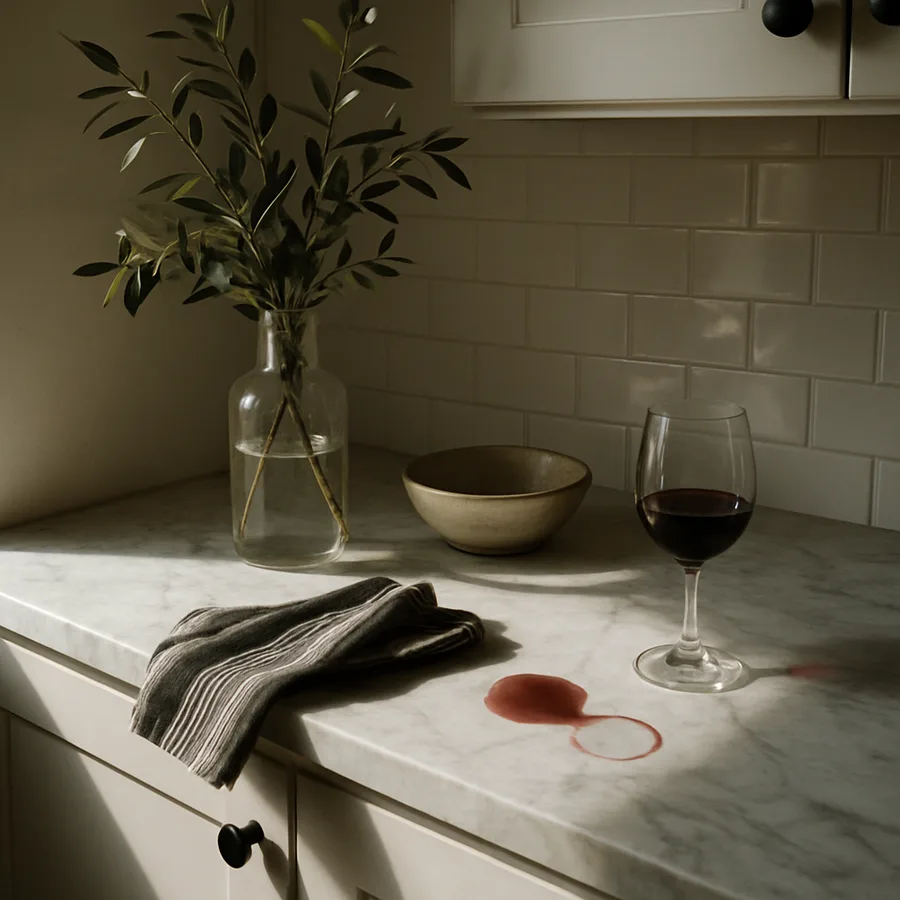
Understanding the Honed Marble Finish
Honed marble has a smooth, matte surface that results from grinding the stone to a consistent flat finish without the final polishing step that creates a glossy sheen. The texture feels almost velvety under your fingertips, softer and more understated than the mirror-like surface of polished marble. This finish has become a favorite among designers who want the elegance of natural marble without the formal, reflective quality that polished slabs introduce. The matte appearance lends itself to casual, lived-in kitchens where warmth and approachability matter more than pristine gloss.
The Marble Institute of America, now part of the Natural Stone Institute, has long classified honed finishes as a distinct category with specific care requirements that differ from polished stone. A polished marble surface has its pores partially closed during the buffing process, which gives it a slight advantage in stain resistance. Honed marble, with its open pore structure, is inherently more absorbent. That porosity is the source of both its tactile appeal and its vulnerability. Understanding this trade-off is essential before you commit to honed marble in a space as demanding as a kitchen.
Why do so many homeowners still choose honed marble despite these risks? The answer lies in how honed marble ages. Scratches, etching, and wear marks that would be glaringly visible on a polished surface tend to blend into the matte texture of a honed finish. Over time, a honed marble counter develops what designers call a patina, a softly weathered character that many people find more beautiful than a factory-fresh surface. If you appreciate materials that tell a story and show the passage of time, honed marble rewards that sensibility in ways that engineered surfaces simply cannot replicate.
The popularity of honed marble in kitchens has surged over the past several years. According to a 2024 design trends report from Houzz, natural stone countertops appeared in 28 percent of kitchen renovations, with honed finishes accounting for a growing share of that segment. The trend reflects a broader movement toward authentic, imperfect materials that contrast with the flawless uniformity of engineered alternatives. But choosing honed marble for a kitchen requires an honest assessment of your tolerance for imperfection and your willingness to maintain the surface actively.
The Real Stain Risks You Need to Know
Marble is a metamorphic rock composed primarily of calcium carbonate, and that chemical composition makes it reactive to acids. When lemon juice, vinegar, wine, or tomato sauce contacts a marble surface, it does not merely stain but actually etches the stone, dissolving a thin layer of the calcium carbonate and leaving a dull, lighter mark. Etching is not a stain in the traditional sense because it cannot be removed with cleaning products alone. It requires physical refinishing, either by a professional or with fine-grit sandpaper and elbow grease. On honed marble, etching is less visually disruptive than on polished marble, but it still accumulates over time.
True staining, where a pigmented liquid absorbs into the stone and discolors it from within, is the second category of risk. Coffee, red wine, beet juice, turmeric, and oil-based substances are the most common culprits. The Natural Stone Institute has published testing data showing that unsealed marble can absorb pigmented liquids within 5 to 15 minutes of contact, depending on the specific marble variety and its natural porosity. Honed marble absorbs faster than polished marble because the open pore structure allows liquids to penetrate more readily. A sealed honed surface extends that absorption window significantly but does not eliminate the risk entirely.
Are you someone who cooks with turmeric, sets down wine glasses without coasters, or lets spills sit while you attend to a boiling pot? If so, you need to weigh those habits honestly against honed marble's vulnerabilities. The material is forgiving of scratches and general wear, but it is unforgiving of chemical exposure and prolonged liquid contact. Households with young children, frequent entertainers, and avid home cooks face the highest stain risk simply because the counter sees more action and more variety of substances on a daily basis.
Different marble varieties also carry different risk profiles. Calacatta and Statuario marbles, prized for their dramatic veining, tend to have slightly denser crystal structures and marginally better stain resistance than Carrara marble. Danby marble from Vermont is another option with above-average density for a domestic marble. However, no marble is stain-proof. The variation between specific quarry blocks within the same marble type can be as significant as the variation between different marble names. Always request an absorption test on your specific slab before finalizing the purchase.
Sealing Strategies That Actually Work
Sealing is the single most important step you can take to protect honed marble counters. An impregnating sealer, also called a penetrating sealer, works by filling the microscopic pores of the stone with a resin that repels liquids without altering the surface appearance. Unlike topical sealers that sit on the surface and can peel or yellow, impregnating sealers become part of the stone structure and maintain the natural honed look. Brands such as StoneTech BulletProof, Tenax Hydrex, and DuPont StoneTech Professional are widely recommended by fabricators and restoration specialists.
How often should you reseal? The answer depends on usage intensity, but most professionals recommend resealing honed marble kitchen counters every 6 to 12 months. A simple water test can tell you when resealing is due: place a few tablespoons of water on the counter surface and wait 10 minutes. If the area under the water appears darker when you wipe it away, the sealer has worn thin and the stone is absorbing moisture. If the water beads or the stone shows no darkening, the sealer is still performing. This test takes 60 seconds and should become a regular habit, ideally every three months.
Application technique matters as much as product selection. Clean the counter thoroughly and ensure it is completely dry before applying the sealer. Apply a thin, even coat with a clean microfiber cloth or foam applicator, working in small sections. Allow the sealer to penetrate for the time specified on the product label, typically 10 to 20 minutes, then wipe away any excess before it dries on the surface. A second coat applied immediately after the first improves protection, especially on highly porous honed surfaces. The entire process takes about 30 minutes for an average kitchen and requires no professional assistance.
The American Society of Interior Designers (ASID) has noted in its material specification guidelines that sealed honed marble, when properly maintained, can perform adequately in residential kitchens for decades. The key word is "properly maintained," which means consistent resealing, prompt spill cleanup, and avoidance of harsh chemical cleaners. Sealing does not make marble bulletproof, but it transforms a fragile surface into a manageable one for homeowners who are willing to commit to the routine.
Daily Care Routines for Long-Term Beauty
The daily care protocol for honed marble is straightforward but requires discipline. Use a soft cloth or sponge with warm water and a pH-neutral stone cleaner for routine wiping. Avoid dish soap, which can leave a film that dulls the surface over time, and absolutely avoid any cleaner containing acid, ammonia, or bleach. Products marketed specifically for natural stone, such as those from StoneTech or Method Daily Granite, are formulated to clean without damaging the sealer or the stone itself. Keep a dedicated spray bottle of stone cleaner near the kitchen sink so that wiping down the counters after meal preparation becomes automatic.
Spill response time is critical. The faster you wipe up a spill, the less likely it is to etch or stain the surface. Red wine, citrus juice, coffee, and tomato-based sauces should be blotted immediately with a dry cloth, then the area cleaned with stone cleaner. Rubbing a spill can spread it and drive the liquid deeper into the pores. For oil-based stains that have already set, a poultice made from baking soda and water or a commercial stone poultice can draw the stain out over 24 to 48 hours. This technique works remarkably well on marble because the same porosity that admits the stain also allows the poultice to extract it.
Cutting boards, trivets, and coasters are not optional accessories with honed marble; they are essential protective tools. Never cut directly on the marble surface, not because the knife will damage the marble significantly, but because acidic food residue from fruits and vegetables will etch the stone along the cut lines. Place trivets under hot pots and pans to prevent thermal shock, which can cause hairline cracks in marble over time. Use coasters under glasses, especially those containing wine, juice, or carbonated beverages. These small habits compound into significant protection over the life of the countertop.
Deep cleaning should happen weekly. Move small appliances and clear the counter completely, then clean the entire surface with a stone-safe cleaner and a soft cloth, working in overlapping sections. Pay special attention to areas around the sink and stove where splashes accumulate. Once a month, inspect the counter under bright, angled light to check for emerging etch marks or stains that might benefit from early treatment. Catching issues early prevents them from becoming permanent features of the surface.
Repairing Etching and Stains When They Happen
Despite your best efforts, etching and staining will eventually occur on a honed marble kitchen counter. Accepting this reality is part of choosing the material. For light etch marks on honed marble, fine-grit sandpaper in the 400 to 600 range can be used to blend the mark into the surrounding matte surface. Wet the sandpaper and work in a circular motion, feathering outward to avoid creating an obvious spot repair. Because honed marble lacks a glossy finish, this technique is far more forgiving than attempting the same repair on polished marble, where any sanding would create an obvious matte spot.
For deeper etch marks or widespread dullness, a marble restoration professional can regrind and rehone the surface to restore a uniform finish. The Natural Stone Institute maintains a directory of certified stone restoration professionals who have demonstrated competency in marble refinishing. Professional rehoning typically costs $3 to $7 per square foot and is recommended every three to five years for actively used kitchen counters. The process removes a thin layer of the stone surface, so it cannot be repeated indefinitely, but most marble slabs are thick enough to support multiple refinishing cycles over their lifetime.
Organic stains from food and beverages respond well to poulticing. Mix baking soda with hydrogen peroxide to form a thick paste, spread it over the stained area to about a quarter-inch thickness, cover with plastic wrap, and tape the edges to slow evaporation. Leave the poultice in place for 24 to 48 hours, then remove it and clean the area. Stubborn stains may require two or three poultice applications. Oil-based stains require a different approach: use baking soda mixed with acetone instead of hydrogen peroxide, as acetone dissolves the oil and the baking soda draws it out of the stone pores.
How much repair effort are you willing to invest over the years? This question should shape your material choice more than any other. Some homeowners find the maintenance ritual meditative and satisfying, a form of caring for their home that connects them to the material. Others find it tedious and anxiety-inducing, particularly when a dinner party guest sets a wine glass directly on the counter. There is no wrong answer, but there is a wrong match between temperament and material. Be honest with yourself about which camp you fall into before signing a fabrication contract.
Is Honed Marble Right for Your Kitchen
Honed marble is the right choice for homeowners who value natural beauty, accept imperfection, and are willing to participate actively in their kitchen's upkeep. It suits households where the kitchen is treated as a living space rather than a showroom, where a water ring from a coffee cup becomes part of the counter's biography rather than a source of frustration. Designers often recommend honed marble for clients who describe their aesthetic preferences using words like "warm," "authentic," "collected," and "timeless." If those words resonate with your vision, honed marble will likely satisfy you for years.
Honed marble is a poor choice for rental properties, vacation homes, or any kitchen where maintenance will be inconsistent. It is also a difficult fit for households where multiple people share the kitchen and not everyone will follow the care protocols. A single household member who habitually leaves citrus slices on the counter can undo months of careful maintenance. If you cannot guarantee that everyone who uses the kitchen will respect the material's requirements, consider more forgiving alternatives like quartz or quartzite that offer a similar visual character with significantly less risk.
Budget-conscious homeowners should factor in the full lifecycle cost. According to data compiled by the National Kitchen and Bath Association, honed marble countertops cost between $75 and $200 per square foot installed, with sealing supplies adding roughly $50 to $100 per year and professional refinishing adding $300 to $700 every few years. Over a 15-year period, the total cost of ownership for a 40-square-foot marble counter can reach $9,000 to $14,000. Comparable quartz would cost $6,000 to $9,000 over the same period with virtually no maintenance expense. The premium for marble is the price of living with an extraordinary natural material.
Ultimately, honed marble in a kitchen is a lifestyle decision as much as a design decision. It asks something of you in return for what it gives. The surface rewards attentiveness with a beauty that no engineered product can duplicate, a depth and luminosity that changes with the light and evolves with use. If you choose it with open eyes and a clear maintenance plan, honed marble will serve as the heart of your kitchen for decades. If you choose it impulsively because it looked stunning in a magazine photograph, you may find yourself frustrated within the first year.
Conclusion: Making a Confident Decision
Honed marble counters belong in kitchens where their beauty will be appreciated and their needs will be met. The stain and etch risks are real but manageable with consistent sealing, prompt spill cleanup, and periodic professional refinishing. The material rewards careful ownership with a patina and depth that synthetic alternatives cannot replicate. Understanding the specific vulnerabilities of honed marble, and planning for them rather than hoping they will not apply to you, is the foundation of a successful marble kitchen.
Before committing, request a sample of your chosen marble and live with it on your counter for a week. Spill coffee on it, set a lemon slice on it, drip olive oil on it, and see how the stone responds. This hands-on test will tell you more about your compatibility with the material than any article or showroom visit. Some people fall more deeply in love with marble after seeing how it reacts. Others realize they need a surface that does not require their attention. Both reactions are equally valid.
The choice between honed marble and a lower-maintenance alternative is not about which material is better. It is about which material matches your life. If you have read this far and feel excited rather than apprehensive about the care requirements, honed marble is probably the right surface for you. If the maintenance routine sounds like a burden, trust that instinct and explore materials that will bring you joy without the obligation.
Take the next step today: Visit a local stone yard and ask to see full slabs of honed Carrara, Calacatta, and Danby marble side by side. Run your hands across each one, ask the yard about absorption rates for the specific blocks in stock, and request a small sample to take home for your own stain test. That direct experience will confirm whether honed marble belongs in your kitchen.
More Articles You May Like



Comments
Post a Comment