Slate Tile Entryway Floors for a Durable Natural Stone Look
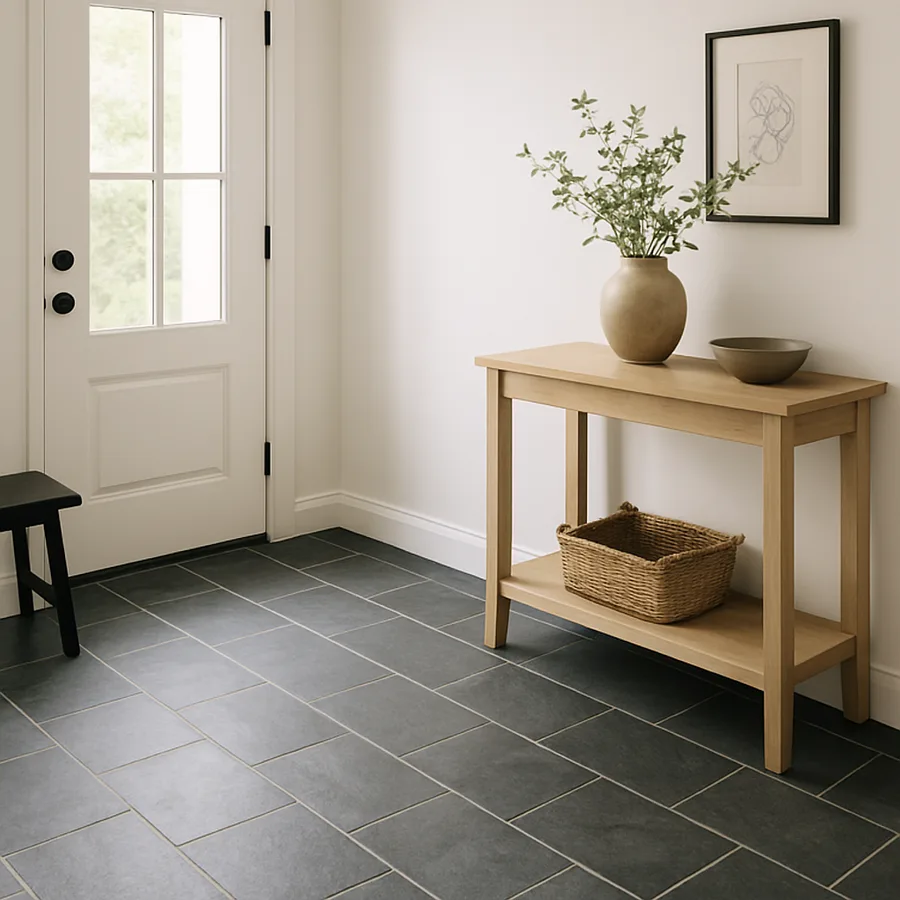
Slate is the foyer material of patient homeowners. It is not the cheapest option, it is not the lowest-maintenance option, and it is definitely not the smoothest option, but for sheer presence, durability, and visual depth there is almost nothing that competes with a well-installed slate entryway. A natural stone quarried primarily in Pennsylvania, Vermont, China, India, and Brazil, slate arrives at a jobsite with color variation, surface cleft, and mineral banding that no printed tile can fully replicate. This guide covers slate grades, layout strategies, sealing, cleaning, and the honest tradeoffs so you know exactly what you are getting.
What Slate Actually Is and Why It Lasts
Slate is a metamorphic rock formed when ancient clay and silt deposits are compressed and transformed under heat and pressure for millions of years. That geological history gives slate its two defining structural traits: fissility (the ability to split cleanly into thin, flat sheets) and low water absorption (typically under 0.4 percent, per ASTM C121 testing referenced by the Natural Stone Institute (NSI)). Those two traits are exactly what you want in an entryway floor: a stone that can be produced in tile form and that will not absorb the moisture tracked in on boots.
The practical consequence is longevity. A properly installed and periodically resealed slate entryway can last 60 to 100 years or more. There are English farmhouses with original slate flooring that is still functional after three centuries. The Marble Institute of America (now part of the Natural Stone Institute) reports that well-maintained slate floors routinely outlast the houses they are installed in. Compared with manufactured alternatives that get replaced every 20 to 50 years, slate is effectively a one-generation decision.
Grades, Origins, and What the Labels Actually Mean
Not all slate is equal. Commercial grading loosely organizes slate into Grade I (highest quality, uniform, and dense), Grade II (some veining or color variation), and Grade III (rustic, variable, often with through-going cracks filled at the factory). For an entryway subject to heavy traffic and moisture, specify Grade I or a high-quality Grade II. Low-grade slate can delaminate (flake) along its natural cleavage planes, which looks exactly as bad as it sounds and cannot be repaired without replacement.
Origin matters too. Vermont slate is prized for deep saturated colors (green, purple, red) and exceptional density. Pennsylvania slate tends to be gray and black with good uniformity. Chinese and Indian slate is often more variable and more affordable, with the best product lines offering genuinely compelling multi-color palettes but the worst lines suffering from delamination risk. According to procurement data published by the NSI, imported slate accounts for roughly 70 percent of the U.S. residential market by volume, which means supplier vetting is critical. Ask for the ASTM C629 dimension slate specification and request references for prior installations in similar applications. The Natural Stone Institute maintains a directory of accredited suppliers and a technical library on stone selection.
Surface Finishes and How They Change the Look
Slate's natural surface after quarrying and splitting is cleft: a textured, slightly irregular face with small ridges and micro-variations that accentuate the stone's geological origin. Cleft slate has excellent slip resistance (a DCOF frequently above 0.60, per ANSI A137.1 testing) and a rustic, handcrafted visual quality. Honed slate has a smoother, matte-finished face achieved by mechanical grinding; it reads more refined and contemporary but loses some slip resistance. Polished slate is rare and mostly unsuitable for entryway use because it becomes slippery when wet and shows every water spot.
For a durable, natural entryway look, cleft slate is the classic choice and pairs well with farmhouse, craftsman, tudor, and eclectic design directions. Honed slate suits modernist and transitional homes where the palette is more restrained. Reader question: if you love the look of cleft slate but worry about cleaning difficulty in the ridges, is there a middle path? Yes: specify a gauged cleft slate, which is mechanically calibrated to a uniform thickness while retaining the natural face texture. This combines the visual benefits of cleft with a consistent installation plane, which simplifies grouting and cleaning.
Sealing: The Non-Negotiable Maintenance Step
Slate is a natural stone with microscopic porosity, and an unsealed slate floor will absorb oils, wine, coffee, and foot-traffic grime over time in ways that are difficult or impossible to reverse. Sealing is not optional. The industry standard is a penetrating impregnating sealer applied immediately after installation and grout cure, then refreshed on a schedule determined by the sealer's warranty (typically every 1 to 3 years for residential entryway use).
Two sealer categories matter: penetrating sealers (also called impregnators), which soak into the stone and protect from within without changing the surface appearance; and topical sealers, which form a film on the surface and can add sheen but wear unevenly in traffic paths. For an entryway, penetrating sealers are almost always the correct choice. Topical sealers can look beautiful on a new install but require full stripping and reapplication every few years, which is a significant ongoing maintenance burden. According to technical guidance from the ASTM International and the NSI, a properly applied penetrating sealer reduces stain absorption by 90 percent or more in laboratory testing. Reader question: how do you know when to re-seal? Drip water onto the stone in the highest-traffic zone; if it beads up, the sealer is still working, but if it darkens the stone within a few seconds, it is time to re-seal.
Installation Details That Make Slate Last
Slate installation is more demanding than porcelain or ceramic for several reasons. The stone comes from the quarry with variable thickness (often 3/8 to 5/8 inch on ungauged product), which means the installer must back-butter every tile and build up the mortar bed to compensate for individual tile thickness variations. This is slow, skilled work. A cheap installer with no slate experience will install slate like ceramic tile and produce a floor that lippage-cracks within a year.
The Tile Council of North America (TCNA) specifies that natural stone installations should be performed by installers carrying Advanced Certification for Tile Installers (ACT) credentials or equivalent experience, with lippage tolerances under 1/32 inch for honed stone and slightly more permissive tolerances for cleft. Verify credentials before hiring. A quality slate installation also requires a cement backer board substrate, a crack-isolation membrane, and an uncoupling layer in homes with wood subfloors to prevent structural movement from transferring stress into the stone. For foundational installation standards, see the Tile Council of North America.
Maintenance, Cleaning, and What Not to Use
Slate's daily cleaning routine is simple: dry-dust mop or vacuum to pick up abrasive grit, then damp mop with a neutral-pH stone cleaner approved by the NSI. Never use acidic cleaners (vinegar, citrus, many generic bathroom cleaners) because they etch calcium-bearing stones and degrade mortar joints over time. Alkaline cleaners (ammonia, bleach) can also damage sealer coatings and should be avoided. Dedicated stone cleaners are inexpensive and widely available.
For periodic deeper cleaning, a stone-specific poultice can lift embedded staining from unsealed or older floors. For heavily worn slate with visible flaking in cleavage planes, professional restoration services can clean, repair, and re-seal the entire floor for roughly $3 to $7 per square foot, which is still dramatically cheaper than replacement. Research from the Green Building Council (USGBC) notes that natural stone floors have a lower lifetime carbon footprint than most manufactured flooring precisely because they are so rarely replaced, which makes their maintenance investment a sustainability investment as well. Additional cleaning product guidance is available through the EPA Safer Choice program for non-toxic stone-safe cleaners.
Conclusion
A slate entryway is a generational floor. With a Grade I or high Grade II stone from a reputable supplier, a skilled ACT-credentialed installer, a proper substrate with crack-isolation and uncoupling membranes, and a disciplined penetrating-sealer maintenance schedule, a slate foyer will look beautiful for the entire time you own the house and well into the next owner's tenure. The upfront investment is real (budget $15 to $30 per square foot installed for quality slate, higher for premium Vermont or imported multi-color product), but the cost-per-year over a 60-year service life is lower than almost any alternative.
The honest tradeoffs: slate is colder underfoot than LVP (pair with radiant heat for serious cold-climate comfort), harder on dropped items than vinyl or wood, and demands a non-trivial maintenance routine compared with maintenance-free materials. None of these tradeoffs is disqualifying, but all of them deserve your eyes-open consideration before you commit. A homeowner who hates cleaning will hate slate; a homeowner who appreciates natural materials and periodic stewardship rituals will love it for decades.
For the right household, a slate entry delivers a combination of authenticity, durability, and character that manufactured materials cannot match at any price point. It is heavy, grounding, tactile, and unmistakably natural. Paired with a warm lighting plan, a comfortable bench, and a proper doormat sequence, it becomes the detail guests remember long after they have left the house, and the detail you look forward to seeing every time you come home.
Considering slate for your own entry? Request full 4-foot-by-4-foot tile mock-ups from two competing suppliers, lay them out in your foyer under morning and evening light, and only commit after you have lived with the actual stone samples on your actual floor for at least a week.
Beyond its pure aesthetics, slate offers a number of genuine functional benefits that are surprisingly easy to miss during a brief showroom comparison with manufactured alternatives. Its natural thermal mass means it moderates room temperature swings: a cool foyer in summer stays comfortable longer before heating up, and a heated foyer in winter releases warmth gradually after the thermostat cycles off. Its non-combustibility makes it a genuinely fire-resistant surface, which matters in foyers that contain a wood stove, candles, or seasonal decor with open flames. And its low embodied energy relative to highly manufactured alternatives appeals to homeowners pursuing LEED or Living Building Challenge certification paths, per program guidance from the U.S. Green Building Council.
One particularly attractive quality of slate is how it ages. Unlike manufactured tile, which tends to look progressively more worn over time, slate develops a patina that many homeowners come to love more than the original finish. Foot traffic burnishes high-use paths, oils from cooking and candles subtly darken sections, and the stone acquires a lived-in depth that reads as authenticity rather than wear. This is exactly the opposite of porcelain or LVP, where visible wear is universally viewed as damage. If you appreciate materials that improve with use, slate is uniquely rewarding among flooring choices.
Regional climate also affects slate specification. In cold, wet climates with freeze-thaw cycles, an exterior-rated slate is occasionally specified right up to the threshold so that the interior entry material matches an adjacent covered porch or stoop. The ASTM C616 / C616M standard distinguishes slate grades by weathering resistance, and high-grade exterior slates remain dimensionally stable through hundreds of freeze-thaw cycles. If you want seamless continuity from exterior stoop to interior foyer, consult with your supplier about matching the stone across both applications; it is one of the most dramatic architectural moves available and it creates a powerful sense of arrival.
Finally, on the topic of resale and appraisal: real-estate professionals tracking high-end listings consistently note that natural stone flooring in entries, bathrooms, and kitchens is among the features most cited in luxury-segment listing copy. The National Association of REALTORS (NAR) has reported in its remodeling-impact surveys that natural stone upgrades often recoup 70 percent or more of their cost at sale in appropriate market segments, with the strongest returns in the over-$750,000 listing bracket. For homeowners planning to stay for decades, resale returns are secondary to enjoyment; for homeowners considering resale within a shorter horizon, slate's market reception in the right price band is a genuine asset worth factoring into the decision.
More Articles You May Like



Comments
Post a Comment