Natural Stone Slab Backsplash Behind the Stove: Pros and Cons
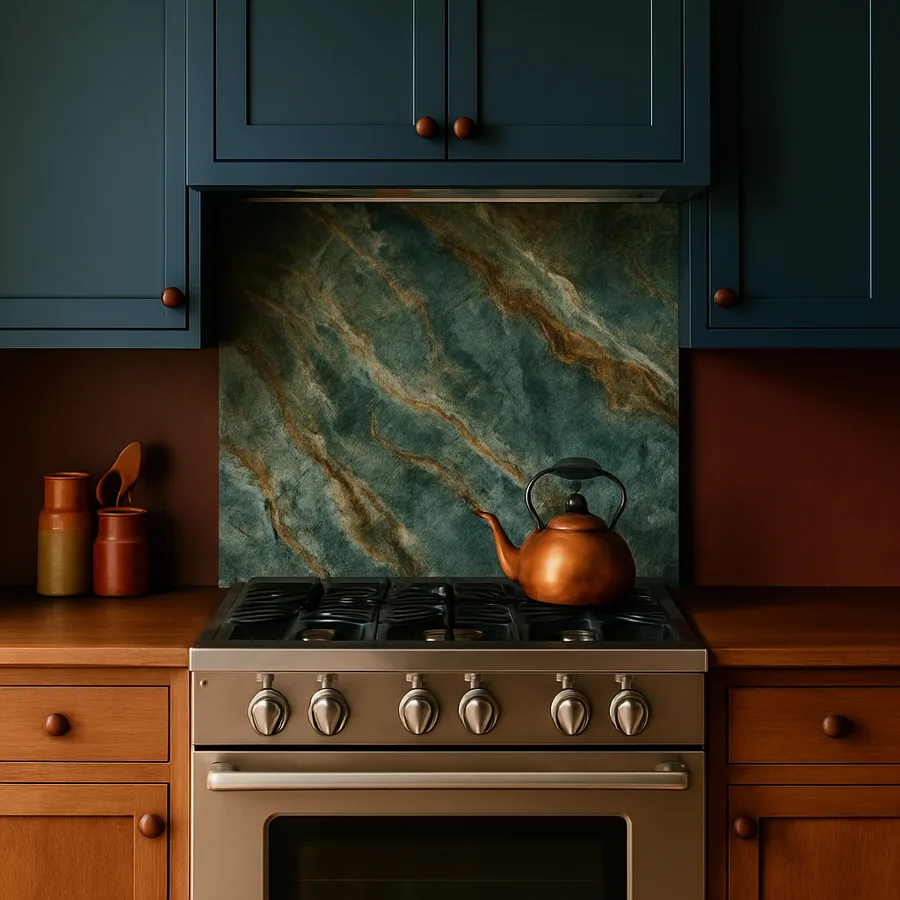
Flip through any luxury kitchen magazine and you will see a recurring visual motif: a single, uninterrupted sheet of dramatic natural stone rising from the countertop straight up the wall behind the range, all the way to the hood. It is a design choice that photographs beautifully and feels instantly elevated. A natural stone slab backsplash has become shorthand for high-end residential kitchen design, embraced by builders of custom homes and designers with demanding clients.
Yet behind the glossy photography lies a set of real, practical trade-offs. Not every stone performs equally behind a hot stove. Not every homeowner has the patience for sealing, specialty cleaners, or the occasional etched ring. This article walks through the honest pros and cons of installing a natural stone slab backsplash behind the cooktop, so you can decide whether the visual payoff justifies the ongoing commitment.
Why the Slab Look Has Become So Popular
The appeal is partly visual and partly emotional. A continuous slab allows the stone's natural veining to flow uninterrupted from countertop to backsplash, creating what designers call a "waterfall of veining". This effect is impossible to achieve with tile, and it reads as custom, luxurious, and intentional. According to the Marble Institute of America, demand for full-height stone backsplashes in residential projects roughly doubled between 2016 and 2023, outpacing nearly every other kitchen material category.
There is also a practical side. A seamless slab has no grout lines, which means no porous joints to trap grease, no discoloration over time, and no annual regrouting projects. For homeowners who cook heavily, the ease of wiping down a single continuous surface is a genuine daily improvement over grouted tile.
The material also signals permanence. Unlike ceramic tile, which can feel trend-sensitive, a stone slab feels quarried rather than manufactured. Reader question: when you picture the kitchen you want in ten years, does it lean toward layered, changeable materials, or toward one or two dramatic, permanent statements? The answer matters here.
The Stone Options: Marble, Quartzite, Granite, Soapstone
Not all stones are equally suited to the area behind a stove. Here is where realistic expectations help.
Marble is the most visually iconic. Calacatta, Carrara, and Statuario slabs deliver the dramatic veining that has defined luxury design for centuries. However, marble is calcareous and etches when exposed to acidic substances like tomato sauce, wine, or vinegar. Behind a stove, splatter is routine. The Natural Stone Institute publishes detailed care guides noting that even well-sealed marble will etch over time, and owners must accept a developing patina rather than expect permanent showroom appearance.
Quartzite is often the recommended middle ground. True quartzite is a metamorphic stone that is both harder and more acid-resistant than marble, while still offering dramatic veining in varieties like Taj Mahal, Mont Blanc, and Fusion. The Natural Stone Institute and independent petrographic testing labs confirm that genuine quartzite scores roughly a 7 on the Mohs scale, comparable to granite.
Granite is the most durable and heat-tolerant option. Its speckled, crystalline appearance is less dramatic than marble or quartzite but significantly more forgiving to cook behind. Soapstone, finally, is softer but nonporous and famously heat-resistant, which is why it has been used in laboratories and old New England farmhouse kitchens for over a century.
Heat, Staining, and Real-World Performance
A backsplash directly behind a gas range is the harshest location in the kitchen. Temperatures near the wall can exceed 400 degrees Fahrenheit during high-BTU searing, and grease particulate settles steadily onto the surface. How do stones actually handle this environment?
Granite, quartzite, and soapstone all handle heat exceptionally well. Direct flame contact from a tall flame is not recommended on any finished stone surface, but normal radiant heat and splatter pose no issue. Marble is more nuanced. While marble will not crack from heat alone, repeated grease exposure can darken the stone if sealers degrade, and acidic splatter will etch the finish.
Staining is the more persistent concern. Olive oil, red wine, turmeric, and coffee all stain porous stones if left unwiped. The American Society for Testing and Materials (ASTM) standard C97 measures stone porosity, and variations between slabs can be significant even within the same stone type. A reputable fabricator will test your specific slab and recommend a penetrating sealer appropriate to its absorption rate, typically a 15-year impregnating sealer for residential applications.
Cost Realities and Budget Planning
A natural stone slab backsplash is rarely inexpensive. Fabricated and installed, most projects fall between 80 and 250 dollars per square foot, with exotic marbles and book-matched slabs climbing well above that range. The National Association of Home Builders (NAHB) tracks kitchen renovation spending and reports that natural stone features have contributed significantly to kitchen cost inflation over the past five years, with premium stone installations rising approximately 11 percent annually since 2020.
There are three main cost drivers. The first is slab selection, which can more than double total project cost depending on whether you choose a common granite or a rare calacatta. The second is fabrication complexity, including book-matching two slabs so veins continue as mirror images. The third is installation, particularly in kitchens where the wall requires reinforcement to bear the weight of a full-height stone panel.
Reader question: is there a single design element in your kitchen that you would be willing to prioritize above all others? For many clients, a book-matched stone slab becomes that one element, with cabinetry and flooring chosen deliberately to let the stone speak first.
Installation, Sealing, and Ongoing Care
Installing a stone slab behind a stove is not a DIY project. Professional fabricators laser-measure the wall, template the exact profile, cut the slab with water-cooled bridge saws, polish the exposed edges, and mechanically secure the stone with epoxy and concealed brackets. For slabs over 50 square feet or especially heavy stones like quartzite, wall reinforcement may be required, and in some jurisdictions a building permit becomes necessary.
Sealing is the homeowner's most important ongoing task. A penetrating sealer fills the microscopic pores in the stone surface, dramatically reducing stain absorption. Most manufacturers recommend annual resealing for kitchen applications, though newer 15-year sealers can stretch that interval. The Natural Stone Institute also recommends daily cleaning with a pH-neutral stone cleaner rather than general-purpose products, because acidic or alkaline cleaners can etch or dull the finish over time.
Expect a patina. Even with perfect care, a stone slab behind a busy stove will acquire small signs of use. Designers who specialize in this look often frame it as a feature rather than a flaw, comparing it to the developing character of a well-used copper pan or a leather chair.
When a Slab Backsplash Makes Sense and When It Does Not
A natural stone slab backsplash is ideal for homeowners who value dramatic visual impact, plan to stay in their home long enough to amortize the investment, and are comfortable with materials that develop character over time. It pairs especially well with custom cabinetry, integrated appliances, and high-end ventilation hoods that match the ambition of the stone.
It is less ideal for homeowners with young children who may press cartons of tomato juice against the wall, for investment properties where maintenance routines will not be followed by tenants, or for anyone who expects perfection from a porous natural material. In these cases, a hard quartz composite backsplash or a porcelain slab with stone-look printing can deliver much of the visual effect with fewer maintenance demands.
Designers affiliated with the American Society of Interior Designers (ASID) increasingly offer a compromise: a honed quartzite or porcelain slab behind the stove, paired with a genuine marble island, letting each material perform in the area best suited to it. This thoughtful materiality produces striking kitchens without sacrificing daily usability.
Climate and location also influence the decision. Homes in humid coastal regions can accelerate sealer breakdown, requiring more frequent maintenance. High-altitude homes with strong UV exposure through south-facing windows can cause certain dark stones to fade subtly over years. Before committing, ask your fabricator about how your specific stone has performed in homes similar to yours. The best stone yards keep long-term client feedback and can speak honestly to these regional realities.
Finally, consider the emotional dimension of the decision. Natural stone is an inherently imperfect material, and the very qualities that make it beautiful, the veining, the mineral inclusions, the subtle color shifts, are also the qualities that make two slabs of the "same" stone visually distinct. Homeowners who approach the purchase as a one-of-a-kind art acquisition rather than a standardized product tend to be the most satisfied. Those who expect warehouse-level uniformity are often disappointed by the natural variation that is, in fact, the whole point.
Conclusion
A natural stone slab rising behind a stove is one of the most visually powerful design moves available in a kitchen. The seamless flow of veining, the absence of grout lines, and the sense of craft all contribute to a space that feels curated rather than assembled. For the right homeowner, no substitute captures the same emotion.
At the same time, the decision carries real weight. The cost premium over tile can be substantial. Maintenance routines are ongoing. Certain stones, particularly marble, will show the marks of daily cooking regardless of precaution. Approaching the project with realistic expectations, a trusted fabricator, and an honest assessment of household habits separates installations that bring years of joy from those that produce years of worry.
If you are leaning toward a slab backsplash, spend time in stone yards handling actual samples, review care guides from the Natural Stone Institute, and interview at least two fabricators with strong portfolios. Ask specifically about sealing recommendations, warranty details, and post-installation support. The stone is only as good as the team that installs and maintains it.
Ready to explore slabs in person? Schedule a visit to a local stone yard this month, bring photos of your cabinetry and countertops, and ask the yard manager to show you full slabs rather than small samples. Seeing the veining at scale is the moment most homeowners know whether this material belongs in their home.
Recommended reading:
Sustainability, Sourcing, and Provenance
Natural stone carries a provenance that manufactured materials cannot claim, and for some homeowners that story is part of the value. A Calacatta slab from the Apuan Alps in Italy, a Taj Mahal quartzite from Brazil, or a Vermont soapstone from a 150-year-old quarry all bring a geographic and geological narrative into the home. Buyers increasingly ask about this origin information, and reputable fabricators aligned with the Natural Stone Institute now routinely provide quarry documentation alongside slab purchases.
Environmental considerations are more nuanced than they first appear. Natural stone is energy-intensive to quarry and ship, but it is also inert, durable, and fully recyclable at end of life. A porcelain slab printed to look like marble requires less shipping weight but involves high-energy firing and is harder to recycle. Homeowners concerned about environmental impact should ask about regional stone options, which dramatically reduce transport emissions, and about fabricators who participate in third-party sustainability certifications.
Local sourcing also simplifies matching and repair years later. A homeowner who installs a Georgia or Tennessee granite is much more likely to find a matching slab a decade later for a future renovation or repair than a homeowner who selected an exotic stone from a small foreign quarry. This practical consideration often tips long-term-oriented buyers toward regional options even when exotic stones initially capture their imagination.
Budget-Smart Alternatives That Read Like Real Stone
For homeowners who love the slab look but cannot justify the cost or maintenance of genuine marble or quartzite, technology has created alternatives worth serious consideration. Large-format porcelain slabs, manufactured by companies whose standards align with guidelines published by the Porcelain Tile Certification Agency (PTCA), can reproduce convincing marble veining at a fraction of the cost. These slabs measure up to 10 feet by 5 feet, allowing a single seamless backsplash behind most residential cooktops.
Engineered quartz composites also deliver strong visual results with almost no maintenance. Unlike natural stone, engineered quartz is non-porous, requires no sealing, and resists staining from acidic substances that would etch marble. The trade-off is subtle: the veining is repeated across slabs rather than truly unique, and the surface lacks the subtle temperature differential and mineral character of real stone. For many homeowners, that trade-off is well worth the durability gain.
When comparing alternatives, always view full slabs rather than small samples. Printed surfaces reveal their repetition patterns only at scale, and a sample that looks convincing in a four-inch square may reveal obvious tiling at eight feet. Visiting a fabricator's yard and inspecting full material under bright light is the only reliable way to judge whether a porcelain or quartz alternative will satisfy you long-term.
More Articles You May Like



Comments
Post a Comment