Zellige Tile Backsplash Ideas for a Handmade Kitchen Look
What Makes Zellige Tile Different From Every Other Option
Zellige tiles are hand-cut, hand-glazed terracotta tiles that originate from the Fez region of Morocco, where artisans have been producing them using the same techniques for over a thousand years. Unlike machine-made ceramic or porcelain tiles that arrive in perfectly uniform sheets, each zellige tile carries subtle variations in thickness, surface texture, and glaze depth that result directly from the human hand that shaped it. These imperfections are not flaws; they are the entire point. When installed as a kitchen backsplash, hundreds of these individually unique pieces create a luminous, undulating surface that shifts in appearance as light moves across it throughout the day.
The production process itself explains much of zellige's distinctive character. Moroccan artisans mix local clay with water, press it into molds by hand, and allow the tiles to dry slowly in the open air before firing them in traditional wood-burning kilns at temperatures that vary naturally within the chamber. The glaze, applied by dipping each tile individually, pools and thins unevenly across the slightly irregular surface, creating the color variation that collectors and designers prize. The Tile Council of North America (TCNA) classifies zellige as a handmade artisan tile, acknowledging that standard dimensional tolerances for machine-made products do not apply to these traditionally produced pieces.
What separates zellige from other handmade tile options is its particular glaze quality. The surface has a depth and translucency that flat, opaque glazes simply cannot achieve. Light penetrates the glaze layer and reflects off the clay body beneath, creating a glow that tile professionals often describe as jewel-like. This optical effect is why zellige backsplashes photograph so beautifully and why they look dramatically different in person than they do in catalog images. Have you ever noticed how certain materials seem to change character completely depending on whether the kitchen lights are on or off? Zellige is one of those materials, and its responsiveness to light conditions keeps the kitchen feeling dynamic rather than static.
The American Society of Interior Designers (ASID) has documented a significant rise in client requests for artisanal and handmade materials in kitchen renovations over the past several years, with handmade tile leading the category. According to a 2024 ASID design trends report, approximately 62 percent of surveyed designers observed increased demand for materials with visible maker's marks and intentional imperfection. Zellige sits at the intersection of this demand for authenticity and the practical need for a durable, wipeable backsplash surface, which explains its remarkable trajectory from niche import to mainstream design staple.
Color Palettes That Work in Real Kitchens
White and off-white zellige tiles remain the most popular choice for kitchen backsplashes, and for good reason. The subtle variation within a field of white zellige, where individual tiles range from bright white to soft ivory to the faintest warm gray, creates visual richness that a uniform white subway tile cannot approach. This range of tones within a nominally single-color installation is one of zellige's signature qualities, and it allows a white backsplash to feel warm and handmade rather than clinical and sterile. White zellige pairs effortlessly with virtually any cabinet color, countertop material, and hardware finish, making it a safe but far from boring default choice.
Green zellige tiles have emerged as the second most requested color family, spanning a range from pale sage and celadon through deep emerald and forest tones. Houzz reports that green tile backsplashes have seen consistent year-over-year growth in user saves and project inclusions, reflecting a broader appetite for nature-inspired color in kitchen design. Green zellige works particularly well against warm wood cabinetry and brass or unlacquered copper hardware, creating a palette that feels organic and grounded. The glaze variation inherent in zellige means that a green backsplash naturally contains hints of blue, teal, and olive that add complexity without requiring multiple tile colors.
Blue zellige, ranging from soft powder blue through cobalt to deep navy, carries strong Mediterranean and Moroccan associations that can transport a kitchen to another place and time. These cooler tones pair naturally with white cabinetry and stainless steel appliances, creating a crisp, fresh aesthetic that suits coastal and contemporary kitchens alike. The challenge with saturated blues is that they can dominate a small kitchen if used on every available wall surface, so many designers recommend limiting blue zellige to a single feature area, such as the range backsplash or a niche behind the sink, and using a complementary neutral elsewhere. This approach delivers the color impact without overwhelming the space.
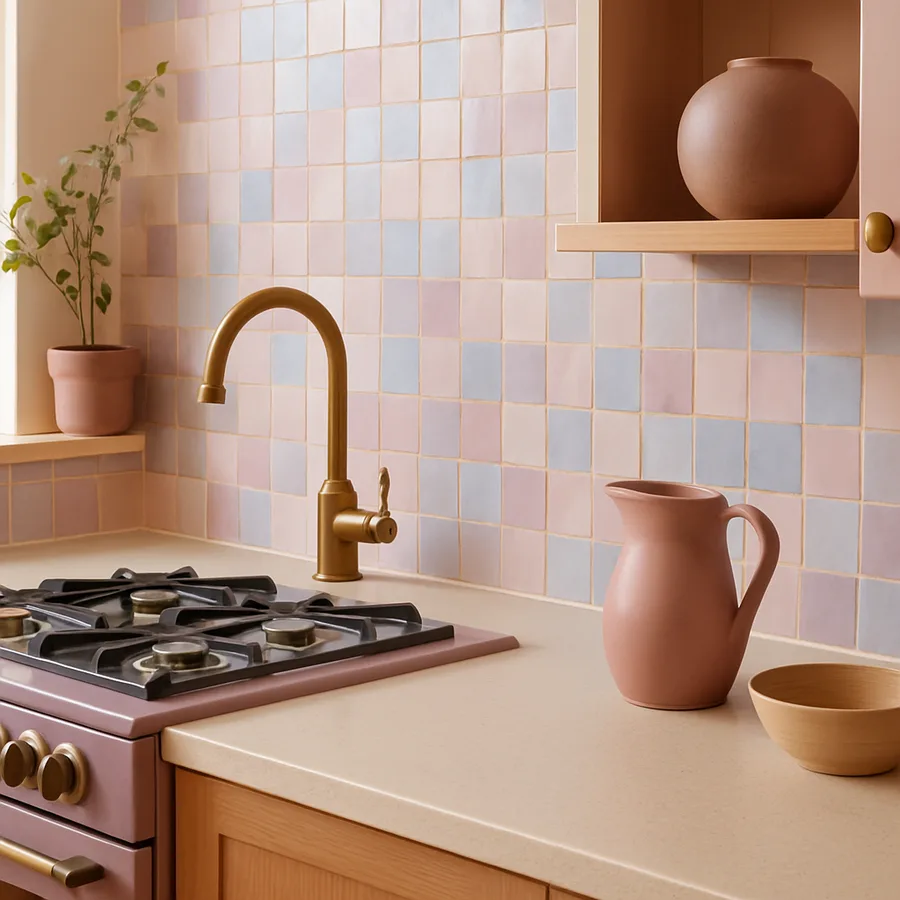
Terracotta, blush, and warm pink zellige tiles represent a bolder choice that pays off in kitchens designed around warm, earthy palettes. These clay-adjacent tones connect directly to the material's terracotta origins and create a particularly cohesive effect when paired with natural stone countertops, unlacquered brass fixtures, and open wood shelving. The National Kitchen and Bath Association (NKBA) has identified warm earth tones as a growing preference in kitchen color schemes, noting that homeowners increasingly seek alternatives to the all-white kitchen that dominated the previous decade. Pink and terracotta zellige offers warmth and personality while remaining sophisticated enough for long-term satisfaction.
Layout Patterns From Classic to Creative
The straight stack bond, where square tiles are aligned in a simple grid with edges directly above and below each other, is the most common layout for zellige backsplashes and arguably the most effective. This grid pattern provides a clean, orderly framework that allows the handmade irregularity of each individual tile to stand out. The contrast between the geometric regularity of the layout and the organic imperfection of the tiles creates the visual tension that makes zellige installations so compelling. Stack bond works equally well with small 2x2-inch tiles, which create a mosaic-like density, and larger 4x4-inch tiles, which produce a bolder, more contemporary look.
The running bond or brick pattern offsets each row by half a tile width, creating a staggered layout that echoes traditional brickwork. This pattern introduces horizontal movement that can make a narrow kitchen feel wider, and the offset alignment is slightly more forgiving of dimensional variation between tiles than a strict grid. Running bond is the natural choice for rectangular zellige tiles, particularly in the popular 2x6-inch format that mirrors the proportions of classic subway tile. The handmade quality of zellige transforms what might otherwise be a conventional subway layout into something with significantly more character and depth.
Herringbone and chevron patterns bring dynamic diagonal energy to a zellige backsplash, creating a sense of movement and visual complexity that elevates the entire kitchen. These patterns require more precise cutting and careful installation, which increases labor costs, but the result is a backsplash that reads as a deliberate design statement rather than a simple surface covering. Herringbone works best with rectangular tiles in a 1:2 or 1:3 proportion, and the pattern can be oriented vertically, horizontally, or at a 45-degree angle depending on the desired effect. Does the idea of a backsplash that draws the eye upward and outward appeal to your sense of kitchen design?
Mixed-format layouts combine different tile sizes within the same installation, creating a patchwork effect that amplifies the handmade quality of zellige. A field of 4x4-inch tiles interspersed with occasional 2x2-inch accent pieces, or a transition from smaller tiles at the bottom to larger tiles at the top, adds another layer of visual interest without introducing additional colors. This approach has deep roots in traditional Moroccan architecture, where zellige installations frequently incorporate multiple geometric formats in intricate compositions. For a kitchen backsplash, a simplified version of this tradition adds artisanal authenticity without the complexity and cost of a full mosaic installation.
Grouting Decisions That Change Everything
The grout color and width you choose for a zellige backsplash will alter the finished appearance as dramatically as the tile color itself, yet many homeowners make this decision as an afterthought. Matching grout, where the grout color closely approximates the tile color, creates a cohesive, monolithic surface that emphasizes the overall texture and light play of the zellige field. The individual tiles blend together, and the eye reads the backsplash as a single shimmering plane rather than a collection of separate pieces. This approach works exceptionally well with white and light-colored zellige, where the goal is luminous texture rather than graphic pattern.
Contrasting grout produces the opposite effect, outlining each tile individually and creating a distinct grid pattern that emphasizes the geometry of the layout. Dark grout with light tiles or light grout with dark tiles transforms the backsplash into a more graphic, structured composition where each piece is clearly delineated. This approach highlights the dimensional variation between tiles, since uneven edges become more visible against a contrasting background. The Architectural Digest tile guide suggests that contrasting grout works best when homeowners want to celebrate the irregular, handmade quality of each individual zellige piece rather than creating a smooth overall surface effect.
Grout joint width is equally consequential. Traditional zellige installations in Morocco use minimal grout joints, sometimes as narrow as one-sixteenth of an inch, which creates a tight, mosaic-like surface where tiles nearly touch each other. This tight spacing maximizes the tile-to-grout ratio and produces the most luminous, light-catching result. However, the dimensional variation inherent in handmade tiles means that very tight joints require more skilled installation and more aggressive tile sorting to ensure a satisfactory fit. Wider joints of one-eighth to three-sixteenths of an inch are more forgiving and easier to install, but they introduce more grout surface that can shift the visual balance away from the tile itself.
Grout sealing is a non-negotiable step for any zellige backsplash, particularly behind the stove and sink where grease, moisture, and food splatter are constant threats. Unsanded grout in narrow joints and sanded grout in wider joints both require a penetrating sealer applied after the grout has fully cured, typically 48 to 72 hours after installation. The zellige tile surface itself also benefits from sealing, since the porous, hand-applied glaze can absorb stains if left unprotected. A quality impregnating sealer will protect both tile and grout without altering the natural appearance or glaze depth that makes zellige special. Plan to reseal annually in heavy-use areas to maintain protection over time.
Installation Realities: Cost, Labor, and Setting Expectations
Zellige tile typically costs between fifteen and thirty-five dollars per square foot for the tile itself, placing it in a premium category well above standard ceramic subway tile but below hand-painted or custom mosaic options. This price range reflects the labor-intensive handmade production process and the cost of importing from Morocco or, increasingly, from artisan producers in other regions who use traditional techniques. A typical kitchen backsplash covers 25 to 40 square feet, so material costs for a zellige backsplash generally fall between 400 and 1,400 dollars before installation. Ordering 15 to 20 percent overage is strongly recommended because dimensional variation makes precise quantity estimates difficult and color batch matching on reorders is unreliable.
Labor costs for zellige installation run significantly higher than for standard tile because the work requires more skill, more time, and more patience. An experienced tile setter working with zellige typically covers 15 to 25 square feet per day, compared to 40 to 60 square feet per day with uniform machine-made tile. The installer must sort tiles by thickness, adjust thinset application to compensate for surface irregularity, and make judgment calls about acceptable variation throughout the process. The National Tile Contractors Association (NTCA) recommends hiring installers with specific handmade tile experience, as technicians accustomed to uniform products may struggle with the tolerances that zellige demands and produce a result that looks uneven rather than intentionally irregular.
Setting realistic expectations about the finished product is essential for satisfaction with a zellige backsplash. The surface will not be flat. Individual tiles will sit at slightly different heights, creating a three-dimensional texture that catches light beautifully but means the backsplash cannot be wiped with a single smooth stroke the way a flat ceramic surface can. Some tiles will have small pinholes, crazing, or glaze pooling that are considered characteristic of the product rather than defects. If these qualities cause concern rather than delight, zellige may not be the right choice for your kitchen, and that is a perfectly valid conclusion to reach before purchasing rather than after installation.
The substrate beneath the zellige requires proper preparation, particularly if you are tiling over existing backsplash material or directly onto drywall. A cement board or tile backer substrate provides the most stable, moisture-resistant base for zellige installation, and the additional cost and labor of installing backer board pays dividends in long-term adhesion and crack prevention. Any irregularity in the substrate will be amplified by the handmade tile, so ensuring a flat, sound surface before the first tile goes on is time well spent. Your installer should use a white thinset mortar for light-colored zellige, as gray thinset can telegraph through translucent glazes and muddy the color.
Maintaining Zellige for Lasting Beauty
Daily maintenance of a zellige backsplash is straightforward, but it differs from the simple wipe-down that flat ceramic tile requires. The textured, three-dimensional surface means that grease and food particles can settle into the slight recesses between tiles and along uneven glaze surfaces. A soft cloth or sponge with warm water and a mild pH-neutral dish soap handles routine cleaning effectively. Avoid abrasive scrubbers, acidic cleaners, or products containing bleach, which can etch the glaze surface and dull the luminous quality that defines zellige. The area directly behind the stove deserves attention after every cooking session to prevent grease buildup that becomes progressively harder to remove.
Periodic deep cleaning every three to six months addresses accumulated grime that daily wiping misses. A paste of baking soda and water applied gently with a soft brush can lift stubborn stains from grout lines without damaging the tile glaze. For the tile surface itself, a dilute solution of pH-neutral stone cleaner works well and is safe for sealed zellige. The Ceramic Tile Education Foundation (CTEF) advises against steam cleaning handmade tile, as the intense heat and moisture can compromise both the glaze seal and the grout integrity over time. Patience and gentle products outperform aggressive methods with this material every time.
Resealing is the single most important long-term maintenance task for a zellige backsplash. The original sealer applied after installation will gradually wear away, particularly in high-splash areas near the sink and stove. Testing the seal annually is simple: sprinkle a few drops of water on the tile surface and observe whether it beads up, indicating active protection, or absorbs into the tile, indicating that resealing is needed. The same impregnating sealer used during installation can be reapplied in an afternoon with minimal preparation. Consistent resealing prevents the staining and discoloration that lead some homeowners to regret choosing a porous handmade tile for their kitchen.
Chips and cracks, while uncommon in a properly installed zellige backsplash, can occur from impact with heavy pots, utensils, or appliances. The handmade nature of zellige actually works in your favor here, because a replacement tile from the same color batch will blend into the irregular field far more seamlessly than a replacement piece in a uniform machine-made installation. Keep a small box of leftover tiles from the original order stored in a dry location for exactly this purpose. A skilled tile setter can remove a damaged piece and install a replacement in under an hour, leaving virtually no trace of the repair in the finished surface.
Conclusion: Choosing Craft Over Uniformity
A zellige tile backsplash is a declaration that imperfection, when it results from skilled human hands and centuries of tradition, is more beautiful than machine-made perfection. Every undulation in the glaze surface, every slight variation in color, and every minor irregularity in dimension tells the story of an individual tile made by an individual artisan using techniques passed down through generations. In a kitchen filled with precision-engineered appliances and factory-produced cabinetry, this handmade surface provides a counterbalance that makes the entire room feel warmer and more alive.
The practical considerations are real and should not be minimized. Zellige costs more than standard tile, takes longer to install, requires more careful maintenance, and demands a skilled installer who understands how to work with handmade materials. These are not reasons to avoid zellige but rather factors to plan for and budget accordingly. Homeowners who go in with clear expectations about cost, timeline, and the inherent character of the material consistently report deep satisfaction with their choice years after installation.
If the idea of a kitchen backsplash that glows differently in morning light than it does under evening fixtures appeals to you, start by ordering sample tiles from two or three suppliers and living with them in your kitchen for a week. Prop them on the countertop, hold them against the wall, and observe how they interact with your cabinets, countertops, and natural light at different times of day. This hands-on evaluation will tell you more than any photograph or showroom visit, and it will confirm whether zellige's particular brand of handmade beauty belongs in your kitchen.
More Articles You May Like



Comments
Post a Comment