Roman Shades vs Roller Blinds: Which Fits Your Windows Best
Understanding the Core Difference Between These Two Treatments
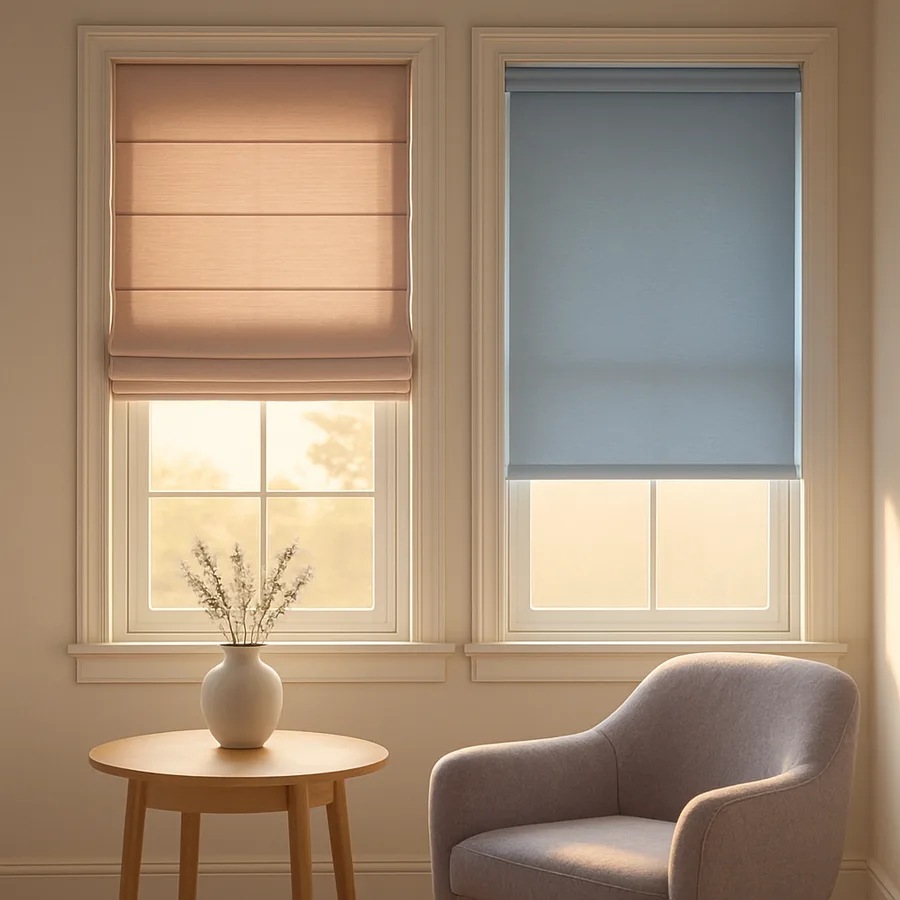
Roman shades and roller blinds both mount inside or outside the window frame, both raise and lower to control light, and both come in a broad range of fabrics and colors. Yet the mechanisms that drive them create two fundamentally different experiences in a room. A roman shade draws upward by folding fabric into soft horizontal pleats that stack at the top of the window, producing a layered, upholstered look that adds visual depth and texture even when the shade is fully raised. A roller blind wraps around a cylindrical tube at the top, retracting into a compact roll that nearly disappears when open, leaving the window frame clean and unobstructed. That mechanical distinction cascades into differences in bulk, light control, insulation, cost, and the overall personality each treatment brings to a space.
The choice between them is not a matter of one being objectively superior. According to the American Society of Interior Designers (ASID), window treatments rank among the top five decisions that shape how a room feels to occupants, which means the roman-versus-roller question deserves more deliberation than most homeowners give it. The wrong pick can leave a room feeling bare when you wanted warmth, or cluttered when you wanted minimalism. The right pick reinforces the design language you have already established through furniture, wall color, and architectural trim, tying the window into the room rather than treating it as an afterthought.
Roman shades trace their lineage back thousands of years to the fabric panels Romans hung in the Colosseum to shield spectators from the sun, and the modern versions retain that sense of soft, generous drapery. Roller blinds emerged in the industrial era as a practical, space-saving solution for offices and factories, and their contemporary descendants still carry that efficiency-forward DNA even when dressed in luxury fabrics. Understanding this heritage helps explain why romans feel warmer and more decorative while rollers feel sleeker and more utilitarian, even when both are made from identical material. The construction method, not just the fabric, determines the emotional register of the finished product.
Before committing to either option, measure the depth of your window frame. Roman shades require at least three and a half inches of frame depth for a clean inside mount because the folded fabric stacks several inches thick at the top. Roller blinds need only two inches of depth because the rolled fabric compresses tightly around the tube. Shallow frames that cannot accommodate a roman shade inside mount can still use one with an outside mount, but the proportions shift and the shade projects further into the room. This practical constraint eliminates the roman option for some windows before aesthetics even enter the conversation.
Light Control, Privacy, and How Each Treatment Performs Daily
Both roman shades and roller blinds offer light-filtering and room-darkening fabric options, but they achieve opacity differently and with different degrees of success at the edges. A roller blind, when properly sized, sits close to the glass with minimal light gaps on the sides, making it highly effective at blocking light across the full face of the window. The compact roll at the top does allow a sliver of light above the blind when it is fully closed, but this gap is small and can be eliminated with a cassette valance that encloses the roll. Roman shades, by contrast, press less tightly against the frame because the fabric needs room to fold, and the pleating mechanism can create tiny light leaks along the fold lines that become visible in a darkened room. For bedrooms where total blackout is the priority, roller blinds generally outperform romans in edge-to-edge light suppression.
Privacy performance follows a similar pattern. Roller blinds in an opaque or blackout fabric create an unbroken visual barrier when closed, offering complete privacy from exterior sightlines at any angle. Roman shades provide excellent frontal privacy but can allow limited visibility through the folds at extreme side angles, particularly if the fabric is lightweight or the folds do not lie perfectly flat. For ground-floor rooms facing a sidewalk or a neighbor's window, where privacy under all viewing angles matters, the roller blind's tighter fit against the frame provides a measurable advantage. For upper-floor rooms or rooms with limited exterior exposure, the difference is negligible and should not override aesthetic preference.
How often do you actually adjust your window treatments during the day, and does the adjustment mechanism matter to your daily routine? Roller blinds operate with a simple pull-down-and-release spring mechanism, a continuous loop chain, or a motorized system, all of which allow fast, one-handed adjustment to any height. Roman shades use a cord-lock or continuous-loop mechanism that requires slightly more deliberate operation because the fabric must fold neatly as it rises. A roman shade that is rushed during raising can develop uneven folds that look sloppy until manually smoothed. If you adjust your window treatments multiple times per day to track the sun, the roller blind's effortless operation becomes a genuine practical advantage over weeks and months of daily use.
The Window Covering Manufacturers Association (WCMA) reports that cordless and motorized operation now accounts for over 40 percent of residential window treatment sales, driven by both child safety regulations and convenience preferences. Both roman shades and roller blinds are available in cordless lift and motorized configurations, so the operating mechanism is not exclusive to either type. However, motorization tends to be less expensive for roller blinds because the simple rolling mechanism requires a smaller, less powerful motor than the folding mechanism of a roman shade, which must lift heavier fabric stacks with precision alignment.
Fabric Options and the Aesthetic Divide
Roman shades showcase fabric in a way that roller blinds simply cannot replicate. Because the fabric hangs flat when lowered and folds into visible pleats when raised, a roman shade becomes a textile display that brings pattern, weave, and drape into the room as a design element. Bold prints, woven textures, embroidered details, and heavyweight linens all look their best on a roman shade because the construction allows the fabric to express its full character. A roller blind stretches the same fabric taut and flat, which minimizes the visibility of texture and can distort large-scale patterns as the fabric curves around the roll. For homeowners who have invested in a specific fabric because of its visual or tactile qualities, the roman shade is the construction method that honors that investment.
Roller blinds excel with solid colors, subtle textures, and performance fabrics where the clean, uninterrupted surface reads as intentional and modern. Solar screen fabrics, which reduce glare and UV transmission while preserving outward visibility, work exceptionally well as roller blinds because the taut mounting keeps the screen weave uniform and the view through the fabric clear. These same solar fabrics perform poorly as roman shades because the folding distorts the screen weave and creates uneven transparency across the folds. Architectural Digest has featured roller blinds in solar screen fabric as a top recommendation for modern homes with expansive glass, where the goal is to tame glare without obscuring the architecture.
The style of roman shade you choose further refines the aesthetic outcome. Flat-fold romans produce crisp, tailored pleats that suit contemporary and transitional rooms. Hobbled or looped romans create cascading fabric loops that feel more traditional and decorative. Relaxed romans drape into a gentle curve at the bottom, adding a casual, organic softness that works in cottage and coastal interiors. Roller blinds offer far less variation in silhouette because the rolling mechanism produces the same clean line regardless of fabric choice. This means roman shades provide a wider range of design expression within a single product category, which is valuable for designers and homeowners who want the window treatment to participate actively in the room's visual story rather than recede into the background.
Color fading is a consideration for both treatments, but the exposure dynamics differ. A roller blind presents the same portion of fabric to direct sunlight every day, which can accelerate fading on the sun-facing side over several years. A roman shade distributes sun exposure across the full length of fabric, and the pleated sections that fold up receive less direct exposure than the flat sections that face the glass. Neither treatment is fade-proof, and the Better Homes & Gardens fabric care guide recommends UV-resistant or solution-dyed fabrics for any window treatment on south- or west-facing windows regardless of construction type. Investing in quality fade-resistant fabric at the outset costs less than replacing a sun-damaged treatment after three or four years.
Insulation, Energy Performance, and Room Comfort
Windows are the weakest thermal link in most homes, responsible for 25 to 30 percent of residential heating and cooling energy use according to the U.S. Department of Energy. The window treatment you choose can reduce that energy loss meaningfully, and roman shades and roller blinds perform differently as insulators. Roman shades, particularly those with a thermal or blackout lining, create an air pocket between the fabric folds and the glass that acts as insulation, slowing heat transfer in both directions. The fabric's weight and loft contribute additional insulating value, and cellular roman shades, which incorporate honeycomb-structured lining, can achieve R-values comparable to an additional pane of glass.
Roller blinds mounted close to the glass provide a different kind of thermal benefit. By sitting nearly flush with the window frame, a well-fitted roller blind reduces convective airflow across the glass surface, which is the primary mechanism of heat loss through single-pane and older double-pane windows. However, the single layer of taut fabric in a standard roller blind provides less insulating mass than the folded layers of a roman shade, and the small gaps at the edges of the roller allow more air circulation than the fuller coverage of an outside-mounted roman. For homeowners in cold climates where heating costs dominate the energy budget, roman shades with thermal lining deliver superior insulation per window compared to standard roller blinds.
In hot climates where solar heat gain through windows drives cooling costs, roller blinds in reflective or solar screen fabrics can outperform roman shades because the taut, close-to-glass mounting reflects solar radiation before it enters the room as heat. A white or metallic-backed roller blind can reject up to 75 percent of solar heat gain on a sun-facing window, significantly reducing air conditioning load during peak afternoon hours. Roman shades in the same reflective fabric lose some effectiveness because the folds create surface irregularities that trap radiant heat rather than reflecting it uniformly. The National Fenestration Rating Council (NFRC) provides solar heat gain coefficient ratings for window treatments that quantify this difference, and consulting these ratings can guide the choice for energy-conscious homeowners in specific climate zones.
Sound dampening is an often-overlooked benefit of heavier window treatments. Roman shades constructed from thick, lined fabric absorb a meaningful amount of ambient noise, softening street sounds, neighborhood activity, and the general acoustic harshness of rooms with hard floors and minimal soft furnishings. Roller blinds, being thinner and tighter, offer minimal sound absorption unless specifically manufactured with acoustic-rated materials. If your room faces a busy street or sits above a noisy neighbor, the additional fabric mass of a roman shade contributes to a quieter, more comfortable interior in a way that a roller blind typically cannot match.
Cost Comparison and Long-Term Value
Price is where the roman-versus-roller decision often gets settled for budget-conscious homeowners, and the gap between the two can be substantial depending on materials and customization. A standard-size roller blind in a basic fabric from a home improvement store costs between 25 and 80 dollars per window, making it one of the most affordable window treatment options available. A comparable roman shade, even in a basic fabric, typically runs 80 to 250 dollars per window because the construction requires more material, more sewing, and a more complex lifting mechanism. Custom roman shades from design-trade workrooms, made in designer fabrics with thermal lining and motorized lift, can exceed 600 dollars per window. Custom roller blinds in the same scenario top out around 300 to 400 dollars. Across a home with 15 to 20 windows, these differences compound into thousands of dollars.
Installation costs follow the same pattern. Roller blinds are lighter, simpler to mount, and more forgiving of minor measurement errors because the rolling mechanism adjusts to small discrepancies in frame width. Most homeowners can install roller blinds as a DIY project with a drill, a level, and thirty minutes per window. Roman shades are heavier, require more precise mounting to ensure the folds hang evenly, and benefit from professional installation that costs 50 to 100 dollars per window from a qualified installer. The Houzz cost guide for window treatments notes that professional installation is recommended for roman shades wider than 48 inches, where the weight and complexity of the mechanism make accurate mounting difficult without experience.
Maintenance and cleaning costs over the treatment's lifespan also differ. Roller blinds can be wiped clean with a damp cloth for routine maintenance, and most can be removed and cleaned with a gentle spray without risk of distortion. Roman shades accumulate dust in their folds and typically require professional ultrasonic cleaning every two to three years to maintain their appearance without shrinking or warping the fabric. A professional cleaning costs 20 to 40 dollars per shade, which adds up across a full home over a decade of ownership. Homeowners who want minimal-maintenance window treatments will find roller blinds significantly easier and less expensive to keep looking fresh.
Durability and replacement frequency round out the cost picture. A quality roller blind with a reliable spring or chain mechanism lasts eight to twelve years with routine use before the fabric begins to show wear or the mechanism needs replacement. A well-constructed roman shade with quality cord locks and hardware can last fifteen years or more because the fabric experiences less mechanical stress than a roller blind's constant winding and unwinding. The fabric in a roman shade does not develop the memory creases that roller blind fabric sometimes acquires from being wound around the tube for extended periods. For homeowners planning to stay in their home long-term, the higher upfront cost of roman shades can be offset by longer service life and less frequent replacement.
Room-by-Room Recommendations for Choosing the Right Treatment
Living rooms and family rooms benefit most from roman shades when the design goal is warmth, texture, and visual interest. The living room is where you entertain guests and relax with family, and the window treatments contribute significantly to the room's personality. A flat-fold roman in a linen or cotton blend adds softness without formality, while a hobbled roman in a rich velvet or silk brings drama and luxury. Roller blinds work in living rooms with a decisively modern or minimalist aesthetic where the architecture and furniture carry the design weight and the windows should stay visually quiet. Consider pairing roller blinds with decorative side panels or a cornice board if the window area feels too sparse with the blind alone.
Bedrooms prioritize light control and privacy above all other factors, which gives roller blinds in blackout fabric a functional edge. The tighter seal against the frame blocks more ambient light from streetlamps and early morning sun, supporting better sleep quality. However, many homeowners find the bedroom is precisely the room where the softness of a roman shade matters most, because the bedroom should feel like a sanctuary rather than an office. The compromise solution that works for many bedrooms is a blackout roller blind mounted inside the frame for light control, layered behind a decorative roman shade mounted outside the frame for aesthetics. This dual-layer approach costs more but delivers the best of both worlds.
Is your kitchen a space where function must always trump form at the window, or can it accommodate a bit of decorative indulgence? Kitchens present unique challenges for window treatments because of moisture, grease, and the need for easy cleaning. Roller blinds in moisture-resistant PVC or polyester fabric are the practical choice for windows near the stove or sink, where steam and splatter are inevitable. Roman shades in a natural fabric like linen or cotton absorb kitchen odors and moisture over time and are more difficult to clean. For kitchen windows that are not directly adjacent to cooking surfaces, a flat-fold roman in a wipeable synthetic fabric offers a reasonable balance of style and practicality.
Bathrooms demand moisture resistance above all else, and roller blinds in vinyl, PVC, or coated polyester perform reliably in humid environments without warping, mildewing, or deteriorating. Roman shades in natural fabrics are generally not recommended for bathrooms with showers or tubs because the sustained humidity breaks down the fabric and promotes mold growth in the folds. If you want the roman shade aesthetic in a bathroom, choose a synthetic fabric rated for high-humidity environments and ensure adequate ventilation to prevent moisture from settling permanently in the fabric layers. For powder rooms without showers, where humidity is less intense, a roman shade in any fabric is perfectly appropriate and adds a touch of refinement that elevates the small space.
Conclusion: Matching the Treatment to Your Priorities
The roman shade and the roller blind each solve the same problem through different philosophies. Roman shades treat the window as an opportunity for decoration, texture, and architectural enrichment, accepting greater cost, weight, and maintenance as the price of that decorative contribution. Roller blinds treat the window as a problem to be solved efficiently, prioritizing clean operation, tight light control, compact storage, and minimal upkeep. Neither philosophy is wrong, and many well-designed homes use both treatments in different rooms, matching each window to the approach that best serves that room's function and aesthetic.
Start your decision by identifying what matters most in each room. If warmth, fabric presence, and insulation rank highest, the roman shade is your treatment. If clean lines, easy maintenance, and precise light blocking rank highest, the roller blind is your treatment. If budget is the controlling factor, roller blinds deliver competent performance at a fraction of the cost. If longevity is the controlling factor, quality roman shades outlast their roller counterparts by several years.
Whatever you choose, invest in quality hardware, accurate measurements, and fabrics appropriate to the room's conditions. A well-chosen window treatment, whether roman or roller, disappears into the room's design so seamlessly that visitors notice the beautiful window rather than the mechanism covering it. That invisible integration is the mark of a treatment that fits your windows not just in dimensions, but in character and purpose.
Ready to make your selection? Order fabric samples from two or three manufacturers, hold them against your window frames at different times of day, and observe how the light, color, and texture interact with your existing room. That fifteen-minute test will confirm your instinct and ensure that the treatment you commit to is one you will appreciate every time you walk into the room.
More Articles You May Like



Comments
Post a Comment