Narrow Entryway Console Tables That Maximize Tiny Foyers
The Challenge of Furnishing a Tiny Foyer
A narrow foyer presents one of the most common frustrations in residential design. Whether you live in a pre-war apartment, a townhouse, or a starter home built on a compact footprint, the entryway often measures just three to five feet wide. That slender corridor must serve as the first impression of your home while also functioning as a practical drop zone for keys, mail, and daily essentials. Skipping furniture entirely leaves the space feeling cold and unfinished, but choosing the wrong piece can block foot traffic and make the foyer feel even smaller than it already is.
The American Society of Interior Designers (ASID) has noted that entryway design consistently ranks among the top areas where homeowners seek professional guidance, precisely because the margin for error is so thin. According to a survey published by Houzz, 57 percent of homeowners undertaking foyer renovations cited "not enough storage" as their primary pain point. The right narrow console table addresses both the aesthetic and functional demands of this tricky space without overwhelming it.
What makes a console table "narrow" in practical terms? The standard definition among furniture designers is any table with a depth of 12 inches or less, compared to the typical 14-to-18-inch depth of regular console tables. That seemingly small difference of a few inches translates to significantly improved walkway clearance in tight foyers. Some ultra-slim models measure just 8 inches deep, functioning almost as a shelf with legs while still providing a landing surface for everyday items.
This guide walks through the essential dimensions, materials, styles, and storage strategies that make narrow console tables work in small entryways. Rather than listing specific products that go in and out of stock, the focus here is on the principles and features that help you evaluate any console table for your particular foyer. Armed with these criteria, you can confidently shop at any retailer and identify the right fit.
Getting the Measurements Right Before You Shop
The single most important step before purchasing a narrow console table is measuring your foyer with precision. You need three measurements: the total width of the hallway or foyer, the distance from the wall to any door swing arc, and the clear walkway you want to maintain after the table is in place. The National Kitchen and Bath Association (NKBA) recommends a minimum of 36 inches of clear passage width in residential hallways for comfortable single-person traffic. In a foyer where two people might pass simultaneously, 42 to 48 inches is preferable.
Start by measuring the wall where the console table will sit. Record the full length of uninterrupted wall space, accounting for any outlet covers, light switches, baseboard heaters, or radiators that might limit placement. Then measure the perpendicular distance from that wall to the opposite wall or to the nearest obstruction such as a closet door. Subtract your desired walkway clearance from this measurement, and the remainder is your maximum allowable table depth. If your foyer is 48 inches wide and you want 36 inches of clearance, your table depth limit is 12 inches.
Height matters as well. Standard console table height falls between 28 and 32 inches, which aligns with comfortable standing reach for placing keys or picking up mail. However, if your foyer has a low window, a wall-mounted thermostat, or other features at mid-wall height, you may need a shorter table to avoid interference. Taller tables at 34 to 36 inches can work in foyers with high ceilings, creating a more commanding visual presence that anchors the vertical space.
Have you measured the swing arc of your front door recently? Many homeowners discover only after placing a console table that their door catches the corner when fully opened. Measure the door's full arc by opening it completely and noting where the edge travels. Your console table must sit entirely outside this zone. A table that forces you to open your front door only partway is a daily annoyance that no amount of style can compensate for.
Materials and Construction for Durability in High-Traffic Zones
An entryway console table endures more wear than most people anticipate. It gets bumped by bags, scratched by keys, splashed by wet umbrellas, and loaded with heavy packages. The material you choose should withstand this daily punishment without showing premature damage. Solid hardwood remains the gold standard for durability, with oak, walnut, and maple offering excellent resistance to dents and scratches. These woods also age gracefully, developing a patina that adds character rather than looking worn out.
Metal-framed console tables provide exceptional strength in a slim profile. Steel or iron frames can support substantial weight while maintaining legs as thin as half an inch in diameter. This visual lightness is a major asset in narrow foyers because thin metal legs allow the eye to travel through the piece, making the space feel more open. Brass, gold-toned, and matte black finishes are the most popular for metal console frames, each lending a different mood to the entryway. The Architectural Digest design team has highlighted metal-and-marble console tables as a perennial favorite for compact foyers.
Engineered materials like MDF with veneer or laminate surfaces offer budget-friendly alternatives without sacrificing appearance. High-quality veneer can be nearly indistinguishable from solid wood at a fraction of the cost. The trade-off is reduced repairability: a deep scratch on veneer exposes the composite core, whereas solid wood can be sanded and refinished. For households with young children or heavy daily use, solid wood or metal construction justifies the higher price through longevity.
Glass-topped console tables create an illusion of transparency that can benefit very tight foyers. A tempered glass surface on a slim metal frame nearly disappears visually, providing function without visual mass. However, glass requires frequent cleaning to maintain its transparent effect, and it shows fingerprints, dust, and water rings more readily than wood or stone surfaces. If you prefer low-maintenance furniture, a matte wood or stone finish is a more practical choice for an entryway setting.
Storage Solutions Built Into Slim Designs
The most effective narrow console tables incorporate storage features that compensate for the reduced surface area. A single shallow drawer, even one just two inches deep, provides a concealed spot for keys, sunglasses, dog leashes, and other pocket items that would otherwise clutter the tabletop. Some designs include two or three slim drawers stacked vertically, offering categorized storage in a footprint no wider than the table itself.
Open lower shelves are another valuable feature in narrow console tables. A shelf six to eight inches above the floor creates a natural spot for a basket containing gloves, scarves, or reusable shopping bags. This approach keeps items accessible without piling them on the main surface. According to organizing professionals at the National Association of Productivity and Organizing Professionals (NAPO), entryway clutter is the number one trigger for the feeling of household disorganization, affecting nearly 68 percent of respondents in their membership survey.
Wall-mounted console tables, sometimes called floating consoles, eliminate legs entirely and attach directly to wall studs via concealed brackets. This design frees the entire floor area beneath the table for shoe storage, an umbrella stand, or simply visual breathing room. Floating consoles require proper installation into studs to support weight safely, but once mounted they provide the cleanest possible look in a narrow foyer. The absence of legs also simplifies floor cleaning, a practical benefit in an area that accumulates tracked-in dirt.
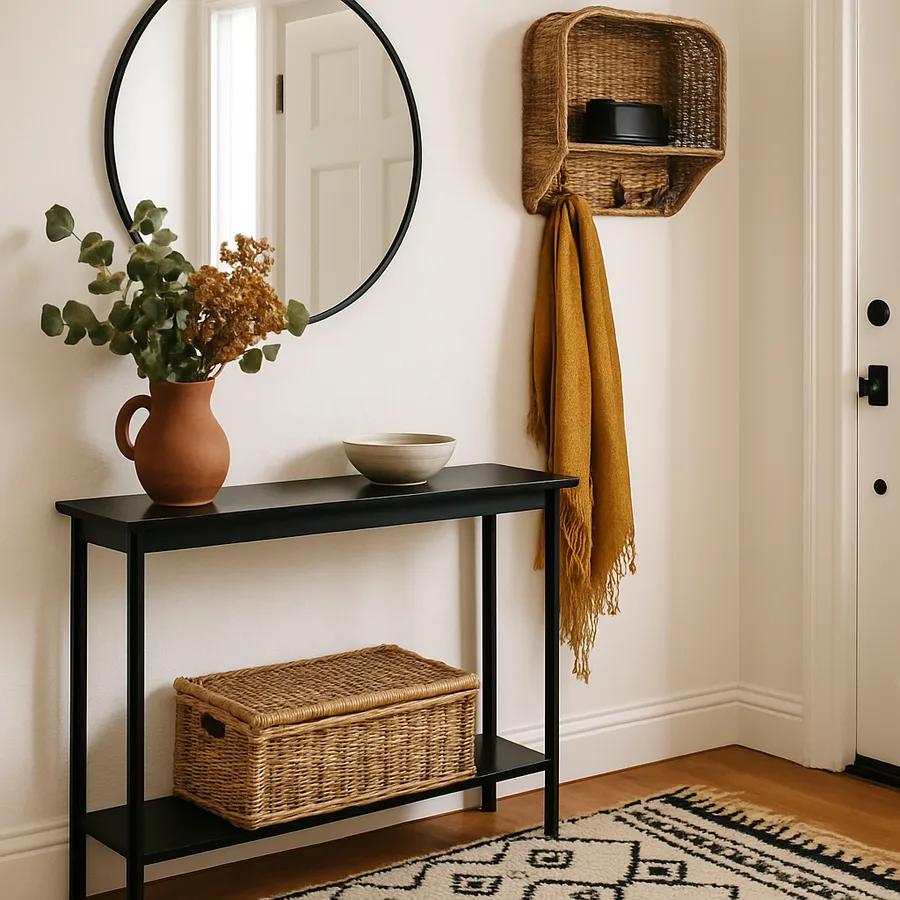
Consider pairing your console table with wall-mounted accessories to expand functionality without consuming floor space. A small row of hooks mounted above the table handles coats and bags. A wall-mounted mail sorter or key rack organizes items that would otherwise land on the table surface. A mirror above the console table serves a practical purpose for last-minute appearance checks while also reflecting light to brighten the foyer. These layered solutions create a complete entryway station within a footprint of just 10 to 12 inches of depth.
Style Approaches That Work in Compact Entryways
Mid-century modern console tables with tapered legs and clean geometric lines are particularly well suited to narrow foyers. Their visual simplicity avoids the heavy, ornate look that can overwhelm a small space. The angled legs create a sense of openness at floor level while the slim rectangular top provides adequate surface area. Walnut and teak are classic material choices for this style, pairing naturally with neutral wall colors and simple artwork.
Industrial-style console tables combine metal frames with reclaimed wood or concrete-effect surfaces for a raw, urban aesthetic. These pieces tend to be structurally minimal, with thin pipe-style legs and open frameworks that maintain visual lightness. The exposed hardware and mixed materials add textural interest to an otherwise plain hallway. This style pairs especially well with exposed brick, concrete floors, or modern loft-style interiors. Better Homes & Gardens has featured industrial consoles as a top pick for small-space entryway styling in multiple seasonal design roundups.
Traditional and transitional styles can work in narrow foyers if you select pieces with refined proportions. A console table with cabriole legs and a shaped apron can feel appropriately elegant without consuming excess space, provided the overall depth stays under 12 inches. White or cream painted finishes brighten the foyer and prevent the piece from feeling heavy. Avoid ornate carvings or bulky turnings on legs, as these details add visual weight that makes narrow spaces feel more constrained.
What style is your home's interior leaning toward? Answering this question narrows your console table search considerably. A mismatched style creates visual friction that is especially noticeable in a foyer because it is the first space visitors encounter. If your living room features Scandinavian minimalism, carrying that same light wood and clean-line aesthetic into the entryway creates a coherent flow. Conversely, if your home embraces traditional warmth, a sleek chrome-and-glass console would feel jarring at the front door.
Lighting and Accessories That Amplify the Effect
A narrow console table reaches its full potential when paired with thoughtful lighting and accessories. A small table lamp placed at one end of the console provides warm, welcoming illumination that greets you as you enter. Battery-operated or rechargeable lamps eliminate the need for a nearby outlet, which is often unavailable in older foyer configurations. The lamp height should be proportional to the console, generally 16 to 22 inches tall, to avoid looking top-heavy on a slim surface.
Mirrors are arguably the most powerful accessory for a tiny foyer. A mirror mounted directly above the console table reflects both natural and artificial light, effectively doubling the perceived brightness and depth of the space. Round mirrors soften the linear quality of a rectangular console, while rectangular mirrors maintain a more structured geometric look. The ASID recommends sizing the mirror to be approximately two-thirds the width of the console table beneath it for balanced proportions.
Decorative objects should be scaled down for a narrow console. A single small vase, a decorative tray for keys, and one framed photo or small piece of art are sufficient. Overcrowding the surface defeats the purpose of having a slim table in the first place. The rule of three, grouping objects in odd numbers, creates visual interest without clutter. Vary the heights of your three items to add dimension: for example, a tall slim vase, a medium-height candle, and a low decorative bowl.
Under-console lighting is a subtle but effective enhancement. A battery-powered LED strip adhered to the underside of the table casts a soft glow on the floor beneath, creating a floating effect that makes the foyer feel more spacious and inviting after dark. Motion-activated strips are especially practical in entryways, turning on automatically when you walk in and shutting off after a set interval. This hands-free convenience means you never fumble for a light switch while carrying groceries or packages through the front door.
Bringing It All Together for Your Foyer
Choosing the right narrow console table for a tiny foyer is a process that rewards careful measurement and honest assessment of your daily habits. Start with precise dimensions of your space, establish your depth limit based on walkway clearance needs, and then filter your options by material durability and storage features. A table that looks stunning in a showroom but blocks your front door or lacks a spot for your keys will become a source of daily frustration rather than a welcoming accent.
The investment need not be large. Quality narrow console tables are available at every price point, from budget-friendly engineered wood models under $150 to handcrafted solid hardwood pieces above $800. What matters more than the price tag is the fit, both physical and stylistic, within your specific foyer. A $200 table that perfectly suits your space will serve you far better than an $800 table that is two inches too deep for comfortable passage.
Remember that the console table is just the foundation of your entryway setup. The mirror, lighting, hooks, and organizational accessories you add around it complete the system and multiply its usefulness. Approach the foyer as a cohesive vignette rather than a single furniture purchase, and even the tiniest entryway can become both functional and beautiful. The National Association of Home Builders reports that well-designed entryways contribute positively to overall home satisfaction scores in post-occupancy surveys.
Grab a tape measure this weekend and record your foyer's dimensions. With those numbers in hand, you can shop with confidence knowing exactly which tables will fit and which ones to skip. Your front door deserves to open onto a space that feels intentional, organized, and unmistakably yours.
More Articles You May Like



Comments
Post a Comment