French Country Kitchen Elements: Open Shelving and Linen Accents
Step One: Understand the Foundation of French Country Style
Before pulling a single item off the shelf or ordering fabric swatches, you need to understand what French country style actually is beneath the surface aesthetics. This is not a style defined by specific products or brand names but by a philosophy of living that prizes comfort, functionality, and beauty in equal measure. Originating in the rural provinces of France, particularly Provence and the Loire Valley, the aesthetic emerged from homes where every object earned its place through daily use. Kitchens in these homes were working spaces first and gathering places second, and the design reflected that practical orientation with open storage, durable materials, and an absence of unnecessary ornament.
The critical distinction between French country and other rustic styles lies in its sense of quiet refinement. Where American farmhouse design tends toward a more rugged, utilitarian sensibility, French country introduces subtle elegance through curved furniture legs, soft color palettes, and carefully chosen textiles. The National Kitchen and Bath Association (NKBA) has documented the enduring popularity of French-inspired kitchen design, noting that it consistently ranks among the top five most-requested kitchen styles in designer surveys. This staying power reflects the style's ability to feel both timeless and personally expressive, adapting to individual tastes without losing its essential character.
Color sets the emotional tone for a French country kitchen. The palette draws from the natural landscape: soft lavender, muted sage, warm cream, faded blue, and weathered white. These are not saturated colors but rather tones that look as though sunlight and time have gently bleached them. Walls are frequently finished in plaster, limewash, or matte paint that absorbs light rather than reflecting it, creating an atmosphere of quiet warmth. Against this restrained backdrop, the kitchen's contents provide color and visual interest through stacked pottery, copper cookware, fresh herbs, and the textiles that are central to the French country identity.
Understanding this foundation matters because it prevents the most common mistake people make when attempting French country design: over-curating. A French country kitchen should look as though it accumulated organically over years of living, not as though everything was purchased during a single shopping trip. The imperfections, the mix of old and new, the slightly mismatched ceramics on the open shelf, these are features rather than flaws. Keeping this principle in mind as you work through the following steps will help ensure that your finished kitchen feels authentic rather than theatrical.
Step Two: Install Open Shelving That Serves and Displays
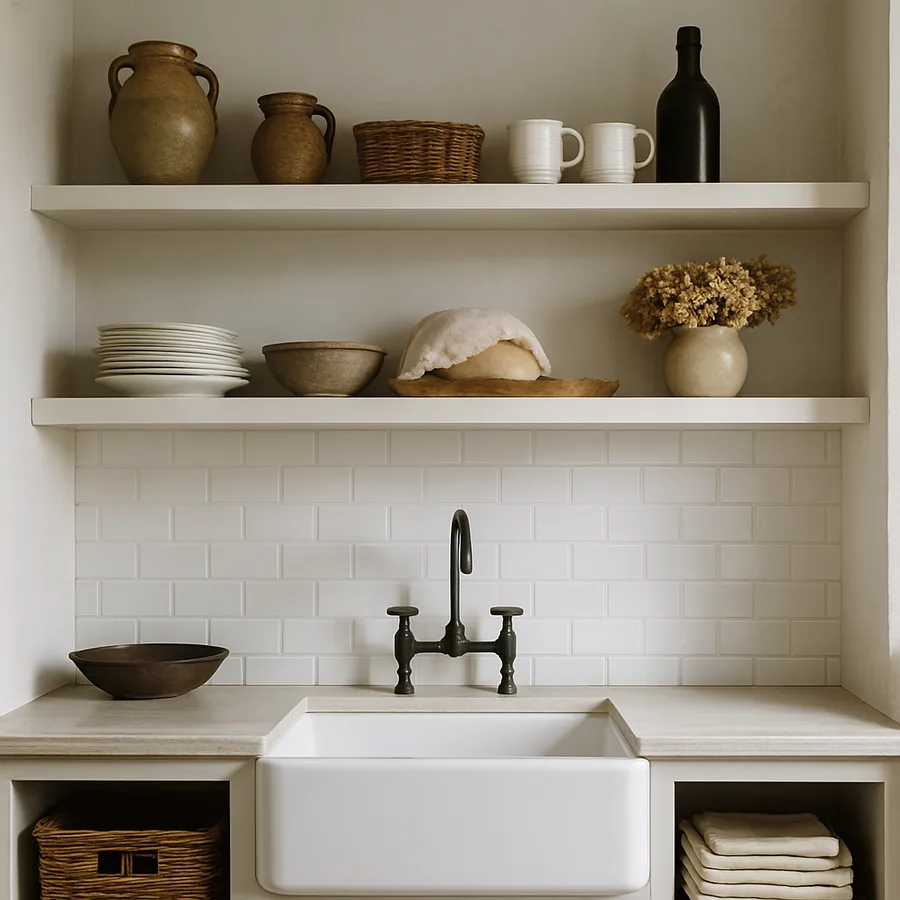
Open shelving is the single most defining feature of a French country kitchen, and getting it right requires attention to both construction and styling. The shelves themselves should look substantial and honestly made. Thick reclaimed wood planks with visible grain and slight imperfections are ideal, though new wood that has been wire-brushed and lightly stained to suggest age works equally well. Avoid thin, sleek floating shelves that read as contemporary, and instead opt for shelves supported by iron brackets, turned wooden corbels, or simple wooden battens that reference traditional joinery. The hardware should feel handmade or at least hand-finished, with wrought iron or aged brass fitting the style far better than polished chrome or matte black.
Placement follows function in a French country kitchen. Shelves flanking the kitchen window create a symmetrical frame that draws the eye and provides easy access to everyday items. A run of shelving above the countertop between base cabinets and the ceiling replaces upper cabinets entirely, opening the kitchen visually and making the room feel larger and more inviting. Better Homes and Gardens has featured numerous French country kitchen renovations where the removal of upper cabinets in favor of open shelving transformed the space from closed and dark to airy and welcoming. The practical trade-off is reduced enclosed storage, which means you need to be thoughtful about what gets displayed and what gets tucked into lower cabinets, a pantry, or a freestanding armoire.
Styling open shelves is where artistry enters the equation. The goal is an arrangement that looks effortless but is actually quite deliberate. Stack plates and bowls in varying sizes, lean a cutting board or small framed print against the wall behind smaller items, and leave some breathing room between groupings so the display does not feel cluttered. French country shelves favor ceramics in cream, white, and soft blue, but mixing in earthenware, wood, and the occasional copper piece adds the visual variety that keeps the eye moving. Fresh herbs in small pots, a glass jar of dried lavender, or a small vase of garden flowers introduce organic elements that reinforce the connection to nature.
What items should you avoid placing on open shelves in a French country kitchen? Anything that looks mass-produced, overly uniform, or aggressively branded will break the spell. Matching sets of identical mugs in bright colors, plastic containers, and small appliances with visible logos all undermine the handcrafted, collected-over-time quality that defines the style. Reserve open shelving for your most beautiful everyday pieces, the hand-thrown pottery, the vintage transferware, the simple glass jars filled with staples, and keep everything else behind closed doors. This editing process is essential and ongoing; the shelves should evolve as you acquire new pieces and retire others.
Step Three: Introduce Linen as a Foundational Textile
Linen is to French country design what leather is to a gentleman's study: the defining textile that sets the sensory tone for the entire space. Made from flax fibers, linen has been produced in France for centuries, with the northern regions of Normandy and Flanders historically serving as major production centers. The material's slightly rough texture, natural drape, and ability to soften with washing make it uniquely suited to kitchen use. Unlike cotton, which can look flat and uniform, linen carries a visual depth created by its uneven fiber structure, catching light differently across its surface and developing a beautiful patina over time.
The most impactful way to introduce linen into a French country kitchen is through window treatments. Simple linen cafe curtains covering the lower half of a window provide privacy while allowing light to flood in from above, a treatment seen throughout rural France. Full-length linen panels in a natural oatmeal or soft white, hung from an iron rod with ring clips, create a softer frame for the window that billows gently with a breeze. Avoid heavy pleating or elaborate valances; the beauty of linen curtains lies in their relaxed, slightly rumpled fall. The American Society of Interior Designers (ASID) has identified natural fiber textiles as a leading specification trend in residential projects, reflecting broader consumer interest in sustainable, tactile materials.
Beyond curtains, linen appears throughout the French country kitchen in smaller but equally important roles. Dish towels in ticking stripes or simple monogrammed designs hang from brass hooks or a wooden rail near the sink. A linen table runner in a muted check pattern dresses a farmhouse table without hiding its wooden surface. Seat cushions on rush-seated chairs gain comfort and visual warmth from linen covers in faded florals or solid earth tones. Even a simple linen bread bag hanging from a shelf peg contributes to the layered textile quality that distinguishes French country from styles that rely more heavily on hard surfaces.
Where do you find quality linen that suits this aesthetic? Specialty European textile companies like Libeco, a Belgian manufacturer with roots stretching back to the nineteenth century, produce kitchen and table linens specifically designed for this kind of application. French companies including Linge Particulier offer pre-washed linen in a range of muted colors that arrives already soft and slightly crinkled, eliminating the stiff formality of brand-new fabric. Vintage and antique linen, found at estate sales, brocantes, and specialty dealers, carries an authenticity that new fabric cannot replicate. A well-worn monogrammed linen towel from a French flea market tells a story that no retail purchase can match.
Step Four: Layer Natural Materials and Vintage Finds
With open shelving and linen in place, the next step is building out the kitchen's material palette with complementary natural elements. Copper cookware is perhaps the most iconic French country kitchen accessory, and a few well-chosen pieces hung from a wall-mounted pot rack or arranged on a shelf add warmth and visual weight that balances the lighter tones of linen and ceramics. You do not need a complete matching set; in fact, a mix of old and new copper pieces in varying sizes and patina levels looks more authentic. French manufacturers like Mauviel, which has been producing copper cookware in Villedieu-les-Poeles since the mid-nineteenth century, remain the gold standard for both function and beauty.
Wood surfaces deserve careful consideration in a French country kitchen. The countertops might include at least one section of butcher block for food preparation, ideally in a thick, end-grain configuration that develops character with use. A large wooden cutting board propped against the backsplash serves as both tool and decor. Wooden spoons and utensils stored upright in a stoneware crock on the counter add a working-kitchen authenticity that styled photography sometimes misses. The wood should look used and loved rather than pristine; a brand-new butcher block benefits from several months of regular oiling and use before it achieves the warm golden tone that French country design calls for.
According to a report by the National Association of Home Builders (NAHB), approximately sixty-five percent of homebuyers express preference for kitchens that incorporate natural materials over those dominated by synthetic surfaces. This preference aligns perfectly with French country principles, which favor stone, wood, iron, ceramic, and textile over plastic, laminate, and stainless steel. A stone or terracotta floor, a farmhouse sink in fireclay, iron cabinet pulls with a hand-forged look, and walls finished in breathable plaster or limewash all contribute to the material honesty that defines the style.
Vintage and antique finds provide the final layer of personality. A salvaged wooden bread board, an antique scale, a collection of old glass bottles arranged on a windowsill, a wire basket filled with eggs or produce: these objects carry histories that new items cannot. French brocante markets and their American equivalents, from estate sales to curated vintage shops, are the best sources for these kinds of pieces. The rule of thumb is to choose objects that you would actually use or that represent something you value, rather than collecting decorative items for their own sake. Does a piece spark recognition, as though it belongs in a kitchen you have always imagined? That intuitive response is usually a reliable guide.
Step Five: Address Lighting, Hardware, and Finishing Details
Lighting in a French country kitchen should feel warm, layered, and slightly imperfect. A central pendant or pair of pendants over an island or table provides ambient illumination, with wrought iron, aged brass, or wooden fixtures fitting the style best. Avoid anything too polished, too industrial, or too overtly modern; a simple iron chandelier with candle-style bulbs or a single large lantern pendant creates the right atmosphere. Architectural Digest has repeatedly highlighted the importance of lighting temperature in achieving French country warmth, recommending bulbs in the 2700K range that cast the golden glow associated with late afternoon sunlight in Provence.
Under-cabinet lighting is a practical necessity that needs to be handled thoughtfully so it does not introduce a harsh, clinical quality. Warm LED strips hidden behind a small valance or the shelf's front edge provide task illumination without visible hardware. Natural light remains the most important light source in any French country kitchen, so window treatments should maximize daylight hours. If your kitchen has limited window area, consider adding a window during renovation or installing a glass-paneled door that brings in borrowed light from an adjacent room or outdoor space.
Cabinet hardware is a small detail with outsized impact. Iron pulls and knobs with a matte, hand-forged appearance are the most traditional choice, while cup pulls in aged brass offer a slightly warmer alternative. Ceramic knobs in white or cream, sometimes with a simple blue motif, reference traditional French faience pottery and add a delicate accent to painted cabinetry. Whatever you choose, consistency matters less than quality: mixing two or three complementary hardware styles across different cabinet types, pulls on drawers and knobs on doors, for example, creates the collected-over-time quality that French country demands.
The backsplash provides a final opportunity to reinforce the style. Hand-shaped terracotta tiles, reclaimed encaustic cement tiles in muted geometric patterns, or a simple lime-plastered wall all serve the aesthetic faithfully. Subway tile, while popular, reads as more American farmhouse than French country unless it is laid in an irregular pattern with wide grout lines that suggest age. The grout color itself matters: a warm gray or sandy tone ages more convincingly than bright white, which can look too clean and new for the lived-in quality the style pursues.
Step Six: Bring the Outdoors In With Garden Elements
No French country kitchen is complete without a strong connection to the garden and the natural world beyond its walls. Fresh flowers, even a simple bunch of wildflowers or a few stems of rosemary in a stoneware jar, bridge the gap between indoor and outdoor living in a way that feels quintessentially French. Potted herbs on the windowsill serve double duty as both decoration and cooking ingredients, with basil, thyme, lavender, and rosemary being the most traditional choices. A kitchen garden visible through the window extends the living space visually and reinforces the farm-to-table ethos that is central to French country life.
Dried botanicals provide year-round interest when fresh flowers are not available. Bundles of dried lavender, hanging from a hook or tucked into a pitcher on the shelf, are perhaps the most iconic French country decorative element. Dried hydrangeas in muted blues and greens, wheat sheaves, and bay laurel branches all contribute seasonal texture without requiring the maintenance that living plants demand. These dried elements should be replaced periodically as they fade and become dusty, typically every three to six months, to maintain a fresh appearance that reflects genuine care rather than neglect.
The practice of displaying food as decoration is deeply rooted in French country tradition and deserves a place in your kitchen. A wire basket of fresh eggs on the counter, a wooden bowl of seasonal fruit, a glass jar of preserved vegetables, or a wheel of cheese under a glass cloche all serve as edible still lifes that celebrate the kitchen's primary purpose. This approach requires a commitment to using and replenishing these displays, which naturally encourages a rhythm of regular market visits and seasonal eating that is itself a core part of the French country lifestyle.
Have you noticed how the most compelling French country kitchens seem to blur the line between indoors and out? This is not accidental but the result of deliberate choices: natural materials on every surface, living plants and dried botanicals throughout, food on display, and views of greenery through generous windows. The kitchen becomes not a sealed box for food preparation but a permeable space where nature is always present. Achieving this quality in your own kitchen may be as simple as adding a few herbs to the windowsill and propping open the back door, or as involved as redesigning the window configuration to maximize garden views.
Conclusion: Building a French Country Kitchen That Lasts
Creating a French country kitchen with open shelving and linen accents is not a weekend project but an evolving process that rewards patience, intentionality, and a willingness to let the space develop character over time. The steps outlined here, from understanding the style's philosophical foundation to layering materials, textiles, and garden elements, provide a roadmap that you can follow at your own pace. The most authentic French country kitchens were not designed in a single burst of activity but assembled gradually as their owners discovered pieces, refined their tastes, and let the space grow into its personality.
The practical benefits of this approach extend beyond aesthetics. Open shelving encourages mindful ownership, keeping only what you use and love rather than accumulating forgotten items behind closed doors. Linen textiles become softer and more beautiful with each washing. Copper develops a richer patina with use. The entire kitchen improves with age rather than declining, which stands in sharp contrast to trend-driven designs that feel dated within a few years. The NKBA reports that kitchens designed around timeless principles rather than fleeting trends deliver significantly higher owner satisfaction over a ten-year period, a statistic that validates the French country approach.
Begin with a single step that excites you most: install one run of open shelves and style them with your best ceramics, or replace your synthetic dish towels with a set of quality linen ones. Each change will inform the next, and within months you will find your kitchen taking on the warm, lived-in quality that makes French country design so enduringly appealing. The goal is not a magazine-ready showpiece but a kitchen that invites you to cook, gather, and linger, one that feels like home in the deepest sense of the word.
Take your first step this week: choose one element from this guide, whether it is a set of linen towels or a pair of reclaimed wood shelves, and introduce it into your kitchen. Notice how even a single authentic piece shifts the room's energy, and let that observation guide your next move.
More Articles You May Like



Comments
Post a Comment