LED Closet Light Bars That Turn On When the Door Opens
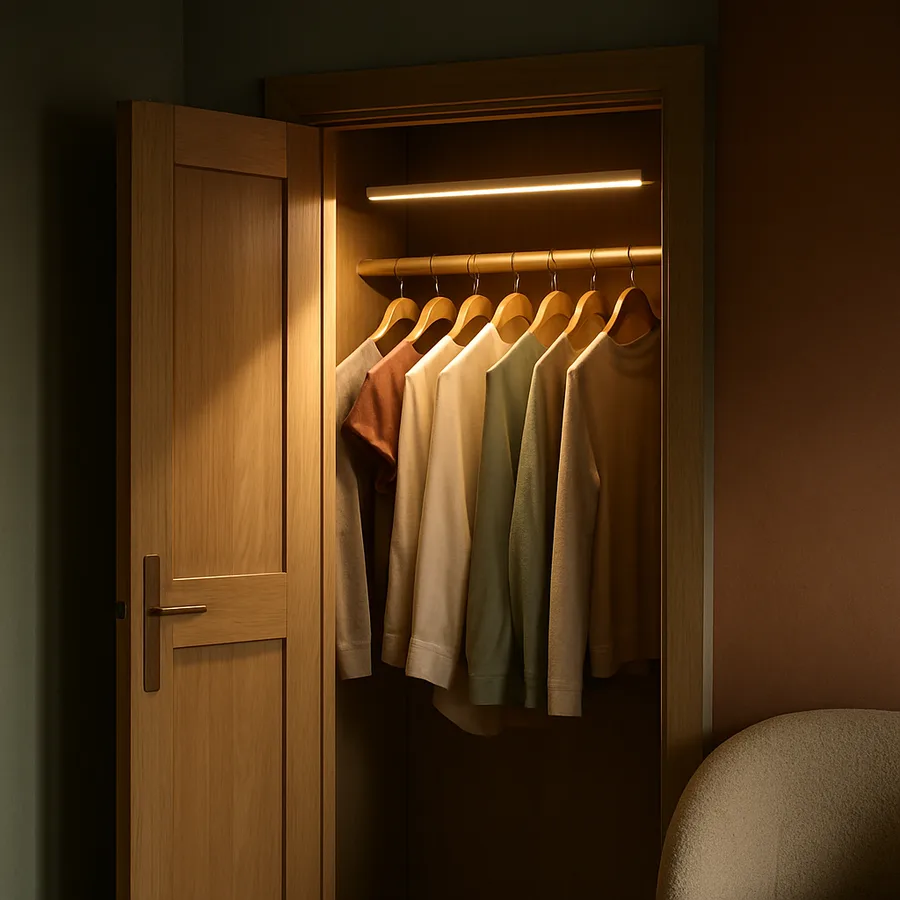
Walking into a dimly lit closet and fumbling through stacked sweaters and hanging shirts is a universal frustration that most homeowners tolerate far longer than they should. The solution is remarkably simple and increasingly affordable: LED closet light bars equipped with magnetic door-activated switches that illuminate the moment you open the closet door and shut off automatically when the door closes. These compact fixtures have transformed closet lighting from a luxury renovation add-on into an accessible upgrade that requires no electrician, no wall fishing, and in many cases no tools beyond an adhesive strip. According to the American Lighting Association, residential LED fixture sales grew by 38 percent between 2021 and 2024, with closet and cabinet applications driving a significant share of that growth as homeowners discovered the dramatic difference that targeted interior lighting makes in daily convenience and garment care.
How Door-Activated LED Light Bars Work
The mechanism behind door-activated LED closet light bars is elegant in its simplicity. A small magnetic reed switch embedded in the fixture detects the proximity of a magnet mounted on the closet door frame or the door itself. When the door is closed, the magnet holds the reed switch in its off position, keeping the light dormant and preserving battery life. The instant the door swings open and the magnet separates from the switch by more than approximately half an inch, the circuit closes and the LEDs illuminate at full brightness with no perceptible delay. This magnetic switching mechanism has been used in security systems and industrial applications for decades and is exceptionally reliable, with most quality reed switches rated for over 100,000 cycles before any degradation in performance.
The LED modules themselves are typically arranged in a linear strip along a slim aluminum or polycarbonate housing, producing a wide, even wash of light that minimizes harsh shadows across the closet interior. Most quality units deliver between 200 and 400 lumens per bar, which is comparable to a 25-to-40-watt incandescent bulb but concentrated in a directional beam that targets shelves and hanging rods rather than wasting light on the closet ceiling. Color temperature varies by manufacturer, but the most popular options fall in the 4000K to 5000K range, a neutral to cool white that renders fabric colors accurately without the yellowish cast of warm bulbs or the clinical harshness of daylight-rated fixtures. Accurate color rendering is particularly important in closets, where distinguishing between navy and black garments or matching coordinating pieces depends entirely on the quality of the light source.
Power sources for door-activated LED light bars fall into three categories: disposable batteries, rechargeable lithium-ion cells, and hardwired connections. Battery-operated units are the most popular for retrofit applications because they eliminate the need for any electrical work. A typical unit running on three AAA batteries provides approximately 80 to 120 hours of cumulative illumination, which translates to several months of normal use when the door-activated switch limits run time to actual closet visits. Rechargeable models with built-in lithium cells offer the convenience of USB charging, usually requiring a recharge every four to eight weeks depending on usage frequency. Hardwired options connect to existing closet electrical circuits and are the preferred choice for new construction or major renovations where an electrician is already on site.
The adhesive mounting system used by most battery and rechargeable models deserves specific attention because it determines whether the installation remains secure over time. Premium units use 3M VHB (Very High Bond) tape, an industrial-grade adhesive that bonds permanently to smooth surfaces and supports several pounds of static weight. Budget models often substitute generic foam tape that loses adhesion in the warm, enclosed environment of a closet within a few months, eventually resulting in the light bar falling onto clothing or shelves. When evaluating products, checking the adhesive specification is a more reliable predictor of long-term satisfaction than reading lumens or battery life claims, because a light bar that falls off its mounting is useless regardless of its other specifications.
Choosing the Right Light Bar for Different Closet Types
Closet dimensions and configuration determine which style and size of LED light bar will deliver the best illumination results, and the differences between closet types are significant enough that a one-size-fits-all approach almost always underperforms. A standard reach-in closet with bifold or sliding doors and a single hanging rod typically measures 24 to 36 inches wide and 24 inches deep. For this configuration, a single light bar between 12 and 20 inches long, mounted on the header above the door opening and angled slightly downward, provides sufficient illumination across the entire interior. The relatively shallow depth means that a single front-mounted fixture eliminates the shadow zones that would occur in a deeper space.
Walk-in closets present a fundamentally different lighting challenge because their depth, multiple walls, and L-shaped or U-shaped layouts create zones that a single fixture cannot reach. A walk-in closet measuring six by eight feet requires a minimum of two light bars to avoid dark pockets, and three bars positioned to illuminate each wall of hanging and shelving is the configuration most often recommended by closet designers. In walk-in applications, motion sensor activation may be more practical than door-activated switches, since the closet door is often left open while the user moves between zones selecting garments. However, if the walk-in has a standard hinged door that the homeowner habitually closes, door-activated bars remain a viable and cost-effective option when positioned to cover the primary dressing and selection zones near the entrance.
Linen closets and pantry-style utility closets benefit from LED light bars positioned on the underside of each shelf rather than on the header above the door. This under-shelf mounting approach places the light source directly above the items stored on the shelf below, eliminating the shadows that overhead lighting casts when tall items on upper shelves block light from reaching lower levels. Under-shelf light bars are typically shorter, between 6 and 12 inches, and are available in slim profiles that do not interfere with items stored on the shelf above. For a five-shelf linen closet, four under-shelf light bars connected to a single door-activated switch provide dramatically better visibility than any single overhead fixture could achieve.
Have you measured your closet dimensions and identified where shadows currently make it difficult to see clothing colors and labels accurately? Spending five minutes with a tape measure and noting the dark spots in your closet under its current lighting conditions will tell you exactly how many light bars you need and where each one should be positioned for maximum coverage. This simple assessment prevents the common mistake of purchasing a single light bar for a closet that needs two or three fixtures to achieve complete illumination.
Installation Methods That Preserve Your Closet Surfaces
One of the most appealing aspects of LED closet light bars is that most models install without drilling, screwing, or making any permanent modifications to the closet interior. The standard adhesive mounting process begins with cleaning the target surface with isopropyl alcohol to remove dust, oils, and any residue that would weaken the bond. After allowing the surface to dry completely, the homeowner peels the backing from the adhesive strip on the light bar, presses the fixture firmly against the mounting surface for 30 seconds, and waits 24 hours before applying any load. This waiting period allows the adhesive to develop its full bond strength, and rushing this step is the most common cause of premature mounting failures. The Better Homes and Gardens home improvement editors recommend performing adhesive installations in temperatures above 60 degrees Fahrenheit, because most construction adhesives cure poorly in cold conditions.
For homeowners who want a more secure mounting or who need to install on textured surfaces where adhesive performs poorly, magnetic mounting systems offer a versatile alternative. These systems use a steel mounting plate that attaches to the closet surface with screws or adhesive, and the light bar itself contains embedded magnets that snap onto the plate. The magnetic connection is strong enough to hold the light bar firmly during normal use but allows easy removal for battery replacement or recharging. This approach also enables the homeowner to reposition the light bar between different mounting plates, which is useful in closets where seasonal wardrobe changes alter the optimal lighting position.
Hardwired installations require a licensed electrician and are most cost-effective when performed during new construction or a closet renovation that already includes electrical work. The electrician installs a junction box in the closet header or wall, connects the light bar to household wiring, and integrates the door-activated switch into the circuit. The advantage of hardwired installation is the elimination of batteries entirely: the light bar draws power continuously from the home's electrical system and the door switch simply interrupts the circuit when the door is closed. The National Electrical Code (NEC) requires that closet lighting fixtures maintain specific clearances from stored combustible materials, with surface-mounted fixtures requiring a minimum 12-inch clearance from the nearest shelf or rod. LED light bars generate minimal heat compared to incandescent fixtures, but the clearance requirements still apply and should be verified with the electrician before selecting mounting locations.
Regardless of the mounting method, cable management for rechargeable units deserves attention during installation. Models with USB charging ports require periodic access to the charging port, which means the light bar must be positioned so that a charging cable can reach the port without requiring the unit to be completely removed from its mount. Some manufacturers address this by placing the USB port at one end of the bar and including a short charging cable that plugs in while the unit remains mounted. Others require removal for charging, which means the adhesive or magnetic mount must support repeated attach-detach cycles without degradation. Checking the charging procedure before purchasing avoids the frustration of discovering that the light bar's excellent illumination comes with an inconvenient recharging process.
Color Temperature and Color Rendering: Why They Matter in a Closet
The color temperature of a light source, measured in Kelvin (K), determines whether light appears warm and yellowish or cool and bluish, and this seemingly technical specification has a direct practical impact on how effectively you can select and coordinate clothing in your closet. Warm white light in the 2700K to 3000K range, the standard for residential living spaces, creates a cozy ambiance but shifts fabric colors toward the yellow-orange end of the spectrum. A navy blazer under warm white light can look nearly identical to a charcoal blazer, and matching brown shoes to a brown belt becomes a guessing game when both items are bathed in amber-tinted illumination. This color distortion is why experienced closet designers and the National Kitchen and Bath Association recommend neutral to cool white light sources between 4000K and 5000K for closet and dressing room applications.
The Color Rendering Index (CRI) is an equally important but less widely understood specification that measures how accurately a light source reveals the true colors of objects compared to natural sunlight. CRI is rated on a scale of 0 to 100, with 100 representing perfect color accuracy. Most standard LED light bars carry a CRI between 80 and 85, which is adequate for general illumination but noticeably inferior to high-CRI alternatives in a closet context. Premium LED light bars with a CRI of 90 or above render subtle color differences, such as the distinction between burgundy and maroon or between cream and ivory, with significantly greater fidelity. The price premium for high-CRI LED modules is typically 15 to 25 percent above standard CRI options, a modest investment that pays dividends every morning when you can confidently select coordinating garments without carrying them to a window for color verification.
The interaction between color temperature and CRI creates a combined effect on perceived color accuracy. A light bar with a 4500K color temperature and a CRI of 93 will render a closet full of clothing in colors that closely approximate how those garments will look in daylight conditions, which is ultimately the lighting environment where most clothing is worn and seen by others. According to the Illuminating Engineering Society (IES), the recommended minimum CRI for any application where color discrimination is important, including retail, medical, and residential dressing areas, is 90. This professional standard provides a useful benchmark for homeowners selecting closet lighting, because the IES recommendation is based on extensive research into human visual perception rather than marketing claims.
Does the current lighting in your closet allow you to accurately distinguish between similar dark colors like navy and black without carrying garments to a window or another room for verification? If you find yourself regularly discovering color mismatches after leaving the house, upgrading to a high-CRI, neutral-white LED light bar will solve the problem more effectively and permanently than any organizational strategy or labeling system. The few seconds of accurate color assessment that proper closet lighting enables each morning compound into significant time savings over weeks and months of daily wardrobe decisions.
Battery Life Optimization and Maintenance Strategies
Maximizing the operational life of battery-powered LED closet light bars requires understanding the factors that drain power and implementing simple habits that extend the interval between battery replacements or recharges. The door-activated magnetic switch is the single most important power-saving feature, because it ensures the light operates only when the closet is actually in use. A well-functioning magnetic switch reduces cumulative run time to approximately 15 to 30 minutes per day in a typical household, compared to the hours of unnecessary operation that result from a light left on by a manual switch. Verifying that the magnetic switch is properly aligned during installation, with the magnet positioned close enough to the reed switch to achieve reliable shutoff when the door closes, is the most impactful maintenance step a homeowner can take.
Battery chemistry affects both capacity and longevity in ways that matter for closet light applications. Alkaline batteries are the least expensive option but suffer from voltage sag as they discharge, which means the light output gradually dims over the final 20 to 30 percent of the battery's life before the fixture shuts off entirely. Lithium primary batteries (non-rechargeable lithium cells like Energizer Ultimate Lithium) maintain nearly constant voltage throughout their discharge cycle, delivering consistent brightness until they are almost completely depleted. They also perform better in temperature extremes and have a shelf life of 15 to 20 years, making them the preferred choice for light bars in closets that are used infrequently, such as guest room or seasonal storage closets. The higher per-unit cost of lithium batteries is offset by their longer service life, typically two to three times that of alkaline cells in the same application.
Rechargeable models with built-in lithium-ion cells introduce a different maintenance consideration: the long-term degradation of the rechargeable battery itself. All lithium-ion batteries lose capacity with each charge cycle, typically retaining about 80 percent of their original capacity after 300 to 500 full charge cycles. For a closet light bar that is recharged monthly, this translates to approximately 25 to 40 years before the battery capacity drops to a level that noticeably affects performance, which effectively means the battery will outlast the fixture in nearly all cases. However, storing the unit at extreme temperatures or consistently draining the battery to zero before recharging accelerates degradation. Charging the light bar when it reaches approximately 20 percent capacity rather than waiting for complete depletion extends the battery's useful life significantly.
Routine maintenance beyond battery management is minimal but worth scheduling. Wiping the LED lens cover with a soft cloth every few months removes the thin film of dust and fabric lint that accumulates in closet environments and can reduce light output by 10 to 15 percent over time. Checking the adhesive mount for any signs of loosening, particularly during seasonal transitions when temperature and humidity changes can stress adhesive bonds, prevents the inconvenience of a fixture falling onto stored clothing. For units with rechargeable batteries, keeping the USB charging port free of lint buildup ensures reliable connections during recharging. These simple maintenance tasks take less than five minutes per quarter and keep the light bar performing at its rated specifications for the full duration of its expected service life.
Integrating LED Light Bars with a Complete Closet Organization System
LED closet light bars deliver their maximum benefit when they are part of a thoughtfully designed closet organization system rather than an isolated afterthought added to a cluttered space. The relationship between lighting and organization is reciprocal: good lighting makes an organized closet easier to use, and a well-organized closet makes the most efficient use of the available light. Beginning with the organization system and then positioning light bars to illuminate the specific zones where garments and accessories are stored produces dramatically better results than mounting lights in a closet that lacks a coherent organizational structure. The Houzz Kitchen and Closet Study found that 78 percent of homeowners who invested in closet organization systems reported using more of their wardrobe regularly, and the addition of targeted interior lighting was cited as the feature that most increased their satisfaction with the completed system.
The vertical zones of a closet, typically divided into long-hang, short-hang, and shelving or drawer sections, each benefit from different light bar placement. Long-hang zones for dresses, coats, and full-length garments need light from above that extends deep enough to illuminate items at the back of the rod. Short-hang zones for shirts, blazers, and folded pants benefit from a light bar positioned at the top of the zone so that light falls across the shoulders and collar area of each garment, which is the region most important for identifying items at a glance. Shelving zones for folded knitwear, handbags, and accessories perform best with under-shelf lighting that eliminates the shadows cast by items stacked on upper shelves. A three-zone closet with three appropriately positioned light bars consumes no more power than a single unit, because the door-activated switch controls all bars simultaneously, and the visual improvement over a single overhead fixture is transformative.
Shoe storage areas are frequently the most poorly illuminated section of any closet, partly because shoes are stored at floor level where overhead light cannot penetrate and partly because shoe storage configurations, whether angled racks, cubbies, or floor-level shelves, create dense shadow patterns. A short LED light bar mounted on the underside of the lowest shelf above the shoe area, or a flexible LED strip adhered to the inside edge of a shoe rack, addresses this dark zone without requiring a separate switch or power source. Connecting this additional fixture to the same door-activated switch as the primary light bars ensures that the shoe area illuminates simultaneously with the rest of the closet, making it possible to coordinate footwear with the selected outfit without bending down and squinting into a shadowed corner.
Consider installing LED closet light bars as the final step in any closet reorganization project, positioning each fixture to illuminate the specific zones you have created rather than relying on a single overhead light to cover a redesigned space. The combination of purposeful organization and targeted lighting produces a closet that functions more like a well-designed retail display than a residential storage space, making daily wardrobe selection faster, more accurate, and genuinely enjoyable.
Conclusion
Measure each closet in your home this weekend, note the dark spots where you struggle to identify garment colors, and purchase one LED light bar for the closet you use most frequently to experience the difference before committing to a whole-home installation.
LED closet light bars with door-activated switches represent one of the highest-impact, lowest-effort upgrades available to homeowners who want to improve their daily routines without undertaking a major renovation. The combination of automatic activation, accurate color rendering, and adhesive mounting means that any closet in the home can go from frustrating darkness to professional-grade illumination in less than fifteen minutes and for less than the cost of a casual dinner out. The technology behind these fixtures, from the magnetic reed switch to the high-CRI LED modules, is mature, reliable, and specifically engineered for the enclosed, low-use environment of a residential closet.
The practical benefits extend beyond mere convenience into the preservation of clothing investments and the reduction of daily decision fatigue. When every garment in the closet is clearly visible and accurately color-rendered, wardrobe selections happen faster and with greater confidence. Forgotten items buried in dark corners get reintegrated into regular rotation. Damage from fumbling through stacks in poor light is eliminated. These incremental daily improvements, compounded over months and years, justify an investment that typically ranges from $15 to $50 per fixture.
The closet is the first functional space most people interact with each morning and the last one they use each evening, which gives it an outsized influence on daily mood and efficiency despite its modest square footage. Treating closet lighting as a genuine design decision rather than an afterthought acknowledges this influence and addresses it with a solution that is proportionate in cost, effort, and complexity. Whether you install a single light bar in a reach-in coat closet or outfit an entire walk-in with a multi-zone system, the improvement in visibility, usability, and daily satisfaction is immediate and lasting.
More Articles You May Like



Comments
Post a Comment