Window Film for Privacy Without Blocking Natural Light
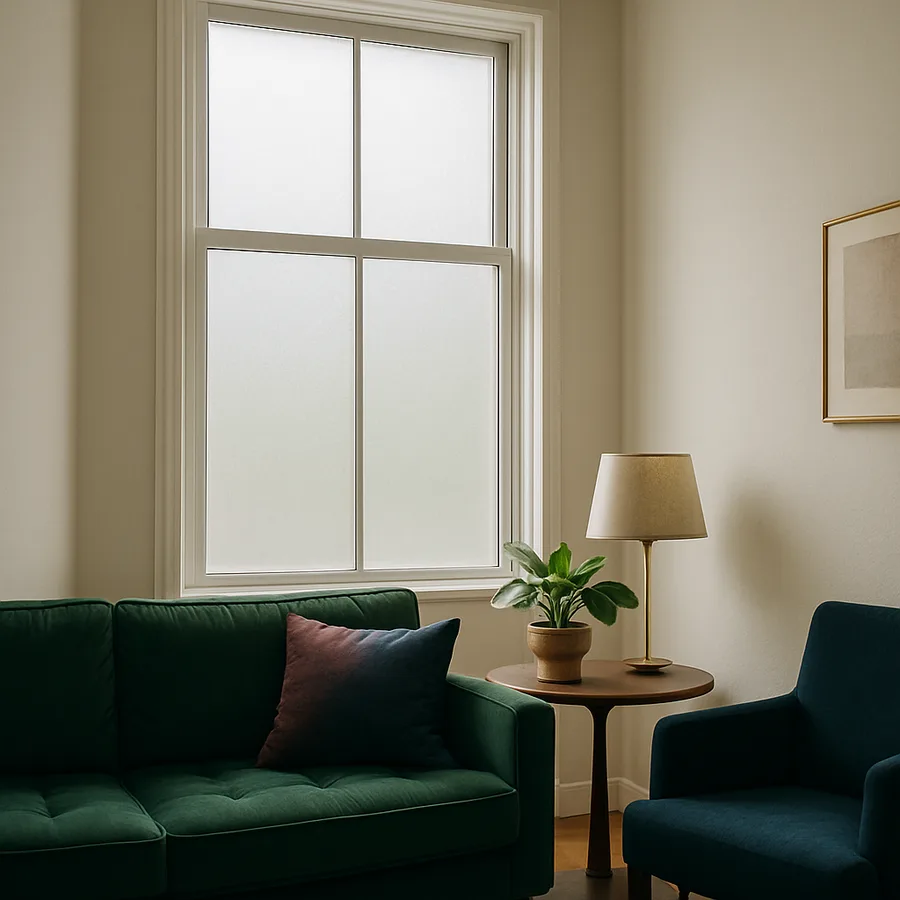
The Privacy Problem That Window Film Solves Better Than Curtains
Every ground-floor room with street-facing windows presents the same dilemma: you want natural light flooding the interior, but you also want to move through your home without feeling observed by pedestrians, neighbors, or delivery drivers who happen to glance toward your glass. Traditional solutions like curtains, blinds, and shutters address privacy by blocking the view, but they block light at the same time, forcing you to choose between a bright room where you feel exposed and a private room that feels like a basement. Window film breaks this trade-off by modifying the glass itself, allowing light to pass through while obscuring the view from outside, so you get both brightness and seclusion from a single transparent layer that is thinner than a credit card.
The technology works by altering how light interacts with the glass surface. Different film types use different optical principles, from light diffusion to reflective coating to micro-etching, but they all achieve the same fundamental outcome: light transmission with view obstruction. A well-chosen window film allows 50 to 80 percent of visible light to enter the room while reducing exterior visibility by 80 to 100 percent, depending on the film type and the lighting conditions on each side of the glass. No curtain or blind can match this ratio of light to privacy because fabric-based treatments work by physically blocking the window opening, which blocks light and view indiscriminately.
Window film also preserves the architectural lines of the window itself, which is an aesthetic advantage that designers value highly. Curtains add fabric bulk to the window wall and project into the room. Blinds add horizontal or vertical hardware lines that compete with the glass. Film adds nothing visible from across the room; the window retains its original proportions and framing, and the glass simply appears subtly different in finish. In minimalist and modern interiors where clean lines and uncluttered surfaces are foundational design principles, window film provides privacy without adding any visual element that was not already part of the architecture.
According to the International Window Film Association (IWFA), the residential window film market has grown at approximately 8 percent annually over the past five years, driven primarily by privacy applications in urban and suburban homes where lot sizes have decreased and window-to-neighbor distances have shrunk. The American Society of Interior Designers has identified window film as one of the fastest-growing categories in residential interior specification, noting that younger homeowners in particular prefer the clean, hardware-free aesthetic of film over traditional window treatments for privacy-critical windows.
Frosted Film: The Most Popular Privacy Solution and How It Performs
Frosted window film replicates the appearance of acid-etched or sandblasted glass at a fraction of the cost, creating a translucent surface that scatters incoming light into a soft, even glow while completely obscuring the view through the glass from both sides. The film itself is a thin polyester sheet with a microscopically textured surface that diffuses light rather than transmitting it in straight lines, which is why objects on the other side of the glass appear as blurred shapes without discernible detail. Frosted film provides the same level of privacy during the day and at night, regardless of which side has more light, making it the most reliable privacy film for any window that needs consistent obscurity around the clock.
Light transmission through frosted film typically ranges from 70 to 85 percent, which means the room behind a frosted window receives nearly as much total light as an untreated window. The character of that light changes significantly, however. Direct sunlight passing through frosted film becomes diffused, eliminating the sharp shadow lines and bright hotspots that clear glass produces and replacing them with a soft, even illumination that interior photographers and designers describe as similar to north-facing light. This diffused quality can actually improve the perceived brightness of a room by distributing light more uniformly across walls and ceilings, even though the total light energy entering the room is slightly reduced. Rooms with harsh afternoon sun often feel more comfortable with frosted film because the glare is tamed without dimming the space.
Frosted film is available in full-coverage and partial-coverage configurations that serve different privacy needs. Full-coverage frosted film, applied to the entire glass surface, provides maximum privacy but eliminates any view through the window, which can feel isolating in rooms where a connection to the outdoors matters. Partial-coverage applications, such as a frosted band covering the lower two-thirds of the window while leaving the upper third clear, allow light and sky views through the top while blocking sightlines at eye level where privacy is most needed. This banded approach is especially popular for bathroom windows, front doors with sidelights, and ground-floor living spaces where the lower portion of the glass faces pedestrian traffic and the upper portion faces only sky and treetops.
Installation of frosted film is a straightforward DIY project that requires a spray bottle with soapy water, a squeegee, a utility knife, and approximately 30 minutes per standard window. The film is applied to the interior surface of clean glass using the soapy water as a lubricant that allows repositioning before the film adheres. Once positioned, the squeegee pushes out water and air bubbles, and the film bonds to the glass through static adhesion and a light adhesive layer. Most quality frosted films can be removed without residue by peeling them off the glass, making window film a renter-friendly privacy solution that does not damage the window or require landlord approval in most situations. The National Apartment Association lists removable window film among the approved temporary modifications in their model lease addendum for tenant improvements.
Decorative and Patterned Films for Style-Conscious Privacy
Frosted film is the functional baseline, but the decorative film category has expanded enormously to include patterns, textures, and designs that provide privacy while simultaneously serving as an artistic element in the room. Geometric patterned films use repeating motifs like hexagons, chevrons, diamonds, or abstract linear patterns printed or etched into the film surface, creating areas of frosted opacity separated by narrow clear lines that allow glimpses of light and color without compromising privacy. These patterned films appeal to homeowners who want their privacy treatment to contribute visual interest to the room rather than simply obscuring the glass with a uniform frost.
Stained glass window films reproduce the leaded-glass appearance of traditional stained glass panels using translucent colored vinyl overlays that transmit colored light into the interior. These films range from faithful reproductions of Victorian and Art Nouveau patterns to contemporary abstract designs with bold color blocking. When sunlight passes through a stained glass film, it projects colored light patterns onto interior walls and floors that shift throughout the day as the sun angle changes, creating a dynamic decorative effect that no other window treatment can produce. The privacy performance of stained glass films varies depending on the density and saturation of the colors: darker, more saturated designs provide strong privacy, while lighter, more transparent designs provide moderate privacy with greater light transmission.
Textured films that replicate the appearance of specific materials, such as rice paper, hammered glass, water droplets, or woven linen, offer privacy through surface distortion rather than uniform frosting. A rice paper film scatters light through a pattern of irregular fiber-like lines that closely resembles the translucency of traditional Japanese shoji screens, creating a warm, organic privacy effect that pairs naturally with Asian-influenced, minimalist, and Scandinavian interior styles. A hammered glass film mimics the vintage textured glass found in early twentieth-century homes, providing privacy through optical distortion while maintaining a sense of depth and movement in the glass surface that flat frosting does not achieve.
When selecting a decorative film, consider how the pattern will read from both inside and outside the home. A film that looks beautiful and intentional from the interior may appear busy, confusing, or cheap from the exterior, which affects your home's curb appeal and the impression your windows make on visitors approaching the front door. The most successful decorative films use restrained patterns with ample negative space, which look sophisticated from both sides and avoid the cluttered appearance that heavily patterned films can create. The Better Homes & Gardens window treatment guide recommends viewing decorative film samples from at least ten feet away, both indoors and outdoors, before committing to a full-window application, because patterns that look appealing in a hand-held sample can overwhelm a large glass surface.
One-Way Mirror Film: Daytime Privacy With a Critical Limitation
One-way mirror film, also called reflective or mirror film, creates a highly reflective exterior surface that prevents people outside from seeing in during daytime hours while allowing occupants inside to see out clearly. The film works on the same optical principle as a police interrogation room mirror: the side with more light appears as a mirror to the observer, while the side with less light is transparent. During the day, when outdoor light intensity far exceeds indoor lighting, the exterior surface reflects sunlight and renders the glass opaque from outside while the darker interior side remains transparent, providing unobstructed outward views with strong inward privacy.
The critical limitation that every homeowner must understand before choosing mirror film is that the privacy effect reverses at night. When interior lights are on and the exterior is dark, the brighter side is now inside the home, which means the glass becomes a mirror from the inside and transparent from the outside. Neighbors and passersby can see into a mirror-filmed window at night with the same clarity as an untreated window, which is the exact opposite of the privacy the film was purchased to provide. This reversal makes one-way mirror film a daytime-only privacy solution that must be supplemented with curtains, blinds, or another treatment for nighttime privacy. Homeowners who install mirror film expecting 24-hour privacy are consistently disappointed when they discover this physics-based limitation after installation.
Despite this limitation, mirror film has legitimate and valuable applications. Homes that need daytime privacy but already have curtains or blinds for nighttime use can layer mirror film behind their existing treatments, gaining daytime privacy during the hours when the curtains are open without adding any additional hardware or fabric to the window. Office spaces and home studios that are occupied primarily during daylight hours benefit from mirror film's combination of daytime privacy and outward visibility. Street-facing commercial storefronts use mirror film extensively because the business is open and occupied during daylight hours when the film is effective and closed and empty during nighttime hours when the reversal occurs and there is nothing inside to protect from view.
Mirror film also provides the strongest heat rejection of any window film category, blocking 50 to 80 percent of solar heat gain depending on the film's tint density and metallic content. The reflective layer that creates the privacy effect also reflects infrared radiation, which is the primary component of solar heat. In hot climates, mirror film can reduce cooling costs by 15 to 30 percent on sun-exposed windows, a substantial energy savings that may justify the film's cost purely on thermal performance even if the privacy benefit is secondary. However, some homeowners' associations (HOAs) and municipal building codes restrict or prohibit reflective window films because of the glare they create for neighboring properties and passing motorists. Check your local regulations and HOA covenants before purchasing mirror film to avoid an installation that you are later required to remove.
Application Tips for a Bubble-Free, Long-Lasting Installation
Surface preparation is the single most important factor in achieving a professional-quality window film installation, and it is the step that DIY installers most commonly rush or skip. The glass must be thoroughly cleaned of all dirt, dust, oils, paint residue, and mineral deposits before the film is applied, because any contamination trapped between the film and the glass will be permanently visible as a bump, haze, or bubble. Start by washing the glass with a solution of dish soap and water, then scrub the entire surface with a razor scraper held at a 30-degree angle to remove invisible mineral deposits and paint overspray that washing alone cannot eliminate. Follow with a final wipe using a lint-free cloth and a 50/50 mixture of isopropyl alcohol and distilled water to remove all remaining residue.
Cutting the film to size before separating the liner requires a clean, flat surface larger than the film piece and a sharp utility knife with a fresh blade. Cut the film one inch larger than the glass on all sides, which provides overlap for precise trimming after application. A dull blade tears the film rather than cutting it cleanly, leaving ragged edges that are visible from close range and that peel away from the glass prematurely. Replace the blade after every two or three windows to maintain clean cuts throughout the installation. The International Window Film Association recommends using a straightedge guide for all cuts to ensure perfectly straight lines, particularly on the visible edges where the film meets the window frame or stops short in a partial-coverage application.
The application itself follows a wet-mount process that is forgiving of errors as long as you work before the water dries. Spray the glass generously with the soapy water solution (approximately three drops of baby shampoo per quart of distilled water), then peel the protective liner from the film and spray the adhesive side of the film with the same solution. Position the wet film on the wet glass, sliding it into alignment. The soapy water allows nearly unlimited repositioning during this stage, so take your time ensuring the film is straight and evenly positioned before squeegeeing. Once positioned, squeegee from the center outward toward the edges using firm, overlapping strokes that push water and air out from under the film. Hold the squeegee at a 45-degree angle and apply consistent pressure to avoid creating streaks or leaving water pockets.
Have you ever tried to trim a material precisely while it was still wet and slippery? After squeegeeing, trim the excess film using a sharp blade guided along the window frame or gasket edge, leaving a one-sixteenth-inch gap between the film edge and the frame to allow for thermal expansion. Film that is cut flush against the frame or overlaps onto the frame will peel at the edges as the glass expands and contracts with temperature changes. Small bubbles that remain after squeegeeing will typically disappear on their own within seven to fourteen days as the residual moisture evaporates through the film, so resist the urge to poke or re-squeegee bubbles smaller than a dime during the first two weeks. Larger bubbles or water pockets that persist after two weeks can be punctured with a pin at the edge and squeegeed flat. Curing time for full adhesion is typically 30 days, during which the film should not be cleaned or disturbed.
Comparing Film Types by Room and Privacy Need
Bathrooms are the most common application for privacy window film and the room where frosted film delivers its greatest value. The consistent day-and-night privacy of frosted film is essential in bathrooms where occupants need guaranteed visual obstruction regardless of lighting conditions or time of day. A partial frosted application covering the lower 75 percent of the glass with the top 25 percent left clear provides privacy at body level while allowing steam to vent toward the ceiling through the clear section if the window is opened. For shower enclosure windows that are inside the bathroom and face only the bathroom interior, a full-coverage frosted film prevents water spotting from making the glass transparent and eliminates the need to curtain a window that serves no privacy function from the exterior.
Home offices that face the street or a neighbor's house benefit from either frosted or mirror film depending on whether outward visibility matters. If you want to see the street and the weather while working but do not want passersby looking in at your desk, one-way mirror film provides exactly this combination during work hours, and your office is unoccupied at night when the privacy reverses. If outward visibility is not important and you prefer the diffused-light quality that reduces screen glare, frosted film is the better choice because it eliminates the nighttime privacy reversal entirely and creates a softer, more comfortable light quality for extended screen work.
Do your front door sidelights or transom windows give visitors a clear and unobstructed view into your entry hall before you have even decided whether to answer the doorbell? Entry doors and sidelights are high-value film applications because they address a specific, recurring privacy concern that curtains handle poorly. A sidelight is too narrow for most curtain rods, and the curtains that do fit tend to look awkward on a narrow vertical window next to a door. Frosted or decorative film covers the sidelight elegantly, maintains light transmission through the entry, and prevents anyone standing at your front door from surveying the interior of your home. A decorative film with a subtle geometric or botanical pattern adds a custom-glass appearance to a standard sidelight at a cost of 15 to 30 dollars per panel, compared to several hundred dollars for actual etched or textured glass replacement.
Living rooms and bedrooms with large windows present the most complex film decisions because these rooms serve multiple functions at different times of day and the windows are prominently visible in the home's interior design. Full-coverage frosted film on a living room picture window sacrifices the outdoor view that was likely the reason for the large glass in the first place, which makes frosted film a poor choice for view-oriented windows. Mirror film preserves the view during the day but requires a secondary treatment for nighttime. The most versatile approach for large living room windows is a horizontal band of frosted or decorative film covering the bottom 18 to 24 inches of the glass, which blocks sightlines from the street at seated eye level while leaving the upper majority of the window clear for sky views, treetop views, and full light transmission. This banded strategy is used extensively in Scandinavian residential design, where large windows and close-set housing create privacy challenges similar to those in American urban and suburban neighborhoods.
Conclusion: A Low-Cost Solution With Outsized Impact
Window film occupies a unique position in the window treatment landscape: it solves privacy problems that cost hundreds of dollars to address with curtains or blinds for a fraction of that price, and it does so without adding hardware, bulk, or visual clutter to the window. A full roll of quality frosted film costs 20 to 40 dollars and covers four to six standard windows, making it one of the most cost-effective home improvements available in any category. The installation requires no professional skills, no specialized tools, and no permanent modification to the glass, which means renters and homeowners alike can implement it immediately and remove it without consequence when circumstances change.
The key to a successful window film installation is matching the right film type to each window's specific privacy needs and lighting conditions. Frosted film for consistent day-and-night privacy in bathrooms, bedrooms, and entry sidelights. Decorative film for windows where privacy meets design ambition. Mirror film for daytime-only privacy where outward views matter. Partial-coverage applications for rooms that need both privacy at eye level and clear views above. Each application is a targeted solution, not a one-size-fits-all treatment, and the most satisfying results come from homeowners who analyze each window individually rather than applying the same film to every piece of glass in the house.
Before purchasing, order sample swatches from two or three film manufacturers and tape them to the interior of the windows you plan to treat. Live with the samples for a full day-and-night cycle, observing the light quality during morning, afternoon, and evening hours and checking the privacy performance from the exterior at each time of day. This simple test costs nothing if you order from manufacturers that provide free samples, and it provides direct, personal experience with the film's optical performance in your specific windows and lighting conditions. The five minutes you spend taping a sample to your glass will prevent the frustration of discovering, after full installation, that the film you chose does not perform the way you expected when you read the description online.
More Articles You May Like



Comments
Post a Comment