Grab Bars That Look Like Luxury Hardware in Aging-In-Place Baths
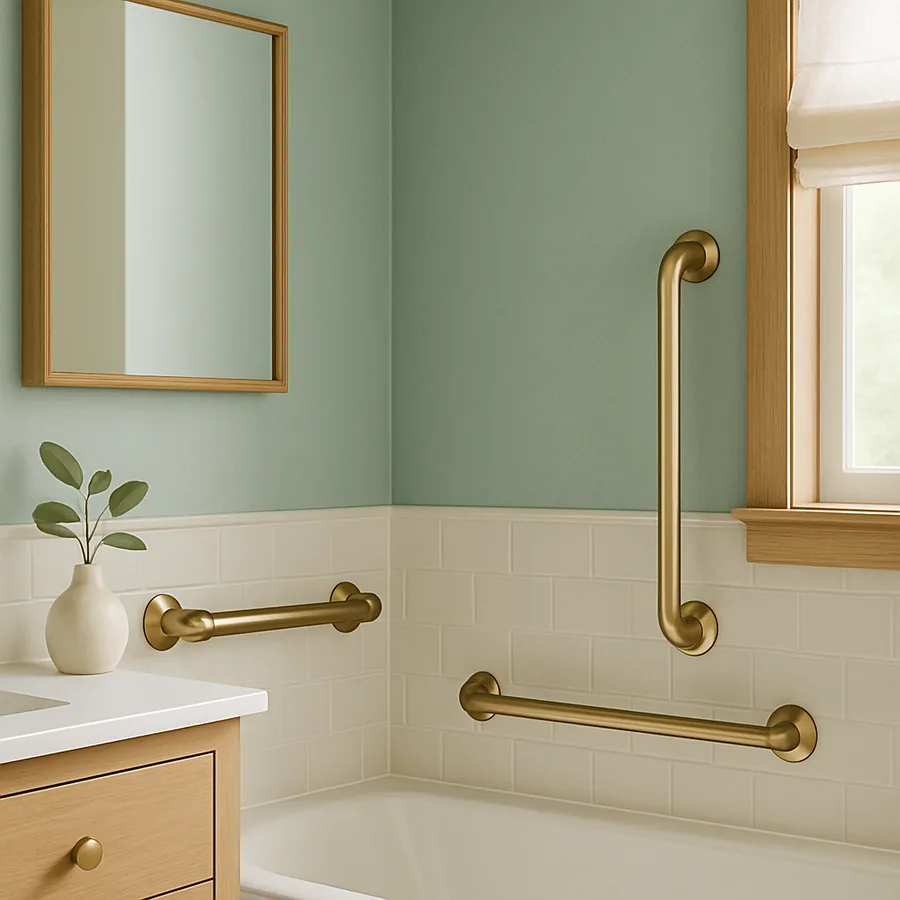
For decades, the grab bar carried an unmistakable association with institutional settings: a stainless-steel tube bolted to a tile wall, announcing to every visitor that someone in the household needed help. That stigma kept millions of homeowners from installing a device that could prevent a life-altering fall, and the consequences have been staggering. The Centers for Disease Control and Prevention reports that one in four Americans aged sixty-five and older falls each year, and the bathroom is the most dangerous room in the house due to wet surfaces, hard edges, and the physical demands of getting in and out of a tub or shower. Yet the design world has finally caught up with the safety data. A new generation of decorative grab bars now mimics towel bars, shelf brackets, shower niches, and robe hooks so convincingly that they serve their safety function without broadcasting it. This guide examines every option worth considering, from architectural-grade finishes and integrated accessories to installation best practices and ADA-informed placement, so you can build a bathroom that protects its occupants and impresses its visitors in equal measure.
Why Every Bathroom Deserves a Grab Bar
The case for universal grab bar installation extends far beyond aging-in-place scenarios. Children slip in bathtubs. Athletes recover from knee surgery. Pregnant women navigate changing balance and center of gravity. A grab bar provides a secure handhold for anyone whose stability is temporarily or permanently compromised, and because slippery surfaces are an inherent feature of every bathroom, the risk is present for occupants of all ages. The National Kitchen and Bath Association now recommends that all new bathroom construction include structural blocking behind the walls at grab bar locations, even if the bars are not installed immediately, because adding the blocking during construction costs almost nothing while retrofitting it later requires opening finished walls.
The financial case is equally persuasive. A fall resulting in a hip fracture costs an average of forty thousand dollars in medical expenses according to data from the National Council on Aging, not counting lost income, rehabilitation, and potential long-term care. A high-end decorative grab bar costs between seventy-five and three hundred dollars, and professional installation adds another one hundred fifty to three hundred dollars depending on whether blocking already exists. The math is unambiguous: the most expensive grab bar on the market is a fraction of a percent of the cost it can prevent.
Beyond economics, there is a quality-of-life argument that resonates with homeowners of every age. A grab bar next to a deep soaking tub makes entering and exiting the bath more graceful rather than less. A bar inside a walk-in shower provides a place to steady yourself while shaving a leg or rinsing a foot, tasks that even young, able-bodied people perform on one leg with soapy hands. Reframing the grab bar as a universal convenience rather than a disability accommodation removes the emotional barrier that has historically prevented adoption and opens the door to designs that are as beautiful as they are functional.
Have you ever reached for a towel bar to steady yourself and felt it flex under your weight? Standard towel bars are not engineered to bear a human load, and relying on one in a moment of instability can result in the bar pulling out of the wall and the person falling harder than they would have without it. A properly installed grab bar rated to support at least two hundred fifty pounds eliminates that risk entirely and gives every member of the household a reliable anchor point in the most hazardous room of the home.
Finishes That Match High-End Bath Hardware
The single biggest advancement in grab bar design is the expansion of available finishes to match every major hardware line on the market. Brushed nickel, polished chrome, matte black, satin brass, oil-rubbed bronze, champagne gold, and unlacquered brass are now standard offerings from multiple manufacturers. When a grab bar shares the same finish as the showerhead, faucet, and towel ring, the eye reads all of those elements as a coordinated hardware suite rather than identifying the grab bar as a separate, medical-purpose device.
Several premium plumbing brands have introduced grab bars as part of their core bathroom collections, engineering them to match the exact diameter, knurling pattern, and mounting-plate profile of their towel bars. Houzz editors have highlighted these collections as evidence that the line between safety hardware and decorative hardware has effectively disappeared at the high end of the market. When you shop, compare the grab bar's rosette (the circular or square plate at each mounting point) to the rosettes on your existing hardware. A matching rosette is the detail that makes the grab bar visually vanish into the suite.
For homeowners pursuing a truly custom aesthetic, some manufacturers offer grab bars in living finishes such as unlacquered brass and raw copper that patina over time, developing a warm, aged character that complements vintage and Old World bathroom designs. Others provide powder-coated options in custom RAL colors, allowing you to match the bar to a specific paint color, tile glaze, or vanity finish. These bespoke options carry a premium, typically two to three times the cost of a standard-finish bar, but for a bathroom where every detail has been curated, the investment ensures that the safety hardware contributes to the design story rather than interrupting it.
Texture is a functional detail that also carries aesthetic weight. A lightly knurled surface provides grip when hands are wet or soapy without looking clinical. A smooth surface is sleeker but less secure in a slippery environment. Some bars offer a hybrid approach: smooth along most of the length with a textured grip zone in the center third, creating a visual rhythm that mimics the transitional detailing found on high-end door levers and cabinet pulls. When selecting texture, balance the aesthetic preference with the practical reality that the bar will be grasped by wet hands under urgent conditions.
Grab Bars Disguised as Functional Accessories
The cleverest category of decorative grab bars hides in plain sight by performing double duty as another bathroom accessory. A grab bar with an integrated shelf creates a ledge for shampoo bottles, a soap dish, or a small plant, and the shelf's visual presence makes the bar beneath it look like structural support for the shelf rather than a safety device. These shelf bars are particularly effective inside walk-in showers where a traditional niche might be impractical due to wall construction or waterproofing constraints.
Towel-bar-style grab bars are the most common disguised variant. Manufactured to the same visual proportions as a standard towel bar, typically twenty-four to thirty-six inches long with decorative end brackets, these bars are structurally reinforced to support human weight while looking identical to their non-structural counterparts. The American National Standards Institute requires that any bar marketed as a grab bar meet ANSI/ICC A117.1 standards, which include a static load test of at least two hundred fifty pounds applied at the midpoint. A towel bar that meets this standard is, by definition, a grab bar that happens to hold towels.
Robe-hook grab bars and toilet-paper-holder grab bars extend the concept to smaller accessories. A robe hook rated for grab-bar loads provides a handhold next to the shower entry, exactly where a person is most likely to need one while stepping over a threshold onto a wet floor. A toilet-paper holder with an integrated grab bar arm gives a person something to push off when rising from a seated position, addressing one of the most common fall scenarios for older adults. These accessory hybrids are available in the same range of designer finishes discussed earlier, and because they occupy wall positions where accessories already belong, they attract no attention whatsoever.
Would your guests notice if the towel bar in your guest bathroom was actually a grab bar rated to hold two hundred fifty pounds? Almost certainly not, and that invisibility is precisely the point. When safety hardware is indistinguishable from decorative hardware, every member of the household and every visitor benefits from its presence without anyone feeling singled out or self-conscious. This is the core philosophy of universal design, and the modern grab bar is one of its most successful expressions.
Placement Strategies Based on ADA and Universal Design Principles
Effective placement is just as important as attractive appearance. The Americans with Disabilities Act provides detailed guidelines for grab bar positioning in public restrooms, and while residential bathrooms are not required to comply, the ADA dimensions represent decades of research into where people actually need support. In a shower, horizontal bars should be mounted on the side wall thirty-three to thirty-six inches above the floor, running the full length of the wall. A vertical bar near the shower entry, mounted from approximately thirty-two inches to approximately sixty inches above the floor, gives a person something to grip while stepping in and out.
Next to the toilet, the ADA calls for a horizontal bar on the side wall, forty-two inches long, mounted twelve inches from the rear wall and thirty-three to thirty-six inches above the floor. A second bar on the rear wall, thirty-six inches long and centered behind the toilet, provides additional support. In a residential context, you can adjust these dimensions to suit the specific user's height and reach, but the general zones identified by the ADA are an excellent starting point. The National Kitchen and Bath Association publishes residential bathroom planning guidelines that adapt ADA principles for home use, and consulting those guidelines or working with a CKBD-certified designer ensures that your bars are positioned where they deliver maximum benefit.
Angled grab bars, mounted at approximately forty-five degrees, deserve special consideration for the area next to the bathtub. An angled bar allows a person to pull themselves from a seated position at the low end and then transition to a standing grip at the high end, all in a single continuous motion. This biomechanically efficient placement reduces the effort required to stand and sit, which is particularly valuable for individuals with limited upper-body strength. From a design perspective, an angled bar introduces a diagonal line into a room dominated by horizontals and verticals, creating visual interest that a purely functional placement would lack.
Plan your bar locations before finalizing tile work. If you are renovating or building new, have the contractor install solid wood blocking, typically two-by-six lumber or three-quarter-inch plywood, between the studs at every intended bar location. This blocking provides a secure anchor for the mounting screws and distributes the load across a wide area. If blocking was not installed during construction, toggle bolts rated for grab-bar loads can anchor directly into tile and drywall, but the holding strength is lower and the installation requires more care. Either way, every bar must be tested by applying a firm downward pull of at least two hundred fifty pounds before it is considered ready for use.
Integrating Grab Bars Into a Cohesive Bathroom Renovation
The most seamless grab bar installations happen when the bars are planned as part of a broader bathroom renovation rather than added as an afterthought. When you are already selecting tile, fixtures, lighting, and hardware, adding grab bars to the specification sheet is a natural extension of the design process. The designer or contractor can coordinate finishes, align bar positions with tile layout lines, and ensure that blocking is installed behind the finished surfaces before a single tile is set. This integrated approach produces results that look factory-original because, functionally, they are.
Consider the bar's visual relationship to other horizontal and vertical elements in the room. A grab bar mounted at the same height as the towel bar on the opposite wall creates a sense of symmetry and intentional placement. A vertical grab bar aligned with the edge of a glass shower panel continues the panel's vertical line and reads as an architectural accent. These alignment decisions are subtle but powerful. When every element in a bathroom shares a consistent language of height, spacing, and proportion, the room communicates confidence and professionalism, and no single element stands out as anomalous.
Material selection for the surrounding surfaces can reinforce the integration. A grab bar mounted on a decorative tile accent strip, whether mosaic, subway, or slab, gains visual support from the strip's color and texture. The eye focuses on the tile detail and accepts the bar as part of the composition. Similarly, a grab bar installed on a wood-paneled accent wall in a spa-style bathroom inherits the warmth of the wood and disappears into the material palette. The American Society of Interior Designers encourages designers to treat accessibility features as opportunities for creative expression rather than constraints, and the modern grab bar is one of the clearest examples of that philosophy in practice.
If a full renovation is not in the budget, retrofitting grab bars into an existing bathroom can still produce polished results. Choose bars in a finish that matches or closely coordinates with the existing hardware. Install them at positions that align with existing tile grout lines to minimize visual disruption. Replace the towel bar with a grab-bar-rated equivalent so that the new bar looks like an upgrade rather than an addition. These low-disruption strategies achieve eighty percent of the aesthetic benefit of a full renovation at a fraction of the cost and timeline.
Maintaining Safety and Style Over the Long Term
A grab bar is a life-safety device, and like any safety device it requires periodic inspection and maintenance. Check each bar every six months by gripping it firmly and applying a strong downward pull. The bar should feel absolutely rigid with no movement, rotation, or loosening at the mounting plates. If any play is detected, tighten the mounting screws immediately. If the screws no longer bite, the blocking or anchor behind the wall may have deteriorated, and a professional assessment is warranted before the bar is trusted again.
Finish care is straightforward and identical to maintaining any other bathroom hardware. Wipe the bar weekly with a damp cloth and mild soap to remove soap scum and water spots. Avoid abrasive cleaners that can scratch plated finishes or strip patina from living finishes. For matte black and oil-rubbed bronze bars, a light application of furniture wax every three months preserves the finish and prevents water spots from becoming permanent. For polished and brushed finishes, a microfiber cloth and glass cleaner restore shine without risk of scratching. Treating the grab bar with the same care you give the faucet and showerhead ensures it remains a visual asset indefinitely.
As household needs evolve, grab bar placement may need to evolve as well. A bar installed at a height suited to a six-foot adult may not serve a five-foot-two partner recovering from knee replacement. The beauty of modular grab bars, those that mount with standard screw patterns into pre-installed blocking, is that they can be repositioned in under an hour. Keep a record of blocking locations, either in a home maintenance file or photographed before the walls are closed up, so that future additions or moves can be made without exploratory demolition.
Ready to upgrade your bathroom with hardware that protects everyone in your household without advertising the fact? Begin by inventorying your current bath hardware finishes, measuring the key zones next to the toilet, tub, and shower entry, and browsing the collections offered by manufacturers who engineer their grab bars to match their decorative lines. The result will be a bathroom that feels luxurious and intentional, where the safety features are woven so completely into the design that they become invisible to every eye except the one that reaches for them when it matters most. That is the definition of great design: it works flawlessly, it looks effortless, and it never calls attention to the problem it solves.
More Articles You May Like



Comments
Post a Comment