Entryway Floor Tile Patterns That Hide Dirt and Scuff Marks
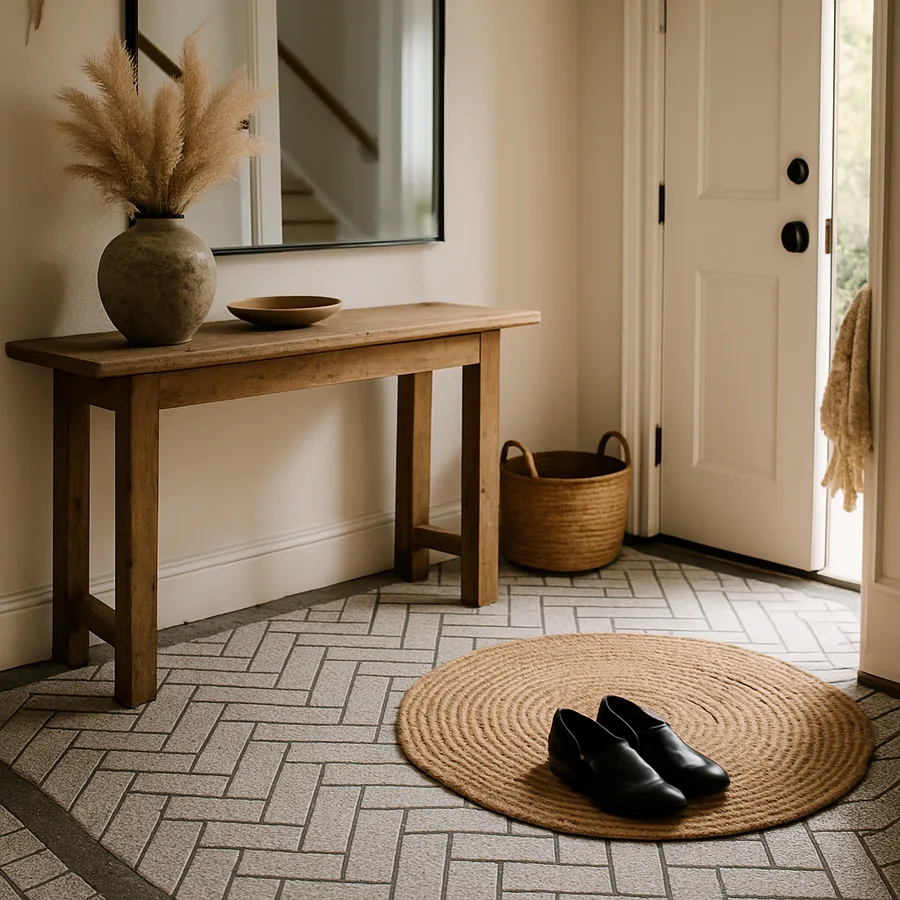
The entryway takes more abuse than any other square footage in a home. According to a consumer-behavior study published by the National Association of Home Builders (NAHB), households with children track in grit, salt, and moisture across the front threshold an average of 17 times per weekday, and exterior debris accounts for roughly 80% of interior floor soiling per research summarized by the Institute of Inspection, Cleaning and Restoration Certification (IICRC). The tile you pick, and more importantly the pattern you lay it in, can make that relentless traffic nearly invisible between mop sessions. This guide walks through the grout colors, tile sizes, surface finishes, and geometric layouts that professional designers specify when a client asks the eternal question: how do I keep this floor from looking dirty?
Why Some Entryway Tile Patterns Disguise Soil Better Than Others
Visual camouflage on a floor comes down to three variables: color variation, grout contrast, and pattern rhythm. A solid cream tile in a straight grid will telegraph every footprint, but a multi-tone porcelain with warm grays and taupes laid in a third-offset running bond can absorb a week of boot traffic without looking neglected. The Tile Council of North America (TCNA) notes in its Handbook that pattern choice interacts with lighting angle: raking sunlight through a sidelight window will reveal smudges that overhead lighting hides, so pattern selection should always account for how the foyer is lit at 8 a.m. and at 6 p.m.
Have you ever wondered why hotel lobbies seem to stay immaculate despite thousands of feet crossing them daily? Commercial designers lean on patterned layouts with mid-tone grout specifically because the grid lines break up the eye's ability to track individual soil events. When you cannot see where one tile ends and another begins, you cannot easily see a smudge in the middle of either.
The Science of Color Variation and Grout Contrast
Porcelain tile manufacturers now produce through-body color products with as many as sixteen face variations per run, meaning no two adjacent tiles look identical. This variegation is the single most effective dirt-hiding feature you can buy. According to a materials brief from the Ceramic Tile Education Foundation (CTEF), specifying a product rated V3 (High Variation) or V4 (Random) on the industry shade-variation scale can reduce perceived soiling by up to 40% compared with a V1 (Uniform) tile in an equivalent color.
Grout color is the other half of the equation. A bright white grout will show every speck of black rubber scuff from the sole of a running shoe, while a warm gray, mushroom, or taupe grout sits a value step or two darker than a mid-tone tile and visually disappears. The National Kitchen and Bath Association (NKBA) recommends matching grout to the darkest flecks in a variegated tile, not to the tile's overall body tone, because that darker reference point catches shoe marks before they register to the eye. Epoxy grout adds a second benefit: its non-porous surface resists the embedded staining that turns cementitious grout gray-brown over time.
Patterns That Outperform in High-Traffic Foyers
Five specific layouts dominate pro designer portfolios when the brief is dirt-hiding: herringbone, third-offset brick, pinwheel, basketweave, and random ashlar. Each of these breaks the visual grid in a way a half-offset standard pattern cannot. Herringbone, in particular, forces the eye to follow diagonals rather than scan horizontally, which masks the linear streak patterns created by wet boots walking from the door toward the living room.
Pinwheel layouts, which combine a small accent square with four larger rectangular tiles, introduce a second scale of pattern that further fragments perception. Random ashlar, which mixes three or more tile sizes in a planned pseudo-random set, is the most forgiving of all because there is no regular rhythm for a smudge to disrupt. The tradeoff is installation cost: expect labor quotes 25% to 40% higher than a straight-set grid, per rate data published by HomeAdvisor and corroborated by the National Tile Contractors Association (NTCA).
Surface Finish, Slip Rating, and How They Affect Cleaning
A matte or honed finish hides smudges better than a polished one, but it also traps more soil in microscopic surface pores, which means the cleaning frequency equation shifts. The American National Standards Institute (ANSI) A137.1 standard requires a Dynamic Coefficient of Friction (DCOF) of 0.42 or higher for wet interior floors, and most textured entryway tiles exceed that threshold. A slightly textured, matte-finish porcelain with a DCOF in the 0.55 to 0.65 range delivers the sweet spot: it masks scuff marks, resists slipping when tracked snow melts into a puddle, and still releases grit under a weekly microfiber damp mop.
Avoid glossy finishes in direct-entry foyers unless you enjoy polishing. Polished porcelain shows every water droplet, every heel scuff, and every paw print with studio-quality clarity, and it is also more slippery when wet, especially for older family members. Reader question: if you already installed a polished floor you now regret, is it worth it to refinish? A professional hone-and-refinish service runs $4 to $8 per square foot and produces a permanent matte finish that dramatically improves both safety and maintenance.
Color Palettes That Disguise Winter Salt and Summer Dust
Salt residue in winter and fine pollen dust in summer sit on opposite ends of the value scale: salt reads as a chalky white haze, pollen as a yellow-beige film. A floor that hides both needs to live in the middle. Mid-tone warm grays, weathered taupes, and layered beige-to-charcoal blends are the workhorse palettes for exactly this reason. Pure white marble-look tile will show every salt track; pure black slate-look tile will show every speck of pollen and every dog hair. The sweet spot is a tile that reads as 60% mid-value with 40% dark flecking, which is roughly how quartzite and many wood-look porcelain planks present visually.
Stone-look tiles that mimic travertine, limestone, and flamed granite are especially effective because real stone evolved those mottled palettes in response to environmental weathering, which is exactly the kind of deposition your entryway sees at smaller scale. The Natural Stone Institute (NSI) publishes a selection guide noting that stones with visible crystalline structure or fossil inclusions read as pre-textured to the eye, which means dirt does not register as a contrasting addition. Porcelain manufacturers now reproduce these palettes in digitally printed tile at roughly one-third the installed cost of natural stone, so you can get the camouflage without the sealing schedule. For deeper sourcing research on authentic stone patterns, consult the Natural Stone Institute.
Real-World Maintenance Routines That Keep Patterns Looking New
The best pattern in the world will lose its camouflage if grout dulls or finish wears. A sustainable maintenance routine has three tiers: daily (walk-off mats and a quick sweep), weekly (neutral-pH damp mop), and quarterly (grout inspection and spot re-seal). According to maintenance research published by ISSA (the Worldwide Cleaning Industry Association), 85% of entryway soil can be captured by a properly sized walk-off mat system placed both inside and outside the door, which means the tile itself only handles a fraction of what actually arrives on shoes.
Reader question: what is the single biggest mistake homeowners make with tile foyer maintenance? Using the wrong cleaner. Bleach, vinegar, and citrus-based products erode cementitious grout and damage the factory finish on porcelain over time. Stick with a neutral-pH tile cleaner approved by the tile manufacturer, and re-seal cementitious grout every 12 to 18 months. Epoxy grout does not need sealing, which is why it pays for itself in entryway applications despite a higher upfront cost. For additional guidance on cleaning products appropriate to ceramic and porcelain tile, review the Tile Council of North America maintenance resources. Technical care specifications and installation tolerances are also available through the NKBA professional reference library.
Conclusion
The entryway is the hardest-working floor in the house, and its pattern choice determines whether you spend weekends deep-cleaning or drinking coffee. Variegated mid-tone porcelain in a herringbone, pinwheel, or random ashlar layout, paired with warm-gray or taupe epoxy grout and a matte finish in the 0.55 to 0.65 DCOF range, will outperform almost any other combination on both the visual and maintenance axes. Layer in a two-stage walk-off mat system and a neutral-pH cleaning routine, and you can buy yourself days to weeks between the moments when the floor actually looks like it needs attention.
Remember that pattern and color do the heavy lifting, but finish and grout do the maintenance work. A V3 or V4 shade-variation tile, laid diagonally to the primary sightline, with grout keyed to the darkest tile flecks, is the formula most designers return to year after year because it continues to perform long after the client has stopped noticing the floor. That is the real test of a good entryway tile selection: when guests look at the room and see the furniture, the art, and the light, not the smudges at the threshold.
If the tile you currently have is already installed and you are not ready to replace it, the highest-ROI moves you can make are regrouting with a pigmented epoxy, adding a proper commercial-grade walk-off mat inside and outside the door, and switching to a manufacturer-approved neutral-pH cleaner. These three steps alone can extend the visual life of an underperforming floor by years. And when you are ready for a full redesign, work with a tile professional who can show you full 4-foot-by-4-foot dry layouts before commit, because a pattern that looks great on a single sample rarely reads the same way across an entire foyer.
Ready to upgrade your entryway? Save this guide, take photos of your foyer at morning and evening light, and bring both to your next tile-showroom visit so you can test sample patterns against the exact conditions your real floor faces every day.
A homeowner-friendly way to compare tile performance before committing is to ask your showroom for a soil-transfer demonstration. Take two candidate tile samples and rub a standard amount of dry black shoe polish, then garden soil, then diluted coffee across each one; clean with a neutral-pH cleaner and compare residual staining. Tiles with through-body color, V3 or V4 shade variation, and matte finish will release soil cleanly and show no residual mark, while glossy or light-solid tiles will retain visible traces. This ten-minute test is more predictive of real-world performance than any manufacturer specification sheet, and it costs nothing to perform. The American Institute of Architects (AIA) publishes material-selection guides that similarly recommend empirical rather than theoretical evaluation for high-wear applications, and entryways qualify as exactly that kind of application.
One practical diagnostic exercise is worth performing in any foyer that already exists and disappoints you: stand at the front door at 9 a.m. on a sunny day and again at 5 p.m. on a cloudy one, photograph the same floor area under both conditions, and compare. The worst-performing floors will show a visible traffic streak in the raking morning light that disappears in diffuse afternoon light, which tells you the problem is not the tile color but the finish sheen and the grout contrast combining to amplify directional soil. Small adjustments to finish (a careful professional honing) and grout (a pigmented re-grout) can rescue floors that seem unsalvageable without replacement.
For homeowners planning a new build rather than a remodel, specifying the tile, grout, and finish as a coordinated system in the earliest design phase saves money. Ordering a sample kit that includes three candidate tiles, three candidate grout colors, and two finish options in large enough pieces to lay out a real 4-foot-by-4-foot mockup costs under $150 from most showrooms and prevents thousand-dollar regrets. The American Society of Interior Designers (ASID) notes in its practice guides that material mockups are the single highest-leverage tool for avoiding late-stage specification changes, which in renovation contexts routinely run into five-figure change orders.
Finally, keep in mind that household habits shape floor performance as much as materials do. A family that consistently removes shoes at the door, uses a well-maintained interior walk-off mat, and damp-mops weekly will get visibly better results from any reasonably specified tile than a family without those habits would get from the best tile on the market. Behavior and materials both matter, and they compound: the right tile in a low-effort household looks mediocre, while a modest tile in a disciplined household looks great. Plan both in parallel when designing the room.
More Articles You May Like



Comments
Post a Comment