Garage Floor Epoxy Coating: DIY Application Steps and Costs
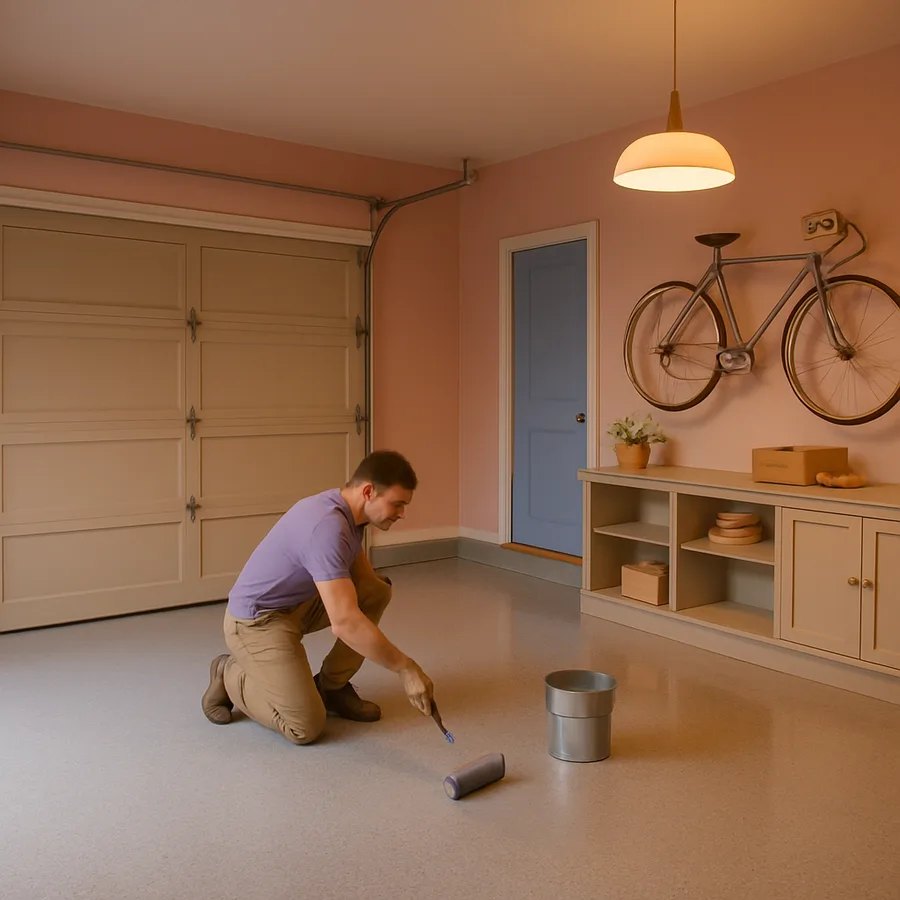
A freshly epoxied garage floor is one of those rare home improvements that changes the way you feel about a space the moment it cures. The floor stops looking like a dusty slab and starts looking like a showroom. Oil stains wipe off instead of seeping in, spilled tools no longer chip the surface, and the entire garage seems brighter because light bounces off the coating instead of absorbing into raw concrete. The appeal is obvious, and the DIY epoxy market has grown steadily for more than a decade as a result. But the failure rate among DIY installations is also higher than manufacturers like to admit. Peeling, bubbling, hot-tire pickup, and hazy finishes are all common, and almost every one of those failures traces back to shortcuts in the preparation stage, not in the coating stage.
This guide walks through the full DIY process in the order you should do it, with realistic costs at each stage and honest notes about what can go wrong. We will cover moisture testing, concrete prep, crack and pit repair, etching, mixing, rolling, flaking, topcoat selection, cure time, and ongoing maintenance. By the end you will know whether DIY is the right call for your garage, what a realistic budget looks like, and which decisions separate a 15 year floor from a 3 year floor.
Understand What Epoxy Is and What It Is Not
Epoxy coatings are two-part thermoset resins that cure through a chemical reaction between a resin and a hardener. Unlike paint, which dries as its solvent evaporates, epoxy actually forms a rigid plastic when the two components react, which is why the bond to properly prepared concrete can last more than a decade. The American Coatings Association classifies garage floor epoxies into three broad tiers: water-based, solvent-based, and 100 percent solids. Water-based products have the lowest solids content, the easiest cleanup, and the shortest lifespan. Solvent-based epoxies have higher solids and better durability but much stronger fumes. 100 percent solids products, the professional grade, produce the thickest and longest-lasting film but are less forgiving to apply.
Most DIY kits sold at home centers are water-based or hybrid products with solids content between 40 and 70 percent. These are genuinely good for budget projects and apartment-adjacent garages, but they will not match the performance of a professionally applied 100 percent solids system. Expect a realistic lifespan of 3 to 7 years for a well-applied DIY water-based kit in a two-car garage, and 8 to 15 years for a DIY 100 percent solids application in the same space. Those numbers come from contractor feedback aggregated in forums and in studies referenced by This Old House coverage of the category.
Test for Moisture Before You Do Anything Else
The single most common cause of epoxy failure is moisture migrating up through the slab. Concrete is porous, and a slab poured without a modern vapor barrier, or a slab sitting on damp soil in a high-water-table region, will continuously push water vapor toward the surface. An epoxy coating applied over a wet slab will blister, peel, or simply fail to bond. The good news is that moisture testing is cheap and fast.
Tape a 2 foot by 2 foot piece of clear plastic sheeting to the floor with edges fully sealed, leave it for 24 hours, and check for condensation underneath. If you see water droplets or darkening of the concrete, you have an active moisture issue that needs to be addressed with a moisture-tolerant primer or with a different coating system entirely. For a more rigorous test, the American Society for Testing and Materials (ASTM) publishes standards including ASTM F1869 (calcium chloride test) and ASTM F2170 (relative humidity probe test), which are what professional flooring contractors use. A calcium chloride test kit costs about $20 and will give you a quantitative reading in 60 to 72 hours. Test in three locations for a two-car garage, because moisture levels often vary across a single slab. Have you ever walked into a garage after a heavy rain and noticed dark patches on the concrete? That is the warning sign this test is designed to quantify.
Prep the Slab Aggressively, Because Prep Is 80 Percent of the Job
Surface preparation is where DIY projects succeed or fail. The goal is a clean, open-pored concrete surface that epoxy can mechanically key into. That means removing any existing sealer, paint, or curing compound, grinding or etching the surface to a texture roughly equivalent to 120 grit sandpaper, and removing every trace of dust, oil, and loose material.
You have three realistic prep options. Acid etching with muriatic or phosphoric acid is the cheapest and the most commonly used DIY approach. It costs $20 to $40 per car bay in materials but requires careful safety practice, including chemical-resistant gloves, eye protection, and thorough ventilation. The OSHA guidelines for handling corrosive chemicals translate directly to home use. Mechanical grinding with a rented concrete grinder is vastly superior and produces a much more reliable bond, but the rental costs $80 to $150 per day and kicks up significant dust. Shot blasting is the professional option and typically costs $1 to $2 per square foot when contracted, which for a 400 square foot two-car garage puts it in the $400 to $800 range. If your budget allows, hiring out the prep and doing the coating yourself is a genuinely smart hybrid. Oil stains and grease must be removed before any prep step because acid and grinders cannot penetrate oil. Use a dedicated concrete degreaser, let it dwell, scrub with a stiff brush, and rinse thoroughly.
Repair, Mix, Roll, and Flake in the Correct Working Window
Every garage slab older than five years has at least a few hairline cracks and a few small pits where coarse aggregate popped during cure. These imperfections will telegraph through the epoxy film and, if wide enough, will eventually fracture the coating along the crack line. Repair them before you coat. For hairline cracks up to 1/16 inch wide, a two-part epoxy crack filler works well and runs about $15 for enough to fill the typical two-car garage. For wider cracks, chase them out slightly with a grinder wheel to create a clean V-groove, vacuum thoroughly, and fill with a polyurea crack filler that cures in 15 to 30 minutes. For pits and spalled areas larger than 1/4 inch, use a patch compound designed for concrete overlay, not household patching products.
The American Concrete Institute (ACI) publishes repair guidelines that product manufacturers reference, and the short version is that every repair must be flush with the surrounding surface and must itself be clean and sound before coating. Allow all repairs to cure fully per the manufacturer's instructions, which is typically 1 to 24 hours depending on the product. Skipping this step is one of the three most common reasons DIY epoxy floors fail within two years.
Once the slab is prepped and dry, mixing and application is the satisfying part. Most DIY kits ship with a resin part A and a hardener part B in matched quantities. Combine the two into a clean five gallon bucket, mix with a paddle on a drill for 3 to 5 minutes scraping the sides, and watch your clock. Epoxy has a pot life, typically 30 to 45 minutes for DIY kits at 70 degrees Fahrenheit, after which the coating becomes thick and unworkable. Warmer weather shortens pot life significantly.
Cut in the edges with a brush, then roll the main field with a 3/8 inch nap roller in overlapping strokes, working in sections you can finish before the pot life expires. Broadcast decorative color flakes by hand toss immediately after rolling each section, while the epoxy is still wet. Flakes improve slip resistance and hide minor imperfections, and they are included in most DIY kits for that reason. Work from the back of the garage toward the door so you never trap yourself against a wet surface. The Family Handyman step-by-step epoxy features walk through this sequence with excellent photos if you want visual reference. Let the base coat cure the manufacturer-specified time, typically 12 to 24 hours before a topcoat and 5 to 7 days before driving on it.
Add a Topcoat and Plan the Cure
A topcoat is optional on some DIY kits and strongly recommended on others. It improves abrasion resistance, locks the decorative flakes in place, adds UV resistance on the sunny side of the garage, and dramatically extends the life of the floor. Most topcoats are either a second clear epoxy layer or a polyurethane designed for epoxy overcoat. Polyurethane topcoats are slightly more expensive but meaningfully tougher, and they are what premium professional installers default to.
Cure time is not negotiable. Walking on an epoxy floor too early leaves permanent footprints in the surface. Driving on it too early causes hot-tire pickup, the frustrating failure mode where warm car tires pull the coating right off the slab. Manufacturer instructions typically specify 18 to 24 hours for light foot traffic and a full 5 to 7 days before any vehicle parks on the surface. In cooler weather you may need to add space heaters or wait even longer. ANSI has published voluntary standards for coating performance that manufacturers reference in their technical data sheets, and following those data sheet timelines is the single easiest way to avoid the most common DIY failure. Is your garage above 60 degrees Fahrenheit for the full cure window? If not, plan the project for a different season.
Total Cost, Timeline, and Honest Tradeoffs
For a typical 400 to 500 square foot two-car garage, a realistic DIY budget for a water-based kit runs $200 to $400 in materials, a hybrid solvent-based kit runs $400 to $700, and a 100 percent solids professional-grade kit runs $700 to $1,200. Add $50 to $150 for prep supplies (acid, degreaser, brushes, rollers, mixing paddles), another $50 to $100 for safety gear (respirator, goggles, chemical-resistant gloves, knee pads), and $150 to $300 if you rent a concrete grinder instead of etching.
Timeline-wise, expect one full weekend minimum: Saturday for prep, Sunday for the base coat, then midweek evenings for the topcoat if the kit includes one. Cure and reoccupancy takes the following weekend. A professional contractor will typically charge $4 to $8 per square foot for a comparable install, which for a two-car garage puts the bid in the $1,600 to $3,500 range. So DIY saves $1,000 to $2,500 if everything goes right. Does it always go right? No. Surveys published by the Portland Cement Association suggest DIY epoxy failure rates in the 15 to 25 percent range within five years, which is meaningfully higher than professional installs. The savings are real but they come with risk.
Conclusion: Commit to the Prep or Hire Out the Prep
Epoxy floors reward careful work and punish shortcuts. The single most reliable predictor of a long-lasting DIY floor is a homeowner who took the moisture test seriously, prepped aggressively, and allowed the cure windows to run in full. The second most reliable predictor is a homeowner who was willing to hire out the one step they could not do well, which for most people is the slab prep. Combining DIY coating with professional shot-blasting prep is a strategy that delivers near-pro results at meaningful savings, and it is worth pricing in your market before you commit to a pure DIY path.
Before you buy a kit, walk your garage at night with a flashlight and inspect the slab honestly. Look for spalling, cracks, oil stains, and any signs of moisture. Tape down a plastic sheet and check it 24 hours later. If the slab is dry and in reasonable condition, you are a good DIY candidate. If it shows moisture, or if it has large spalled sections, or if it has been painted before, the project complexity escalates and a professional consultation becomes money well spent. Do not let optimism override what the concrete is actually telling you.
Plan the project for a time of year when your garage temperatures will stay above 60 degrees Fahrenheit for a full week, ventilate aggressively during the acid etch and coating steps, keep pets and children out of the space until cure is complete, and take before and after photos because you will not believe the transformation otherwise. A properly installed epoxy floor is one of the few home improvements that genuinely pays for itself in maintenance savings, stain resistance, and the simple daily pleasure of walking into a clean, bright garage. Block out a three-weekend window on your calendar, order a kit this week, and commit to the full prep sequence, because half-measures on epoxy always fail.
Helpful supporting references include project walkthroughs from Family Handyman, coating science overviews from This Old House, and chemical safety guidance from OSHA. A good floor is patient work, but the finished result is worth every careful hour.
More Articles You May Like



Comments
Post a Comment