Soundproofing a Home Gym Floor to Protect Rooms Below
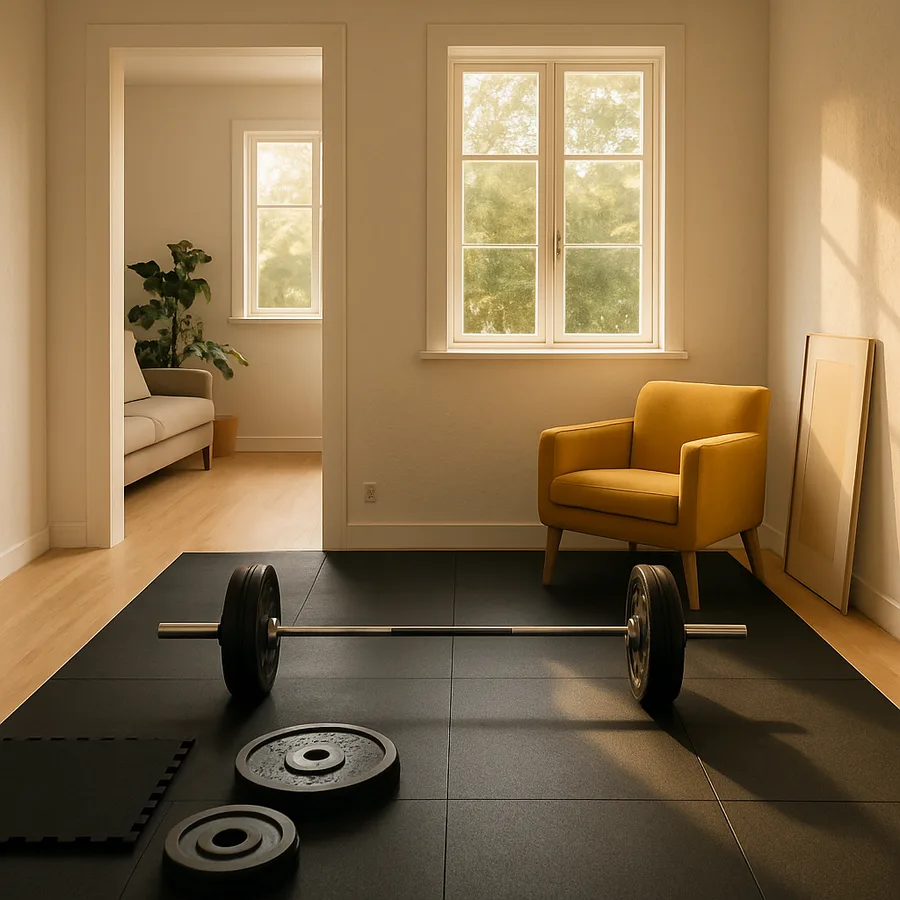
The physics of a deadlift dropped onto a second-floor bedroom gym is unforgiving to whoever lives below. A 315-pound loaded barbell falling six inches to the floor delivers roughly 1,200 foot-pounds of kinetic energy into the structural system, and in a conventionally framed house with 2x10 joists and a half-inch subfloor, the impact insulation class (IIC) rating of the floor-ceiling assembly is typically between 35 and 42. That means the occupant of the room below experiences the drop as a dinner-plate-rattling thud. Building codes require IIC 50 for new multi-family construction according to the International Building Code, and residential retrofits for dropped-weight gym floors typically target IIC 65 or higher to keep the peace with everyone else in the house.
This article walks through how to soundproof a home gym floor effectively, with realistic expectations about what materials actually achieve, how they stack together, and what budget is required. The short version: meaningful results require multiple layers working together, no single product solves the problem by itself, and the cheapest solutions deliver the smallest improvements. Expect to spend between $8 and $22 per square foot for a genuine retrofit, not counting the labor.
Understanding Impact Noise Versus Airborne Noise
The first concept that trips up homeowners is the distinction between airborne noise and impact noise. Airborne noise is a conversation, a TV, a fan, transmitted as pressure waves through air that strike a wall or floor and pass through to the other side. Impact noise is a footstep, a dropped object, a rolling chair, transmitted as mechanical vibration directly through the structure. The two noise types travel through building assemblies differently, and a floor that blocks airborne noise beautifully can be completely transparent to impact noise.
For a home gym, the dominant problem is impact noise. Dropped weights, jumping rope, box jumps, sled pushes, and even heavy footfalls during sprint intervals all generate impact events that couple directly into the floor structure. The STC (sound transmission class) rating you see on most building products measures airborne performance and is largely irrelevant to gym floor design. The metric that matters is IIC, which measures impact performance with a standardized tapping machine, and you should ignore any product marketed for residential gym use that does not publish an IIC contribution number.
The Acoustical Society of America has published extensive research on impact noise transmission, and the core finding is that impact noise is hardest to stop at low frequencies. A 45-pound plate drop produces peak energy in the 30 to 80 hertz range, which is below the sensitivity range of most IIC test methodologies. This means that achieving IIC 65 on paper may still let through perceptible low-frequency thuds in practice. Effective soundproofing for gym drops requires attention to low-frequency attenuation specifically, which calls for mass and decoupling rather than just rubber padding.
The Four Mechanisms That Actually Reduce Sound
Acoustic engineers identify four mechanisms that reduce sound transmission through an assembly: mass, decoupling, absorption, and damping. A well-engineered gym floor uses all four, and understanding how each contributes tells you where to spend money for maximum effect.
Mass is the simplest: heavy assemblies transmit less sound than light ones, and doubling the mass of a floor adds about 6 dB of transmission loss at most frequencies. In practice, mass contributions come from additional plywood layers, concrete overlays, or mass-loaded vinyl sheets. A 1/2-inch layer of mass-loaded vinyl (MLV) at 1 pound per square foot adds about 4 dB of broadband transmission loss when laid under rubber flooring. This is meaningful but modest.
Decoupling separates the finished floor surface from the structural subfloor so that vibration cannot travel directly between them. This is the single most effective strategy for impact noise and typically contributes 10 to 15 dB of improvement when properly executed. Decoupling comes from resilient channels, rubber isolation pads under a floating plywood layer, or engineered acoustic underlayment products like QuietWalk Plus or Proflex 90. Decoupling is where your soundproofing budget produces the highest return.
Absorption converts sound energy into heat within porous materials. Mineral wool insulation in the joist bay of the ceiling below the gym is the standard implementation, adding 3 to 5 dB to the IIC rating of the assembly. The Rockwool Safe'n'Sound product is the residential standard, rated for fire, sound, and thermal performance simultaneously. Fiberglass batts work too but are less effective than mineral wool for acoustic duty.
Damping is the most technical mechanism and refers to materials that dissipate vibration energy within their own molecular structure. Green Glue compound applied between two layers of plywood, or specialized damping polymers laminated between rubber layers, add 5 to 8 dB of transmission loss. Damping pays off particularly well at low frequencies, which makes it worth the premium for gym floor applications where plate drops dominate.
Realistic Floor Assemblies: Budget to Premium
Let me describe three assembly tiers that represent realistic build specs at different budget levels, with published IIC performance estimates drawn from manufacturer data and published testing.
Budget tier (IIC 50 to 55): A 3/4-inch interlocking rubber tile laid over a 1/4-inch rubber underlayment laid over the existing subfloor. Total thickness about 1 inch, total cost around $8 per square foot installed. This assembly handles dumbbell work and moderate barbell lifts without dropping weights. It does not handle deadlifts dropped from standing height, and the occupant below will hear clear thumps during barbell drops. Appropriate for home gyms where the lifter commits to not dropping weights.
Mid tier (IIC 60 to 65): A 3/4-inch rolled rubber floor fully adhered to a 3/4-inch plywood floating layer, which sits on 3/4-inch rubber isolation pads arranged in a grid across the existing subfloor. Optional mass-loaded vinyl under the floating plywood for an additional 3 dB. Total thickness about 2 inches, total cost around $14 per square foot installed. This assembly absorbs standard weight drops from standing height without waking the household, and the occupant below perceives drops as distant low thuds rather than sharp impacts.
Premium tier (IIC 70 and higher): A 1-inch poured gypsum concrete or hydronic radiant-style overlay on top of decoupled floating plywood with engineered resilient underlayment, finished with 1/2-inch rolled rubber on top. Ceiling below is resilient-channel-isolated drywall with mineral wool in the joist bay. Total thickness approaching 3 inches, total cost approaching $22 per square foot installed plus ceiling work. This assembly handles Olympic lifting dropped from overhead and is effectively transparent to anyone in the room below.
A reader asked me recently whether the premium tier was overkill for a shared-wall condominium situation. The honest answer is that in any multi-unit building where the space below is not yours, the premium tier is the minimum defensible spec if you plan to do any dropped lifting at all. Condominium soundproofing disputes have resulted in injunctions, equipment confiscations, and lease termination in multiple reported cases, and the Community Associations Institute has published guidance pushing HOAs toward strict enforcement of impact noise rules.
The Often-Ignored Ceiling Below
One of the biggest leverage points for gym floor soundproofing is not the floor at all. It is the ceiling of the room directly below. Upgrading the floor-ceiling assembly from the ceiling side requires removing the existing drywall, filling the joist bays with mineral wool insulation, installing resilient channel or sound isolation clips, and hanging a new double layer of 5/8-inch drywall with Green Glue damping compound between the layers. This kind of retrofit adds 15 to 20 IIC points to the assembly for about $12 per square foot of ceiling area, which is the best acoustic dollar you can spend.
The reason the ceiling work matters so much is that it attacks impact noise at its exit point, breaking the mechanical coupling between the joists and the finish ceiling surface. Even if your floor assembly is modest, a properly isolated ceiling below prevents most of the vibration from radiating into the room. Conversely, the most expensive floor assembly in the world loses a good chunk of its performance if the ceiling below is directly attached to the joists with no decoupling.
A reader in a Brooklyn brownstone asked me whether ceiling work was feasible in a room with ornate crown molding and plaster ceilings she wanted to preserve. The honest answer is that historic plaster ceilings are almost impossible to upgrade acoustically without removing them, and the trade-off becomes whether to accept reduced acoustic performance or to lose the historic detail. In those cases, pouring more money into the floor assembly is the only viable path, and you should expect to hit an IIC ceiling (pun intended) of around 60 even with premium floor work.
Flanking Paths: Where Sound Escapes Your Assembly
Professional acoustic consultants spend much of their time thinking about flanking paths, which are the routes sound takes around rather than through an assembly. A perfectly soundproofed floor is still a noisy floor if vibration couples into the wall studs, travels down them, and re-radiates into the room below through the connected walls. This is why soundproofing a room is always a whole-envelope problem rather than a single-surface problem.
The primary flanking paths in a home gym are the wall-to-floor connection, mechanical ductwork that penetrates the floor, electrical outlet boxes on exterior walls of the gym, and any doorway into the gym space. The ASTM E336 standard describes how to measure flanking transmission, and the Acoustical Society of America recommends treating the lower 12 inches of wall framing around a gym with resilient isolation at the floor sill to break the vibration path.
A practical retrofit approach is to install a perimeter isolation strip of 1/2-inch neoprene or cork around the entire gym floor where it meets the wall, extending up the wall behind the rubber flooring by 2 inches. This creates a floating floor within the envelope of the gym and prevents the floating assembly from touching the walls. The improvement is real: professional acoustic measurement typically shows 4 to 7 dB of additional transmission loss across the low-frequency range where gym drops live.
Another practical reader question concerns floor drains and piping, which are common in basement gyms converted from utility spaces. Pipes penetrating through a soundproofed floor provide a direct coupling path for vibration, and the fix is to wrap the pipes in pipe isolation sleeves or to stuff the annular space around the pipe with acoustic sealant rated for penetration fill. The IICRC has documented commercial acoustic isolation assemblies that offer useful analogs for residential gym work.
Testing and Verification
How do you know your soundproofing actually worked? The rigorous answer is to hire an acoustic consultant to perform IIC and STC field tests, which run $800 to $1,500 and produce a certified measurement. For most homeowners, a less formal approach gives adequate feedback. Stand in the room below and have a training partner perform representative lifts, including the most aggressive drops you anticipate. Rate the perceived noise on a simple scale: undetectable, faintly audible, clearly audible, disruptive. Iterate on the assembly until the rating is acceptable.
Phone-based sound level meter apps are approximately accurate for broadband measurements and can give you rough dB readings before and after improvements. The National Institute for Occupational Safety and Health (NIOSH) has published a free Sound Level Meter app for iOS that is calibrated against professional reference microphones and is adequate for this kind of relative measurement. Expect drops to register at 50 to 65 dBA in the room below for a well-soundproofed assembly, which is below the threshold of sleep disturbance for most people.
Be honest with yourself about what the room below is used for. If it is a laundry room or mechanical space, your tolerance for residual noise is high. If it is a primary bedroom, a home office for video calls, or a nursery, your tolerance is zero and you need to commit to the premium assembly plus ceiling work regardless of budget. Acoustic complaints from household members are not solved by additional training sessions or by asking the complainer to be more tolerant. They are solved by better engineering, and the engineering is well understood.
Conclusion
Soundproofing a home gym floor to protect rooms below is a whole-system engineering problem that responds well to a considered investment of money and labor. The core principles are straightforward: combine mass, decoupling, absorption, and damping in layered assemblies; treat the ceiling below as seriously as the floor above; manage flanking paths around the perimeter and through penetrations. The products are well-developed and available at residential building-supply retailers. The performance is predictable when the installation is executed correctly.
Budget realistically. A mid-tier assembly at IIC 60 to 65, installed across a 200-square-foot gym, will run $2,800 to $3,500 in materials and labor. A premium assembly at IIC 70-plus, including ceiling upgrades, approaches $6,000 to $8,000 for the same space. These numbers sound significant until you compare them to the alternative, which is either an ongoing household conflict or a relocated gym that you use less often because it is no longer convenient. Neither of those alternatives has a happy long-term outcome.
The organizations worth consulting as you plan the project are the Acoustical Society of America for underlying acoustic theory, the NAHB Remodelers Council for residential construction best practices, the ASTM International for testing methodology, and the Community Associations Institute if you live in multi-family housing with governing rules. Each publishes guidance relevant to residential sound isolation, and the overlap between their recommendations is large and defensible. Do not rely on product marketing alone; verify performance claims against independent testing data when available.
Ready to start? Measure your gym floor this week, document the joist framing direction and spacing from below, and sketch a proposed assembly with product thicknesses and published IIC contributions. Get quotes from at least two flooring contractors who have experience with acoustic assemblies rather than just standard residential flooring. For further reading as you plan, consult technical publications from the Acoustical Society of America, building science guidance from the National Association of Home Builders, and installation standards from the ASTM International. Your neighbors, your family, and your training consistency will all benefit from the effort.
More Articles You May Like



Comments
Post a Comment