Full-Length Leaning Mirrors: Where to Place Them Safely
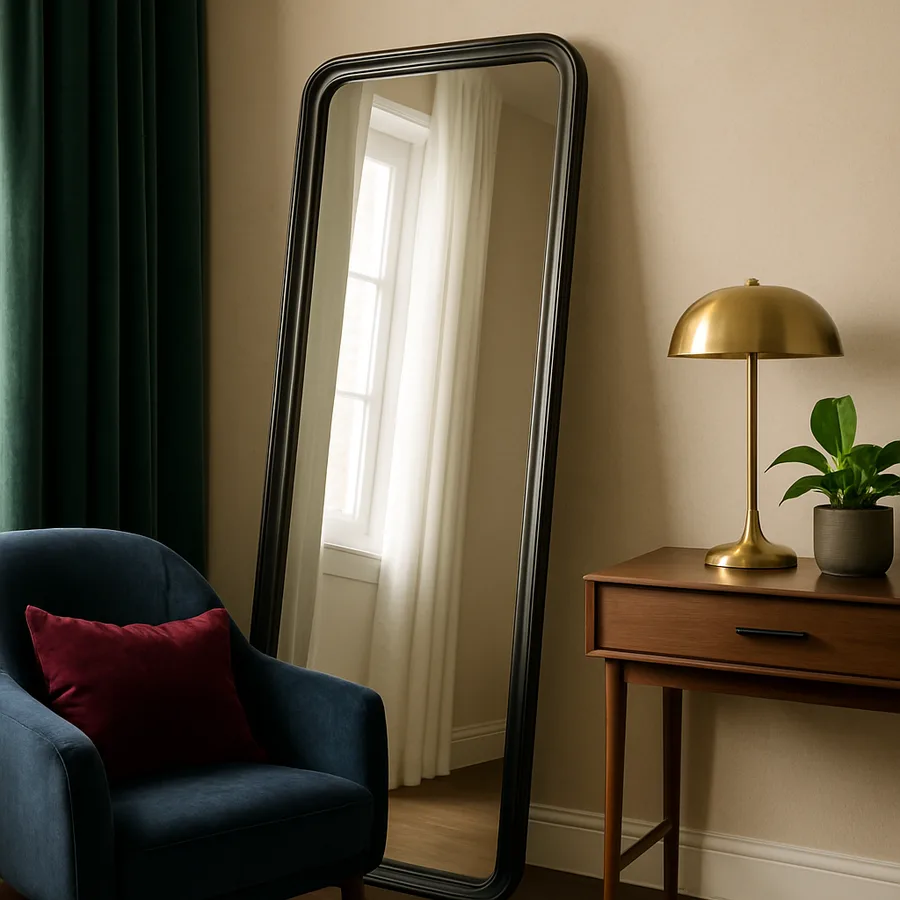
A full-length leaning mirror is the rare decorative object that manages to feel both casual and glamorous at once. Propped confidently against a wall, it signals a room that has not been overthought; it is also, statistically, one of the most frequently involved pieces of furniture in household tip-over incidents. The U.S. Consumer Product Safety Commission (CPSC) has documented a steady rise in injuries related to unsecured furniture and large décor, with an average of one furniture- or appliance-related tip-over death reported every two weeks in recent years. Large floor mirrors appear frequently in those reports, not because they are inherently dangerous, but because homeowners rarely secure them the way the manufacturer recommends.
The appeal is understandable. A leaning mirror can run 60 to 80 inches tall, fill an awkward corner, flood a room with reflected daylight, and double as a full-body dressing mirror without the cost or commitment of a built-in. It works in bedrooms, walk-in closets, entryways, dining rooms, and even home offices. The question is not whether to own one, but where to place it and how to keep it there, upright, stable, and safe, for the long haul.
The Physics of a Leaning Mirror
Before choosing a location, it helps to understand how a leaning mirror behaves physically. Any object leaned against a wall creates a triangle between the floor, the wall, and the mirror itself. The stability of that triangle depends on three variables: the lean angle, the coefficient of friction between the mirror's base and the floor, and the weight distribution of the mirror's frame. A lean angle between 5 and 10 degrees from vertical is generally considered ideal by furniture engineers affiliated with the American Home Furnishings Alliance (AHFA). Less than 5 degrees and the mirror is essentially vertical and prone to falling forward; more than 10 degrees and the top of the mirror projects outward enough to become a snag hazard for curtains, clothing, or passing elbows.
Floor surface matters as much as the angle. Hardwood, tile, and polished concrete offer little friction, which means the base of the mirror can slide out from under it, especially if someone nudges the frame. Low-pile rugs or silicone grip pads placed under the mirror's feet dramatically reduce this risk. Carpeted floors add friction but introduce a separate issue: the carpet pile compresses unevenly over time, slowly changing the lean angle. Most designers recommend re-checking the lean every three to six months on carpet.
Weight distribution is the third variable. A mirror with a heavy wooden base and a light top is inherently more stable than one with a thin metal frame that distributes weight evenly. When evaluating a mirror before purchase, tilt it slightly forward by hand and feel where the center of mass sits. If it wants to fall forward easily, you will need to anchor it mechanically, not just rely on gravity.
Bedroom Placement: Corners, Dressing Zones, and the Bed Wall
In bedrooms, the leaning mirror traditionally lives in one of three locations: a corner, a dressing zone near the closet, or the wall opposite the bed. Each choice has trade-offs. A corner placement is the most forgiving from a safety standpoint because two walls meet behind the mirror, which can help catch a tipping frame, and traffic patterns naturally avoid corners. A dressing zone placement, typically near a window for natural light, offers the most utility for choosing outfits, but it also places the mirror in the daily path of a sleepy person moving quickly in the morning.
Opposite-the-bed placement is the most debated. Proponents argue that it reflects light, expands the perceived size of the bedroom, and doubles a headboard's visual impact. Critics, often citing feng shui principles codified by practitioners affiliated with the International Feng Shui Guild, caution that a mirror facing the bed can disturb sleep by reflecting movement and subconscious stimuli during the night. Whichever camp you fall into, the safety question remains the same: a mirror opposite the bed must be anchored to the wall, because any movement from a nearby doorway or an opening closet can destabilize it.
Have you thought about what happens if a child, pet, or guest bumps the mirror in the dark? That single question has changed more placements than any design principle. If the answer is "it would fall on someone," the placement needs revision or anchoring, no exceptions.
Closet and Dressing Room Placement
Walk-in closets and dressing rooms are often the ideal environment for leaning mirrors because foot traffic is low, the floor is usually uniform, and lighting can be controlled. A 2024 report from the Houzz closet design index found that 41% of renovated walk-in closets included a full-length mirror, up from 28% five years prior, with leaning mirrors accounting for roughly half of that growth. The reason is flexibility; a leaning mirror can be repositioned as the closet's layout evolves, unlike a wall-mounted or door-mounted mirror.
In closets, the priority is light quality. The best leaning-mirror placements allow the user to stand facing the mirror with even light on their face and body, rather than a single overhead downlight that creates harsh shadows. A north-facing window, if one exists, provides the most accurate color rendering, which matters when you are trying to decide whether two garments truly match or merely look similar under warm bulbs. For closets without windows, a pair of diffused LED strips along the mirror's sides, at a color temperature of 4000K, replicates daylight reliably.
Closet floors are often carpeted, which means the lean angle will drift. A simple fix is a thin plywood or MDF board cut to the width of the mirror's base and placed under the feet; the board distributes weight across a wider area of carpet and holds the lean angle more consistently than the feet alone.
Entryway and Hallway Placement: Traffic Flow Considerations
Entryways benefit enormously from a full-length mirror because they give homeowners and guests a last look at the complete outfit, shoes included, before leaving the house. However, entryways also carry more traffic per square foot than any other room, and every person passing through is potentially a tipping hazard for an unsecured mirror. This is the location where wall anchoring is non-negotiable.
Hallways pose similar challenges, with the added complication of narrow widths. The International Residential Code (IRC), maintained by the International Code Council, specifies a minimum hallway width of 36 inches for residential construction. A leaning mirror set against the hallway wall projects outward by 4 to 8 inches depending on the lean angle, reducing that clear path. In a hallway under 42 inches wide, a leaning mirror is generally unsafe; a wall-mounted full-length mirror is the better option.
Entryway readers often ask: should the mirror face the front door or sit adjacent to it? Both work, but they create different effects. A mirror facing the door greets visitors with a reflected view of themselves, which some find welcoming and others find startling. A mirror adjacent to the door, typically on the wall perpendicular to the entry, acts more as a grooming station and feels less theatrical. Either way, confirm that the door at full swing cannot contact the mirror frame.
Anchoring Methods: What Actually Works
The single most important safety step for any leaning mirror taller than 48 inches is anchoring it to the wall. The American Society of Interior Designers (ASID) has echoed CPSC guidance in recommending that any large floor mirror be tethered with either a furniture safety strap or a purpose-built anti-tip wall bracket. These brackets cost between $8 and $25, install in minutes with basic tools, and can be placed behind the mirror so they remain invisible.
The most reliable method uses two anchor points: one on the wall and one on the back of the mirror frame, connected by a short metal strap or nylon cable. The cable should have just enough slack to allow for micro-adjustments of the lean angle but not so much that the mirror can tip more than a few degrees forward before the cable catches it. Screws should penetrate a wall stud or a certified toggle bolt anchor rated for at least double the mirror's weight. Drywall alone, with only a plastic anchor, is not sufficient for mirrors over 40 pounds.
Silicone grip pads on the feet are a secondary layer of defense, not a replacement for anchoring. They reduce sliding but do nothing to prevent a forward tip. Some manufacturers now ship mirrors with pre-installed D-rings on the back and matching wall hardware; if yours does, use it. If yours does not, a hardware store can sell you everything you need for under fifteen dollars.
Child and Pet Safety
Households with children under ten or large active pets require extra consideration. A curious toddler climbing on the base of a leaning mirror can exert enough leverage to pull the entire frame forward. According to data compiled by Safe Kids Worldwide, furniture and appliance tip-overs send a child to the emergency room approximately every 30 minutes in the United States. Large mirrors, because they are tall and often appear in bedrooms and living rooms where children play, are disproportionately represented in these incidents.
For families, the safest strategy is either to mount the mirror to the wall entirely, eliminating the lean, or to choose a smaller freestanding cheval mirror with a wide, weighted base and dual-anchor straps. Some newer products on the market are specifically marketed as "child-safe leaning mirrors," with tempered or laminated glass that holds together if shattered, and integrated tip-resistant feet. The Glass Association of North America has published safety standards for decorative mirror glass, and tempered options cost only 15 to 30 percent more than standard silvered glass.
Pets introduce a less obvious risk: reflection agitation. Dogs and cats, seeing their own reflection, sometimes lunge at or paw the mirror's base, which over time can loosen anchoring hardware or scratch the backing. A leaning mirror at pet height in a room the pet frequents should be checked and retightened periodically. If your dog has a habit of barking at its own reflection, that mirror belongs in a different room.
Styling and Light Optimization
Once placement and safety are settled, the leaning mirror earns its keep by amplifying light and expanding perceived space. The highest-impact placement reflects a natural light source, such as a window or a glass door. The mirror should sit on the wall opposite or at a 45-degree angle to the window; this bounces daylight into the darker half of the room and can reduce the need for additional lamps during the day. Designers at Architectural Digest regularly cite this technique as one of the fastest ways to brighten a dim room without renovation.
Frame choice influences the overall mood. A slim black or brass frame disappears into the reflection, making the mirror feel architectural and unobtrusive. A thick wood or ornate frame turns the mirror into a statement object. In minimalist rooms, the slim frame almost always wins; in eclectic or maximalist rooms, the ornate frame adds necessary personality.
Consider what the mirror will reflect at eye level. If the view it captures is a cluttered bookshelf or an untidy dresser, the mirror will amplify that visual noise. The best-placed leaning mirrors reflect either a window, a piece of art, or a clean architectural surface. Walk around the room, stand where the mirror will stand, and look at what appears in the reflection before committing to the spot.
Conclusion
A full-length leaning mirror is a design investment that rewards thoughtful placement and punishes carelessness. The casual aesthetic, the impression of a room that has been styled effortlessly, is a product of careful engineering underneath. Lean angle, floor friction, weight distribution, and anchoring all matter, and they all need attention before the mirror ever goes up. The payoff, when everything is done correctly, is a piece that expands a room, bounces daylight, and earns compliments for years.
The safety dimension cannot be overstated. CPSC data and independent reporting from organizations like Safe Kids Worldwide make clear that furniture tip-overs are among the most preventable household injuries, and large mirrors are an overrepresented category. Spending twenty dollars and ten minutes on an anti-tip strap is the single highest-return safety investment in any home with a leaning mirror, particularly for families with young children or active pets.
When you are evaluating where to place yours, start by mapping the room's traffic patterns, then the light sources, then the safety anchor points, and only then the aesthetic considerations. That order matters. A beautifully placed mirror that cannot stay upright is not actually beautifully placed. A functionally placed mirror that also looks stunning, reflecting a window and framing a doorway, represents the intersection of design and common sense where the best interiors always live.
Ready to place your leaning mirror with confidence? Download our free Interior Bliss safety-anchor checklist, subscribe to our newsletter for more expert placement guides, and explore our hand-picked collection of full-length mirrors with built-in anti-tip hardware for lasting peace of mind.
More Articles You May Like



Comments
Post a Comment