Butler's Pantry Between Kitchen and Dining Room: Layout Ideas
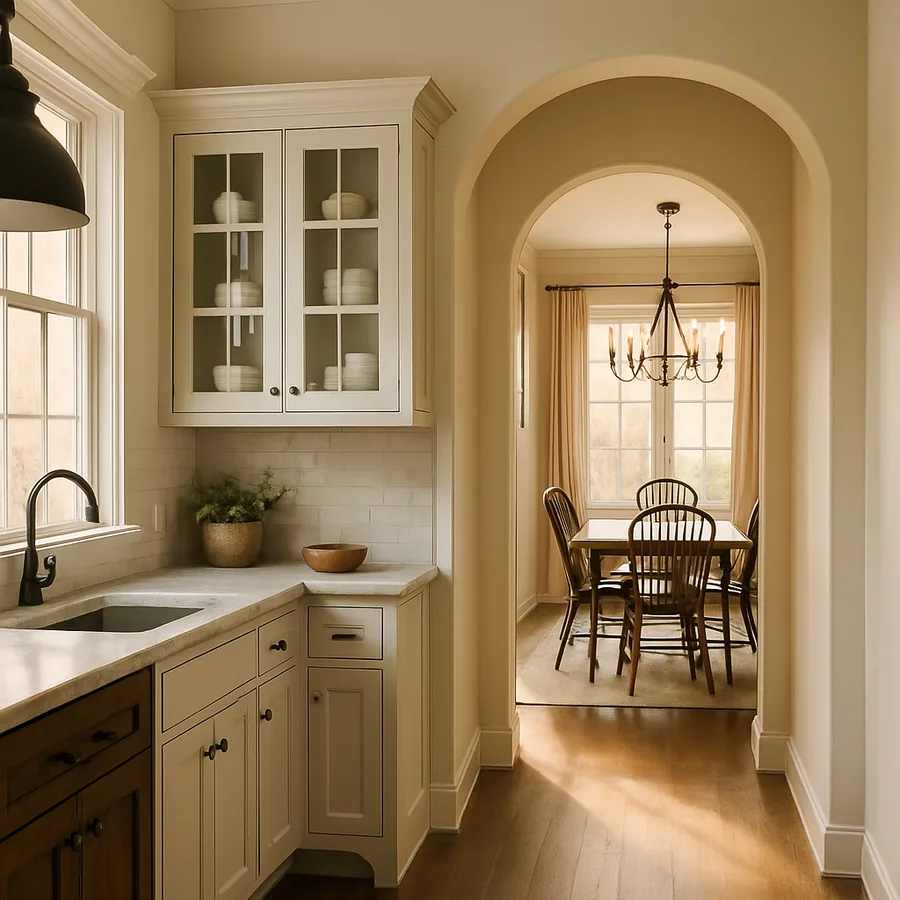
The Butler's Pantry Renaissance in Modern Home Design
The butler's pantry, once considered a relic of Victorian-era estates, has made a remarkable return to contemporary home design. Originally conceived as a staging area where household staff prepared serving trays and stored fine china between the kitchen and dining room, the modern butler's pantry serves a fundamentally different purpose. It functions as a transition zone that absorbs the mess of meal preparation, hides dirty dishes during dinner parties, and provides dedicated storage that would otherwise crowd the main kitchen. Its placement between the kitchen and dining room remains the defining feature, but everything else about the space has evolved.
The resurgence is backed by real market demand. According to the National Association of Home Builders (NAHB), butler's pantries appear in more than 50 percent of homes priced above 500,000 dollars in recent new construction surveys. This is not a trend limited to luxury homes, either. Mid-range builders have begun incorporating narrow butler's pantry corridors into standard floor plans as homeowners increasingly prioritize functional storage over open-concept minimalism. The pendulum has swung back toward purposeful, task-specific rooms.
What makes the butler's pantry particularly valuable in a kitchen-to-dining-room configuration is its role as a service corridor. Rather than carrying dishes through open living areas, the host moves through a private passageway equipped with counter space for plating, storage for serving ware, and sometimes a secondary sink for quick cleanup. This flow keeps the dining experience polished while the kitchen remains a working zone that guests do not need to see during the meal.
Whether you are designing a new home or carving a butler's pantry out of an existing hallway or closet, the layout decisions you make will determine whether this space becomes a hardworking asset or an underused afterthought. The following sections examine specific layout configurations, dimensional guidelines, storage strategies, and design details that make a butler's pantry between the kitchen and dining room genuinely functional rather than merely fashionable.
Galley Layout: The Classic Corridor Approach
The galley layout is the most traditional and space-efficient butler's pantry configuration. It consists of a narrow corridor with cabinetry and countertops on one or both sides, connecting the kitchen at one end to the dining room at the other. A single-wall galley places all storage and counter space along one wall, leaving the opposite wall as a clear walkway. A double-wall galley lines both sides with cabinetry, creating a denser storage environment but requiring more width to maintain a comfortable passage.
For a single-wall galley, the minimum recommended width is 42 inches from the face of the cabinets to the opposite wall. This provides a 24-inch-deep counter and 18 inches of walkway, which is adequate for one person moving through with a serving tray. A double-wall galley needs at least 60 inches of total width to accommodate 24-inch counters on both sides and a 12-inch aisle, though 66 to 72 inches is far more comfortable. The National Kitchen and Bath Association (NKBA) recommends a minimum 42-inch clearance between opposing base cabinets in any work corridor, and a butler's pantry should meet or exceed that standard.
The length of the galley depends on how much storage and counter area you need, but most residential butler's pantries run between 6 and 12 feet. A 6-foot galley provides enough room for a short run of lower cabinets, a section of upper glass-front cabinets, and a small countertop work surface. A 12-foot galley can accommodate a full secondary prep station with a sink, wine storage, a beverage refrigerator, and extensive dish storage. Longer corridors risk feeling tunnel-like unless broken up with visual elements like open shelving, glass cabinet doors, or a window at one end.
Traffic flow is the galley layout's greatest strength. The straight-line path between kitchen and dining room creates an intuitive service route that does not require turns or navigation around obstacles. During a dinner party, the host can plate dessert on the butler's pantry counter, stack dirty dishes in the secondary sink, and emerge into the dining room with clean hands and a fresh course in under a minute. This seamless flow is why the galley remains the preferred layout for serious entertainers and the configuration most frequently recommended by designers featured on Houzz's butler's pantry design pages.
L-Shaped and Pass-Through Configurations
Not every floor plan allows a straight corridor between the kitchen and dining room. When the two rooms are offset or separated by a corner, an L-shaped butler's pantry wraps around the angle and maintains the connection while adapting to the architecture. The L-shape places cabinetry along two perpendicular walls, with the corner serving as either a transition point or a dedicated workstation. Corner counter space works well for a beverage station or a display area for decorative serving pieces.
The challenge with L-shaped layouts is the corner itself. Dead corner space is a persistent problem in kitchen design, and it applies equally to butler's pantries. A lazy Susan or blind-corner pull-out in the lower cabinets rescues this otherwise wasted area. For upper cabinets, open shelving around the corner avoids the awkward deep cabinet that no one can reach into. Some designers eliminate upper cabinets at the corner entirely and install a statement light fixture or a piece of art, which prevents the space from feeling cramped while turning a functional problem into a design feature.
The pass-through configuration is a variation where the butler's pantry does not have a traditional door on one or both ends but instead opens directly into the kitchen and dining room through wide archways or cased openings. This approach maintains the visual connection between the rooms while still providing a distinct zone for storage and prep. Pass-throughs work especially well in homes with semi-open floor plans where hard walls between rooms have been partially removed but the homeowner still wants separation between the cooking zone and the dining zone.
Have you noticed that some homes have an awkward hallway between the kitchen and dining room that serves no purpose beyond connecting the two spaces? That hallway is a prime candidate for a butler's pantry conversion. Adding shallow cabinets (12 to 15 inches deep) along one wall, a narrow countertop, and a few glass-front uppers transforms dead circulation space into a functional storage and staging area. The hallway still works as a passage, but it now earns its square footage by housing china, glassware, table linens, and entertaining essentials that previously cluttered the main kitchen.
Essential Features and Fixtures
Every butler's pantry benefits from three core features: counter space, storage cabinetry, and adequate lighting. Counter space is the workhorse of the butler's pantry, providing a surface for plating food, staging courses, arranging flowers, and temporarily holding dirty dishes between the dining room and the kitchen sink. A minimum of 4 linear feet of counter is recommended, though 6 to 8 feet is ideal for households that entertain regularly. The counter material should be durable and easy to clean; quartz, granite, and butcher block are all practical choices.
A secondary sink is the single most impactful upgrade you can add to a butler's pantry. It allows quick rinsing of serving platters, hand washing between courses, and flower arrangement without returning to the main kitchen. A small bar sink (12 to 15 inches wide) is sufficient for most butler's pantry applications and requires less counter sacrifice than a full-sized basin. Plumbing a sink into an existing wall is straightforward if the butler's pantry shares a wet wall with the kitchen or a bathroom, and a licensed plumber can typically complete the rough-in within a day.
Storage should be divided between display and concealed zones. Glass-front upper cabinets showcase fine china, crystal stemware, and decorative serving pieces while keeping them dust-free. Solid-door lower cabinets hide everyday items like serving platters, chafing dishes, table linens, and backup supplies. Drawer storage within the lower cabinets works well for flatware, napkin rings, candles, and small entertaining accessories. The American Society of Interior Designers (ASID) recommends designing butler's pantry storage around specific inventory rather than generic dimensions, which means measuring your serving pieces before finalizing cabinet specifications.
Lighting in a butler's pantry needs to be both functional and atmospheric. Under-cabinet LED strip lights illuminate the counter for food prep and plating tasks. Interior cabinet lighting behind glass doors creates a warm glow that is visible from the dining room, adding ambiance during evening events. Overhead lighting, whether recessed cans or a small pendant fixture, provides general illumination for the corridor. Dimmable controls on all circuits let you shift the butler's pantry from a bright work zone during prep to a softly lit backdrop during dinner service.
Storage Strategies for China, Glassware, and Serving Pieces
The butler's pantry is the logical home for items that are used periodically rather than daily: the good china, holiday serving platters, wine decanters, and specialty glassware that sit unused in main kitchen cabinets for months at a time. Moving these items into the butler's pantry frees prime kitchen real estate for everyday dishes and cookware while placing entertaining essentials closer to the dining room where they are actually used. This redistribution alone can resolve the chronic cabinet shortage that plagues many kitchens.
For china storage, plate racks or peg-based dividers inside cabinets protect rims from chipping and allow you to store plates vertically rather than stacked. Vertical storage makes it easy to pull a single plate without lifting the stack above it, which reduces breakage and speeds up table setting. A set of 12 dinner plates stored vertically in a plate rack occupies roughly 14 inches of horizontal cabinet space, compared to a single 10-inch-wide stack that requires clearing the entire shelf to access the bottom plate.
Stemware storage is best handled with under-cabinet stemware racks that hang wine glasses and champagne flutes upside down by their bases. This approach protects the rims, displays the glassware attractively behind glass cabinet doors, and frees shelf space for other items. A 36-inch under-cabinet rack holds 12 to 18 standard wine glasses depending on bowl size. For homes with extensive wine glass collections, dedicating an entire upper cabinet to hanging stemware creates a visual focal point that doubles as practical storage.
Serving platters, cake stands, and chafing dishes present a storage challenge because of their irregular shapes and sizes. Deep lower cabinets with adjustable dividers allow you to create custom-width slots for each piece. Alternatively, pull-out shelves with non-slip liners keep heavy platters accessible without stacking. The key is preventing the Tetris-like nesting that occurs when odd-shaped items are simply placed on a shelf together. Once platters are stacked haphazardly, the bottom piece becomes inaccessible, and the whole arrangement collapses the first time you try to retrieve something from the middle.
Connecting the Spaces: Doors, Openings, and Sightlines
How the butler's pantry connects to the kitchen and dining room at each end dramatically affects both its functionality and the overall feel of your home. A full swinging door at each end provides maximum sound and visual separation, which is ideal if you want complete privacy between the kitchen work zone and the dining experience. However, swinging doors require clear floor space for their arc and can be awkward when carrying trays with both hands. Butler's pantry doors historically swung in both directions using double-action hinges, and this hardware remains available from specialty suppliers.
Pocket doors are an increasingly popular alternative that provides the closure of a solid door without consuming floor space. A pocket door slides into the wall cavity, leaving the full width of the opening clear when open and a solid barrier when closed. The only requirement is a wall section wide enough and deep enough to house the door slab, which typically means a 2x6 stud wall rather than a standard 2x4. For homeowners retrofitting a butler's pantry into an existing home, confirming wall thickness before specifying pocket doors can prevent an expensive mid-project surprise.
Open archways or cased openings create the most fluid transition between spaces and work well in homes with casual entertaining styles. An open butler's pantry becomes a visible extension of both the kitchen and dining room, which means its contents and organization are always on display. This approach demands a higher standard of neatness and intentional styling, including attractive cabinet hardware, consistent countertop materials, and thoughtful accessory choices. The reward is a sense of spaciousness and connection that closed doors cannot provide.
Do you entertain formally or casually? The answer should guide your door decision. Formal entertaining benefits from doors that hide the kitchen chaos and let the dining room feel like a self-contained experience. Casual entertaining thrives on openness, where the cook is part of the conversation and guests drift between rooms freely. Many homeowners install pocket doors and simply leave them open most of the time, closing them only for seated dinner parties. This flexibility makes pocket doors the most versatile option for households that do both.
Design Details That Distinguish a Butler's Pantry
A butler's pantry should feel like a deliberate space, not a leftover corridor with cabinets bolted to the walls. One effective strategy is to treat the butler's pantry as a design bridge between the kitchen and dining room, borrowing elements from each. If the kitchen features shaker-style cabinets in white and the dining room has dark walnut furniture, the butler's pantry might use shaker cabinets in a warm greige that mediates between the two palettes. This visual transition makes the spaces feel connected but distinct.
Countertop selection offers another opportunity for differentiation. While the main kitchen might feature durable quartz in a neutral tone, the butler's pantry can showcase a more dramatic material like honed marble, soapstone, or a richly veined quartzite. Because the butler's pantry counter handles less heavy-duty prep than the kitchen, you can choose materials that prioritize beauty over maximum durability. A marble countertop in a butler's pantry adds a layer of elegance that feels intentional without the maintenance concerns that come with using marble as a primary kitchen surface.
Hardware and fixtures in the butler's pantry should coordinate with but not necessarily match the main kitchen. Unlacquered brass pulls in the butler's pantry can complement brushed nickel in the kitchen, creating visual interest without clashing. A small pendant light with a decorative shade adds personality that would be impractical over a busy kitchen work zone but feels perfectly appropriate in a butler's pantry where the pace is slower and the atmosphere more curated. These details signal that the space was designed with intention, not simply filled with leftover kitchen components.
Flooring continuity is one detail that many homeowners overlook. If the kitchen and dining room share the same flooring, extending that material through the butler's pantry creates a seamless visual flow. If the rooms have different flooring, such as tile in the kitchen and hardwood in the dining room, the butler's pantry is the natural place for the transition. A well-placed threshold or a gradual material change within the butler's pantry corridor makes the shift feel intentional. The design features highlighted in Architectural Digest consistently show that flooring continuity is one of the simplest ways to make a butler's pantry feel integrated rather than inserted.
Conclusion: Making the Butler's Pantry Work for Your Home
A butler's pantry between the kitchen and dining room is more than a luxury feature; it is a functional upgrade that improves storage capacity, streamlines entertaining, and creates a purposeful transition between two of your home's most important rooms. The layout you choose, whether galley, L-shaped, or pass-through, should respond to your floor plan's geometry and your household's traffic patterns. The features you include, from a secondary sink to glass-front display cabinets, should reflect how you actually entertain rather than a generic checklist of upgrades.
Start your planning by mapping the physical connection between your kitchen and dining room. Measure the available corridor width, identify which walls carry plumbing lines, and note where electrical circuits run. These practical constraints will narrow your layout options quickly and prevent the disappointment of designing a dream butler's pantry that conflicts with your home's existing infrastructure. A 30-minute measurement session with a tape measure and a notepad will save weeks of redesign later.
Sketch your ideal butler's pantry layout this weekend and list the specific items you want it to store. Bring that sketch and inventory list to a kitchen designer or contractor for a feasibility consultation. With clear dimensions and a defined purpose, your butler's pantry will become one of the most hardworking and satisfying spaces in your home, a room that earns its square footage every time you set a table or host a gathering.
More Articles You May Like



Comments
Post a Comment