Deep Kitchen Drawer Dividers for Pots, Lids, and Baking Sheets
The Case for Moving Cookware From Cabinets to Drawers
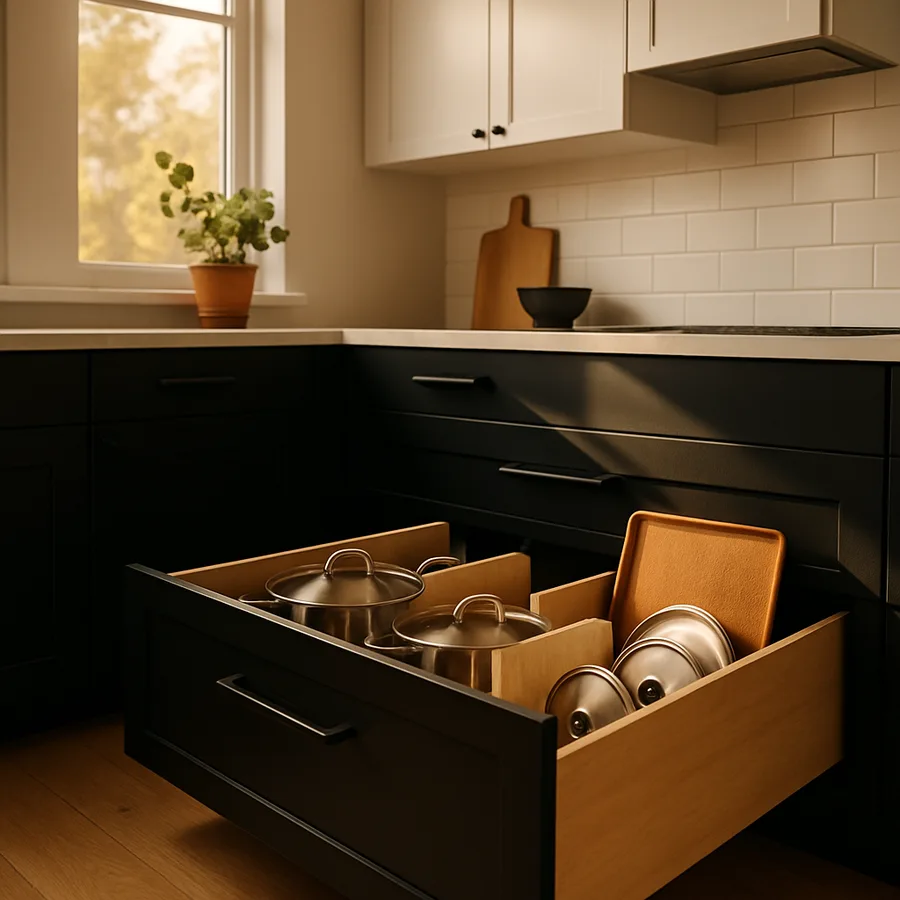
Stacking pots inside cabinets has been the default kitchen storage approach for generations, but it has never been a good one. Every time you need the pan at the bottom of the stack, you have to lift and shuffle three or four other pieces to reach it. Lids slide off and clatter against the shelf. Baking sheets lean against each other and fall forward the moment you open the cabinet door. Deep kitchen drawer dividers solve all of these problems by storing cookware vertically, giving each piece its own slot and making every item accessible without disturbing its neighbors. The shift from cabinet to drawer storage is one of the most impactful kitchen organization changes a homeowner can make.
The National Kitchen and Bath Association (NKBA) has documented a steady increase in deep drawer installations in new kitchen builds over the past decade. Designers now routinely specify drawers that are six to twelve inches deep specifically for cookware storage, replacing the lower cabinets with fixed shelves that made pot retrieval so frustrating. According to their design research, kitchens with deep drawer systems report measurably higher satisfaction scores in post-renovation surveys. The reason is straightforward: drawers pull out completely, giving you a full overhead view of the contents, while cabinets force you to crouch down and reach into a dark interior.
Deep drawers also protect your cookware better than cabinets do. When pots are stacked, the bottom of one pan rests against the cooking surface of another, which scratches non-stick coatings and dulls the finish on stainless steel over time. Vertical dividers eliminate this metal-on-metal contact entirely. Each pot, pan, lid, and baking sheet occupies its own slot, separated from adjacent pieces by a solid divider panel. This arrangement is especially important for cast iron cookware, which is heavy enough to dent or chip the enamel on lighter pieces stacked beneath it.
The ergonomic benefits deserve attention as well. Reaching into a lower cabinet requires bending or kneeling, which becomes increasingly uncomfortable as we age. A deep drawer at waist height brings all of your cookware to a level where you can see and grab what you need while standing upright. For households with mobility limitations, this difference is not merely a convenience but a meaningful improvement in kitchen accessibility. The combination of better visibility, easier access, and superior cookware protection makes deep drawer storage with dividers a clear upgrade over traditional cabinet stacking.
Types of Dividers That Work Best for Heavy Cookware
Not all drawer dividers are built to handle the weight and bulk of pots, pans, and baking sheets. The dividers designed for utensil drawers are too short and too flimsy for cookware duty. What you need are heavy-duty deep drawer dividers made from materials that can support ten to twenty pounds per slot without bowing or tipping. The three main categories worth considering are peg-based systems, fixed panel dividers, and adjustable wire rack dividers, each with distinct advantages depending on your cookware collection and drawer dimensions.
Peg-based systems use vertical wooden or metal dowels that insert into a perforated base panel. The pegs create flexible boundaries between items, and you can rearrange them whenever your cookware collection changes. This system works particularly well for baking sheets, cutting boards, and flat items that stand upright between two pegs. The downside is that pegs do not provide a continuous barrier, so smaller lids can sometimes slip between them. A survey by Houzz found that peg-based drawer systems ranked among the top five most-desired kitchen features in recent remodeling projects, with 68 percent of respondents expressing interest in installing them.
Fixed panel dividers are solid partitions, typically made from plywood, bamboo, or stainless steel, that create permanent compartments within the drawer. These provide the most rigid separation and work best for heavy cast iron skillets and Dutch ovens that need substantial support. The trade-off is reduced flexibility: once the panels are installed, adjusting the compartment width requires removing and repositioning the hardware. For homeowners with a stable cookware collection that rarely changes, fixed panels offer the cleanest look and the most reliable support.
Adjustable wire rack dividers offer a middle ground between pegs and fixed panels. These typically feature a metal frame with movable divider panels that slide along a track at the bottom of the drawer. The wire construction allows you to see the contents at a glance, and the adjustable panels can accommodate everything from narrow baking sheets to wide stock pots. Wire dividers are also the easiest to clean, since you can lift the entire rack out of the drawer and wash it in the sink. For kitchens where the cookware collection evolves frequently, adjustable wire racks provide the best balance of flexibility and support.
Measuring and Planning Your Deep Drawer Layout
Accurate measurement is the foundation of a successful deep drawer divider installation. Start by measuring the interior dimensions of your drawer: width from side to side, depth from front to back, and height from the drawer bottom to the underside of the countertop or upper drawer. Write these numbers down before you start shopping, because the difference between a divider system that fits perfectly and one that is frustratingly wrong often comes down to a quarter of an inch. Remove any existing organizers or liners before measuring, and check whether the drawer bottom is flat or has a raised edge that could affect the placement of a base panel.
Next, inventory the cookware you plan to store in the drawer. Lay everything out on the counter and group items by size: large pots together, medium saucepans together, lids together, and flat items like baking sheets and cutting boards together. Measure the diameter of your widest pot and the height of your tallest item when standing on its side. These measurements determine the minimum compartment width and the minimum drawer depth you need. A common planning error is focusing only on the drawer dimensions while ignoring the actual size of the cookware, which leads to compartments that are either too narrow to hold a pot handle or too wide to keep items from leaning.
Consider how frequently you use each item when deciding on placement within the drawer. The pieces you reach for daily should occupy the front compartments, closest to where you stand when cooking. Less frequently used items, like specialty baking pans or the roasting pan you only bring out during holidays, can go in the back. This front-to-back prioritization might seem obvious, but many people simply place items randomly and then wonder why they are always reaching past everything to grab their everyday skillet. Intentional placement turns a deep drawer from a storage box into a workflow tool that supports how you actually cook.
If you are planning to install dividers in multiple drawers, sketch a layout on paper before purchasing any hardware. Assign each drawer a category: one for pots and pans, one for lids and flat items, one for baking supplies. This prevents the common problem of buying a one-size-fits-all divider system and trying to force every type of cookware into the same compartment style. The American Society of Interior Designers (ASID) recommends this zone-based approach for kitchen organization, noting that dedicated storage zones reduce the time spent searching for items by up to 40 percent compared to mixed-category storage.
Installation Methods for Different Drawer Types
The installation process for deep drawer dividers varies significantly depending on whether you are working with standard builder-grade drawers, custom cabinetry, or retrofit situations where you are adding dividers to existing drawers that were not originally designed for cookware storage. Each scenario requires a slightly different approach, but the principles remain consistent: secure the dividers firmly so they do not shift under the weight of heavy cookware, ensure adequate clearance for the drawer to close fully, and protect the drawer interior from scratches caused by metal divider hardware.
For standard drawers, most off-the-shelf divider systems use a spring-tension mechanism that presses against the drawer sides, similar to how an adjustable shower curtain rod works. These require no drilling, no screws, and no permanent modification to the drawer. The tension holds the dividers in place surprisingly well, even with heavy items leaning against them. However, the spring force must be strong enough to resist the lateral pressure of a leaning cast iron skillet, so check the weight rating before purchasing. Budget dividers with weak springs will slowly compress and allow the compartments to collapse inward, which defeats the entire purpose.
Custom cabinetry often comes with the option to have dividers built directly into the drawer box during manufacturing. This is the ideal scenario because the dividers are integrated into the drawer structure, using the same material and finish as the drawer sides. If you are in the planning phase of a kitchen renovation, specify your divider preferences to the cabinet maker before production begins. Adding dividers after the fact to custom drawers usually requires professional installation to avoid damaging the finish. According to the NKBA consumer resources page, specifying internal drawer organization during the design phase adds only 5 to 10 percent to the cabinet cost, compared to 20 to 30 percent for aftermarket retrofit installations.
Retrofit installations in older kitchens may require additional steps. Older drawers tend to have shallower depths, thinner bottom panels, and less sturdy construction than modern soft-close drawers. Before loading a vintage drawer with twenty pounds of cast iron, verify that the drawer slides can handle the weight. Many older kitchens use side-mounted roller slides rated for only 25 to 50 pounds, while modern undermount slides are rated for 75 to 100 pounds or more. Upgrading the drawer slides before installing dividers is a worthwhile investment that prevents the frustration of a drawer that sags, jams, or pulls free from its tracks under a full load of cookware.
Regardless of the installation method, always line the bottom of the drawer with a non-slip mat before placing the dividers. This protects the drawer finish from scratches, dampens the noise when setting heavy items down, and prevents the entire divider system from shifting during use. Cork liner is an excellent choice for this application because it provides cushioning, grip, and moisture resistance all in one material. Cut it to fit the drawer bottom precisely, and replace it every two to three years as it compresses and loses its cushioning properties.
Organizing Lids Without Losing Your Mind
Lids are the most frustrating category of kitchen storage because they refuse to stay organized in any conventional arrangement. They are round, they have handles that protrude, they come in similar sizes that are hard to tell apart at a glance, and they invariably end up in a clattering pile at the back of a cabinet. Deep drawer dividers solve the lid problem decisively by standing each lid on its edge in its own narrow slot, with the handle facing up for easy identification and retrieval. Once you experience a lid drawer with proper dividers, you will wonder how you ever tolerated the cabinet lid avalanche that preceded it.
The key to lid organization is matching the slot width to the lid thickness plus handle clearance. Most pot and pan lids are about half an inch thick at the rim, but the handle adds another one to three inches depending on the style. Measure the handle height of your tallest lid and ensure the drawer depth accommodates it when the lid is standing on edge. Glass lids with loop handles typically require wider slots than flat metal lids, and tempered glass lids are heavier than you might expect, so weight capacity matters here too. Placing a small piece of felt or foam at the bottom of each lid slot prevents chipping on glass lids and reduces noise when placing lids back in the drawer.
A dedicated lid drawer separate from the pot drawer is the gold standard approach, but not every kitchen has the drawer space for it. If you need to store lids in the same drawer as their matching pots, position the lid section at the front of the drawer and the pots behind them. This arrangement works because lids are thinner and can occupy the shallow space near the front, while the deeper section behind them accommodates the pot bodies. Alternatively, some divider systems include a narrow upper tray that sits across the top of the drawer, creating a second level specifically for lids while the pots remain below. This two-tier approach maximizes the cubic volume of the drawer without compromising access to any item.
How often do you find yourself lifting three lids to find the one that fits the pot you are using? If the answer is more than once a week, a divider-based lid organization system will pay for itself in saved time and reduced annoyance within the first month. The average household owns between eight and twelve lids, and a well-organized lid drawer using vertical dividers can accommodate all of them in a single standard-width drawer. Label each slot if your lids look similar, or arrange them in order from smallest to largest so you can locate the right size instantly by position alone.
Protecting Your Investment in Quality Cookware
Quality cookware represents a significant financial investment. A single copper-core saucepan can cost over two hundred dollars, and a complete set of premium stainless steel cookware from brands like All-Clad or Le Creuset can easily exceed a thousand dollars. Storing these pieces in a way that preserves their condition is not fussiness but rather basic asset protection. Deep drawer dividers prevent the surface damage that occurs when heavy pieces are stacked or when metal surfaces grind against each other during the routine action of opening and closing a cabinet door. The cost of a quality divider system is typically less than five percent of the cookware it protects.
Non-stick cookware is especially vulnerable to storage damage. The coating on even premium non-stick pans is susceptible to scratching from metal contact, and those scratches compromise both the cooking performance and the safety of the coating. Storing non-stick pans vertically in individual divider slots eliminates the surface-to-surface contact that causes this damage. For added protection, place a soft cloth or felt liner in each slot where non-stick cookware will be stored. This extra layer of cushioning costs almost nothing but can extend the useful life of your non-stick pans by several years, according to guidance published by the Better Homes and Gardens cookware care section.
Cast iron cookware presents its own storage challenges. These pieces are extremely heavy, and their rough bottom surfaces can scratch drawer interiors, countertops, and other cookware. A deep drawer with sturdy dividers is actually the ideal storage solution for cast iron because the weight is supported by the drawer slides rather than by another piece of cookware beneath it. Ensure that each cast iron piece has a divider slot wide enough to accommodate the handle, and consider lining the slots with cork to protect both the seasoned surface of the pan and the drawer interior. Cast iron also benefits from air circulation, and vertical storage in an open-topped divider slot provides better airflow than stacking inside a closed cabinet.
Baking sheets, muffin tins, and cooling racks are prone to bending when stored horizontally under the weight of other items stacked on top. Vertical storage in divider slots maintains their flat profile and prevents the warping that causes uneven baking results. If you have ever noticed that your cookies brown more on one side than the other, a warped baking sheet may be the culprit rather than your oven. Storing these items on edge in a dedicated section of a divided deep drawer keeps them flat, accessible, and in the condition that produces consistent baking results every time you use them.
Conclusion
Deep kitchen drawer dividers transform cookware storage from a daily frustration into a system that works with you rather than against you. By storing pots, lids, and baking sheets vertically in individual compartments, you eliminate the stacking, shuffling, and clattering that characterize traditional cabinet storage. Every piece is visible, accessible, and protected from the surface damage that degrades even the most expensive cookware over time.
The investment required is modest relative to the benefits delivered. A quality divider system for a single deep drawer typically costs between twenty and sixty dollars, while professional-grade integrated systems installed during a renovation add only a small percentage to the overall cabinet budget. The return on that investment comes in the form of faster meal preparation, longer cookware life, reduced noise, and a kitchen that feels organized rather than cluttered. Whether you choose pegs, fixed panels, or adjustable wire racks, the right divider system matches your specific cookware collection and cooking habits.
What would you do with the extra minutes you save each day when every pot, pan, and lid is exactly where you expect it to be? Start by measuring your deepest kitchen drawer today, inventorying the cookware you use most frequently, and selecting a divider system that turns that drawer into the most efficient storage space in your kitchen.
More Articles You May Like



Comments
Post a Comment