Patio String Light Hanging Methods For Permanent Display
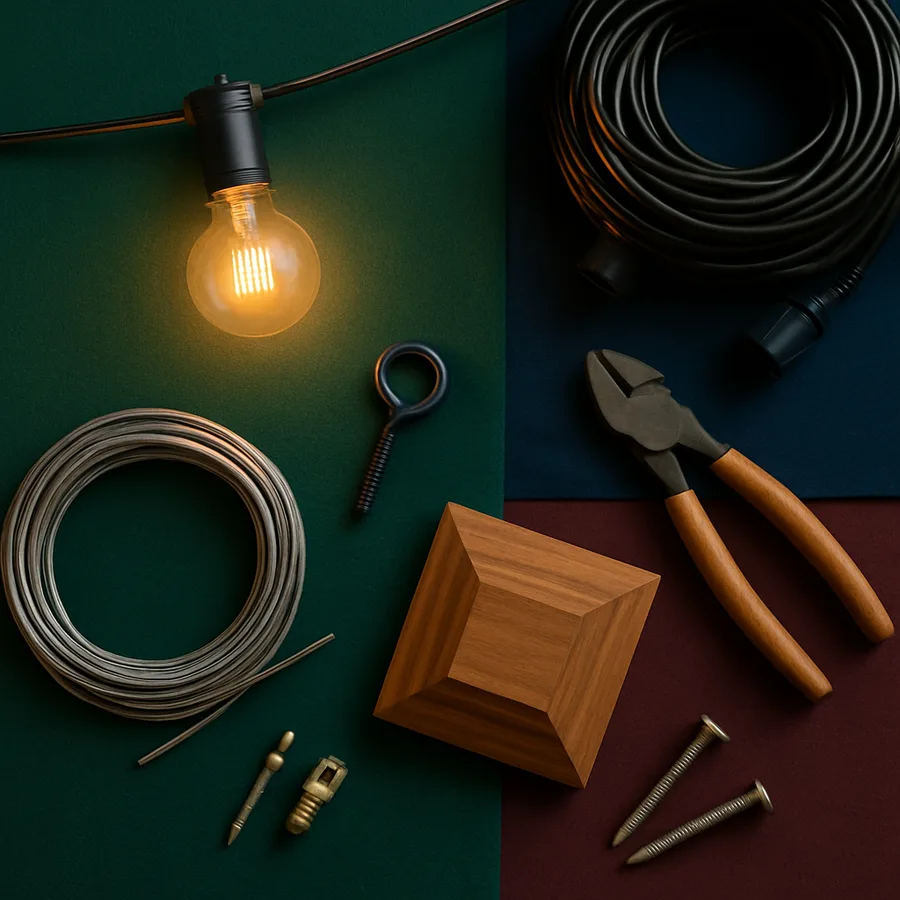
A patio that glows from dusk until midnight changes the way a household uses its outdoor square footage. Where occasional string lights once vanished after Labor Day, permanent installations now serve as nightly infrastructure, extending dinner parties, reading hours, and quiet conversations into the cool side of the day. The challenge sits at the intersection of electrical safety, structural engineering, and quiet visual design. A festoon hung from a flimsy hook will sag, swing, and eventually fail. One mounted with intent will stay taut for a decade.
This guide walks through every credible approach to anchoring patio string lights for year-round, permanent display. It covers the catenary cable systems used by professional landscape lighting designers, the merits of dedicated posts, wall-mounted hardware that respects masonry, and the wiring practices the National Electrical Code (NEC) expects on residential exteriors. Whether the goal is a single span across a deck or a grid above a multi-zone backyard, the underlying principles remain the same: anchor into structure, control tension, and detail the wiring as if it will outlive the bulbs.
Why Permanent Installation Demands a Different Mindset
Temporary string lights forgive almost anything. Tape, plastic clips, and a nail in a fascia board will hold a single season of light. Permanent installations cannot lean on these shortcuts. They must absorb wind loads, thermal expansion, ultraviolet exposure, and the slow creep of any line under tension. According to the American Lighting Association, outdoor decorative lighting failures stem more often from poor anchoring and water intrusion than from bulb or wire defects themselves.
The first decision is whether the lights will hang from the building, from freestanding structure, or from a hybrid of the two. Each path has consequences. Building-mounted runs are simple to wire but transmit every gust into the siding or fascia. Freestanding posts isolate the load but require footings and a sightline strategy. Hybrid layouts, in which one end ties to the house and the other to a post or tree, are the most common residential approach because they balance ease with flexibility.
Before any hardware enters the wall, the homeowner should ask two questions. First, what is the prevailing wind direction across the patio, and where will tension be highest during a storm? Second, what is the wiring path back to a protected outdoor receptacle, and is that circuit protected by a ground-fault circuit interrupter (GFCI) as required by NEC Article 210.8? Answering both before drilling prevents the most common mistakes.
The Catenary Cable Method: Professional Standard
The single most durable permanent installation method uses a stainless steel aircraft cable, also known as a catenary wire, that carries the structural load while the string lights themselves clip to it. The lights never bear tension. This is the approach used by the majority of commercial patios, beer gardens, and high-end residential designers because it survives wind, ice, and seasonal expansion without sagging into the dining zone.
The components are modest. A run requires stainless cable rated for outdoor use (typically 1/8 inch, 7x7 strand), two heavy turnbuckles, two thimbles to protect the cable at each loop, and either eye bolts sunk into structure or wall-mounted brackets rated for the expected tension. Industry estimates from professional landscape lighting installers suggest that catenary systems retain proper tension for eight to ten years before the turnbuckle needs a single retightening, compared with hooks-only installations that often sag within a single season.
Tensioning is the craftsmanship step. The cable should sag enough to absorb thermal movement, generally three to four percent of the total span, but not so much that bulbs swing into furniture or guests below. Once tension is set, string lights attach with small zip ties or dedicated cable clips at the socket caps, never around the wire itself. The bulbs hang plumb, the wire stays slack, and the catenary takes the punishment.
Dedicated Posts: When Structure Will Not Cooperate
Many patios lack a second building or mature tree to anchor against. The answer is a purpose-built post, either set in concrete or bolted to a deck rim joist. Dedicated posts give the designer full control over height, spacing, and sightline. They also let the installation read as intentional rather than improvised.
Height matters more than most homeowners expect. A post that places the lowest bulb between nine and eleven feet above the patio surface keeps light out of guests' eyes while still creating the warm overhead canopy that makes outdoor rooms feel enclosed. Wood posts are the most common, but powder-coated steel posts deliver a slimmer profile and resist rot. For ground-set installations, the National Association of Home Builders (NAHB) recommends footings that extend below the local frost line to prevent heave, with concrete collars that crown above grade to shed water away from the post base.
Deck-mounted posts demand a different conversation. The lateral load from a tensioned string light run is real, and a post bolted only to a deck board will eventually tear free. The right detail captures the rim joist with a long structural bolt and a backing plate, or uses a saddle bracket designed for this load case. Some homeowners ask whether four-by-four lumber is enough, and for short spans under twenty feet it usually is, provided the connection to structure is engineered rather than improvised.
Wall and Masonry Mounting Done Right
House-mounted installations live or die by the anchor. A lag screw driven into vinyl siding will hold for a few weeks and then pull through, leaving a tear and a leak. The correct path drives through siding into solid framing using a screw eye or eye bolt sized for the expected tension, with an exterior-rated sealant collar at the penetration. The hardware itself should be stainless steel or hot-dip galvanized; lesser finishes will streak rust down the siding within two seasons.
Masonry walls accept either a sleeve anchor or a wedge anchor sunk into solid brick or block, never into mortar joints. Brick is harder than mortar but more brittle, so a slow hammer-drill speed and a sharp masonry bit prevent spalling. Stucco walls require finding the framing behind the substrate, because the stucco itself will crack around a loaded fastener. A licensed electrician or experienced installer can locate framing with a stud finder calibrated for exterior assemblies.
Many readers ask whether they can simply screw a hook into the fascia board under the roof eave. The answer is yes for very light loads, but the fascia is rarely designed to carry lateral tension, and pulling against it can loosen the gutter system or telegraph movement back into the soffit. A short blocking detail behind the fascia, or a dedicated eye bolt driven into a rafter tail, solves the problem permanently.
Wiring, Power, and Code Compliance
Permanent outdoor lighting is permanent wiring, and that distinction triggers code obligations many homeowners do not anticipate. The National Electrical Code requires outdoor receptacles to be protected by a ground-fault circuit interrupter, and any cord-and-plug string light intended for long-term outdoor use must carry a wet-location listing from a recognized testing laboratory. Lights bearing only a damp-location rating belong under covered porches, not exposed pergolas.
Most permanent installations terminate at a weather-resistant exterior receptacle housed in an in-use cover, sometimes called a bubble cover. The cover protects the plug while the cord remains energized in rain. Where multiple light runs converge, a small subpanel or a switched outdoor circuit gives the homeowner a single point of control without trip hazards from extension cords. Smart switches and dusk-to-dawn timers integrate cleanly when the run is hardwired or terminates at a controllable receptacle.
For installations that exceed the capacity of a single 15-amp circuit, the wiring conversation grows quickly. LED string lights consume a fraction of the power of older incandescent festoons, often less than five watts per socket, which means a long run that would have overloaded a circuit a decade ago will now operate well under capacity. Still, manufacturer specifications govern the maximum end-to-end connection of strings, and exceeding that limit risks both fire and warranty.
Layout, Aesthetics, and Common Layout Patterns
A permanent installation rewards careful layout. The eye reads a parallel run of evenly spaced bulbs as orderly; a zigzag or starburst pattern feels festive but quickly grows visually noisy. Most designers favor one of three layouts: a single perimeter run that traces the patio edge, a parallel grid that fills the ceiling plane, or a radial pattern that converges on a central pole. Each fits a different patio geometry.
Bulb spacing along the wire is another decision. Twelve-inch spacing produces a dense, almost theatrical glow appropriate for intimate dining patios, while twenty-four-inch spacing reads as quieter, calmer, and better suited to large entertaining areas where the lights serve as ambient ceiling rather than focal point. Warm color temperatures between 2200K and 2700K consistently outperform cooler whites for outdoor decorative use; they flatter skin tones and feel continuous with candlelight and firepit warmth.
Homeowners often wonder how many runs are enough. A practical rule from the lighting design community holds that two crossing runs deliver enough overhead light for dining and conversation on a patio up to about four hundred square feet, with a third run added for larger surfaces or for patios that adjoin steps or grade changes where additional visibility is welcome. Beyond aesthetics, more runs also distribute the structural load across more anchors, reducing the demand at any single point.
Seasonal Maintenance and Long-Term Care
Even a perfectly installed system benefits from a brief annual check. Walking the run once each spring, looking for slack that has developed in the catenary cable, checking each anchor for movement, and inspecting the bulb sockets for water intrusion catches small issues before they become failures. A single turnbuckle adjustment, taking under a minute, can restore tension that has crept loose across a season of thermal cycling. Replacing one cracked socket cap prevents the moisture path that would otherwise corrode the wiring from the inside.
Bulb replacement is the other recurring task. Quality LED string light bulbs are rated for between fifteen thousand and twenty-five thousand hours of operation, which translates to roughly eight to twelve years of typical dusk-to-midnight use. Replacing burned-out bulbs as they fail, rather than all at once, prevents the visual disruption of a partially dark run and gives the cook station and dining area continuous quality. Keeping a small supply of spare bulbs in a labeled container near the outdoor electrical panel makes replacement a two-minute task rather than a shopping trip.
For homeowners in regions with severe winters, the question of whether to remove the lights for the season comes up often. The honest answer is that quality outdoor-rated LED string lights, properly anchored on stainless catenary, handle winter weather without removal. Snow load on the wire is modest because the bulbs and sockets shed snow naturally, and the cold itself does not damage outdoor-rated electronics. Leaving the system in place year-round also avoids the wear and tear that repeated installation and removal inflicts on the anchors and connections. The trade is purely aesthetic; some households prefer the cleaner winter sightline of bare structure, and removal for storage is reasonable in those cases.
Conclusion
Permanent patio string lights are a small infrastructure project disguised as a decorating decision. Treated as decoration alone, they sag, swing, and fail. Treated as infrastructure, with proper anchoring, code-compliant wiring, and a catenary system to carry tension, they become a quiet backdrop that elevates every evening spent outdoors for the next decade. The difference is not money; the difference is sequence. Plan the layout, source proper hardware, drill into real structure, and protect the wiring before turning attention to bulb spacing and color temperature.
The homeowners who get the best results approach the project the way they would approach finished interior carpentry. They take time choosing the path, they prefer stainless steel to bargain hardware, and they accept that one careful afternoon of installation will save a decade of resagging and replacement. Working with a licensed electrician for the supply side, even when the homeowner intends to install the lights themselves, prevents the most expensive mistakes around grounding, GFCI protection, and circuit loading.
The reward is the kind of patio that hosts itself. Children read under it on summer nights. Friends linger after dinner without anyone reaching for a lamp switch. The lights come on at dusk and go off at midnight without intervention, year after year, because the underlying details were built once and built correctly. That is what permanent means in this context, and it is what separates a quick festoon from a lasting outdoor room.
Ready to upgrade an existing seasonal installation? Start with a site walk this weekend. Sketch the layout, locate the nearest GFCI-protected receptacle, identify the anchor points, and price the cable, turnbuckles, and bulbs together. Then either book a licensed electrician for the supply work or schedule a Saturday for the install, and consult the National Association of Home Builders and the American Lighting Association for additional guidance on outdoor electrical and lighting practice before breaking ground.
More Articles You May Like



Comments
Post a Comment