Outdoor Refrigerator Cabinet Drawer Style Versus Door
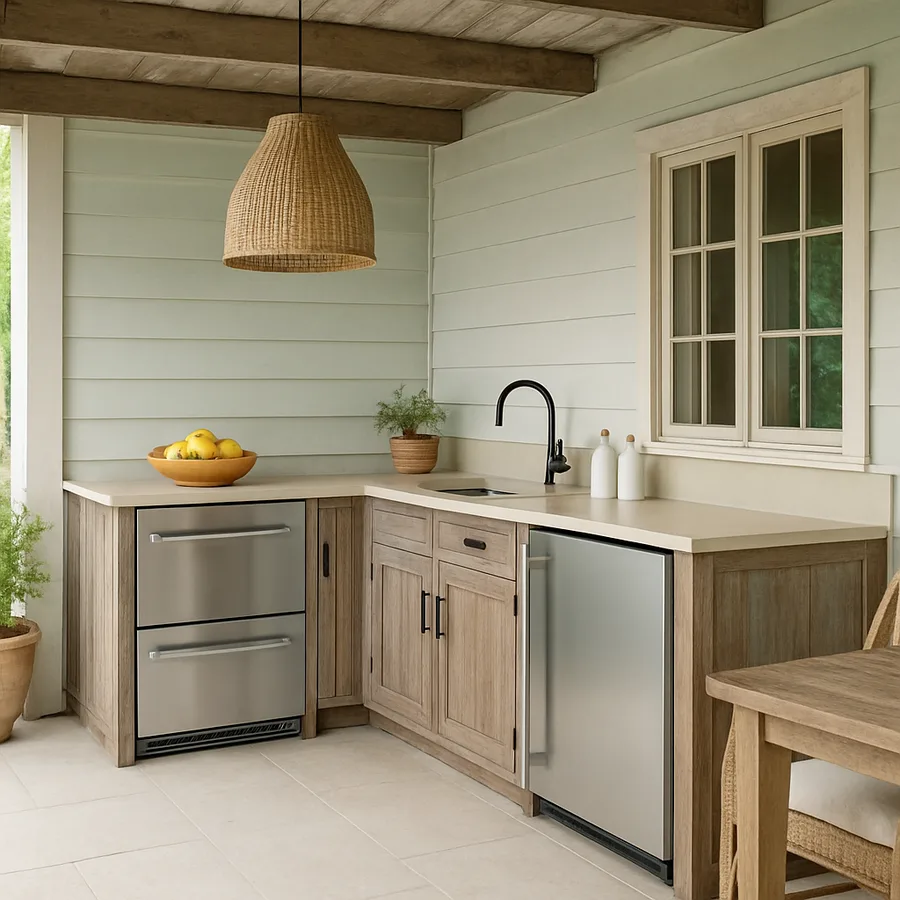
The outdoor refrigerator decision sounds simple until the showroom presents two seemingly identical 24-inch boxes at similar price points, one with a single front door and the other with two drawers stacked vertically. Both keep food cold. Both are built for exterior installation. Both fit the same cabinet opening. Yet the choice between them shapes how the entire outdoor kitchen functions for the next fifteen years. The door unit and the drawer unit serve different cooking workflows, and matching the configuration to the actual use is the difference between an appliance that works and one that gets ignored after the first season.
This guide walks through the practical, performance, and design differences between drawer-style and door-style outdoor refrigeration. It pulls from current outdoor kitchen design standards and from data published by the Association of Home Appliance Manufacturers (AHAM), whose certifications govern how refrigeration products are rated for capacity, energy use, and environmental tolerance. The goal is not to declare a universal winner but to give the homeowner the framework that professional designers use when specifying outdoor appliances.
Two Configurations, Two Use Cases
The door-style outdoor refrigerator is the familiar form. A single vertical compartment opens forward on a left or right hinge, with adjustable wire shelves stacked from floor to ceiling and door bins on the inside panel for bottles. Capacity is the strong suit. A typical 24-inch outdoor refrigerator with a door holds between 4.5 and 5.5 cubic feet of mixed storage, accommodating tall pitchers, large platters, and side dishes prepped well in advance.
The drawer-style unit divides the same cabinet footprint into two horizontal compartments, each opening as a full-extension drawer. The drawers expose their entire contents at once, so nothing hides behind anything else, and bending or reaching deep into a cavity is eliminated. Capacity per drawer typically runs between two and two and a half cubic feet, with total capacity slightly lower than the door equivalent because of the additional structure between drawers. The trade is volume for access.
Choosing between them starts with a question about cooking habits. A household that hosts large gatherings and preps everything in advance benefits from the volume and shelf flexibility of a door unit. A household that grills frequently for two or four people, reaches repeatedly for cold beverages, and values speed at the grill benefits from drawers, which keep frequently used items visible and accessible without leaving the cook station. Many serious outdoor kitchens end up with both, but most projects start with one.
Ergonomics: Where Drawers Genuinely Win
The ergonomic case for drawers is the strongest argument in their favor, and it is the reason most professional outdoor kitchen designers specify them in primary cook zones. A drawer presents its contents from above, at counter height, so the cook can scan and grab without bending. A door requires bending or kneeling to retrieve items from lower shelves and reaching past front items to access rear ones. Over a long evening of grilling, the difference accumulates.
The NKBA publishes ergonomic guidelines for outdoor kitchens that explicitly favor drawer refrigeration in primary work zones, recommending that the most frequently accessed cold items be stored between hip and shoulder height for the principal cook. Drawer units satisfy this guideline naturally; door units do so only for items placed on the middle shelf. Industry usage studies suggest that cooks reach into outdoor refrigeration between fifteen and twenty-five times during a typical grilling session, which makes access ergonomics genuinely consequential rather than a marketing talking point.
Drawer style also wins for incidental users. Children can reach into a lower drawer for juice boxes safely; adults of any height find both drawers comfortable. Wheelchair-accessible designs almost always specify drawers because they eliminate the high-shelf reach that a door creates. Some homeowners ask whether drawers feel substantial enough to hold heavy items, and the answer is yes; quality units use full-extension ball-bearing slides rated for fifty to seventy-five pounds per drawer, comparable to high-end interior kitchen drawer hardware.
Capacity, Layout, and What Actually Fits
The capacity conversation rewards specificity. A door-style outdoor refrigerator with adjustable shelves accommodates irregular items easily; a sheet cake, a tall pitcher of sangria, or a roasting pan of marinated meat all fit because the shelves can move or come out entirely. Drawer units impose a maximum height per compartment, typically nine to eleven inches of clear space, which excludes tall items by geometry. A pitcher that fits the door unit will not fit either drawer of the drawer unit.
This becomes the decisive factor for many households. If the outdoor cooking includes large entertaining, sheet pans of marinated proteins, and pitchers of mixed drinks, a door unit is the right call. If the outdoor refrigeration primarily holds beverages, condiments, and small prep containers, drawers serve better. A common compromise installs a small drawer unit near the grill for cook-side access and a larger door unit elsewhere in the bar zone for bulk storage. The combined cost is higher, but the workflow improvement is substantial for households that cook outdoors frequently.
Footprint constraints matter too. Most outdoor refrigeration comes in 15-inch, 24-inch, and 30-inch widths, with 24 inches being by far the most common. Drawer units are typically only available at 24 inches; the slimmer 15-inch units are almost always single-door beverage refrigerators. If the cabinet plan locks in a 15-inch opening, the drawer option may not exist at all, which makes early appliance selection important to the layout phase.
Outdoor-Rated Construction: The Non-Negotiable
Whether door or drawer, outdoor refrigeration must be rated for outdoor installation. This sounds obvious but matters legally and practically. Indoor-rated refrigerators installed outdoors will void their warranties immediately, fail prematurely from condensation and corrosion, and may violate local code provisions that require outdoor electrical equipment to be listed for wet or damp locations. The UL 471 standard for commercial refrigerators and the additional outdoor-use certifications referenced by manufacturers establish the baseline.
Outdoor-rated units feature several distinct construction details. The cabinet is fully insulated against ambient temperature swings, with refrigeration systems sized to maintain interior temperature when the surrounding cabinet sits at one hundred ten degrees Fahrenheit. The electronics, compressor, and wiring are sealed against moisture and insect intrusion. The exterior is typically 304 stainless steel at minimum, with marine-grade 316 stainless recommended within several miles of saltwater. Gaskets, hinges, and slides are corrosion resistant by design.
Ventilation is the detail most often handled incorrectly. Every outdoor refrigerator requires unobstructed front ventilation; the compressor exhausts heat from the toe-kick area and cannot vent into a sealed cabinet. Installing an outdoor refrigerator into a cabinet without proper ventilation cuts its life dramatically and can lead to thermal cutoff during summer use. Manufacturers publish minimum clearance requirements, and homeowners should verify that the cabinet plan provides them before construction begins.
Energy Use and Thermal Performance
Outdoor refrigerators work harder than their indoor counterparts. They face wider ambient temperature swings, more frequent door or drawer openings during entertaining, and direct or indirect solar gain through the surrounding hardscape. AHAM testing protocols rate energy consumption under controlled conditions; real-world outdoor consumption typically runs ten to thirty percent higher depending on climate. Selecting a unit with strong energy ratings is worth the modest premium, both for utility cost and for compressor longevity.
Drawer units and door units have similar energy profiles when their capacity is comparable, but the way each loses cold air differs. A drawer opening exposes a smaller air volume to ambient temperature because the cold air, being denser, tends to stay in the drawer rather than spill out. A door opening dumps cold air more aggressively, especially when fully opened. For installations in hot climates where the refrigerator opens many times per session, drawers may run measurably more efficiently in practice.
Insulation thickness, compressor type, and condenser placement all affect performance. Variable-speed compressors, increasingly common in premium outdoor models, modulate their output to maintain temperature with less cycling than older single-speed designs. They cost more upfront and pay back through longer life and quieter operation, both of which matter on a patio where conversation is part of the experience.
Cost, Service, and Long-Term Ownership
Drawer-style outdoor refrigerators generally cost more than equivalent door units, often by twenty to forty percent. The premium reflects the additional hardware, the more complex sealing required at two openings, and the typically higher tier in manufacturer product lines. Budget outdoor refrigerators come in door form; drawer units are a step up in both price and build quality on average.
Service life depends heavily on installation quality and climate. Properly installed outdoor refrigerators with adequate ventilation and shading typically deliver eight to twelve years of service, with some premium units reaching fifteen or more. Failure modes differ between door and drawer units; door units more often suffer gasket failures at the hinge side, while drawer units more often experience slide wear from repeated opening under load. Both are field-serviceable on quality brands.
A practical question many readers raise is whether to invest in the drawer premium or apply that money elsewhere in the outdoor kitchen. The answer depends on use frequency. For households that grill weekly or more during the warm season, the ergonomic gains from drawers compound into real quality-of-life value. For households that grill occasionally, a quality door unit serves perfectly well and frees budget for other priorities. A second related question is whether to add a beverage center alongside refrigeration; many designers now recommend exactly this combination, with cold beverages in a dedicated unit and food storage in the primary refrigerator regardless of style.
Layout Decisions That Make Either Option Work
The refrigeration choice integrates with the broader outdoor kitchen layout. Drawer units belong near the cook zone, ideally within arm's reach of the grill, because their access advantage matters most where the cook stands. Door units belong in storage or beverage zones, where the user makes deliberate trips to retrieve specific items. Mixing both, as many premium projects do, separates the workflows cleanly.
The cabinet itself must accommodate the chosen style. Drawer units require a fully framed opening with clearance for both drawers to extend, plus the previously mentioned ventilation at the toe kick. Door units need clearance for the door swing, which means careful planning at corners and adjacent appliances. A grill installed too close to a refrigerator door can prevent the door from opening fully when both are in use, a layout error that becomes obvious only during the first cookout.
Sun exposure deserves explicit attention. A refrigerator that bakes in afternoon sun runs harder, fails sooner, and costs more to operate. Pergolas, overhead structures, or simple cabinet positioning under existing shade extend appliance life substantially. The NKBA layout guidelines and most manufacturer install manuals recommend positioning refrigeration away from direct sun whenever site conditions allow, and many designers treat this as a hard constraint rather than a preference.
Conclusion
The choice between drawer-style and door-style outdoor refrigeration is a workflow decision wearing the costume of an appliance specification. Drawers reward households that cook outside frequently, value cook-side access, and prioritize ergonomics over total capacity. Doors reward households that entertain large groups, store irregular items, and want maximum flexibility from a single appliance footprint. Both configurations, when properly outdoor-rated and properly installed, deliver years of reliable service. The wrong choice is usable but never feels right.
The most consistent advice from professional outdoor kitchen designers is to specify the refrigeration around the actual cooking pattern, not the showroom impression. A homeowner who grills weekly should sit on the patio and walk through a typical session, noting where the cook stands and what gets reached for repeatedly. That walkthrough almost always favors drawers near the grill, with bulk storage handled separately. A homeowner who cooks outdoors three or four times per season can comfortably specify a quality door unit and invest the difference in better ventilation, shade, or surface materials.
Construction details matter as much as the configuration choice. Outdoor-rated certification, proper ventilation at the toe kick, marine-grade stainless in coastal zones, and protection from direct sun all extend service life from a frustrating six or seven years to a satisfying twelve to fifteen. Working with a qualified installer who has built outdoor kitchens before, rather than treating refrigeration as a simple slot-in appliance, separates installations that age gracefully from those that need replacement within a single mortgage term.
Ready to specify outdoor refrigeration for an upcoming project? Spend an evening on the patio with the current grill setup, count how many times the cook reaches for cold items, measure the cabinet opening, verify the sun exposure at the planned location, and review certification and ventilation requirements from a qualified installer. Cross-reference layout best practices with the National Kitchen and Bath Association outdoor kitchen guidelines and energy data published by the Association of Home Appliance Manufacturers before placing an order.
More Articles You May Like



Comments
Post a Comment