Door Knocker Brass Versus Iron Vintage Style Selection
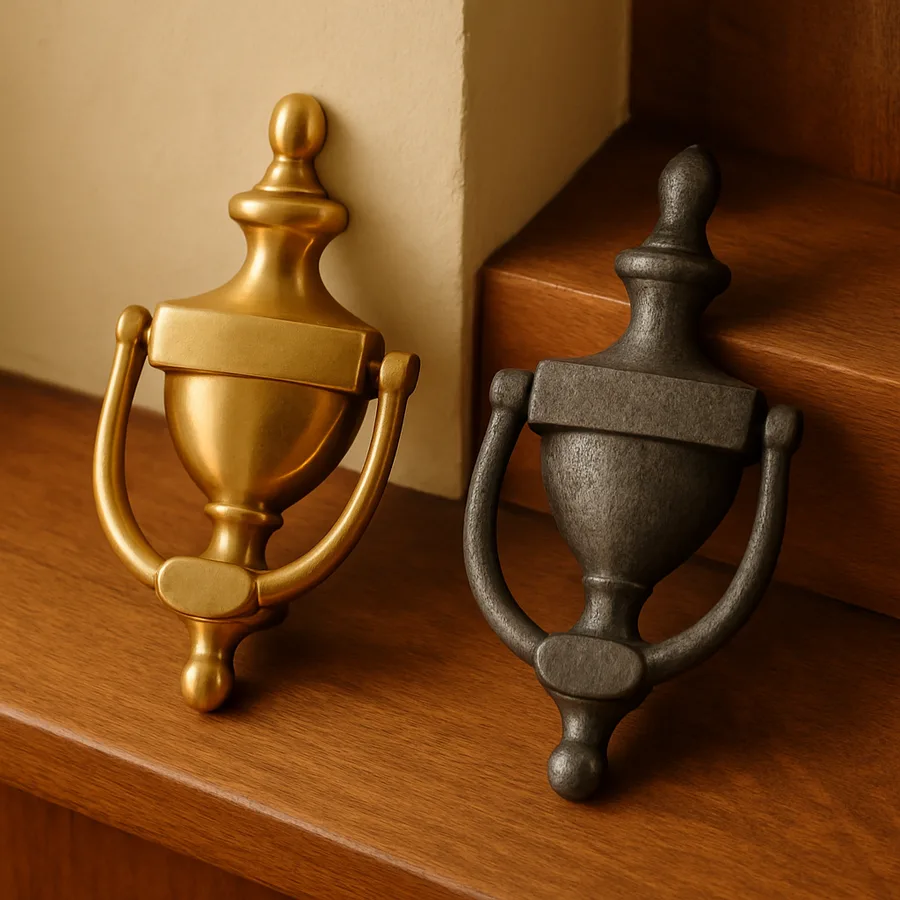
A door knocker is small enough to hold in one hand and important enough to set the tone of the entire entryway. When a guest walks up your path, the knocker is often the first detail they touch and one of the last they see before stepping inside. Choosing between brass and iron for a vintage-style knocker is therefore not a trivial finish question - it is a decision about the character your front door projects every single day.
This comparison walks through the visual, mechanical, historical, and maintenance differences between brass and iron knockers, with an emphasis on selecting authentically for vintage or period-style homes. By the end you will know which metal suits your architecture, your climate, and your tolerance for ongoing care.
The Visual Language of Each Metal
Brass speaks the language of warmth and refinement. Its yellow-gold tone reads as elegant, slightly formal, and welcoming in a way that suits Georgian, Federal, Colonial Revival, and many Victorian homes. Polished brass is bright and reflective; antiqued or living-finish brass mellows over years into a softer honey color with darker recesses where hands rarely touch. Either treatment harmonizes with painted doors in deep colors - black, navy, hunter green, or burgundy - and with natural wood doors finished in medium to dark stains.
Iron speaks the language of strength and craft. Its dark gray-to-black palette reads as grounded, handmade, and slightly rustic, which suits Tudor, Spanish Colonial, Mission, Craftsman, French country, and rural farmhouse architecture. Wrought iron carries visible hammer marks and slight irregularities that brass simply cannot reproduce. Cast iron looks heavier and more sculptural, often featuring the bold scrollwork and ring patterns associated with European medieval and Renaissance revivals.
If your home has light-colored stucco, natural stone, or unpainted timber, iron typically reads better against those textures. If your home has clapboard siding, brick with painted trim, or anything in the classical tradition, brass usually wins. There are exceptions - a black iron knocker on a bright white Colonial can be striking precisely because of the contrast - but the defaults above guide most successful selections.
Historical Authenticity by Period
Door knockers predate doorbells by several thousand years, and the metals you find on surviving period doors were not chosen casually. Understanding what was actually used in each era helps you select something that looks original rather than costume-like.
For Georgian and Federal homes (roughly the 1700s through early 1800s in the American tradition), brass was the dominant choice for refined urban residences. Patterns like the urn, the wreath, the dolphin, and the classical lion-mask were standard. Iron knockers in this period were more common on rural or working homes and on European Catholic church doors, less so on prosperous American doorways.
For Victorian homes, both metals appear in surviving examples, with brass favored on high-style Italianate and Second Empire facades and iron more common on Gothic Revival and Stick-style homes. The Victorian appetite for ornament means even small knockers in this period often featured elaborate naturalistic forms - leaves, vines, faces, and creatures - in either metal.
For Arts and Crafts, Mission, and Spanish Colonial homes (roughly 1890s through 1930s), iron is almost always the historically correct choice. Craftsman aesthetics celebrated the visible hand of the blacksmith, and Spanish-influenced architecture imported wrought iron traditions directly from Iberia. Brass on a true Craftsman door would look anachronistic, however beautifully made.
Durability and Climate Performance
Both metals last for generations on a front door, but they age differently and respond differently to weather. Choosing the right one for your climate prevents disappointment a decade later.
Brass is a copper-zinc alloy that resists corrosion well in most climates. In coastal environments, salt air accelerates patina formation - within months an unlacquered polished brass knocker on a beach house will develop a green-brown verdigris. Some homeowners love this look; others find it sloppy. Lacquered brass resists patina for several years but eventually the lacquer fails unevenly, leaving a blotchy appearance that requires stripping and refinishing. Solid living-finish brass with no coating is the most honest and lowest-maintenance long-term choice, accepting that the metal will continue to age.
Iron rusts. That is the headline. The question is whether the iron has been protected and how. Powder-coated iron resists rust for many years but eventually chips, especially around the strike point where the knocker meets the back plate. Hot-dipped galvanized iron with a black topcoat performs better. Genuine hand-forged iron with a wax or oil finish develops a deep patina that protects the surface but requires periodic re-waxing - typically once a year in dry climates and twice yearly in humid or coastal regions.
A 2023 survey by the Builders Hardware Manufacturers Association reported that 41% of front-door hardware warranty claims in coastal zip codes involve finish failure within five years of installation. Whichever metal you choose, ask the manufacturer specifically about coastal warranty terms if you live within ten miles of saltwater.
Hand Feel, Sound, and Mechanical Quality
This is the comparison most buyers skip, and it is the one that matters daily. A door knocker is a tool. You should evaluate it the way you would a kitchen knife.
Brass knockers tend to feel solid but not heavy. A well-made cast brass knocker has pleasant weight in the hand, and the strike against the back plate produces a bright, ringing tone that carries through a hollow wood door. Lighter stamped or hollow brass knockers feel tinny and produce a thinner sound; avoid these regardless of price.
Iron knockers tend to feel heavier and more substantial. The strike sound is lower and duller - more of a thud than a ring. On a heavy solid-core door this is satisfying; on a hollow door it can be muffled. If your front door is hollow-core (common in mid-century builds), brass will announce visitors more reliably than iron.
Have you ever tested the action of a knocker before buying? Many homeowners do not, then discover the hinge pin is loose or the strike point sits at the wrong height. Pick it up, work it ten times, listen for rattle, and check that the ring or ball returns to rest without sticking. A quality knocker - brass or iron - should feel decisive in the hand and silent at rest.
Coordinating With Other Door Hardware
A knocker rarely lives alone on a door. It shares the field with a handle or lever set, a deadbolt, a kick plate, and often a mail slot, doorbell, or address numbers. Coordinating these elements is where many otherwise good knocker selections fall apart.
The traditional rule is to match metals within the door field but allow contrast between the door hardware and surrounding lighting fixtures. A brass knocker paired with a brass handle set and brass kick plate looks intentional; the same brass knocker paired with brushed nickel handles looks accidental. Iron follows the same logic - pair iron with iron, and reserve brass or copper accents for the sconces flanking the door rather than the door itself.
Are you planning to add a doorbell camera? If so, consider whether the camera's housing comes in a finish that complements your knocker choice. A polished brass knocker beside a bright white plastic doorbell camera reads as a compromise. Several manufacturers now offer cameras in oil-rubbed bronze and antique brass finishes specifically to coordinate with traditional hardware. The Builders Hardware Manufacturers Association publishes finish matching standards that can help you read product spec sheets accurately, and the National Association of Home Builders maintains design resources on entry coordination for both new builds and renovations.
Budget, Sourcing, and Installation Realities
Quality knockers in either metal range from roughly $40 for a serviceable cast piece to $400+ for hand-forged or designer examples. The middle range - $80 to $180 - buys excellent quality from established hardware houses. Avoid anything under $30, which almost always means thin metal, weak hinge pins, and finishes that fail within a year.
For sourcing, look beyond the big-box home centers. Specialty hardware retailers, salvage yards, and small-batch blacksmiths offer pieces with character that mass-market lines cannot match. A salvaged Victorian brass knocker in good condition often costs less than a new reproduction and carries genuine age. For iron, regional blacksmiths in many parts of the country produce hand-forged pieces priced competitively with imported reproductions, and the National Ornamental and Miscellaneous Metals Association maintains directories of practicing smiths.
Installation is generally straightforward - two through-bolts and a back plate - but the door must be drilled accurately. Measure twice. The knocker should sit at roughly the height of a standing adult's eye to upper chest, typically 60 to 66 inches from the threshold. Too high and short visitors cannot reach it comfortably; too low and it looks misplaced. Check that the bolts you receive are long enough for your door thickness, and on solid wood doors pre-drill carefully to avoid splitting.
Care, Patina, and Restoration Over Decades
How you care for a knocker shapes how it ages more than which metal you chose in the first place. Two identical brass knockers can look completely different after ten years depending on whether they were polished weekly, polished annually, or simply left alone. Choosing a care philosophy at install time prevents inconsistent results later.
For polished brass, accept that monthly polishing is the only way to keep the bright look. Use a non-abrasive brass cleaner designed for hardware, never a household abrasive that scratches the surface. Wipe rather than scrub, finish with a microfiber cloth, and avoid letting cleaner pool in recessed details where it can dry into white residue. If monthly polishing sounds tedious, you are not the homeowner for polished brass.
For living-finish brass, do almost nothing. The patina is the finish. A soft cloth wipe twice a year removes surface grime without disturbing the natural color development. Resist any product labeled as a "brass cleaner" - these strip the patina you have been growing. The whole point of choosing unlacquered brass is to let the metal record its own history of use, and aggressive cleaning undoes that.
For iron knockers, the goal is preventing rust without erasing character. Wax-finished iron benefits from a fresh thin coat of paste wax once or twice a year, applied with a soft cloth and buffed lightly. Powder-coated iron typically needs only a wipe with mild soap and water, with touch-up paint kept on hand for chips that appear at the strike point. Hand-forged iron with a more traditional oil finish can be lightly re-oiled annually using a food-safe mineral oil; this is the same approach used historically by blacksmiths to maintain interior ironwork.
When you eventually inherit, buy, or rescue a tarnished antique knocker, resist the urge to restore it to factory shine. A century-old brass lion head with deep patina is genuinely more beautiful, and more valuable, than the same lion head polished bright. Clean only the gripping surface where decades of grime obscures detail, and leave the recesses alone. Have you ever seen an over-restored antique that lost its character to too much polish? Most antique dealers can recall examples, and salvage hardware specialists almost universally advise gentle stabilization over full restoration.
Conclusion
Choosing between brass and iron for a vintage door knocker comes down to four overlapping questions: which metal matches your home's architectural period, which suits the door color and surrounding materials, which fits your local climate, and which complements the rest of your door hardware. When those answers align, the decision often makes itself. When they conflict, period authenticity should usually win for genuinely historic homes and aesthetic preference should usually win for modern homes built in a vintage style.
Whichever metal you choose, invest in a piece that feels right in the hand. A solid cast brass knocker with a pleasing ring, or a hand-forged iron knocker with the satisfying weight of real metal, will outlast every other front door hardware decision you make. Cheap knockers betray themselves within a season; quality ones quietly improve the house for decades.
Remember that knockers patina, and that is the point. A brass knocker that has darkened gently under thousands of hands, or an iron knocker that has rusted slightly around its strike point, looks more honest than any factory finish ever could. Resist the urge to over-polish brass back to factory yellow or to repaint iron at the first sign of wear. The aging is the design.
Ready to choose? Take a clear photo of your front door, your existing hardware, and the surrounding trim and lighting. Bring those photos when you shop, and hold candidate knockers up to your screen to test the match. The right piece will look obvious within minutes. Trust that recognition, and your entry will gain a small daily pleasure that costs almost nothing relative to its impact.
More Articles You May Like



Comments
Post a Comment