Filing Cabinet Wood Versus Metal For Home Office Style
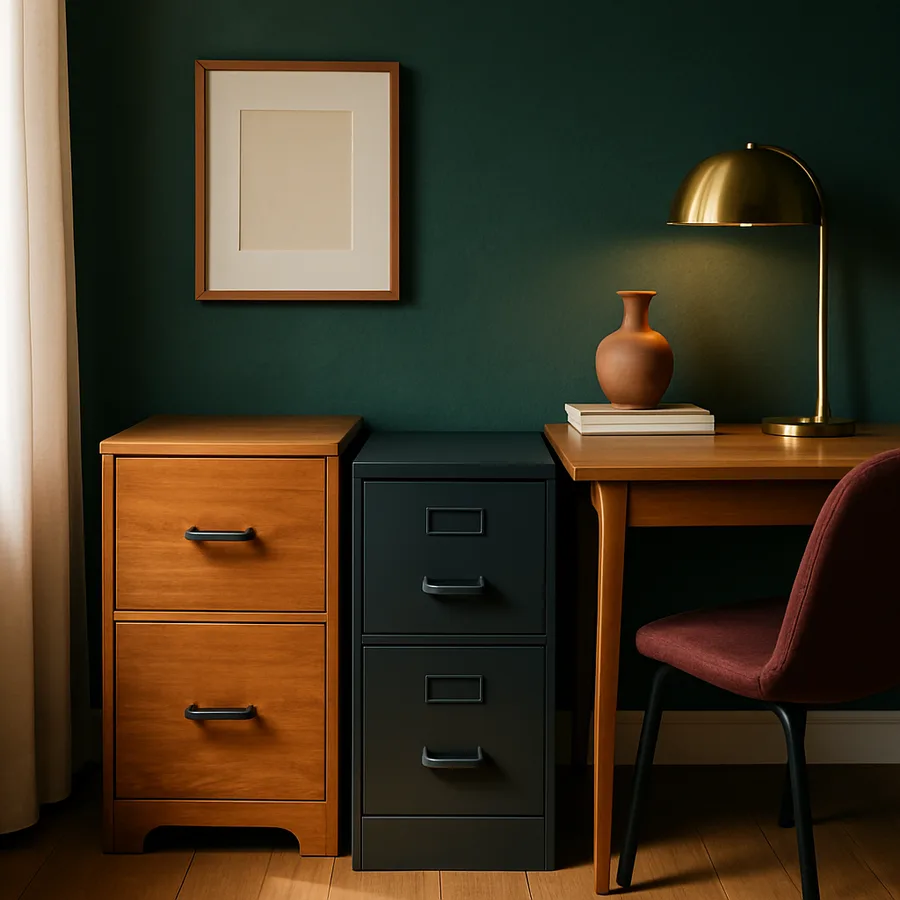
The filing cabinet survived the paperless office revolution. Despite cloud storage, scanned documents, and digital signatures, the average American household still retains roughly 2,000 to 4,000 sheets of paper that need secure, organized storage: tax returns, insurance policies, medical records, real estate documents, vehicle titles, and the children's school records that nobody wants to lose. The question is not whether you need a filing cabinet, but which material best serves your home office aesthetic and functional requirements. The wood-versus-metal decision shapes the entire room.
The Style Stakes Are Higher Than They Used To Be
Home offices used to hide. They lived in spare bedrooms behind closed doors, or in basement corners that nobody photographed for holiday cards. That changed permanently in 2020 and has only intensified since. Today's home office often doubles as a video-call backdrop seen by colleagues, clients, and prospective employers, which means every furniture choice signals something about taste and professionalism. A scuffed beige metal cabinet from a defunct office supply store reads as institutional and undermines the carefully composed shelf behind it.
The American Society of Interior Designers reported in a member survey that home office design inquiries grew more than 230 percent between 2019 and 2024, with storage solutions ranking as the third most-requested category after lighting and seating. Filing cabinets specifically came up repeatedly as a pain point because most existing products were designed for commercial environments, not residential aesthetics. Have you ever shopped for a filing cabinet and felt that everything available looked wrong for your home? You are not alone.
Wood Filing Cabinets: Warmth, Weight, And Wood Movement
A solid-wood filing cabinet from a manufacturer like Hekman, Sligh, or Hooker Furniture brings undeniable presence to a room. The drawer fronts read as cabinetry rather than office equipment, the hardware can be specified to match adjacent built-ins, and the proportions tend to be more generous than commercial metal units. A two-drawer wood lateral file typically weighs between 110 and 180 pounds, which provides stability when fully loaded but also creates installation challenges on upper floors or over hardwood with delicate finishes.
The downsides of wood are real. Wood movement with humidity changes can cause drawer slides to bind in dry winters or humid summers, particularly in homes without consistent climate control. Suspension files designed to hang from metal rails sometimes hang awkwardly on wood-clad rails, and the file-folder gauge can vary by an eighth of an inch from drawer to drawer if the cabinet was built by a lower-tier manufacturer. Expect to pay $800 to $2,400 for a quality two-drawer lateral wood file, with custom or built-in versions running considerably higher.
Metal Filing Cabinets: Function, Fire Resistance, And The Industrial Look
Metal cabinets dominate commercial offices for good reason. They tolerate heavy use, the drawer slides operate smoothly even when fully loaded with paper, and the better units offer genuine fire and impact protection that wood cannot match. A UL-rated one-hour fire-resistant cabinet from manufacturers like FireKing or Schwab can protect paper documents at internal temperatures below 350°F during a structure fire that reaches 1,700°F externally. For homeowners with irreplaceable paper records, this performance gap is significant.
The aesthetic story has improved dramatically. Powder-coated steel cabinets in matte black, deep navy, forest green, or warm cream now compete directly with wood on style. Brands like Bisley have built entire reputations on filing cabinets that work as design objects in domestic interiors. The industrial-design vocabulary of welded steel reads beautifully in lofts, in studios with exposed structure, and in any home office that leans toward a curated, slightly editorial aesthetic. Expect to pay $400 to $1,200 for a quality two-drawer metal lateral file, with fire-rated versions reaching $1,800 or more.
Durability Over Twenty Years
Both materials can last decades, but the failure modes differ. A quality wood cabinet may show drawer-front cracking, finish wear at handles, and slide-binding over twenty years of use, but the underlying structure typically remains sound. A metal cabinet's drawer mechanisms can wear out, hinges can squeak, and powder coating can chip at corners, but the steel itself does not degrade. For homes that include children, pets, or frequent moves, metal tolerates abuse better.
Repair economics also differ. A wood cabinet can be refinished, drawer pulls can be replaced, and a competent woodworker can rebuild drawer boxes if needed. A metal cabinet generally cannot be cost-effectively repaired beyond simple touch-up paint and lock replacement. If your cabinet will live in a high-traffic spot near a door or a chair that gets pushed back constantly, the easier-to-refurbish wood may actually outlast the metal alternative in terms of how long it continues to look acceptable.
Fire Resistance: The Conversation Nobody Has Until It Matters
According to data published by the National Fire Protection Association, U.S. fire departments respond to roughly 350,000 home structure fires annually. Most homeowners never experience one, but those who do typically lose all of their unprotected paper records. A non-rated wood or metal filing cabinet offers essentially zero fire protection. Even a closed metal drawer interior can reach 1,000°F or higher within fifteen minutes of fire involvement.
UL-rated fire-resistant cabinets cost two to three times more than non-rated equivalents but offer documented protection. If you store original Social Security cards, birth certificates, deeds, wills, or business records that exist only on paper, the math favors a rated cabinet for at least one drawer's worth of capacity. Where do you currently keep your most irreplaceable documents? A bank safe deposit box covers the truly critical records, but a rated home cabinet handles the everyday-access category that the bank cannot.
The Style Verdict By Home Office Type
The right choice depends entirely on the room you are furnishing. For a traditional study with built-in bookcases, paneled walls, and Persian rugs, a solid-wood lateral file in walnut, mahogany, or quartersawn white oak is the only credible option. The cabinet should match or coordinate with adjacent millwork. Architectural Digest has profiled numerous private libraries where the filing storage was built into the room as part of the original cabinetry package, and that integrated approach remains the gold standard for high-end traditional offices.
For a modern minimalist home office with a floating desk, slim task lighting, and neutral walls, a matte black or warm cream powder-coated metal cabinet looks intentional and right. The clean industrial lines reinforce the design language of the room rather than fighting it. For a mid-century or eclectic office that mixes wood, brass, and color, either material can work, but the key is committing to the choice rather than splitting the difference with a cheap laminate cabinet that pretends to be wood while behaving like metal. Pick one material and let it speak.
Drawer mechanism quality separates serviceable cabinets from frustrating ones. The best filing cabinets in either material use full-extension ball-bearing slides rated for at least 100 pounds per drawer, with progressive engagement that keeps the drawer aligned through its entire travel. Cheaper cabinets use friction slides or partial-extension ball-bearing slides that bind under load and feel rough during daily use. When evaluating any cabinet, pull a fully loaded drawer all the way out and listen for the sound of the slide. A high-quality slide moves silently; a cheap slide announces itself with the kind of metallic scrape that becomes a daily annoyance.
Lock quality follows a similar logic. A cylinder lock with a published keyway and replaceable cylinder allows future rekeying if keys are lost or if the cabinet changes hands. Cheaper cabinets use proprietary locks with limited key availability and no replacement path, which means a lost key effectively destroys the cabinet's security. For home offices that handle client records, tax documents, or any material covered by privacy regulations, lock specifications belong in the buying decision alongside material and finish. Ask the manufacturer directly whether replacement cylinders are available and at what cost before purchasing.
Ergonomic placement of filing storage often gets overlooked. A two-drawer lateral file at counter height doubles as a printer stand, a credenza for displaying objects, or a landing zone for incoming mail. A taller four-drawer vertical file holds more paper per square foot of floor space but requires reaching down to the lowest drawer in a way that becomes uncomfortable for users with back issues. Think about how often each drawer will be accessed and place the most frequently used drawer at a height that does not require stooping. The American Society of Interior Designers regularly highlights ergonomic placement as the difference between functional and merely furnished home offices.
Finish maintenance differs significantly between the two materials. A wood cabinet with an oil finish develops a patina over years that most owners come to prefer, but it does require occasional re-oiling and shows water rings if drinks are placed on top without coasters. A lacquered or catalyzed-finish wood cabinet resists water and scratches better but cannot be spot-repaired easily if damaged. A powder-coated metal cabinet shrugs off most household abuse but shows chips at corners and edges where it gets bumped. Pick the maintenance profile that matches how you actually live, not the one you wish you lived.
Hardware finish coordination ties the cabinet into the room. A wood filing cabinet with bright nickel pulls reads differently than the same cabinet with aged brass or matte black hardware. Match the cabinet hardware to the door hardware and the light fixtures in the room, not to the desk lamp or to whatever happened to ship from the factory. Replacement hardware is inexpensive relative to the cabinet itself, and the visual upgrade from coordinated finishes is immediate. The American Society of Interior Designers regularly cites hardware coordination as one of the highest-leverage details in room-finishing decisions.
Underfoot protection matters more for metal cabinets than wood. A loaded metal filing cabinet on hardwood will eventually scratch the floor through its sharp bottom edges, particularly during the small movements that happen when drawers are opened forcefully. A felt pad or a small mat under the cabinet prevents this damage. Wood cabinets distribute weight over a broader contact patch and generally do not require additional protection, though a thin felt pad still extends floor life. Both materials benefit from periodic re-leveling, since residential floors are rarely perfectly flat and a slightly tipped cabinet binds its drawers over time.
Mixed-material cabinets occupy an interesting middle ground. Several manufacturers now offer cabinets with steel structural shells and solid wood drawer fronts, marrying the durability of metal with the warmth of wood. These hybrids cost roughly halfway between pure metal and pure wood cabinets and avoid the visual compromises of laminate. For home offices that want the warmth of wood without the maintenance overhead, this category deserves consideration. Inspect the drawer interiors as carefully as the visible exterior, since some hybrid manufacturers cut costs on the parts buyers do not see during showroom inspections.
Conclusion
The wood-versus-metal filing cabinet question has no single correct answer, but it does have a correct process. Start by inventorying what you actually need to store, then check whether any of those documents warrant fire protection, then assess the existing visual language of the room. A home office that already includes substantial wood furniture and traditional detailing wants a wood cabinet. An office built around steel, glass, and industrial references wants a metal cabinet. Avoid laminate hybrids that try to look like wood while costing the same as metal.
Budget realistically for the choice you make. A quality lateral file in either material will run between $600 and $2,000, and that investment pays back over decades of daily use. Cheaper cabinets, particularly the $150 to $300 imports, almost always fail within five years through drawer-slide collapse, warping, or finish degradation. The American Home Furnishings Alliance has documented in industry research that consumer-grade office storage has the shortest average useful life of any furniture category, primarily because buyers treat it as a commodity rather than as furniture.
If your records include irreplaceable originals, prioritize fire resistance over aesthetics for at least one cabinet. A single UL-rated drawer can hold a decade of tax returns, all major life documents, and the small archive of family records that you would mourn if lost. Place this cabinet in your most aesthetically forgiving spot and let the more decorative storage live elsewhere in the room. Stop putting off the filing cabinet decision and order something this month. The right cabinet quietly improves your daily workflow for the next twenty years.
The filing cabinet is not glamorous, but it is one of the few pieces of home office furniture that meaningfully protects your future. Choose the material that matches your room, your records, and your willingness to maintain a finished surface, and the rest of the office design will fall into place around it.
More Articles You May Like



Comments
Post a Comment