Abstract Art Prints vs Original Paintings for Budget Decorating
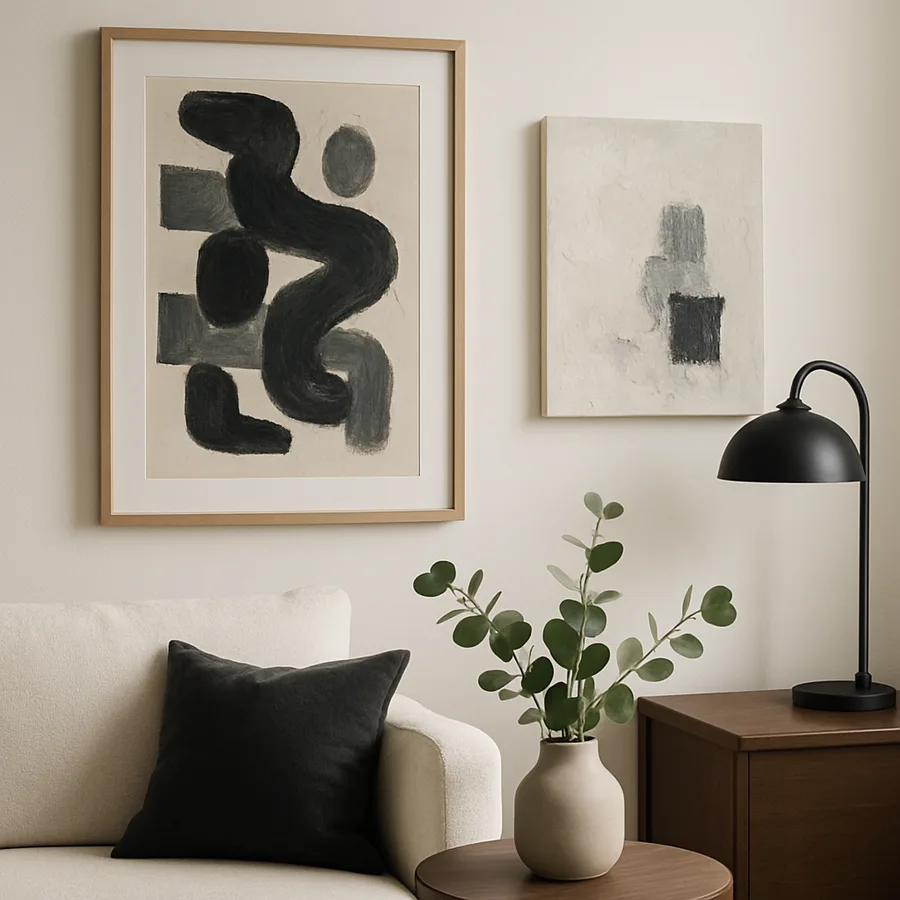
The Budget Decorator's Art Dilemma
Filling your walls with art that you genuinely love is one of the most personal and rewarding aspects of decorating a home. It is also one of the most confusing when budget constraints enter the picture. The market offers abstract art across an enormous price spectrum, from $15 digital prints downloaded and printed at home to $50,000 gallery canvases by established artists. Between those extremes sits a rich middle ground where prints and original paintings overlap in price, quality, and visual impact. Understanding what you actually get at each price point helps you make decisions that maximize both aesthetic satisfaction and financial sense.
Abstract art occupies a unique position in the prints-versus-originals conversation. Unlike representational art, where a print is clearly a reproduction of a specific original work, abstract art blurs the boundary between categories. An original abstract painting by an emerging artist might sell for $200, while a high-quality giclée print of a well-known abstract work might cost $300 framed. The print may carry a recognizable name and gallery provenance, while the original comes from an unknown painter working out of a studio apartment. Which is the better value? The answer depends on what you are actually buying: a decorative object for your wall, a piece of someone's creative expression, or an investment you hope will appreciate.
The Americans for the Arts organization reports that consumer spending on visual art and decorative pieces has grown steadily over the past decade, with the largest growth segment being online purchases of both prints and affordable originals. This shift toward accessible art buying has democratized the market, giving budget-conscious decorators more options than ever before. At the same time, it has created confusion about quality, value, and authenticity that can paralyze decision-making. This guide cuts through that confusion with a direct comparison of abstract art prints and original paintings across the factors that matter most: cost, visual quality, emotional value, and long-term satisfaction.
Are you decorating a space that needs art quickly and affordably, or are you building a collection piece by piece over time? Your answer to that question shapes whether prints, originals, or a strategic combination of both best serves your goals. Both paths can produce beautiful results, but they involve different trade-offs that are worth understanding before you spend.
What Abstract Art Prints Actually Are: Types, Quality Tiers, and Pricing
The term "art print" encompasses a wide range of products at very different quality levels. At the bottom tier, poster prints use offset lithography or large-format inkjet printing on lightweight paper stock. These are mass-produced, widely available, and inexpensive, typically ranging from $10 to $50 unframed. Poster prints serve a decorating function but lack the material quality to hold up over time; colors fade, paper yellows, and the thin stock wrinkles easily. For a temporary space like a dorm room or a room you plan to redecorate within a year, poster prints are a practical choice. For a home you intend to live in and enjoy for years, they are a false economy.
The middle tier is the giclée print, which uses archival pigment inks on high-quality cotton rag or canvas substrates. Giclée (pronounced zhee-CLAY) technology produces prints with exceptional color accuracy, fine detail, and longevity rated at 75 to 200 years under proper display conditions. According to the International Fine Print Dealers Association (IFPDA), giclée printing has become the standard for fine art reproduction, used by museums and galleries worldwide for their authorized print editions. A quality giclée print on canvas can be virtually indistinguishable from a painting when viewed from normal distance, particularly with abstract subjects where brushstroke texture is less critical than color and composition. Prices range from $50 to $300 unframed depending on size and the print studio's reputation.
At the top of the print category sit limited edition prints, which are giclée or screenprint reproductions produced in a numbered run, often signed by the artist. A limited edition of 100 prints carries different cachet and value than an open edition that can be reprinted indefinitely. Some limited edition abstract prints include hand-finished elements where the artist adds brushstrokes, varnish, or other unique touches to each print, bridging the gap between reproduction and original work. These prints range from $200 to $2,000 or more depending on the artist's market position and the edition size. The Art Dealers Association of America (ADAA) recommends that buyers verify edition size, authentication, and print method before purchasing limited editions, as the market includes both legitimate and misleading products.
Framing costs significantly affect the total investment in a print. An unframed giclée print that costs $100 can easily require $150 to $400 in custom framing, depending on the frame material, mat selection, and glass type. Budget decorators often overlook framing when comparing print and original painting prices. A framed giclée print at $300 total occupies the same price territory as many original abstract paintings by emerging artists, which is where the comparison becomes genuinely interesting. For finding affordable framing options, Better Homes & Gardens regularly reviews both custom and ready-made framing sources.
The Case for Original Abstract Paintings on a Budget
Original abstract paintings carry an inherent quality that no reproduction can fully capture: they are singular objects made by a human hand, with physical texture, material presence, and the imperfections that signal authenticity. An original oil or acrylic painting has actual depth where paint sits thicker in some areas and thinner in others, catching light differently depending on the viewing angle. This dimensional quality is something you feel as much as see; it gives the work a living presence on the wall that even the finest flat print cannot replicate. For many art lovers, this physical authenticity is the essential characteristic that justifies choosing an original over a reproduction.
The common assumption that original paintings require thousands of dollars is outdated. The market for affordable original abstract art has expanded dramatically through online platforms, local art fairs, student shows, and direct artist sales. Websites like Saatchi Art, Artfinder, and UGallery feature thousands of original abstract paintings priced between $100 and $500, created by emerging and mid-career artists worldwide. Local art school degree shows and community art center exhibitions offer originals at even lower prices, often $50 to $200, with the added benefit of meeting the artist and understanding the work's context. A survey by Artsy found that 67 percent of first-time art buyers paid under $500 for their purchase, confirming that entry-level original art is more accessible than many people assume.
Buying original abstract art at the budget level does require more effort than ordering a print online. You need to evaluate the work in terms of composition, color, material quality, and personal resonance rather than simply selecting from a curated catalog of proven designs. Not every affordable original will be well-crafted; student work and emerging artist pieces vary widely in technical skill and artistic maturity. Developing your eye for quality takes time and exposure, which means visiting galleries, attending open studio events, and looking at a lot of art before buying. This investment of time and attention, however, produces purchases that carry deeper meaning and satisfaction than clicking "add to cart" on a print that thousands of other people also own.
The resale and appreciation potential of original artwork, while not a primary consideration for budget decorators, is worth noting. A print, even a limited edition, rarely appreciates in value and has minimal resale potential. An original painting by an artist who gains recognition over time can increase substantially in value. This is not a reliable investment strategy at any price level, but it does mean that money spent on originals has at least the possibility of retaining or growing its value, while money spent on prints is purely a consumable expense. How much does the idea of owning a one-of-a-kind work matter to you personally, independent of any financial consideration?
Visual Quality Comparison: When Prints Match or Beat Originals
Abstract art is the one genre where high-quality prints come closest to matching the visual impact of originals. Because abstract works rely primarily on color, composition, and overall visual rhythm rather than representational accuracy or fine detail, the characteristics that distinguish a print from a painting are less apparent than they would be with, say, a photorealistic portrait or a detailed landscape. A giclée print of a color-field abstract by a recognized artist will look nearly identical to the original when hung on a wall and viewed from a typical distance of 6 to 10 feet. Only close inspection reveals the absence of paint texture and the uniform surface that marks it as a reproduction.
Canvas giclée prints narrow the gap further by introducing a textured surface that mimics the weave of a painted canvas. Some print studios apply a clear gel medium or varnish over the print that adds subtle dimensionality and protects the surface, producing a finished product that casual viewers often cannot distinguish from a painting. The Museum of Modern Art (MoMA) and other major institutions sell authorized giclée reproductions through their stores specifically because the quality is high enough to represent the original works respectfully. For abstract pieces where the primary experience is color and composition, these museum-quality prints deliver genuine aesthetic value.
There are situations where prints may actually be the visually superior choice for a specific room. If your decorating plan calls for a specific color palette, finding an original painting in precisely the right shades of blue-green and coral to match your existing furnishings is a needle-in-a-haystack search. The print market, by contrast, offers thousands of abstract designs that can be filtered by color, and some print-on-demand services allow you to adjust the color balance of a design before printing. This color control gives prints a practical decorating advantage when the art needs to serve a specific role in the room's color scheme rather than standing as an independent creative statement.
Where originals clearly outperform prints is in close-up engagement and variable lighting conditions. An original painting changes character as room lighting shifts throughout the day, with textured impasto areas catching morning light differently than evening lamplight. Prints, with their uniform surface, look essentially the same under all lighting. In rooms where you spend extended time near the art, such as a home office or reading nook, the richness of an original becomes more apparent and more valuable. In rooms where the art is viewed primarily from across the space, such as above a dining table seen from the kitchen, the distinction diminishes significantly.
Smart Buying Strategies for Maximum Impact on Minimum Budget
The most effective budget decorating strategy combines prints and originals based on each piece's role in the room. Reserve your original art budget for the focal point positions, the single most prominent wall in each major room where a piece will be viewed closely and frequently. For these positions, an original painting's texture, uniqueness, and emotional presence justify the higher cost. Use quality prints for supporting positions: secondary walls, grouped arrangements, hallways, and rooms where art serves a background rather than foreground role. This hybrid approach lets you enjoy the benefits of originals where they matter most while keeping the total decorating budget manageable.
Timing your purchases strategically reduces costs for both prints and originals. Art school graduation exhibitions in May and June offer original works by newly credentialed artists at the lowest prices they are likely to ever command. Many graduates price their thesis work to sell quickly as they transition to professional practice, and the quality at reputable art programs is often remarkably high. Print sales peak during holiday seasons and during promotional events at online art retailers. The ASID recommends that clients with limited budgets build their art collections over 12 to 24 months rather than filling every wall immediately, allowing time to find the right pieces at the right prices rather than settling for whatever is available today. More seasonal buying strategies appear at Architectural Digest's decorating coverage.
Size dramatically affects price for both prints and originals, but the price curve differs between the two categories. Print pricing scales roughly linearly with size: a 24-by-36-inch giclée costs approximately twice what a 12-by-18-inch version of the same image costs. Original painting pricing scales more steeply because larger canvases require more materials, more studio time, and more physical effort. The budget-conscious buyer can exploit this difference by purchasing large prints and small-to-medium originals. A large, striking print for an expansive wall paired with a small, exquisite original for a more intimate viewing position gives you scale and authenticity without doubling your budget.
Do not overlook the unframed original painting as a budget-friendly display option. Gallery-wrapped canvases with finished edges can hang directly on the wall without any frame, saving $100 to $400 in framing costs. Many contemporary abstract painters work specifically on gallery-wrap canvases for this reason, and the frameless look aligns well with modern and minimalist room aesthetics. Prints on paper, by contrast, almost always require framing both for protection and for visual presentation, making their true cost higher than the print price alone suggests. When comparing a $200 framed print to a $250 gallery-wrapped original canvas, the original becomes the clearly better value.
Where to Buy: Trusted Sources for Both Prints and Originals
For prints, start with the museum stores of major art institutions. The Museum of Modern Art, the Tate Modern, and the Guggenheim all sell authorized giclée reproductions of works in their collections through their online stores. These prints carry institutional backing that guarantees authenticity and quality, and the price points are reasonable for the caliber of the source artwork. Commercial print retailers like Minted, Society6, and Juniper Print Shop offer original designs by independent artists printed on quality substrates, though quality varies by vendor and you should always check the print method and substrate specifications before purchasing.
For affordable originals, online platforms have transformed access. Saatchi Art operates as a curated marketplace with editorial oversight, which means the quality floor is higher than fully open platforms. Etsy hosts thousands of independent artists selling original abstract work, though the range in quality is vast and buyer evaluation skills matter more here. Artfinder provides a middle ground with artist vetting and a satisfaction guarantee that reduces purchase risk. All three platforms allow you to filter by price, size, color, and style, making it practical to search for specific decorating needs. Read seller reviews and look for artists who provide detailed photographs including edge views and close-ups that reveal actual paint texture.
Local sources often provide the best value and the most satisfying buying experience. Community art centers, cooperative galleries, and artist-run exhibition spaces in most mid-sized and large cities show and sell original work by local artists at prices well below the commercial gallery market. Art fairs and outdoor art markets bring dozens of artists together in a single venue, making it possible to compare styles and prices efficiently. University and college art departments host exhibitions and sales that feature student work at entry-level prices. The National Endowment for the Arts (NEA) maintains a directory of community art organizations that can help you locate local venues in your area. Buying locally also eliminates shipping costs and damage risk, both of which add to the expense of online purchases.
Wherever you buy, ask questions before committing. For prints, confirm the exact printing method, substrate, ink type, and whether the print is open or limited edition. For originals, ask about the paint type (oil, acrylic, mixed media), the support (canvas, panel, paper), and whether a certificate of authenticity is included. Reputable sellers welcome these questions because informed buyers make better customers. If a seller cannot or will not answer basic questions about their product, move on to one who will. What is your preferred buying experience: the convenience of online browsing, or the sensory richness of seeing art in person before purchasing?
Caring for Your Art Investment, Large or Small
Both prints and paintings require appropriate care to maintain their appearance over time, but the specific needs differ. Prints on paper are vulnerable to UV light damage and should always be framed with UV-filtering glass or acrylic. Even with protection, avoid hanging paper prints in direct sunlight, which will cause gradual fading regardless of the glazing type. Canvas giclée prints are more durable than paper but still benefit from UV-protective varnish if not already applied by the print studio. Most quality giclée studios apply a protective coating as part of their standard process; verify this at the time of purchase.
Original acrylic paintings are among the most durable art objects you can own. Acrylic paint is resistant to UV light, moisture, and temperature fluctuation, making it forgiving of the less-than-ideal environmental conditions found in most homes. Original oil paintings require more care: they are sensitive to extreme temperature changes and high humidity, and they should not be stored or displayed in bathrooms, kitchens, or other high-moisture environments. Both acrylic and oil paintings can be dusted with a soft, dry brush every few months. Never use water, cleaning solutions, or damp cloths on an original painting without consulting a conservator, as improper cleaning can cause irreversible damage.
The American Institute for Conservation (AIC) recommends maintaining a consistent environment for displayed artwork: temperatures between 65 and 75 degrees Fahrenheit, relative humidity between 40 and 55 percent, and indirect or diffused lighting rather than direct sunlight or harsh spotlights. These conditions are comfortable for human habitation as well, so meeting them does not require special equipment in most climate-controlled homes. The AIC also advises against hanging valuable artwork above fireplaces, heating vents, or exterior walls that may experience temperature extremes or condensation. For a comprehensive discussion of home art display practices, Houzz's design advice section features contributions from both designers and conservators.
Whether your art collection consists entirely of affordable prints, entirely of budget originals, or a strategic mix of both, treating your pieces with basic care ensures they continue to bring visual pleasure for years. Frame your prints properly, hang your originals safely, keep everything out of direct sun, and dust periodically. These minimal maintenance habits protect your investment and keep your walls looking their best regardless of what you paid for the art hanging on them.
Conclusion: Making the Choice That Fits Your Life and Budget
Abstract art prints and original paintings each bring legitimate value to a budget decorating project, and the smartest approach for most people involves both. Prints offer predictable quality, precise color matching, access to recognized artists and iconic designs, and a lower entry price per piece. Originals offer physical texture, emotional authenticity, one-of-a-kind uniqueness, and the connection to a real creative act that mass-produced objects cannot provide. Neither category is inherently superior; the right choice depends on each piece's intended role in your home and the balance of priorities that matters most to you.
The practical takeaway is simple: invest in originals for the walls you live with most intimately, and use quality prints to fill the supporting roles throughout the rest of your home. Buy from reputable sources, verify quality specifications, frame appropriately, and display with basic care. Build your collection gradually rather than rushing to fill every wall, and allow your taste to develop as you see more art and learn what genuinely moves you. A home filled with art you chose thoughtfully, regardless of price, always looks better than one filled with expensive pieces selected by someone else.
Start this week by visiting one local gallery or art fair and browsing one online art marketplace to compare what is available at your budget level. See art in person to understand the textural difference between prints and originals firsthand. Then make your first purchase, even a small one, and put it on your wall. Every collection begins with a single piece, and the confidence you build from that first informed purchase makes every subsequent decision easier and more enjoyable.
More Articles You May Like



Comments
Post a Comment