Outdoor Fireplace Construction Concrete Block Versus Brick
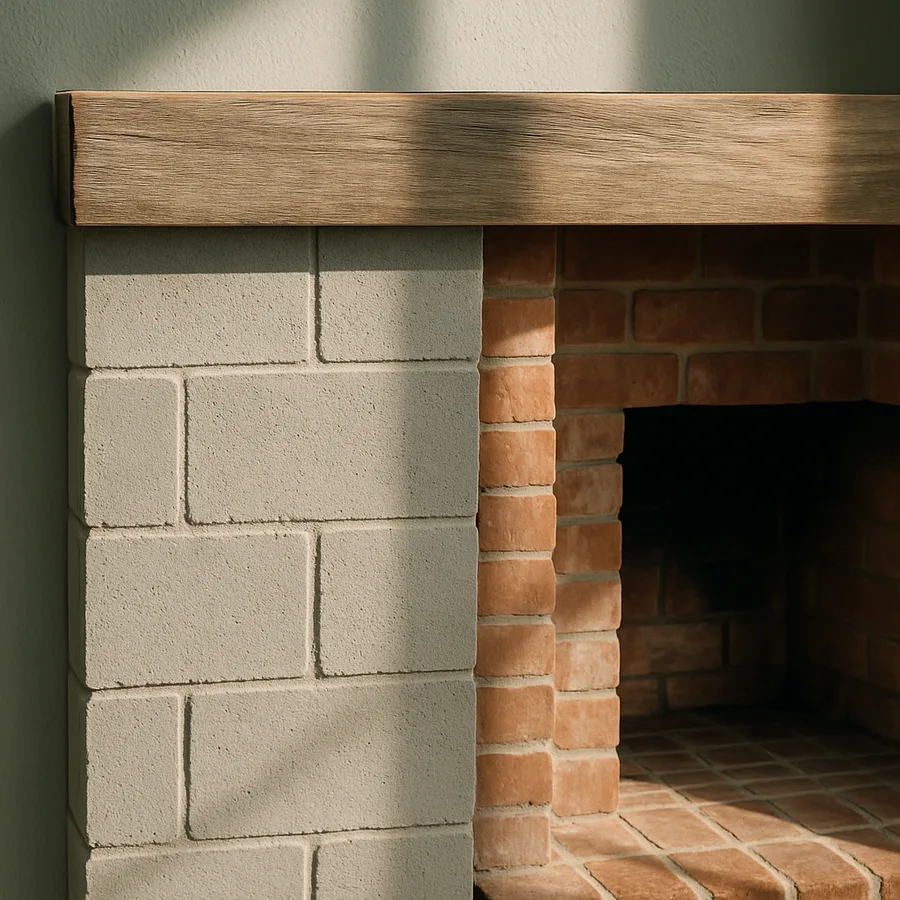
Pick the wrong core material for an outdoor fireplace and the project becomes a slow-motion teardown by year five. Pick the right one and the structure outlives the patio furniture, the dog, and probably the mortgage. Most homeowners default to whichever look they saw on a renovation show, but the underlying decision between concrete masonry units and traditional fired brick has nothing to do with the finish and everything to do with how the structure handles heat cycling, freeze-thaw, and the weight of a full chimney column.
The Brick Industry Association notes that roughly 70 percent of residential outdoor fireplaces in the United States now use a concrete block core with a brick or stone veneer over it. That hybrid approach has become standard because it solves problems that pure solid-brick construction creates. Let's unpack why, and where each material genuinely earns its keep.
Structural Behavior Under Heat And Load
Concrete masonry units, commonly called CMUs or cinder blocks, are manufactured from Portland cement, aggregate, and water. They cure to a compressive strength typically rated between 1,900 and 3,000 psi per ASTM C90, the governing specification for load-bearing concrete masonry. That strength makes them excellent for the structural core that carries chimney weight.
Fired clay brick, governed by ASTM C216 for facing brick and C62 for building brick, generally tests between 3,000 and 10,000 psi. Brick is stronger pound for pound, but the smaller unit size means more mortar joints, and mortar is almost always the weakest link in any masonry assembly.
Reinforcement strategy differs between the two approaches as well. CMU cores accept vertical rebar threaded through the hollow cells, then grouted solid. This produces a reinforced column that resists lateral loads from wind and seismic events. Solid brick walls can be reinforced with bond beams and embedded wire reinforcement at horizontal joints, but the work is fussier and slower. In Seismic Design Categories C and higher under the International Building Code, masonry chimneys taller than six feet typically require engineered reinforcement; a CMU core delivers that reinforcement more economically than solid-brick construction.
Tensile strength deserves attention too. Both materials handle compression loads well, but masonry as a category is weak in tension. A chimney column subjected to wind loads experiences tension on the windward face that the masonry alone cannot resist. Vertical rebar provides the tension resistance. Skip the reinforcement and the chimney may stand fine for years until a high-wind event cracks it across a mortar joint at the worst possible moment.
Under repeated heating and cooling, both materials expand and contract, but they do so at different rates. CMUs expand and contract relatively uniformly. Brick expands permanently over its first decade due to moisture absorption, a phenomenon documented in the Brick Industry Association's Technical Note 18. That permanent expansion can crack a solid-brick chimney that lacks proper expansion joints. A CMU core sleeved in brick veneer with a small air gap accommodates the movement without telegraphing cracks to the surface.
Freeze-thaw cycling is the other invisible enemy. Water enters microcracks in any masonry, then expands roughly 9 percent when it freezes, prying the cracks wider. Each subsequent cycle accelerates the damage. CMUs, with their internal voids, tend to drain water more effectively than solid brick when oriented and detailed correctly. The American Concrete Institute's ACI 530 governs masonry design and explicitly addresses freeze-thaw exposure categories that designers in northern climates should specify. Skipping this consideration is why so many roadside outdoor fireplaces look pristine after three years and disastrous after seven.
Foundation requirements differ too. A typical CMU-core outdoor fireplace weighs 4,000 to 9,000 pounds depending on size. A solid-brick equivalent weighs 6,000 to 14,000 pounds because brick is denser per cubic foot than hollow block. That weight differential changes the footing design. Most jurisdictions require a reinforced concrete footing extending below the frost line, typically 30 to 48 inches deep depending on climate zone, with the footing width sized to keep soil bearing pressure under code limits. The heavier the structure, the wider the footing, and the more expensive the excavation.
Cost, Speed, And Labor Reality
A standard 8-inch CMU costs roughly 2 to 4 dollars per unit, and one block covers the same wall area as approximately six standard brick. A skilled mason can lay 200 to 300 CMUs per day versus 400 to 600 brick. The math favors block for raw structural volume.
Brick, depending on type and region, runs 0.50 to 1.50 dollars per unit for common brick and 1.50 to 4.00 dollars for premium facing brick. A solid-brick fireplace requires substantially more units, more mortar, and more labor hours. Industry estimators typically price a solid-brick outdoor fireplace 35 to 60 percent higher than an equivalent CMU-core build with brick veneer.
Are you doing this yourself? Block goes up faster and forgives amateur tooling because the joints get covered by veneer or stucco. Brick punishes sloppy joint work because every mortar line stays visible forever. A reader recently asked whether weekend warriors should attempt either. Honest answer: a CMU core with rough mortar joints is a forgiving DIY project. A solid-brick chimney visible from the dining room window is not.
Skilled mason availability has shifted over the past decade in ways that affect project cost. The Bureau of Labor Statistics tracks masonry trade employment and projects roughly 1 percent annual decline through 2032, with retirements outpacing apprentice intake. Regions that still have strong masonry guilds, mostly along the Eastern seaboard and parts of the Midwest, can deliver solid-brick projects at competitive prices. Regions reliant on traveling crews see 30 to 50 percent premiums for any brick-intensive work. Get bids from three masons before assuming the standard hybrid approach is cheaper; in some markets a skilled local brick crew can match CMU pricing once you factor travel surcharges out of the comparison.
Mortar type also affects labor speed and finished quality. Type S mortar (1,800 psi) is the workhorse for most outdoor structural work and offers strong bond strength suitable for both block and brick. Type N (750 psi) handles veneer and non-load-bearing applications. Type M (2,500 psi) goes into footings and below-grade work. A mason who specifies the wrong mortar type for the application is signaling either lack of experience or willingness to cut corners; either way, look elsewhere.
Firebox Materials And The Refractory Question
Neither CMU nor standard brick belongs inside the firebox itself. Both will spall, crack, and eventually fail when exposed to direct flame temperatures above 1,200 degrees Fahrenheit. The firebox lining must be firebrick rated to ASTM C27, typically a medium-duty refractory brick that handles temperatures above 2,000 degrees Fahrenheit without breaking down.
The National Fire Protection Association standard NFPA 211 requires a minimum 4-inch thickness of firebrick or equivalent refractory material between the fire and any structural masonry. Skipping this layer to save money is the single most common cause of premature outdoor fireplace failure. The structural core, whether CMU or brick, never sees the flame directly.
Refractory mortar is also non-negotiable for firebrick joints. Standard Type N or Type S masonry mortar will not survive thermal cycling and turns to powder within two seasons. Insist on a high-temperature refractory mortar meeting ASTM C199, even if it costs five times more per bag.
The throat, smoke shelf, and damper assembly above the firebox represent the most technically demanding portion of any masonry fireplace. Get the throat geometry wrong and the fireplace smokes back into the seating area; get the smoke shelf wrong and updraft becomes inconsistent. The Brick Industry Association publishes specific dimensional guidance based on firebox opening area, generally requiring throat area equal to one-tenth to one-twelfth of opening area. These rules of thumb compress decades of empirical experience and should not be improvised. Many DIY failures occur not in the visible masonry but in this hidden geometry that nobody photographs for the housewarming.
Chimney height also affects draft performance. The 2-foot-above-anything-within-10-feet rule from NFPA 211 is a minimum, not an optimum. Practical draft typically requires at least 15 feet of vertical chimney from the firebox opening to the chimney crown, with greater height for fireplaces with large openings. Short chimneys under 12 feet routinely cause smoke spillage and require manufactured draft inducers to correct.
Weather Resistance, Veneer Options, And Aesthetics
An exposed CMU wall absorbs water aggressively and looks utilitarian. Most installations get a finish layer: brick veneer, natural stone, stucco, or manufactured stone. This layered approach is where the CMU-core method actually shines aesthetically, because you choose any finish without compromising structural performance.
Solid brick, by contrast, locks in the aesthetic from day one. It weathers beautifully when the brick is rated SW (severe weathering) under ASTM C216. Lower-grade brick rated MW (moderate weathering) belongs in protected interior locations and will spall after a few winters outdoors. Check the spec sheet before buying.
The International Masonry Institute notes that proper flashing, weep holes every 24 inches along the base of veneer walls, and a continuous capstone with drip edge add roughly 30 years to outdoor fireplace lifespan. These details cost almost nothing during construction and cannot be retrofitted easily.
Sealer selection deserves a paragraph of its own. Silane and siloxane penetrating sealers protect masonry without trapping moisture, allowing the wall to breathe outward while repelling rain inward. Acrylic film-forming sealers look glossy at first but trap moisture behind the film, accelerating spalling within five to seven years. Ask any contractor what they plan to apply and reject any answer that includes "clear acrylic" or "wet-look sealer" for a structural outdoor fireplace. Reapplication every three to five years is normal for breathable sealers and is one of the few homeowner maintenance tasks that genuinely extends life.
Stain options also differ by core material. CMU accepts integrally colored block, painted finishes, or applied veneer with equal grace. Brick locks in its color from the kiln; staining brick is possible but rarely satisfying. If you suspect your taste might shift toward a different aesthetic in a decade, CMU with veneer offers the easier refresh path. A weekend of removing tile or stone veneer and applying a new one is straightforward. Re-staining solid brick is not.
Bottom Line
For most homeowners, a concrete block structural core with a fired-brick or natural-stone veneer is the right answer. It costs less, builds faster, accommodates thermal movement better, and lets you change the finish later if tastes shift. Reserve solid-brick construction for historic restorations, regions with skilled traditional masons, and budgets that can absorb the labor premium.
Whichever route you pick, do not compromise on the firebrick liner, the refractory mortar, or the SW-rated facing brick. Those three line items separate fireplaces that look good at the housewarming from fireplaces that still look good when the kids leave for college. Sketch your design this weekend, then call two local masons for bids. Ask each one which approach they prefer and listen carefully to why; the answer reveals more about their craft than any portfolio.
More Articles You May Like



Comments
Post a Comment