Fireplace Tools Brass Versus Iron Aging And Patina
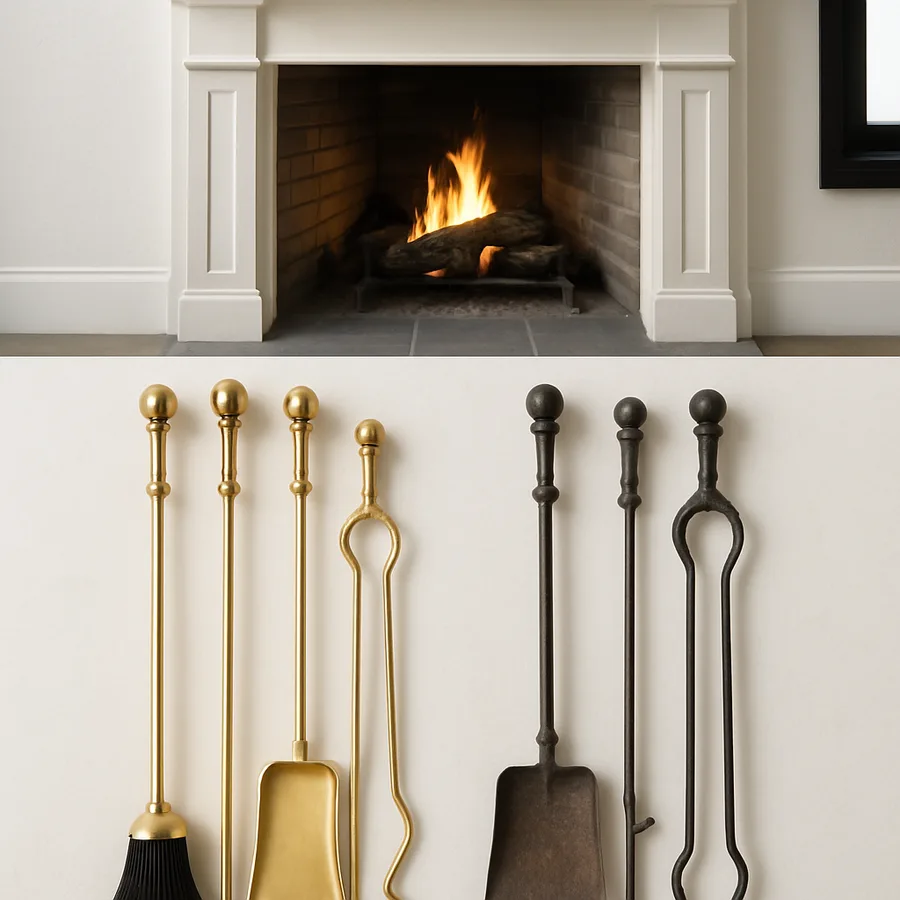
The set of tools that lives beside a working fireplace is one of those small categories of household objects that quietly reveals a homeowner's design sensibility. A polished brass set with a marble base reads completely differently from a forged iron set with a hand hammered finish, and the choice between them deserves more thought than the typical home center purchase receives. The Hearth, Patio and Barbecue Association reports that roughly 78 percent of households with a wood burning fireplace own at least one set of tools, with combined annual sales of hearth accessories exceeding 340 million dollars in the United States alone. Within that market, brass and iron are the two dominant material categories, and they age in dramatically different ways that should shape the decision long before the tools are placed beside the hearth.
Should you choose brass for its warm glow and traditional pedigree, or iron for its forged strength and architectural gravity? The answer depends on the room, the fireplace, your tolerance for maintenance, and the patina story you want to live with over the next twenty or thirty years. Both materials reward owners who understand their tendencies and become quietly disappointing for owners who do not. This guide compares them honestly across the dimensions that matter.
Material Origins And Manufacturing
Brass fireplace tools are typically cast or stamped from alloys containing roughly 65 to 70 percent copper and 30 to 35 percent zinc, sometimes with small additions of lead for machinability. The casting process allows ornate detail in finials and handles, which is why brass dominated the formal hearth tool market through the Georgian, Federal, and Victorian periods. Quality varies enormously, from solid cast brass weighing several pounds per tool down to thin stamped sheet over a steel core that mimics the appearance at a fraction of the price.
Iron fireplace tools are most commonly forged or cast. Hand forged tools from a working blacksmith carry hammer marks, slight irregularities, and a tactile quality that mass produced cast iron cannot replicate. The price difference is substantial: a hand forged set from a respected smith may run 800 to 3,500 dollars, while a cast iron set from a home center retails for 60 to 200 dollars. The forged set will likely outlast both the cast set and the house, while the cast set will perform adequately for a decade or two before showing its age in less flattering ways.
Manufacturing origin matters for both materials. American and European made tools generally use heavier gauge material and better finishes than offshore equivalents, and the price difference reflects real quality rather than branding alone. The American Society of Interior Designers consistently recommends investing in fewer, better hearth accessories rather than rotating through cheap sets, since the tools live in plain view and their quality is read instantly by anyone with an eye for craft.
How Brass Ages
Brass develops a layered patina over years and decades of exposure to air, handling, and the chemistry of wood smoke. A new polished brass tool starts as a mirror bright yellow, then darkens through a series of stages: a warm honey gold within months, a deeper amber within a few years, brown bronze tones over a decade, and ultimately a complex patina that combines greens, browns, and darkened high points where hands have rested.
The progression is reversible. Brass can be polished back to mirror bright at any point with a metal polish such as Brasso or Wright's, then sealed with a thin wax coat to slow re-tarnishing. Better Homes and Gardens has documented that a polished brass tool can hold its bright finish for six to nine months with a wax seal and minimal handling, longer in dry climates. Without intervention the same tool returns to a patinated state within a year or two.
Which version of brass do you want to live with? Some homeowners prize the polished state and commit to twice yearly polishing as part of their household rhythm. Others love the developing patina and would never polish their tools, treating the slow color shift as a record of the years the family has gathered around the fire. Both approaches are legitimate; the mistake is to oscillate between them or to leave polished tools to tarnish unevenly.
How Iron Ages
Iron ages along a different path. New forged iron typically carries a waxed black finish that protects the bare metal from moisture. With handling, the wax wears at high contact points and the underlying metal develops a soft graphite sheen. Over years the finish becomes a subtle map of how the tools are actually used, with the most touched areas glowing slightly and the less touched areas remaining matte black.
Iron does not need to be polished or maintained in the way brass does. A light coat of paste wax once or twice a year keeps the finish from drying out, and an occasional wipe with a soft cloth removes ash and soot. The tools look essentially the same at year ten as they did at year one, with only the subtle wear patterns to record their use. For homeowners who value low maintenance and visual consistency, this stability is part of the appeal.
The risk with iron is rust. If the tools are stored in a damp environment or left in standing moisture, the protective wax can fail and orange rust can develop on bare metal. The National Park Service, which maintains thousands of historic iron hearth tools in its properties, recommends storing tools indoors year round and waxing them annually with a paste wax containing carnauba. Small rust spots can be addressed with fine steel wool and re-waxing; severe rust may require professional restoration.
Matching Tools To Architecture
The choice between brass and iron should respect the architectural character of the fireplace and the room. Brass tools belong with formal surrounds such as carved marble, ornate wood mantels with classical mouldings, and rooms styled in traditional, transitional, or English country idioms. The warmth of polished or patinated brass complements gilded mirrors, oil paintings, and the warm wood tones of antique furniture.
Iron tools belong with surrounds of stone, brick, plaster, and rustic wood, and rooms styled in modern, industrial, farmhouse, or arts and crafts idioms. The architectural weight of forged iron pairs naturally with the heavy proportions of stone hearths and the honest material expression that these styles favor. A black iron tool set against a limestone surround in a vaulted room is one of the most enduring compositions in residential design.
Mixed metal compositions can work but require a deliberate hand. A brass and iron set placed near a hearth that itself mixes warm and cool metals can read as sophisticated rather than confused. The key is to repeat each metal at least once elsewhere in the room so the eye understands the mix as intentional rather than accidental. Architectural Digest has shown several award winning rooms that pair forged iron tools with brass sconces and brass picture lights, and the combination consistently photographs well when the proportions are right.
Practical Selection Criteria
Beyond aesthetics, several practical factors should shape the decision. Tool weight matters: a heavier poker delivers more leverage on stubborn logs, but a tool too heavy for the user becomes unpleasant to handle. Brass tools tend to feel substantial without being unwieldy, while solid forged iron can be genuinely heavy and demands handling strength.
Handle ergonomics deserve attention. Look for handles that fill the hand comfortably, with a clear distinction between the grip and the working end of the tool. Avoid tools whose handles are too short for the working depth of your firebox, since reaching past glowing logs with a short poker is dangerous and tiring.
Stand design completes the set. A heavy stable base prevents the set from tipping when a tool is replaced quickly, while a base of insufficient mass becomes a falling hazard. The stand should also accommodate all the tools without crowding, with each tool dropping cleanly into its hook or loop without fumbling. Have you actually picked up and used a candidate set before purchasing it? Many homeowners regret tools they only viewed in photographs.
Sourcing And Long Term Value
Where should you actually buy fireplace tools? For brass, antique and vintage markets offer extraordinary values, with solid cast brass sets from the 1920s through 1950s frequently available for less than the cost of a modern stamped set. Estate sales, regional auction houses, and dealers specializing in fireplace antiques are productive hunting grounds. The patina on a 70 year old set has a depth that no new manufacture can replicate.
For forged iron, seek out working blacksmiths through the Artist Blacksmith Association of North America or regional craft guilds. A custom set commissioned to your firebox dimensions and aesthetic preferences carries the maker's signature, can be ordered in modest variations such as handle shape and finial style, and becomes a family heirloom in a way that mass produced tools cannot. Expect to pay accordingly and to wait several months for delivery.
If budget is a primary constraint, focus on weight and proportion above ornament. A simple heavy set of either material outperforms an elaborate light set every day of the year. A spare forged set with no decoration at all may be more beautiful in the right room than a fussy brass set with elaborate finials, because the proportions and the material honesty carry the visual weight on their own.
Conclusion
Brass and iron fireplace tools represent two distinct philosophies of how objects should age and how a hearth should be dressed. Brass rewards the homeowner who enjoys ritual maintenance and who wants tools that can be polished bright for special occasions and allowed to patina between them. Iron rewards the homeowner who prefers stability, who wants tools that look essentially the same year after year, and who values the honest material weight of forged steel. Neither choice is universally correct, and neither will disappoint a homeowner who chooses with full awareness of the trade offs.
The decision becomes easier when it is rooted in the architecture of the room rather than abstract preference. A formal traditional room with carved mouldings is essentially asking for brass, while a stone surround in a vaulted great room is essentially asking for iron. When the tools agree with the architecture, they become invisible in the best sense, supporting the fireplace without competing with it. When they disagree, even excellent tools can feel slightly off in ways that are difficult to name.
Invest more than you think you should in tools that will live beside your hearth for decades. A set purchased for 75 dollars at a home center delivers roughly 75 dollars of pleasure each year for a few years before it begins to look tired. A set purchased for 1,200 dollars from a craftsman delivers 1,200 dollars of pleasure every year for the rest of your life and likely for the lives of whoever inherits the house. The math favors quality more decisively than the up front price suggests.
Whether you settle on brass or iron, take care of the set you choose. Wipe ash off after each use, wax the tools annually, and store them indoors year round. Treat them as the working sculptures they are rather than disposable accessories, and they will reward you with the kind of slow developing character that distinguishes a beloved hearth from a merely functional one. Ready to upgrade? Visit an antique dealer, attend a regional craft fair, or commission a blacksmith, and start the relationship with a set that will be part of your family fires for generations to come.
The Sound And Touch Of Quality Tools
A surprising dimension of quality fireplace tools is the sound and feel they produce in use. A well made brass tool returns a soft satisfying click when replaced in its stand, while a cheap stamped equivalent rattles and rings in ways that subtly diminish the ritual of tending a fire. The sound is a tiny detail in any single moment but accumulates into a sense of either quality or carelessness across the thousands of moments that make up a fireplace's working life over the years.
Forged iron tools have their own sonic signature: a deeper, more muted sound that matches their visual weight. The handle of a forged poker fills the hand differently from a cast equivalent, with a slight asymmetry from the hammer marks that locates the grip naturally and prevents the tool from rotating in the hand under load. These tactile qualities are difficult to evaluate in photographs but obvious in person, which is why visiting a craftsman or a specialty hearth shop pays dividends that online shopping cannot match.
The weight distribution of a good tool matters as much as its total weight. A poker that is too heavy at the tip becomes tiring to use across an evening, while one that is too light at the tip lacks the leverage to move logs effectively. The balance point should fall roughly a third of the way down the shaft from the handle, which is the proportion that masters of the craft have arrived at through generations of refinement and is rarely accidental in tools made by serious makers.
Care Rituals That Extend Tool Life
Both brass and iron tools reward simple maintenance rituals that take only minutes per season but extend their service life by decades. For brass, the routine is to wipe each tool with a soft cloth after every use to remove handprints and ash residue, then once a year apply a thin coat of paste wax and buff it out. The wax slows tarnishing and protects against the acidic vapors of certain wood smokes that can pit unprotected brass over time and produce damage that cannot be polished away.
For iron, the routine is similar: wipe after each use, then once a year apply a paste wax containing carnauba or beeswax. Pay particular attention to the handles, which absorb hand oils and can develop sticky residues if left unmaintained. A fine steel wool pad can address minor surface rust if it appears, followed by re-waxing to restore the protective barrier and prevent the rust from returning during humid months.
Have you developed a simple end-of-season ritual for your fireplace tools? Cleaning them thoroughly at the end of the burning season, waxing them, and storing them with the same care you would give garden tools or kitchen knives extends their useful life dramatically. The ritual itself becomes a small pleasure, closing one season and anticipating the next, and the tools reward the attention with decades of reliable service that cheaper sets cannot match.
More Articles You May Like



Comments
Post a Comment