Bonsai Tree Indoor Care Watering And Pruning Schedule
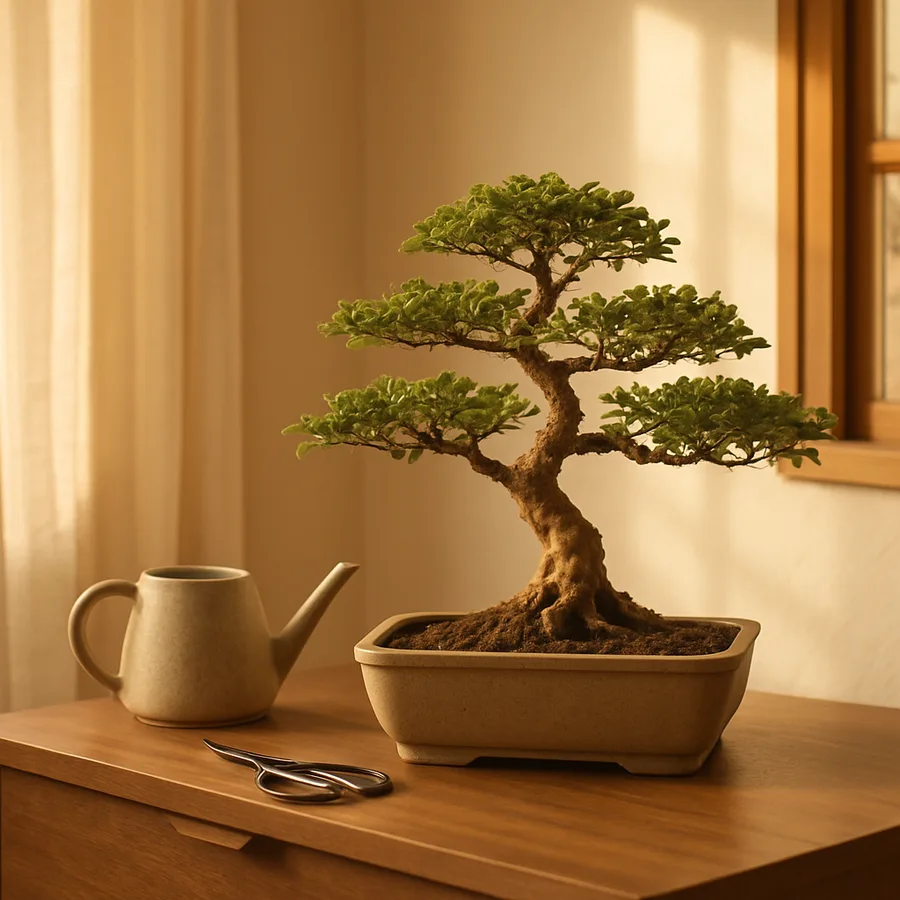
Most indoor bonsai die from the same two mistakes, in the same order, every time. First, the owner waters on a fixed weekly schedule regardless of what the tree needs. Second, the owner avoids pruning because the tree looks "fine," then panics three months later when it has lost its shape entirely. Both mistakes come from treating bonsai as decor instead of as a living horticultural practice. The fix is not complicated, but it does require unlearning some habits.
This guide is the operating manual I wish someone had handed me before I killed my first three trees. We will cover species selection (which matters more than anything), watering by observation rather than calendar, the seasonal pruning logic that keeps a bonsai shaped without exhausting it, and the small environmental tweaks that mean the difference between surviving and thriving.
The Species Question Comes First
"Indoor bonsai" is not a botanical category. It is a marketing term. The truth is that most classical bonsai species - pines, maples, elms, junipers - are temperate trees that need a cold winter dormancy and will slowly die in a heated living room. The trees genuinely suited to year-round indoor life are tropical and subtropical species that never evolved a freeze response.
The reliable indoor species are ficus (Ficus retusa, F. benjamina, F. microcarpa), Chinese elm (Ulmus parvifolia) in some climates, jade (Portulacaria afra and Crassula ovata), fukien tea (Ehretia microphylla), and Hawaiian umbrella (Schefflera arboricola). Ficus is the most forgiving and the species I recommend to almost every beginner. It tolerates low humidity, irregular light, and the occasional missed watering better than anything else in the indoor lineup.
The American Bonsai Society notes that more than 70 percent of beginner failures come from buying a species mismatched to the growing environment. Before you read any further, find out what species you actually have. Has the tag fallen off your tree? Snap a photo, post it to a bonsai forum, and get an ID before you spend energy on a care plan.
If you have a juniper that came labeled as an "indoor bonsai," I am sorry to say you have been sold a slow death. Junipers are temperate conifers that need cold dormancy and full sun. They can survive indoors for six to twelve months on stored energy, which is long enough that the seller is technically not lying when the tree leaves the store green. But it will die. The kind move is to put it outside in a sheltered spot as soon as weather allows, treat it as an outdoor bonsai, and choose a ficus for your indoor display.
Why does the misinformation persist? Because juniper bonsai look the most stereotypically "bonsai" - twisted trunks, needle foliage, ancient appearance - and they sell well. Indoor-suitable ficus look less iconic to casual buyers. Retailers chase what sells. The result is that the most photographed bonsai species in America is also the most commonly killed.
Watering: Why The Calendar Approach Fails
"Water once a week" is the single most damaging piece of advice in bonsai care, because it ignores everything that actually controls how fast a bonsai dries out: pot size, soil composition, humidity, temperature, light intensity, season, and the tree's own water demand. A small ficus in a shallow tray on a sunny south-facing windowsill in July might need water twice a day. The same tree in a deeper pot in a north-facing corner in January might need water every five days.
The correct method is observation. Stick your finger into the soil up to the first knuckle. If it feels dry at that depth, water thoroughly until water runs out the drainage holes. If it still feels damp, wait and check again in a few hours. Some experienced practitioners use a chopstick - push it into the soil, leave it for a minute, then pull it out and look. Dry wood means water now.
The Royal Horticultural Society recommends that bonsai soil should be allowed to dry out partially between waterings, but never reach the point where the soil pulls away from the pot edges. That dry-pulled-away state is bonsai emergency. If it happens, submerge the entire pot in a bucket of water for 10 minutes until air bubbles stop rising, then drain. Have you ever come home from a long weekend to find your bonsai's leaves crispy? That is the rescue protocol.
When you do water, water thoroughly. The amount of water matters as much as the timing. The correct technique is to water until water runs freely out of every drainage hole, then wait a minute and water again until runoff appears once more. This double-pass approach ensures the entire soil volume is rehydrated and breaks up any dry pockets that the first pass missed. Light surface watering is one of the most common beginner mistakes - it wets the top inch and leaves the deeper roots dry, which the tree experiences as drought even though you "watered" it.
Water temperature also matters more than people think. Cold water shocks tropical bonsai roots and slows nutrient uptake. Use room-temperature water, ideally collected and left to stand for a few hours so it reaches ambient temperature and any chlorine off-gasses. Watering with cold tap water from January through March is a subtle stressor that adds up across the dormant season.
Soil And Pot Mechanics
Bonsai soil is not regular potting soil. It is a coarse, free-draining mix designed to provide oxygen to the roots and prevent water from sitting. Standard bonsai mix contains akadama (a Japanese clay aggregate), pumice, and lava rock in roughly equal parts. For tropical species like ficus, you can substitute lava rock with extra organic matter, but the principle holds: water has to drain fast.
If your bonsai came in dense, dark, peaty soil that holds water for a week, that is a problem. The tree was potted for shipping, not for long-term health. Plan to repot in the next growing season using proper bonsai mix. Repotting also lets you root-prune, which is essential maintenance every two to three years for most indoor species. Roots that fill the pot stop the tree from absorbing nutrients and water efficiently.
The pot itself matters. Drainage holes are non-negotiable. Pot depth should match the species - shallow for forest-style designs, deeper for cascade and slanting styles. The University of Illinois Extension publishes a useful primer on bonsai pot selection and repotting timing if you want a fuller reference.
Light: The Most Common Invisible Failure
Indoor bonsai need a lot more light than people realize. Tropical species evolved in environments with 10 to 12 hours of bright daylight year-round. The corner of your living room offers a fraction of that. Light deprivation is a slow killer - the tree does not die in a week, it just slowly loses leaves, fails to produce new growth, and eventually collapses six to nine months in.
The minimum standard is placement within two feet of a south- or east-facing window. Sheer curtains are fine; full blackouts are not. If your only window is north-facing or shaded by buildings, you need supplemental light. A full-spectrum LED grow light 12 inches above the canopy, on a timer for 10 to 12 hours per day, is enough for most indoor species. Ficus will tolerate genuinely low light better than most, but "tolerate" is not "thrive."
Rotate the pot a quarter turn every two weeks so the tree grows symmetrically toward light rather than leaning. Trees that lean develop weak structural branches that have to be pruned away later, which means you lose years of work.
The Pruning Logic No One Explains
Pruning is where bonsai stops being plant care and becomes design. There are two distinct types of pruning, and they happen on different schedules.
Maintenance pruning is what keeps the existing shape. You trim new shoots back to one or two leaves once they have produced six to eight leaves, you remove any branches growing toward the trunk or directly downward, and you snip off suckers from the base. This happens continuously through the growing season, roughly once every two to three weeks for vigorous tropical species like ficus.
Structural pruning is what creates or changes the shape. You remove larger branches that do not fit the design, you shorten the trunk, you wire branches into new positions. This is done sparingly, usually once a year, during the species' specific dormancy or low-vigor period. For ficus and Chinese elm grown indoors, this is typically late winter just before the spring growth flush.
According to data published by the Pacific Bonsai Museum, trees that receive no maintenance pruning for over six months lose 40 percent or more of their fine ramification - the delicate branch structure that makes a bonsai look like a miniature mature tree. That ramification takes years to develop. Letting it disappear is the most expensive form of neglect.
There is a third category of pruning that often gets folded into the others but deserves its own mention: defoliation. For vigorous tropical species like ficus, partial defoliation in mid-summer - removing roughly half the leaves while leaving the petioles attached - forces the tree to produce a second flush of smaller, more refined leaves. This technique is how serious enthusiasts produce ficus with leaves the size of a fingernail rather than a quarter. It is not for first-year owners, but knowing it exists is useful context for understanding what your tree is capable of. Try it only after you have grown the species successfully for at least two full years.
The right tools matter. Cheap household scissors crush branches rather than cut them cleanly, leading to die-back and infection at the cut site. Invest in a basic pair of bonsai shears (around $25) for fine work and a concave cutter (around $35) for larger branches. The concave cutter is designed specifically to leave a wound that heals flush with the trunk rather than producing an ugly stub. These two tools will last decades and dramatically improve your results.
Seasonal Care Calendar For Indoor Tropical Bonsai
Even indoor tropicals respond to seasonal light and temperature shifts. Building a rough calendar gives you a framework that adjusts with the year.
In spring (March through May), increase watering as the tree leafs out, begin light fertilizing every two to three weeks, perform structural pruning early in the period, and watch for new shoot growth that will need eventual pinching. This is the year's biggest push of growth, and the tree needs the resources to do it.
In summer (June through August), water frequently - daily checks are not excessive in hot months - continue maintenance pruning every two to three weeks, fertilize every two weeks, and consider moving the tree outdoors to a sheltered spot for the season if your climate allows it. Outdoor time, even just summer, dramatically improves long-term tree health for indoor species.
In fall (September through November), reduce fertilizer to once a month, slow the watering rhythm as growth slows, do a final light maintenance prune before winter, and bring outdoor-summered trees back inside before night temperatures drop below 55 degrees Fahrenheit.
In winter (December through February), water less frequently - sometimes only every 7 to 10 days for ficus in cool indoor conditions - skip fertilizer entirely, avoid major pruning, ensure adequate light despite shorter natural daylight, and resist the urge to "do something" because the tree is in low-vigor mode and rest is what it needs. What is your tree doing right now, this week? That answer should drive your next intervention.
Humidity, Air, And The Small Environment
Indoor bonsai struggle with the dry air of heated homes. The U.S. Forest Service notes that tropical understory trees, which is what most indoor bonsai species are, evolved in 60 to 80 percent relative humidity. A typical heated American home in winter sits at 25 to 35 percent. That gap shows up as leaf drop, crispy leaf edges, and slowed growth.
The fix is a humidity tray - a shallow dish of pebbles with water in the bottom, with the bonsai pot resting on the pebbles above the waterline. The water evaporates around the tree, raising local humidity by 10 to 20 percent. A small room humidifier is another option and is the better choice if you have multiple tropical plants in the same room.
Air movement matters too. Stagnant air around a bonsai encourages fungal problems and pest outbreaks, especially fungus gnats and scale. A ceiling fan on low or an open window during temperate weather is enough. Avoid placing bonsai directly in the path of HVAC vents, which dry the foliage too aggressively.
What "Healthy" Actually Looks Like
Beginners often cannot tell whether their tree is healthy because they have nothing to compare it against. Here is the visual checklist I run through monthly.
Leaves should be uniformly colored, not yellowing or pale, and firm rather than droopy. New growth should be visible at branch tips during the growing season - small, light green leaves emerging at the ends. Bark should look the way it looked when you got the tree, possibly with slow development of texture over months. Roots, when visible at the soil surface or through drainage holes, should be white or light tan; black or mushy roots mean rot.
Signs of trouble include sudden leaf drop (often a light, water, or temperature stress signal), persistent yellowing (often nutrient deficiency or root issues), sticky residue on leaves (scale or aphids), and white fluff at leaf joints (mealybugs). Each of these has a specific intervention, but the first response is always the same: re-check your watering, light, and humidity baseline before treating symptoms.
One specific case worth mentioning is what experienced growers call "ficus pout." When a healthy ficus is moved to a new location - even just from one window to another - it often drops 30 to 50 percent of its leaves within two weeks. This looks alarming and is the reason many beginners panic-water their newly relocated trees, which makes the problem worse. The leaf drop is the tree adjusting to its new light conditions. Within four to six weeks, new leaves emerge calibrated to the new light intensity, and the tree resumes normal growth. The intervention is to do nothing - just maintain the watering rhythm and let the tree adjust.
Healthy indoor bonsai grow slowly. A ficus might add an inch or two of new branch length in a year. That is normal. Trees that suddenly grow vigorously are sometimes responding to a previous stress release, and trees that have not grown in a year are sometimes about to die. The middle path - steady, slow, deliberate growth - is what you are aiming for.
The Takeaway
An indoor bonsai is not a houseplant and not a sculpture. It is a long-term horticultural relationship that rewards observation and consistency more than expertise. The two highest-leverage practices are: water by checking the soil rather than the calendar, and prune in two modes - light maintenance every few weeks during the growing season, structural shaping once a year. Add adequate light, modest humidity, free-draining soil, and a species genuinely suited to indoor life, and you have a tree that will outlive most of your other furniture.
If you are starting fresh, buy a Ficus retusa from a reputable nursery, not a mall kiosk. Get a chopstick. Put the tree by your brightest window. Run the seasonal calendar above for one full year and keep a small notebook of when you watered and what you observed. By month twelve, you will know your tree well enough that the schedules become invisible. Drop a comment with the species you have and the room you keep it in - I will tell you the single biggest adjustment to make.
Authority references for further reading:
More Articles You May Like



Comments
Post a Comment