Plaster Ceiling Medallion Sizing Around Pendant Light Fixtures
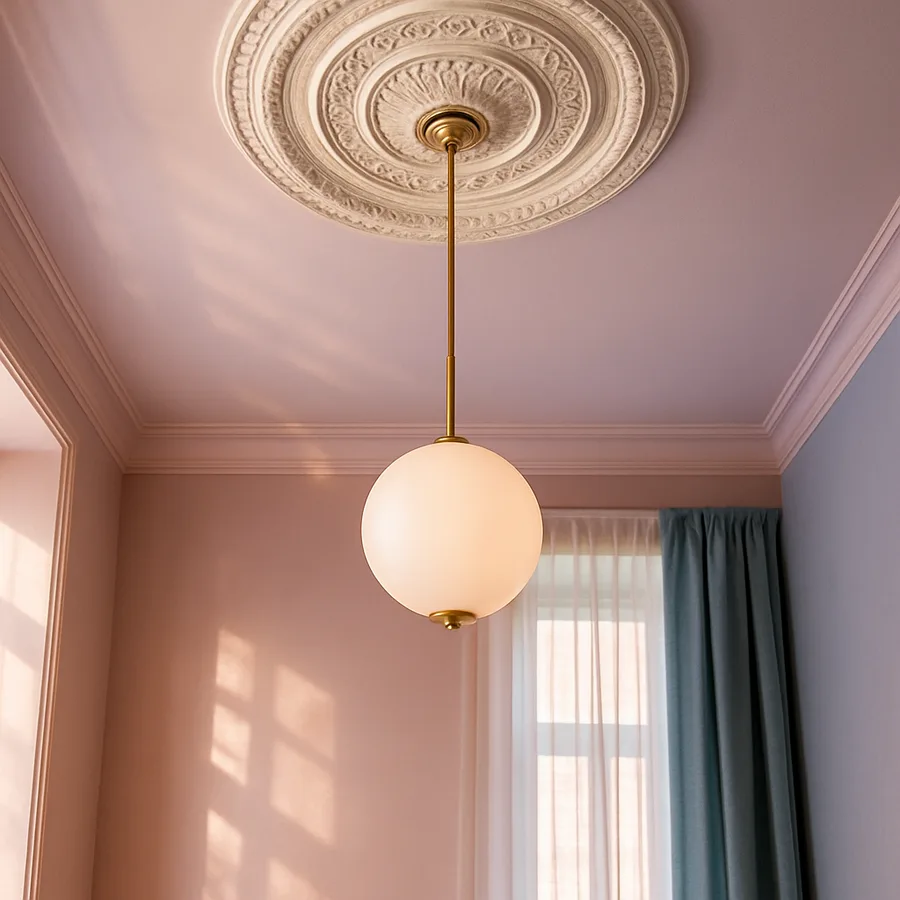
A plaster ceiling medallion is one of the few architectural details that can change the personality of a room without touching the walls or floor. When paired with a pendant light, the medallion acts as a frame, anchoring the fixture and giving the eye a place to rest. Get the proportions wrong, however, and the whole composition collapses: an oversized medallion swallows the pendant, while a tiny one looks like an afterthought taped to the ceiling. The good news is that sizing is not guesswork. There are well-established proportional rules borrowed from classical architecture, modern interior design practice, and even building code clearance requirements. This guide walks through every variable you need to consider, from canopy diameter to ceiling height, room scale, and stylistic register.
Before any decisions are made, it is worth understanding why medallions exist in the first place. Originally cast from lime plaster in 18th-century European homes, these decorative discs were designed to disguise the soot stains left by oil lamps and gas chandeliers. Today they serve a primarily aesthetic role, but they still solve practical problems: hiding old electrical box cutouts, smoothing out drywall imperfections, and adding sculptural relief to flat ceilings. According to the American Institute of Architects, restoration of classical ceiling details is one of the fastest-growing segments of residential renovation, with a reported 18 percent year-over-year increase in specifications between 2023 and 2024.
The Foundational Proportional Rule
The classic guideline used by interior designers and architects is straightforward: the medallion diameter should be roughly 1.5 to 2 times the diameter of the pendant canopy. The canopy is the small metal cup that sits flush against the ceiling, hiding the electrical junction box. If your pendant has a 5-inch canopy, you would want a medallion in the 8 to 10 inch range. This ratio gives the canopy enough breathing room to read as an intentional decorative element rather than a mechanical necessity.
This rule traces back to Beaux-Arts proportional studies and is still cited in restoration handbooks published by the National Park Service. It works because the human eye reads composition through ratios, not absolute measurements. A medallion that is too close in diameter to the canopy creates visual tension, almost like a halo that is choking the light fixture. A medallion that is more than three times the canopy size, on the other hand, makes the pendant look undersized and orphaned.
For pendants without a defined canopy, such as plaster bell pendants or ceramic forms that hang directly from a cord, designers measure the widest point of the fixture body that sits within roughly 6 inches of the ceiling. The same 1.5 to 2x ratio applies. If you are working with a cluster of small pendants on a single canopy plate, treat the plate itself as the canopy for sizing purposes.
Scaling for Room Size and Ceiling Height
Proportional rules are a starting point, not an ending point. Room volume changes everything. A 10-inch medallion that looks perfect in a 10-by-12-foot powder room will disappear in a 20-by-24-foot great room with 14-foot ceilings. Designers at firms accredited by the American Society of Interior Designers often use a secondary check: the medallion diameter in inches should roughly equal 1 to 1.5 percent of the room's total square footage, with adjustments for ceiling height.
For a 200-square-foot room with standard 9-foot ceilings, that math suggests a medallion in the 20 to 30 inch range. But if that same room has 12-foot ceilings, you can push the diameter another 15 to 20 percent to compensate for the increased visual distance. Conversely, in rooms with 8-foot ceilings, you should pull back. A medallion larger than 24 inches in a low-ceilinged room will feel oppressive, no matter how impressive the casting.
Ceiling height also affects relief depth. Most plaster medallions range from three-quarters of an inch to two and a half inches deep. In rooms with ceilings under 9 feet, choose medallions in the 1-inch relief range or shallower. Deeper castings cast harder shadows that can make the ceiling feel lower than it actually is. In double-height entries or stairwells, you can specify medallions with up to 4 inches of relief, since the dramatic shadow play actually enhances the architectural drama.
Matching Style and Detail Density
A Greek Revival home calls for an acanthus-leaf medallion in the 24 to 36 inch range with deep undercuts and crisp egg-and-dart borders. A mid-century modern home should probably skip the medallion entirely, or use a flat plaster disc with no ornamentation. Trying to install a 32-inch Victorian rosette in a clean-lined contemporary loft creates the kind of stylistic dissonance that even the most expensive pendant cannot rescue.
Detail density should also harmonize with the pendant itself. A simple opal glass globe pendant pairs best with a smooth, lightly molded medallion: a plain reeded ring, a single concentric band, or a subtle radial fluting. A heavily ornamented brass chandelier with crystals and arms can support a more intricate medallion with foliate borders and a central rosette. The general principle: the more visually busy your pendant, the simpler the medallion should be, and vice versa. Two competing decorative voices in the same vertical sightline will fight each other.
Period authenticity matters in heritage homes. The National Trust for Historic Preservation recommends sourcing medallions from manufacturers that document the original molds or specifications for your home's era. For a Federal-style home built between 1780 and 1830, expect medallions in the 18 to 28 inch range with neoclassical motifs. For Victorian Italianate homes from the 1860s and 1870s, medallions often pushed to 36 inches with high-relief floral patterns. Have you considered whether your home's architectural period demands a specific motif vocabulary?
Working With Existing Electrical Boxes and Pendant Hardware
The most common installation mistake is choosing a medallion before measuring the existing electrical box. Most residential ceiling boxes are 4 inches in diameter, but the cutout in the medallion needs to accommodate not just the box but also the pendant's mounting bracket. A 5-inch canopy on a pendant typically requires a medallion with a center cutout of at least 5.5 inches to allow for installation tolerance.
Plaster medallions usually ship with a small pre-cut center hole that you can enlarge with a hole saw. If you are buying a polyurethane reproduction (lighter, easier to install, and increasingly indistinguishable from real plaster at typical viewing distances), the center is usually thinner and easier to modify. According to a 2024 industry survey by the National Association of Home Builders, polyurethane medallions now account for roughly 67 percent of new residential installations, up from 41 percent a decade ago, primarily because they are roughly 80 percent lighter and require no specialty plastering skills to install.
Pay attention to weight limits on your electrical box. Standard pancake boxes are rated for fixtures up to 50 pounds. If your pendant plus medallion exceeds that, you will need a fan-rated brace or a structural bracket installed between joists. Medallions over 30 inches in diameter, particularly real plaster ones, can themselves weigh 15 to 25 pounds, so factor that into the load calculation. The electrical box does not support the medallion (it is glued and screwed to the drywall or directly to the joists), but the combined assembly still creates downward pressure that can pull a poorly anchored installation off the ceiling over time.
Common Sizing Mistakes and How to Avoid Them
The single most frequent mistake is sizing the medallion to the chandelier or pendant body rather than to the canopy. A 24-inch chandelier hanging 36 inches below the ceiling will look fine with a 12-inch medallion if the canopy is 6 inches. The visual relationship is between the canopy and the medallion, not between the fixture body and the medallion. The pendant body is read separately because it sits in a different visual plane.
The second mistake is failing to account for sightlines. In a dining room, the medallion is most often viewed from a seated position, which means the angle of view is steeper than the angle from a standing position in a hallway or foyer. From a seated angle, deeper medallion relief reads more dramatically and detail is more legible. In an entry foyer, where most viewing happens at standing height from below, choose flatter relief and more generous diameters because foreshortening will visually compress the medallion.
A third mistake is choosing white-on-white finishes that disappear against the ceiling. While ceiling-color medallions are a classic look, many designers now specify medallions in contrasting glaze finishes, gilded accents, or even soft-pastel tinted plasters to make the detail readable from across the room. Are you aware of how your medallion will be lit? Side lighting from windows or sconces dramatically changes how relief reads compared with the downlight from the pendant itself.
Specifying for Special Conditions and Historic Homes
Sloped ceilings, coffered ceilings, and tray ceilings all require special sizing considerations. On a sloped or vaulted ceiling, the medallion cannot sit flush unless it is custom-cast at an angle to match the slope. Standard practice is to use a sloped-ceiling adapter that creates a level mounting surface, then size the medallion to fit within the adapter footprint. This typically means going one size smaller than you would for a flat ceiling.
For coffered ceilings, the medallion should be sized to fit comfortably within a single coffer with at least 6 inches of clear space between the medallion edge and the coffer beam. If the coffers are 36 inches square, the maximum medallion diameter is 24 inches, and a 20-inch medallion will read more comfortably. In tray ceilings, the medallion belongs in the recessed center area, sized to roughly half the diameter of the tray opening. A 60-inch tray opening calls for a medallion in the 28 to 32 inch range.
In historic homes undergoing restoration, original medallions can sometimes be repaired rather than replaced. The AIA reports that approximately 34 percent of pre-1900 residential restorations now include some form of plaster medallion conservation work. Hairline cracks can be filled with lime-based patching compounds. Missing chunks can be recast from silicone molds taken from intact sections. Full replacements should match the original diameter, profile depth, and motif vocabulary as closely as possible. If you find yourself with a pendant that no longer suits the original medallion proportions, consider changing the pendant rather than the medallion.
Conclusion
Choosing the right plaster ceiling medallion is ultimately about respecting proportional relationships at multiple scales: the canopy-to-medallion ratio at the closest scale, the medallion-to-room ratio at the middle scale, and the medallion-to-architectural-period ratio at the broadest scale. When all three relationships harmonize, the medallion becomes invisible in the best possible sense. It feels inevitable, like it has always been there. When any one of those relationships is off, the medallion announces itself awkwardly and the entire room suffers.
Take the time to measure your canopy, audit your room's volume and ceiling height, and consider the stylistic vocabulary of both your home and your light fixture. Order samples or printouts at full scale before committing. Many manufacturers will send you a paper template at the actual diameter so you can tape it to the ceiling and live with it for a few days before purchasing. This single step prevents more sizing regret than any other piece of advice in this guide.
If you are planning a renovation that involves new ceiling details, work with a designer or plasterer who can show you in-progress photos of similar installations. Bring your pendant fixture with you when you visit a showroom, even if it means lugging a heavy chandelier across town. Seeing the canopy and medallion together at full scale is the only way to know with certainty that the proportions work. Ready to start specifying your own ceiling medallion? Pull out a tape measure today, record your canopy diameter and your room dimensions, and use the formulas in this guide as your starting point for a successful installation.
More Articles You May Like



Comments
Post a Comment