Wall Plate Decorative Versus Standard White Comparison
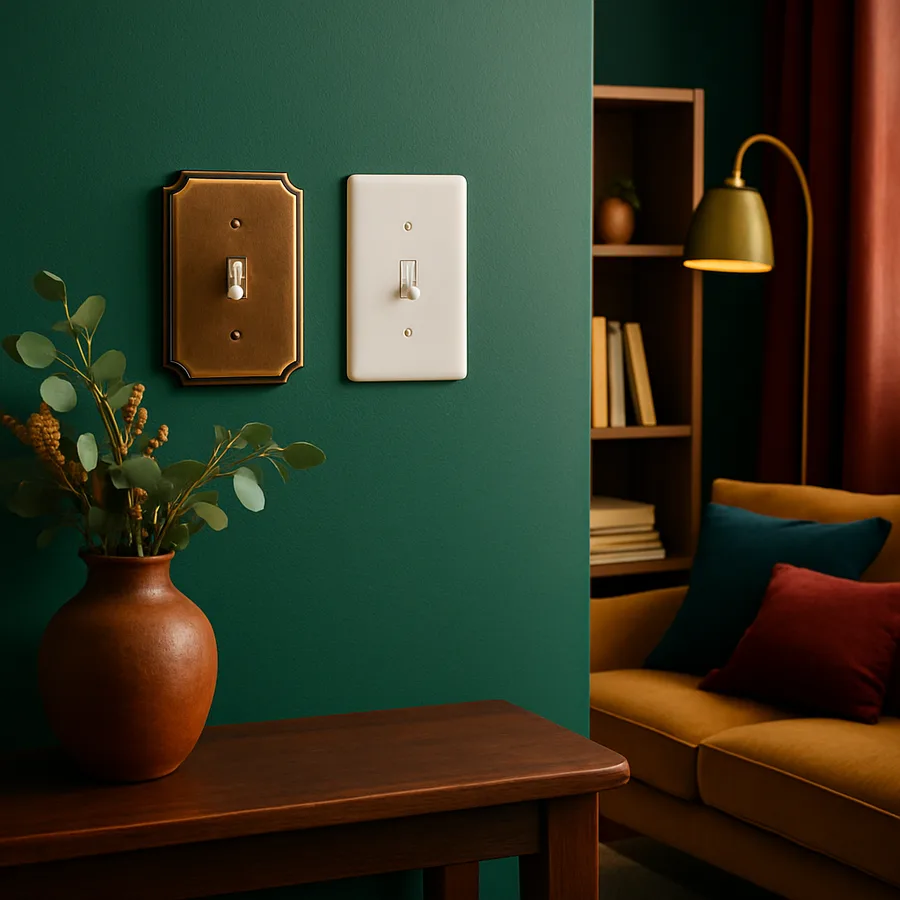
Wall plates are one of the smallest line items in a home's finish budget and one of the most visible. A single room may have ten or fifteen of them scattered across the walls, each one a tiny rectangle of either thoughtful design or default plastic. The choice between a standard white wall plate and a decorative wall plate seems trivial until you walk into a finished room and notice exactly which version was specified. This guide compares the two categories across the dimensions that actually matter: cost, materials, finish coordination, installation, and the design impact in different rooms.
The standard white nylon plate that ships in builder-grade homes costs about thirty cents, has been manufactured to the same dimensions for decades, and disappears into a white wall without comment. Decorative plates span a wide range, from brushed metal to wood veneer to ceramic to hand-painted enamel, with prices that climb from five dollars to over fifty dollars per plate. The decision is rarely about technical performance, since both categories cover the same electrical box opening, but about whether the wall plate is a finish detail worth investing in or a utility component to keep invisible.
Material Differences Between Standard And Decorative Plates
Standard white wall plates are typically made from nylon, polycarbonate, or thermoplastic. They are injection molded, lightweight, and color-stable when fresh, though they yellow over time under sunlight or near sources of heat such as halogen lamps. The white color is rarely the exact same shade as the surrounding wall paint, particularly when the wall is painted in any off-white, warm white, or cream tone. The mismatch reads as slightly grayish against most wall colors.
Decorative wall plates expand the material palette substantially. Metal plates include stamped or cast options in stainless steel, brushed nickel, polished brass, antique brass, oil-rubbed bronze, copper, and matte black powder coat. Wood plates are typically thin laminated veneers over a structural backing, available in oak, walnut, maple, and other species. Stone and ceramic options exist for premium installations. There are also hand-painted enamel plates from specialty makers, often used as accent pieces rather than full-room coverage.
The National Electrical Manufacturers Association (NEMA) publishes the WD-6 standard that governs wall plate dimensions, and both standard and decorative plates that meet WD-6 are dimensionally interchangeable. A decorative brushed brass plate slides onto the same outlet that came with a builder-grade white plate. This standardization is important because it means upgrading to decorative plates is a finish swap, not an electrical change, and rarely requires more than a screwdriver.
Cost Per Plate And Total Project Math
The cost difference is meaningful at the room and home level even though it is small per plate. Standard white nylon plates sell at major retailers for thirty to seventy cents each. Mid-tier decorative plates in brushed metal finishes run three to seven dollars each. Premium decorative plates in solid brass, copper, or stone climb to fifteen to thirty dollars each, and artisan or hand-painted plates can exceed fifty dollars apiece.
A typical three-bedroom home has roughly seventy to ninety wall plates, including outlets, switches, cable plates, and blank covers. Upgrading from standard white to mid-tier decorative across the entire home costs roughly two hundred to six hundred dollars in materials, plus an hour or two of labor if a professional handles the swap. Upgrading just the public-facing rooms, which is what most homeowners actually do, brings the cost down to roughly one hundred to two hundred fifty dollars and addresses the ninety percent of plates that guests actually see.
Industry data from the NAHB suggests that decorative wall plates appear in roughly twenty-five percent of custom homes and a much smaller share of production-built homes, where the builder's default is almost always white nylon. Have you ever counted the wall plates in your own living room and entryway, the two rooms most likely to register on first impression? It is often a smaller number than it feels like, which makes the per-room upgrade cost surprisingly accessible.
Finish Coordination With Hardware And Lighting
The strongest argument for decorative plates is finish coordination with the room's other hardware. A kitchen with brushed brass cabinet pulls, brass faucets, and brass pendant lights looks unfinished when the wall outlets are capped in white plastic. Matching the wall plates to the dominant hardware finish ties the room together visually, the same way matching cabinet pulls to faucets ties a kitchen together.
The hardware finish trend over the last several cycles has shifted toward warmer metals. Polished chrome and brushed nickel dominated the prior decade, and brass, copper, and aged metals have taken over in recent years. The American Society of Interior Designers (ASID) tracks this in member surveys, and warm metals now appear in roughly sixty percent of new residential projects, up from less than twenty percent a decade ago. Matte black is also a meaningful presence, particularly in contemporary and industrial-inflected interiors.
The risk of decorative plates is over-coordinating to a finish that will date faster than the wall paint. Standard white plates do not date because they are not making a stylistic statement. Brushed brass plates installed at the peak of a brass cycle may look tired in ten years when finishes have shifted. This is partly why some designers prefer stainless steel or matte black plates as more finish-neutral choices that pair acceptably with most hardware cycles.
Paintable Plates And The Hidden-Plate Approach
A third category sits between standard white and decorative: paintable wall plates. These are typically made from a smooth, primer-friendly composite material designed to accept latex paint. Installed unpainted, they look like standard plates. Painted in the same color as the surrounding wall, they nearly disappear, an effect sometimes called the monolithic wall.
Paintable plates are particularly effective on accent walls, deep-color walls, or any wall where the contrast between a white plate and a colored wall would otherwise be jarring. A navy blue feature wall with five white outlet plates scattered across it looks dotted and busy. The same wall with all five plates painted navy reads as a single continuous color field. This is a design effect that decorative plates cannot easily replicate, since most decorative plates draw attention to themselves rather than away.
The trade-off is that paintable plates do require an extra step in the finishing process. They must be primed and painted along with the wall, ideally with the same paint batch used on the wall itself. They also do not paint over their screws cleanly, which leaves either two visible screw heads or requires screwless plates, a subcategory with hidden snap-on covers. Have you considered whether your wall colors would benefit from disappeared plates rather than upgraded plates?
Switch Style And Plate Compatibility
The wall plate decision intersects with the switch style decision. Standard toggle switches, the small lever-style switches that have been residential standard for a century, work with most decorative plates, but the visual style of the switch itself remains traditional. Decora-style rocker switches, with wide flat paddles, work with Decora plates that have a single large rectangular opening rather than the keyhole opening of toggle plates. Slide dimmers, rotary dimmers, and smart switches each have their own plate opening requirements.
Decora-style switches paired with decorative Decora plates create a contemporary look that is currently the most common in new construction. Toggle switches paired with decorative toggle plates create a traditional or transitional look. Mixing styles within a single room generally reads as a mistake; consistency in switch style across a room is more important than the specific style chosen.
Smart switches and dimmers from manufacturers like Lutron, Leviton, and Legrand mostly use Decora-style faceplate openings, with proprietary plates required for some smart switch lines that include built-in displays or status LEDs. If you are planning to migrate to smart switches over time, choosing Decora-style plates throughout the home keeps the upgrade path open without requiring a second round of plate changes.
Installation, Maintenance, And Replacement Considerations
Both standard and decorative plates install with two or four screws into the receptacle or switch mounting tabs. The procedure is identical: turn off the breaker, remove the existing plate, install the new plate, and restore power. Most plates take less than a minute to swap. Screwless plates with snap-on covers require an extra step to remove the inner mounting frame from the outlet but are otherwise no more complex.
Maintenance differs by material. Plastic plates can be wiped clean with any household cleaner and tolerate most finishes. Metal plates require finish-specific care: brass develops a patina if not lacquered, copper darkens substantially over time, oil-rubbed bronze can wear at the corners where fingers contact it, and matte black powder coat can scratch and reveal the underlying metal. Wood plates need protection from water and humidity, particularly in kitchens and bathrooms where steam can damage finishes.
Replacement costs after damage favor standard plates by a wide margin. A cracked white plate replaces for under a dollar; a cracked decorative plate may run anywhere from five to fifty dollars and may require ordering from a specialty supplier if the original finish is no longer in production. Buying a few spare decorative plates at the time of original installation is good practice for any finish you care about, since manufacturers do rotate their finish offerings over time.
Compatibility with oversized switches and dimmers deserves attention. Larger dimmer modules, occupancy sensors, and smart switches sometimes have control faces that extend slightly past the standard Decora opening. A few decorative plate manufacturers produce slightly oversized openings designed to accommodate these modules without binding. If you have already chosen smart switches, confirm that the decorative plate line you are considering lists compatibility with that switch series. Returning a set of incompatible plates is a small but avoidable inconvenience.
Plate count rarely matches outlet count exactly because some openings need blank plates rather than functional plates. A wall where an outlet has been removed but the box remains, or where a future device is being preserved, requires a blank wall plate. Decorative lines almost always include matching blanks, and using them rather than a default white blank is what keeps the room visually consistent. A single white blank plate on a wall otherwise outfitted in brushed brass reads as a forgotten loose end.
Conclusion
The choice between standard white and decorative wall plates is rarely a code or technical question and almost always a design question. Both categories function identically, both meet NEMA WD-6 dimensional standards, and both install the same way. The difference is whether the wall plates contribute to the room's finish story or quietly stay out of the way. Each approach has its place, and the right answer depends on the room, the wall color, and the surrounding hardware.
For public spaces with coordinated metal hardware, decorative plates in a matching finish tie the room together and signal that finish-level care was applied throughout. For accent walls or deep-color walls, paintable or hidden plates make the wall read as a single continuous surface. For secondary spaces such as utility rooms, laundry rooms, and back hallways, standard white plates remain the practical and inexpensive default. Mixing strategies across a home is normal; not every plate needs to be a design decision.
The cost math favors selective upgrading. Most homes have ten to twenty plates in public-facing rooms and another sixty to eighty in private and utility spaces. Upgrading the visible plates costs roughly a hundred dollars in mid-tier finishes and pays back in daily visual quality every time someone walks through the entryway, living room, or kitchen. The remaining plates can stay standard white and never register.
Considering an upgrade? Walk through your home and identify every wall plate that sits within a guest's line of sight from the entry, living room, dining room, kitchen, and primary bathroom. Count them and multiply by your target finish cost. The total is often lower than the cost of a single furniture purchase and delivers a noticeable finish improvement immediately. For deeper material specifications, the National Electrical Manufacturers Association publishes the WD-6 wall plate standard. The American Society of Interior Designers publishes trend reporting on finish coordination, and the National Association of Home Builders tracks adoption of decorative finishes in residential construction.
More Articles You May Like



Comments
Post a Comment