Water Filter Pitcher Versus Faucet Mount Comparison
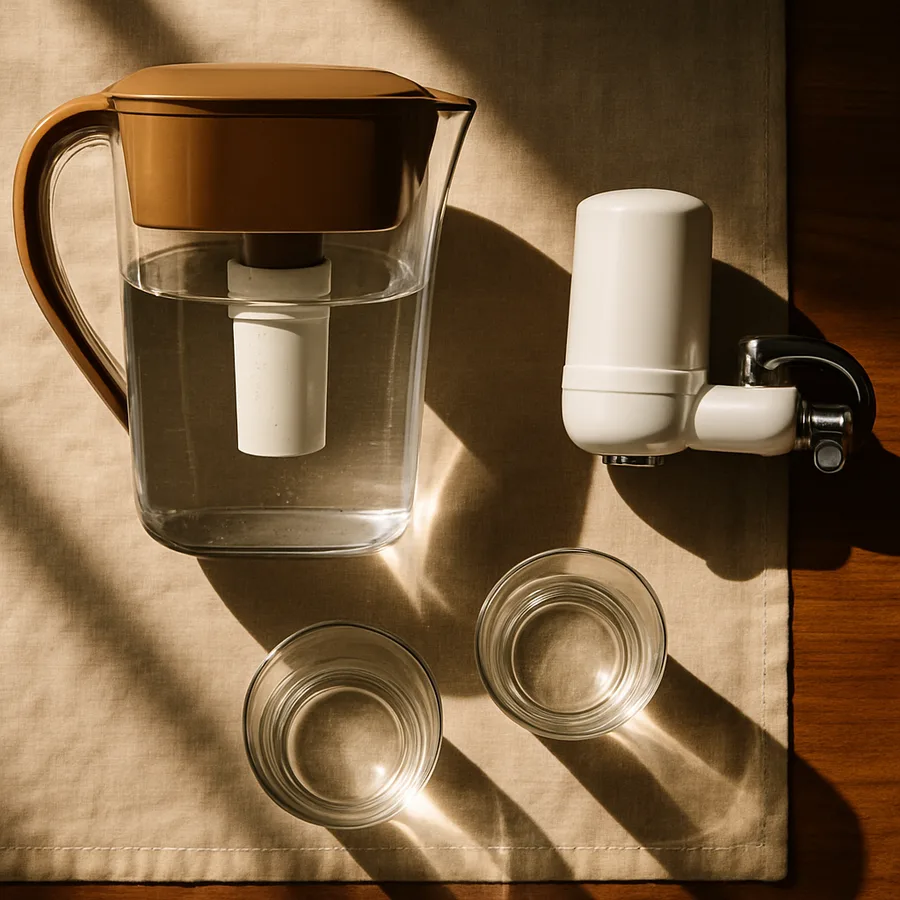
For households that want better-tasting, safer drinking water without committing to an under-sink installation or whole-house treatment, the two friendliest options on the market are the water filter pitcher and the faucet-mount filter. Both attach to your kitchen with minimal effort, both rely on activated carbon as their primary filtration medium, and both can be found at any grocery store for under 50 dollars. Look closely, though, and the similarities thin out quickly. The two formats filter different volumes, target different contaminants, deliver different flow rates, and cost dramatically different amounts per gallon over their working lifetimes. Choosing well depends on your actual habits, not on which box looks tidier on the counter.
How Each Filter Type Actually Works
A pitcher filter is, mechanically, a gravity-fed cartridge of activated carbon, sometimes mixed with ion-exchange resin, sometimes with a microfilter membrane, sealed inside a removable plastic capsule. Water poured into the upper reservoir percolates downward through the cartridge over two to ten minutes, depending on the design and cartridge condition. Contact time between water and media is therefore generous, which is one reason pitchers can be effective despite their small size. The trade-off is the wait.
A faucet-mount filter, by contrast, attaches to the threaded aerator of your kitchen faucet and runs water under household line pressure through a larger but shorter cartridge of similar media. A diverter valve lets you switch between filtered output (slower, through the cartridge) and unfiltered output (full pressure, around the cartridge), so you can wash dishes at normal speed and switch to filtered for drinking and cooking. Contact time is much shorter than a pitcher's, on the order of a few seconds, but the cartridge volume and pressure-driven flow compensate.
Both rely heavily on activated carbon's enormous internal surface area, often cited at 500 to 1,500 square meters per gram, to physically adsorb chlorine, chloramines, volatile organic compounds, and many taste and odor compounds. The EPA recognizes activated carbon as a best-available technology for treating chlorine taste and a long list of organic contaminants in drinking water. The differences in real-world performance come down to which additional media are paired with the carbon, how much of it the cartridge contains, and what NSF/ANSI standards the specific product has been certified against.
Reading the NSF/ANSI Certifications
The certification label is the most useful piece of information on any filter package, and it is also the most commonly ignored. There are several distinct NSF/ANSI standards for drinking water filters, and a product can be certified against one without addressing the others. NSF/ANSI 42 covers aesthetic effects, primarily chlorine taste and odor. NSF/ANSI 53 covers health effects, including lead, mercury, cysts, asbestos, and many volatile organic compounds. NSF/ANSI 401 covers emerging contaminants, including pharmaceuticals, herbicides, and certain pesticides. NSF/ANSI P473 specifically addresses PFOA and PFOS.
A filter certified only against Standard 42 reduces chlorine taste but makes no verified claim about lead. A filter certified against 42 and 53 covers both. The most capable consumer filters carry certifications against 42, 53, 401, and P473 simultaneously. NSF's filter finder database lets you look up any specific product by brand and model and see exactly which contaminants it is certified to reduce and to what level.
This matters because marketing copy on pitcher and faucet-mount boxes can be misleading. A common pattern: a box claims the filter "reduces" twelve contaminants, but the certification fine print covers only two, with the other ten reductions self-reported by the manufacturer's internal lab. Have you ever turned over a filter box at the store and tried to read the certification list? It is usually printed in 5-point type on the side panel for a reason.
Contaminant Reduction Capability Compared
The honest comparison, looking only at NSF-certified models from major manufacturers, shows faucet-mount filters with a noticeable edge on health-related contaminants. Faucet-mount cartridges hold roughly two to three times the carbon volume of a pitcher cartridge, and pressure-driven flow lets manufacturers pack denser media without making the unit unusable. The best faucet-mount filters carry full NSF/ANSI 42, 53, and 401 certification, including reduction of lead, mercury, asbestos, cysts, and 15 to 25 named volatile organics.
Pitcher filters in the mainstream price range typically certify against NSF/ANSI 42 only, with chlorine and a small handful of related compounds. Premium pitcher cartridges, sometimes labeled "long-life" or "advanced," extend coverage to NSF/ANSI 53 lead reduction and a portion of the 401 emerging contaminant list. Specialty pitchers from ZeroWater and similar brands use multi-stage cartridges with ion-exchange resin that meaningfully reduce total dissolved solids, but at the cost of much shorter cartridge life and higher per-gallon cost.
For lead specifically, the certification question is critical. The EPA sets the action level for lead in drinking water at 15 parts per billion, but has stated explicitly that there is no safe level of lead exposure. Households in older homes with original lead service lines, lead-soldered copper plumbing, or brass fixtures predating 2014 should specifically choose a filter certified against NSF/ANSI 53 for lead reduction. Most faucet-mount filters in the premium tier carry this certification; most basic pitchers do not.
Flow Rate, Convenience, and Daily Workflow
Flow rate is where the comparison reverses. A pitcher delivers filtered water on demand only insofar as the pitcher is already full, and refilling a typical 10-cup pitcher takes 2 to 10 minutes. For a single occupant who drinks four glasses a day, that wait is invisible. For a family of four during dinner prep, the pitcher is constantly empty at the moment someone reaches for it, and the rhythm of "fill, wait, pour, repeat" becomes a small kitchen frustration.
Faucet-mount filters deliver continuous filtered water at roughly 0.5 to 1.0 gallons per minute, which is about a quarter to a third of an unfiltered faucet's flow but more than fast enough for filling a pot, a kettle, or a water bottle without waiting. The diverter valve lets you switch back to full pressure for dishes or rinsing. For households that cook frequently, the faucet-mount workflow is meaningfully smoother than the pitcher's, especially for filling stockpots and coffee makers.
Pitchers do win on hot and outdoor use. A pitcher in the refrigerator delivers cold filtered water without running the tap. A pitcher can be carried to the patio for outdoor meals, or to a guest room, or to a sick household member. A faucet-mount filter is locked to its sink. For households where chilled water at all hours is the priority, the pitcher's portability and refrigeration are real advantages that no faucet-mount can match.
Cost Per Gallon Over the Filter's Working Life
This is where the comparison gets quantitative and somewhat unforgiving. A typical basic pitcher cartridge filters 40 to 100 gallons before requiring replacement, costs 5 to 10 dollars per cartridge, and lasts roughly two months in a moderate-use household. A typical faucet-mount cartridge filters 100 to 200 gallons, costs 15 to 25 dollars, and lasts two to four months at similar use. On paper, the per-gallon cost is roughly comparable, around 8 to 15 cents per gallon, with the faucet-mount slightly cheaper.
In practice, two factors reshape that math. First, premium pitcher cartridges that certify against NSF/ANSI 53 cost 12 to 20 dollars and last only the same 40 to 60 gallons, pushing per-gallon cost north of 25 cents. Second, real-world cartridge life often falls below the rated capacity because consumers forget to change them on schedule, and an expired cartridge is worse than no filter at all: accumulated contaminants can release back into the water in a phenomenon called desorption. The WQA consistently emphasizes replacement adherence as the single largest determinant of real-world filter performance.
Built-in change indicators help. Most faucet-mount filters include a color-shift indicator window or an electronic gallon counter that warns when replacement is due. Pitchers often include a simpler timer on the lid that counts down two months from installation. Either is far better than relying on memory. Compare the total annual cartridge cost to your bottled water spending; for most households that drink even moderate amounts of bottled water, either filter format pays for itself within the first few weeks.
Aesthetics, Plumbing Compatibility, and Practical Limits
The faucet-mount filter has one frequent show-stopper: it does not fit every faucet. Modern pull-down kitchen faucets with integrated sprayers cannot accept a threaded mount. Faucets with proprietary aerator threads, especially some high-end European brands, require adapter kits that may or may not be available. Faucets with rectangular or oversized spouts may not have a threaded aerator at all. Before buying a faucet-mount filter, unscrew your aerator with a soft cloth and check for standard threading. Most filters fit faucets with 15/16-inch outer or 55/64-inch inner aerator threads, but plenty of exceptions exist.
Aesthetically, the faucet-mount adds a permanent, somewhat utilitarian box to the side of your kitchen faucet. Manufacturers have worked to slim and chrome these housings, but a faucet-mount is unavoidably visible. A pitcher, by contrast, lives in the refrigerator or on a counter and can be chosen in colors and shapes that suit the kitchen. For renters in apartments with shared sinks or aesthetic restrictions, a pitcher is the lower-profile choice.
Hot water is a quiet third constraint. Most faucet-mount filters specify cold-water use only and warn that running hot water through the cartridge can damage the housing and release accumulated contaminants. This means you must remember to switch the diverter to unfiltered mode before running hot water for dishwashing. Some households find this acceptable; others find it a constant low-grade nuisance. Are you the kind of person who will reliably remember a daily switching habit, or the kind who will forget once and ruin the cartridge?
Pressure can also affect performance on older homes. Faucet-mount cartridges are designed for typical municipal pressure between 30 and 80 psi, and homes outside that band may see slow output, premature cartridge failure, or in rare cases housing cracks. The Plumbing-Heating-Cooling Contractors Association recommends installing a pressure-reducing valve at the meter for any home consistently above 80 psi, which improves the life of every fixture in the house, not just a faucet filter. Pitchers are insensitive to line pressure entirely, which gives them a small edge in well-water houses with variable system pressure or in apartments at the top of tall buildings where pressure can sag during peak hours.
Conclusion
The choice between a pitcher and a faucet-mount filter is less about which technology is "better" in the abstract and more about which fits the specific cadence of your kitchen. For a single person or a couple who drinks moderate amounts of water, primarily cold, primarily for drinking rather than cooking, a quality pitcher with an NSF/ANSI 53-certified cartridge is portable, refrigeratable, and entirely adequate. For a family that cooks frequently, fills pots and kettles, and wants continuous filtered flow without queuing at the pitcher, a faucet-mount filter with NSF/ANSI 42, 53, and 401 certification is the clearly better fit and only modestly more expensive per gallon.
Either way, the certification label is the document that matters. Avoid filters whose only certification is to NSF/ANSI 42 if you live in a home with any plausible lead exposure risk, and consider certifications against 401 and P473 if your local water utility reports detectable pharmaceuticals or PFAS compounds. The EPA publishes Consumer Confidence Reports for every public water system that disclose detected contaminants annually, and reading yours is the first step in choosing intelligently. If specific contaminants of concern appear, certification against those contaminants becomes non-negotiable.
Replace cartridges on schedule. This is the single greatest determinant of real-world filter performance, and the most commonly neglected. Set a calendar reminder, write the install date on the cartridge with a permanent marker, or buy a filter with a built-in counter. The WQA reports that the majority of consumer filters in active homes are operated past their rated capacity, and an expired filter can release more contaminants than it removes.
Look up your municipality's Consumer Confidence Report this week, identify the two or three contaminants that matter most for your household, and buy a filter, pitcher or faucet-mount, certified specifically against those contaminants. The difference between a filter you bought because the box was prettiest and a filter you chose because its NSF certifications match your actual water is the difference between an aesthetic exercise and a meaningful health upgrade. Both formats can be excellent. Both formats can be useless. The label, not the brand, is what separates the two.
More Articles You May Like



Comments
Post a Comment