Retractable Awning Patio Cover For Adjustable Shade
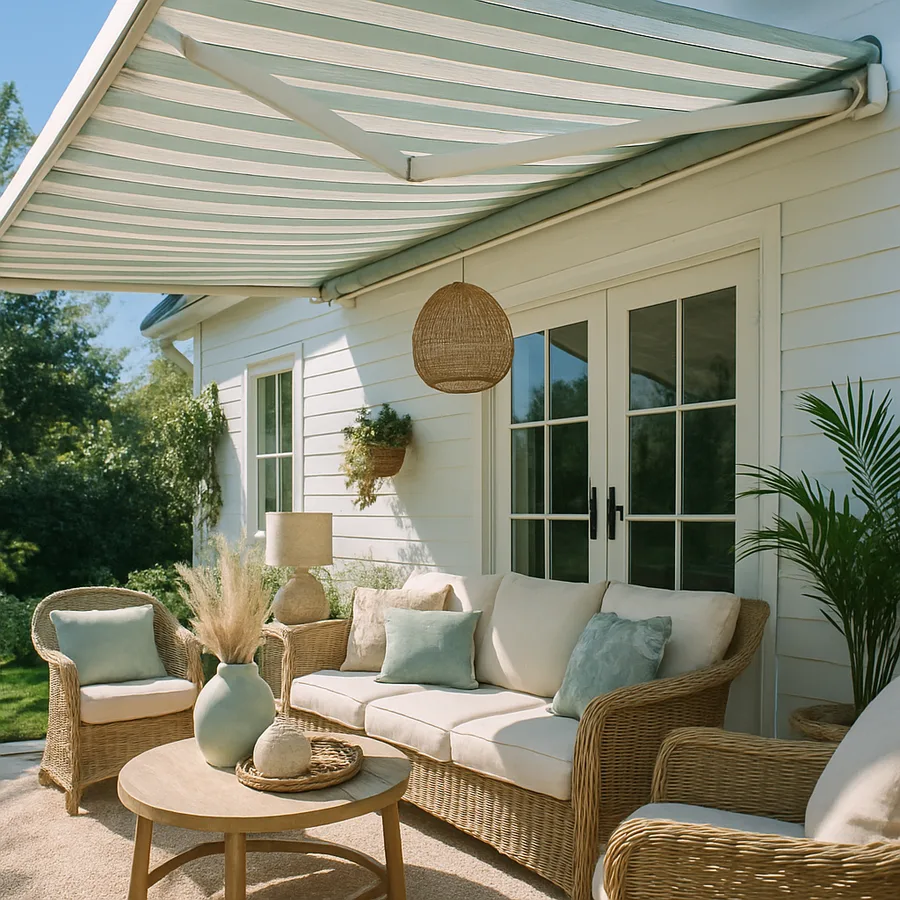
The most underrated piece of outdoor architecture in residential design is the retractable awning. Where a fixed roof commits a patio to permanent shade and the absence of overhead sky, and where an umbrella shades only a small zone, a retractable awning offers something quietly remarkable: shade when you want it, open sky when you don't, deployed in seconds, withdrawn just as fast. For homeowners who use their patios across the full arc of a season - sun-filled mornings, scorching afternoons, mild evenings, occasional showers - adjustability is the feature that turns an outdoor space from situational to genuinely daily.
This guide walks through what makes a retractable awning a long-term success versus an expensive disappointment. We will examine the mechanical and motorized options, fabric and frame specifications, projection and pitch geometry, the wind and rain sensors that protect motorized systems, installation realities, and the cost-of-ownership math that frames the whole decision.
What "Retractable" Actually Means Mechanically
A retractable awning is fundamentally a roll of fabric on a horizontal tube, with hinged arms that extend and retract the fabric horizontally outward from a wall-mounted housing. When retracted, the entire fabric and arm assembly tucks into the housing - protected from sun, weather, and bird droppings - and the patio reverts to full open sky. When extended, the arms unfold and the fabric unrolls, creating an instant overhead shade plane that can range from 8 to 16 feet of horizontal projection in residential systems.
Two mechanical philosophies dominate the residential market. Open-cassette awnings have an exposed roll tube and arms when retracted; they are less expensive but the fabric and mechanism are still exposed to weather even when retracted. Full-cassette awnings enclose the entire fabric and arm assembly in a sealed aluminum housing when retracted, providing dramatically better protection and longer fabric life. For most residential applications, the additional cost of a full-cassette system pays back within a few years in extended fabric and mechanism life.
The arms themselves are the most stressed component. Quality systems use folding arms with internal stainless steel cables that maintain tension across the full range of extension, holding the fabric taut without sag. Lower-cost systems use spring-loaded arms that lose tension over time and produce visible sag in the extended fabric within a couple of seasons.
Manual Crank Versus Motorized Operation
A manual-crank awning extends and retracts via a removable hand crank that engages a worm gear at one end of the roll tube. This is mechanically simple, requires no electrical connection, and can be installed almost anywhere a wall surface and a reasonable mounting substrate exist. Cranking a 12-foot awning takes 30 to 90 seconds of moderate physical effort.
A motorized awning replaces the crank with an internal tubular motor inside the roll tube. A wall switch, remote control, or smart-home integration commands extension and retraction. Operation takes 20 to 40 seconds and requires no physical effort. Premium motorized systems also accept wind, sun, and rain sensors that automatically retract the awning when conditions become unsafe or unsuitable.
Which option is right depends on three factors:
- Frequency of use: an awning extended once a week is fine to crank manually. An awning extended several times daily, or in response to changing weather, justifies motorization for sheer convenience.
- Physical accessibility: cranking requires standing under or near the awning and rotating a handle with steady moderate force. Homeowners with mobility limitations, or installations on second-story balconies where the crank position is awkward, benefit substantially from motorization.
- Wind exposure: in any wind-prone environment, motorized awnings with wind sensors are not a luxury but a safety feature. A manual awning that the homeowner forgets to retract during a wind event can be destroyed in minutes; an automated system retracts itself the moment wind exceeds a threshold.
The cost differential typically runs $400 to $1,200 depending on system size and sensor package. The National Association of Home Builders has tracked retractable awnings as a growing category in residential outdoor renovation, with motorized installations now representing the majority of new sales in moderate to high-end price tiers.
Fabric Performance And UV Resistance
Awning fabric is exposed to substantially more UV per square foot than almost any other residential textile because it spends most of its useful life fully deployed in direct sun. Fabric specification is the single biggest determinant of how the awning looks in five and ten years.
The dominant premium fabric for retractable awnings is solution-dyed acrylic, with Sunbrella and Dickson among the recognized brand names. Color is integrated into the fiber rather than applied to the surface, so fading is dramatically slower than dyed alternatives. These fabrics carry multi-year warranties - typically five to ten years - against fading, fiber degradation, and mildew. They are also breathable, which prevents heat from building up underneath the awning.
The mid-tier alternative is polyester with a water-repellent coating. Polyester is less UV-stable than acrylic and tends to fade and become brittle within three to five years in high-sun environments. The cost savings are modest, and most homeowners regret the substitution within the warranty period of the acrylic option they did not choose.
The bottom tier - uncoated polyester or vinyl-coated alternatives - should be avoided for any installation intended to last beyond a single season or two. Vinyl in particular becomes stiff in cold and brittle within a few years of UV exposure.
Pattern choice deserves a moment of thought. Solid fabrics read as quiet and architectural; broad horizontal stripes evoke European cafe traditions; narrow vertical stripes elongate the visual reach of a small patio. The publication Architectural Digest has covered the resurgence of striped awnings in contemporary residential design as homeowners look for ways to add character to outdoor architecture without committing to permanent ornament.
Projection, Pitch, And Sun Geometry
Projection - the horizontal distance the awning extends from the wall - determines how far into the patio the shade reaches. Standard residential projections range from 8 to 14 feet. The right projection depends on the depth of the patio and the time of day you most want shade.
For morning sun on an east-facing patio, even a modest 8- to 10-foot projection will shade a typical dining area effectively because the morning sun angle is high and the shade falls close to the wall. For afternoon sun on a west-facing patio, you need substantially more projection because the lower sun angle pushes the shade outward across the patio - a 14-foot projection may cover only a 10-foot-deep seating area when the sun is low.
Pitch - the downward angle of the extended awning from horizontal - serves three functions. First, it sheds rain and prevents water from pooling on the fabric. Second, it adjusts how much sun is blocked: a steeper pitch blocks more low-angle afternoon sun. Third, it determines the headroom under the leading edge. Steeper pitch means lower clearance at the outer edge.
Most residential awnings use a pitch of 14 to 25 degrees. Some quality models include adjustable pitch arms that let the homeowner reposition the angle seasonally - a steeper pitch for winter low sun and a shallower pitch for summer high sun. This is a feature worth specifying if your patio gets dramatically different sun angles across the year.
Have you ever sat under an awning where the leading edge cut off your view at exactly eye level, making the seating area feel oppressive? That is a pitch and projection mismatch. Aim for at least 7 feet of clearance under the leading edge in any zone where people will be seated for extended periods.
Wind, Rain, And Sensor Protection
The single largest cause of awning failure is wind. A fully extended awning presents a large surface area to wind, and the forces transmitted to the arms and wall mounts during a gust can exceed the system's design rating in seconds. Manufacturers publish wind ratings - typically on the Beaufort scale, with most residential systems rated for Beaufort 5 (winds up to 24 mph) and premium systems for Beaufort 6 (up to 31 mph). Beyond those thresholds, the awning must be retracted to avoid damage.
This is where wind sensors earn their keep. A vibration-based or anemometer-based sensor mounted near the awning detects wind exceeding the configured threshold and triggers an automatic retraction. The awning can be safely deployed without supervision because the sensor will retract it if conditions change while the homeowner is away from home.
Rain sensors offer a similar value proposition for installations where the homeowner wants rain protection from light showers but does not want substantial standing water to accumulate on the fabric. A rain sensor triggers retraction at a configured precipitation rate, preventing damage from heavy rainfall.
Sun sensors deploy the awning automatically when sun intensity exceeds a threshold and retract it when the sun moves off the wall, creating a fully automated shade system. This level of automation is most valuable for second-home installations or for homeowners who travel frequently and want shade and protection without manual intervention.
Industry guidance from Better Homes & Gardens and similar publications consistently emphasizes that the cost of a sensor package is small relative to the cost of awning replacement, and the protection sensors provide is the difference between a 15-year asset and a 3-year liability.
Installation, Substrate, And Total Cost Of Ownership
A retractable awning is a structural attachment. The wall it bolts to must be capable of supporting both the dead weight of the system (often 100 to 300 pounds for residential sizes) and the dynamic loads from wind and operation. Most installations bolt directly into the wall studs of wood-frame construction, into the structural mortar joints of brick or block walls, or into reinforced concrete with mechanical anchors.
For installations on stucco-over-foam or other low-substrate exteriors, additional reinforcement may be required - sometimes a steel ledger plate spanning multiple studs, sometimes a custom mounting frame. A qualified installer should evaluate the substrate before committing to a mount location and method.
Total installed cost for a residential retractable awning ranges widely:
- Entry-tier manual open-cassette systems: $800 to $1,800 installed.
- Mid-tier motorized full-cassette systems with basic remote: $2,500 to $5,000 installed.
- Premium motorized full-cassette systems with sensor package and smart-home integration: $5,000 to $12,000 installed.
Lifetime cost depends heavily on fabric and mechanism quality. A quality acrylic-fabric, full-cassette, sensor-equipped system can deliver 15 to 20 years of service with periodic fabric replacement (every 8 to 12 years in most climates). A budget polyester open-cassette system may need full replacement in 5 to 7 years. The cost-per-year math frequently favors the premium option, particularly when you factor in the dramatic difference in daily use experience.
Conclusion
A retractable awning is the most flexible shade solution available for residential patios, and for homeowners who use their outdoor spaces across a full range of conditions, the flexibility is transformative. Unlike a fixed pergola or a fabric sail, a retractable awning lets the patio be sunny when sunny is wanted and shaded when shaded is wanted, deployed in seconds without compromise to either condition. That single capability - sky on demand, shade on demand - is hard to overstate as a quality-of-life feature.
The decisions that determine whether the awning delivers on its promise are the same ones that determine the success of any well-engineered outdoor system: fabric quality, mechanism quality, appropriate projection and pitch for the specific sun geometry of the patio, sensor protection for wind and weather, and installation into an appropriate structural substrate by an installer who understands the loads involved. Skip any of these, and the awning becomes a maintenance burden; honor all of them, and the awning becomes the quiet enabler of a patio that gets used every season for a decade or more.
If you are considering a retractable awning this year, walk your patio at the times of day you most want to use it, note where the sun falls and how far across the patio shade would need to reach, identify the wall surface that would host the housing, and have a qualified installer evaluate the substrate before you commit to a quote. The right awning, sized correctly and installed properly, becomes one of those rare home improvements that delivers compounding daily satisfaction long after the cost has been forgotten. Take the time to specify it carefully, and you will spend the rest of your years in that home wondering why you did not install it sooner.
More Articles You May Like



Comments
Post a Comment