
Carbon Monoxide Detector Placement For Bedroom And Hall Code
Carbon Monoxide Detector Placement For Bedroom And Hall Code
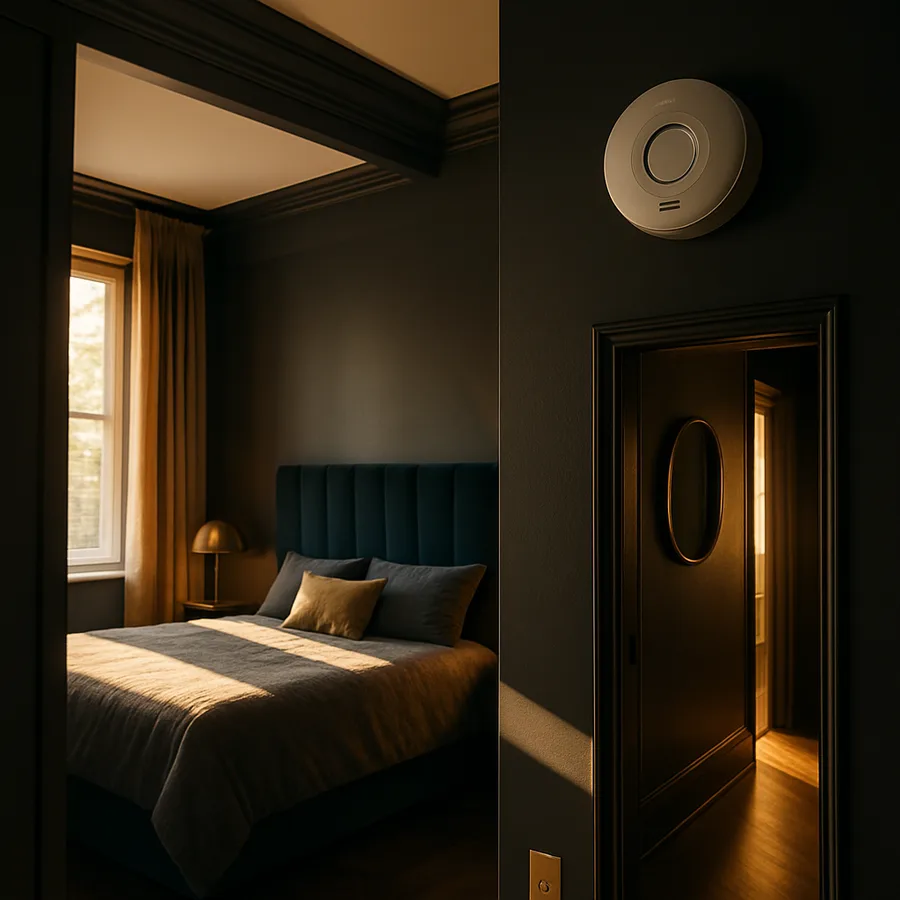
Carbon monoxide is colorless, odorless, and roughly the same density as air, which is exactly why it kills more than 400 Americans every year in non-fire incidents according to the Centers for Disease Control and Prevention. The gas does not behave like smoke. It does not rise dramatically, it does not announce itself, and the early symptoms of exposure look almost identical to seasonal flu. The only reliable defense for a sleeping household is a properly placed carbon monoxide alarm within audible range of every bedroom, installed at the right height, on the right wall, in the right relationship to fuel-burning appliances.
This guide focuses on placement code, the part most homeowners get wrong. We will cover where the codes that govern your home likely come from, what the consensus model code requires, how to translate the rules into a real floor plan, and how to deal with the common edge cases like vaulted ceilings, attached garages, and multi-zone HVAC systems. By the end you should be able to walk every floor of your home and identify exactly where an alarm needs to go.
Understanding Which Code Applies To Your Home
Most U.S. jurisdictions adopt some version of the International Residential Code from the International Code Council, the International Fire Code, or a state-specific amendment of one or both. The CO alarm provisions in those codes are themselves heavily based on NFPA 720, the carbon monoxide detection standard that has since been merged into NFPA 72. Layered on top of the model codes are state and municipal laws that often require CO alarms even in existing homes regardless of whether you pull a permit, particularly after a 2010 wave of statehouse activity following several high-profile fatality cases.
Begin by checking your state. New York, Massachusetts, California, Illinois, and many others have explicit statewide CO alarm requirements with placement specifics. Your local building department maintains a code adoption page that lists the version of the IRC or IFC currently in force, and any local amendments. If you are buying or selling a home, a CO alarm inspection is usually part of the disclosure or transfer process, so being compliant ahead of time saves last-minute scrambles.
The model code rules converge on a few core requirements. A CO alarm is required outside of and in the immediate vicinity of each separate sleeping area, on every level of the dwelling that contains a fuel-burning appliance or an attached garage, and inside any bedroom that contains a fuel-burning appliance itself such as a gas fireplace insert. These three triggers cover the overwhelming majority of single-family homes. Townhomes and condos add a few extra cases around shared mechanical rooms that we address later.
Bedroom And Hallway Placement Specifics
The exact wording most codes use is that CO alarms shall be installed outside of each separate sleeping area in the immediate vicinity of the bedrooms. The phrase "immediate vicinity" generally means within 10 feet of the bedroom doorway as measured along the path of travel. In a typical hallway with two or three bedrooms opening off one side, a single CO alarm centered in that hallway satisfies the rule. In a home with bedrooms on two different floors or in two separated wings, you need at least one alarm per sleeping area cluster.
Inside the bedroom itself, an alarm is required if the room contains any fuel-burning device. A gas-fired direct-vent fireplace, a freestanding propane heater, or a gas log set all trigger this rule. An electric heater does not. A wood stove technically burns fuel and produces CO during smoldering, so most jurisdictions treat a bedroom with a wood stove the same as a bedroom with a gas appliance. Have you walked your bedrooms looking specifically for fuel-burning devices? Many homeowners forget about the decorative gas fireplace in the master suite.
Mounting height for CO alarms is more flexible than for smoke alarms because carbon monoxide mixes with air rather than rising sharply. Most manufacturers permit installation anywhere from knee height to ceiling height. The U.S. Environmental Protection Agency recommends locating the alarm at the breathing height of a sleeping person, which in practice means about 5 feet above the floor on a hallway wall. Avoid the corners of the room and stay at least 15 feet from cooking appliances or open flames to limit nuisance trips.
Per-Level And Fuel Appliance Rules
The per-level rule says you need a CO alarm on every floor where a fuel-burning appliance is present or an attached garage opens into the level. A finished basement with a gas furnace needs an alarm even if no one sleeps down there. A first floor with a gas water heater needs an alarm even if all bedrooms are upstairs. The attached garage rule catches homeowners by surprise because a parked car running for even a minute can flood the connected interior with CO through gaps around the garage door header.
For appliance proximity, install the per-level alarm in the same general area as the appliance but not too close. A CO alarm mounted directly above a furnace will trip on routine startup cycles when the burners briefly produce a CO spike before combustion stabilizes. Aim for a location 15 to 20 feet away from the burner, with line of sight to the appliance if possible. In a mechanical closet, mount the alarm on a wall outside the closet door rather than inside the closet itself, both for sensor longevity and for audible reach into the living space.
Attached garages deserve a dedicated alarm in the room directly inside the door from the garage. This is the entry hallway or mudroom in most homes. Even if you have an alarm in the nearby kitchen, a closer unit catches a CO event sooner and gives more time for the household to evacuate. Some jurisdictions explicitly require this dedicated alarm in any home with an attached garage regardless of fuel-burning interior appliances.
Special Cases And Tricky Layouts
Vaulted ceilings and open lofts complicate the placement story. If your bedrooms open onto a loft balcony overlooking a great room with a gas fireplace, the great room counts as the immediate vicinity of those bedrooms and needs an alarm at sleeping-level height. Do not mount the alarm at the peak of the vault; mid-wall height in the line of sight from the bedroom doorways gives the best combination of detection speed and audible reach.
Multi-level homes with split-level or tri-level configurations need an alarm on each half-level if a fuel appliance is present on any of them. The fire service after-action reports compiled by the National Institute of Standards and Technology repeatedly highlight cases where a single alarm one half-level away from a sleeping family failed to penetrate closed doors and intervening walls. Interconnected wireless alarms that sound together everywhere in the home solve this problem cleanly and are now affordable enough to specify by default.
Vacation homes, cabins, and detached structures need the same protection. A small cabin with a propane furnace, a propane stove, and a propane water heater is one of the highest-risk CO environments in residential building because the appliances are often older, tighter-sealed, and serviced less regularly than in primary homes. Have you confirmed that the seasonal cabin in your family has working alarms before each winter opening?
Choosing Between Standalone, Combination, And Smart Units
Three product categories exist. Standalone CO alarms do one job and do it well, with simple buttons and a digital readout of current PPM. Combination smoke-CO alarms put both sensors in one housing, which simplifies the visual and ceiling layout and is fully code-compliant when the unit carries dual UL listings under UL 217 and UL 2034. Smart alarms add Wi-Fi connectivity, app alerts, and integration with other home systems.
For most homes the right answer is a mix. Use combination alarms in the hallways outside bedrooms because they handle both threats from a single location and simplify the ceiling. Use a standalone CO alarm in mechanical spaces because it can be placed at the right height for combustion gas detection without compromising smoke sensing geometry. Add at least one smart alarm somewhere in the network so that your phone receives push notifications when you are away from home, and so a neighbor or family member can receive a backup alert if you are unreachable.
Check the digital display feature carefully. A unit that shows current CO level in parts per million is dramatically more useful than one that only alarms at a single threshold, because low-level chronic exposure between 30 and 70 PPM still causes headaches and cognitive impairment without triggering most alarm setpoints. The American Society of Heating, Refrigerating and Air-Conditioning Engineers publishes guidance on acceptable indoor CO levels, and a display lets you watch your home stay comfortably under those limits.
Testing, Replacement And Ongoing Maintenance
Press the test button on every CO alarm monthly. The test confirms the siren and the battery but does not confirm the electrochemical sensor, so once a year supplement the button test with a calibrated CO source test using a small aerosol product sold for that purpose. Fire departments in some communities will perform this test free as part of community safety programs, so check with your local station before buying the aerosol.
CO alarms expire faster than smoke alarms because the electrochemical sensor degrades steadily. Most current models are rated for 10 years, but some older alarms in service today have 5 or 7 year ratings. Check the manufacture date on the back of each unit and replace any alarm past its rated life. Studies referenced by the CPSC have shown that a meaningful percentage of CO alarms in homes are past their useful life, with some surveys reporting nearly 20 percent failure rates among alarms older than the manufacturer rating.
Log every replacement date in a home maintenance binder or a smart home app. When you replace one alarm, check the dates on all the others while you are on the ladder. A staggered replacement program where you swap two or three units per year keeps the household budget predictable and prevents the all-at-once spike that can tempt homeowners to defer the project. The cost of a single ambulance call vastly exceeds the lifetime cost of a properly maintained alarm network.
Conclusion
Carbon monoxide placement is fundamentally a sleeping-occupant protection problem. The codes converge on the same priorities for a reason: outside every sleeping area, on every level with a fuel source or attached garage, and inside any bedroom containing a fuel-burning appliance. Once you internalize those three triggers and walk your home with them in mind, the right alarm count and the right locations become obvious. The harder work is convincing every member of the household to take the monthly test seriously and to investigate any chirp or low-PPM reading rather than silencing the device.
The product side has improved meaningfully in the last five years. Digital displays, smart connectivity, and combination smoke-CO housings have collectively reduced the friction of having a comprehensive network. Insurance carriers in many states now offer modest premium discounts for documented smart alarm networks, and some smart home platforms can automatically shut down HVAC systems when a CO alarm sounds to limit the spread of contaminated air. These integrations were exotic a decade ago and are routine now.
Set aside time this month to audit your current CO coverage. Use a tape measure if you need to confirm the 10-foot rule near each bedroom, check manufacture dates on every existing alarm, and place an order for any gaps you find. Pair this audit with the smoke alarm replacement guide we publish separately so that you tackle the full life-safety system in one focused effort. Talk to your family about what each alarm sounds like and what the response plan looks like, because hardware without rehearsal is only half the answer.
For authoritative reading, consult the CDC carbon monoxide page, the Consumer Product Safety Commission, and the EPA indoor air quality resources. These sources are kept current and provide deeper context on health effects, exposure thresholds, and emergency response procedures that complement the placement guidance in this article.


Comments
Post a Comment