Bedroom Closet Lighting Photocell Versus Hard Switch
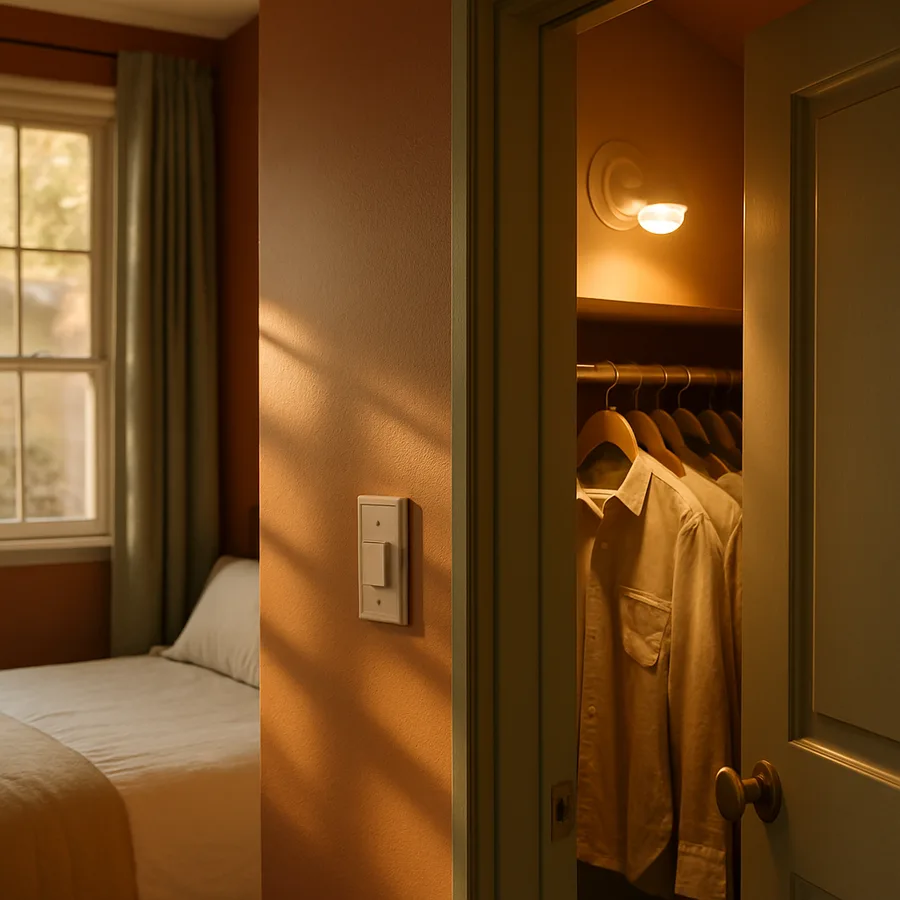
The humble bedroom closet is one of the most overlooked rooms in the house when it comes to lighting design, yet it is also one of the most frequently used. Every morning, every evening, sometimes a dozen times in between, you reach for the door, fumble for a switch, or hope that an automatic sensor does its job. The question of whether to specify a photocell-controlled fixture or a traditional hard-wired wall switch seems trivial at first glance, but the decision touches on electrical code, energy efficiency, user behavior, and even the long-term resale value of a home. This guide walks through both control strategies in depth so you can pick the right one for your closet.
Understanding How Photocell-Activated Closet Lighting Works
It is worth noting that the residential market has largely consolidated around three control archetypes: the simple door-jamb plunger switch, the ceiling or wall-mounted PIR occupancy sensor, and the bulb-integrated sensor that ships pre-paired with the LED light source. Each archetype has a different installation profile, a different price point, and a different failure mode, which is why a single recommendation rarely fits every closet in a single home. Walk through your house and you will likely find a use case for at least two of the three.
A photocell, in its simplest form, is a light-sensitive resistor or photodiode that changes its electrical resistance based on the amount of ambient light striking its surface. In closet applications, however, the term is often used interchangeably with occupancy sensors, door jamb switches, and passive infrared (PIR) detectors. A true photocell responds to light level, which is why dusk-to-dawn yard lamps use them. Inside a closet, the more common automation is a PIR sensor or a magnetic door switch, both of which turn lighting on when the closet is in use and off when it is not.
The U.S. Department of Energy notes that occupancy-based controls can reduce lighting energy consumption by 30 percent or more in spaces with intermittent use, and closets are textbook examples of intermittent-use spaces. The technology is reliable, the components have come down in price, and most modern LED fixtures are now available with integrated sensors that require no additional wiring beyond a standard supply circuit.
One subtlety: door-jamb switches mechanically open and close the circuit when the closet door moves. They are simple and inexpensive, but they fail in walk-in closets where the door is often left ajar. PIR sensors, by contrast, detect body heat and motion and work regardless of door position. Are you designing for a reach-in closet with a swinging door, or a walk-in where you want hands-free convenience after you step inside? That single question often decides which sensor you should specify.
The Case For A Traditional Hard-Wired Wall Switch
There is something to be said for the certainty of a wall switch. You flip it up, the light comes on. You flip it down, the light goes off. There are no false triggers, no timeout intervals, no sensor blind spots. For homeowners who organize their closets with photography lighting or who use the space for tasks like ironing, sewing, or trying on outfits in front of a mirror, the predictability of a manual switch is a feature, not a bug.
Hard-wired switches also remain the default expectation of home inspectors, appraisers, and many building code officials. The National Electrical Code (NEC) does not prohibit sensor-only controls, but local amendments in some jurisdictions require a manual override even when an automatic control is present. A standard single-pole switch satisfies that requirement without any additional hardware.
From an energy perspective, the manual switch is only as efficient as the human flipping it. Studies cited by the ENERGY STAR program show that lights are left on unnecessarily in residential spaces roughly 15 percent of operating hours when no automatic control is present. That figure climbs dramatically in closets, where the line of sight from the bedroom rarely reveals whether the closet light is still burning.
Energy Use, Cost, And Payback Calculations
Let us run the numbers on a representative bedroom closet equipped with a single 9-watt LED ceiling fixture. Assume the fixture is used during four discrete events per day, each lasting two minutes, for a total of eight minutes of legitimate use per day. With a hard-wired switch and average human forgetfulness, the same fixture might actually burn for 45 minutes per day. With a PIR sensor set to a one-minute timeout, the run time drops to perhaps 12 minutes per day, very close to the actual usage profile.
Over a year, the manual-switch scenario consumes about 2.5 kilowatt-hours. The sensor scenario consumes about 0.66 kilowatt-hours. At an average residential electricity rate of 16 cents per kilowatt-hour, the savings amount to roughly 30 cents per closet per year. That is admittedly trivial in isolation, but multiplied across the four or five closets in a typical three-bedroom home, and compounded over the 20-year life of an LED fixture, the savings cover the upcharge for sensor-equipped hardware several times over.
The Illuminating Engineering Society, often known by its acronym IES, has published guidance suggesting that automatic controls deliver the best return on investment in spaces where the human user is most likely to forget to turn off the lights. Closets, pantries, and laundry rooms top that list. Bedrooms, living rooms, and kitchens, where occupants are present and aware, see much smaller relative benefits.
One number that surprises many homeowners: the typical bedroom closet light, if left on by accident, can burn for six to ten hours overnight before anyone notices. Multiply that by 30 or 40 such events per year, and a manual-switch closet quietly wastes considerably more energy than the back-of-envelope calculation suggests. Sensor-based controls eliminate that failure mode entirely, which is the strongest single argument in their favor regardless of the headline efficiency numbers.
Installation, Wiring, And Common Code Considerations
Installing a hard-wired switch in a new-construction closet is straightforward: a single-gang box on the latch side of the door, a 14-2 or 12-2 cable to the fixture, and a standard single-pole switch. Retrofits are slightly more involved because the wall must be opened to fish the cable, but the work is well within the scope of a competent DIY homeowner or any licensed electrician.
Sensor installations come in two flavors. The first is a sensor that replaces the wall switch entirely, requiring a neutral conductor at the switch box. Many older homes lack this neutral, which is why the 2011 edition of the NEC began requiring a neutral at every switch location in new construction. The second flavor is an integrated sensor built into the fixture itself, which sidesteps the neutral problem because the sensor lives at the ceiling where the neutral is always present.
Closet lighting also intersects with NEC Article 410.16, which governs clearances between luminaires and combustible storage. LED fixtures generate very little heat and have generous allowances, but pendant-style or exposed-bulb fixtures still require six to twelve inches of clearance from shelving depending on the fixture type. Always check the latest local code before finalizing fixture placement.
An often-overlooked installation detail is the height and orientation of the sensor itself. A ceiling-mounted PIR with a 360-degree field of view performs best when centered in the closet, away from HVAC vents and out of direct sunlight. A wall-mounted sensor near the door performs best at switch height (roughly 48 inches above finished floor) where it can detect a person entering rather than a person already inside. Bad sensor placement is the single most common cause of complaint after installation, far more common than actual hardware defects.
Comfort, Reliability, And The Human Factor
Reliability is where the two strategies diverge most visibly in daily use. A wall switch has perhaps a 50,000-cycle mechanical lifespan, which translates to decades of typical home use. A PIR sensor depends on solid-state electronics, a small relay, and firmware. Cheap sensors fail prematurely, get stuck in the "on" position, or cycle the lamp annoyingly if the timeout is set too short. Quality sensors from established manufacturers like Lutron, Leviton, and Legrand routinely last 15 to 20 years.
Consider also the user experience for guests and family members who are not accustomed to the home. A wall switch is universally understood. A sensor that activates automatically delights some users and confuses others, particularly older relatives who may interpret the unexpected light as a malfunction. Have you ever watched a houseguest wave their arms in a closet trying to reactivate a sensor that timed out? It happens often enough to matter.
The middle path, and the one I recommend for most bedroom closets, is a hybrid:
Another factor worth weighing is the soft cost of confusion. A home with three different closet control strategies (one with a door switch, one with a wall-mounted sensor, one with a smart bulb) becomes harder to live in, harder to maintain, and harder to explain to guests or future buyers. Pick one strategy per home and apply it consistently across all closets of similar size and use pattern. Consistency is its own kind of quality.
a hard-wired wall switch in series with a sensor-equipped fixture. The switch provides manual override and code compliance, while the sensor handles the automatic on-off cycling. When the switch is in the "on" position, the sensor controls the light. When the switch is "off," the fixture is fully de-energized for maintenance or extended absence.
Specifying Fixtures, Bulbs, And Smart Home Integration
Before settling on hardware, take five minutes to inventory the closet itself. Measure interior dimensions. Note any windows, skylights, or transom panels that admit daylight. Identify whether the door swings inward, outward, or slides on a track. Each of these factors influences the optimal sensor type and placement. A closet with a sliding door and no daylight ingress is a different design problem than a walk-in with a glazed door and a small skylight, even if both are nominally the same square footage.
If you settle on a sensor solution, look for fixtures listed by the National Electrical Manufacturers Association (NEMA) for residential closet use and certified by ENERGY STAR for efficiency. Lumen output for a typical reach-in closet should land between 400 and 800 lumens. Walk-in closets benefit from 1,000 to 1,500 lumens distributed across two or three fixtures rather than concentrated in one. Color temperature in the 3000K to 3500K range renders fabrics naturally without the harsh blue tint of 5000K daylight bulbs.
Smart home integration deserves a brief mention. Z-Wave and Zigbee wall switches let you control closet lighting from a phone app, a voice assistant, or a whole-home scene. The convenience is real, but smart switches add cost, complexity, and another potential failure point. For a humble closet, the analog solution often wins on simplicity. Save the smart hardware for the rooms where scheduling, dimming, and scene control deliver genuine value.
Conclusion
The choice between a photocell or sensor-controlled closet light and a traditional hard-wired switch is not a question with a single correct answer. It depends on the geometry of the closet, the habits of the household, the local electrical code, and the budget available for the project. Sensors win on convenience and energy savings in reach-in closets and pantries. Manual switches win on simplicity, predictability, and universal familiarity. The hybrid approach captures most of the benefits of both at a modest cost premium.
If you are renovating a primary bedroom suite, take the time to walk through your morning and evening routines before specifying hardware. Where do you stand? Where do you reach? How long do you typically linger in the closet? The answers will guide you toward the right control strategy more reliably than any rule of thumb. And if you are uncertain, the hybrid switch-plus-sensor combination almost always satisfies the widest range of users and use cases.
Finally, do not underestimate the impact of fixture quality and color temperature on the daily experience of your closet. A well-chosen tunable LED fixture paired with the right control strategy turns a utility space into a small daily pleasure. Take stock of your existing closet lighting tonight, note the wattage and the control type, and use this guide to plan one upgrade that pays for itself in convenience and energy savings. Small changes in often-overlooked spaces compound into a noticeably better-functioning home.
For readers who care about resale value, here is a closing thought: prospective buyers rarely notice good closet lighting but always notice bad closet lighting. The dim incandescent fixture, the flickering fluorescent tube, the bulb so high in a vaulted ceiling that nobody has changed it in five years, all subtract from the perceived quality of the home. A clean, bright, quiet sensor-controlled LED in every closet adds quiet polish that home stagers, real estate agents, and discerning buyers all register positively even when they cannot articulate why.
More Articles You May Like



Comments
Post a Comment