
Air Purifier HEPA Filter Sizing For Room Square Footage
Air Purifier HEPA Filter Sizing For Room Square Footage
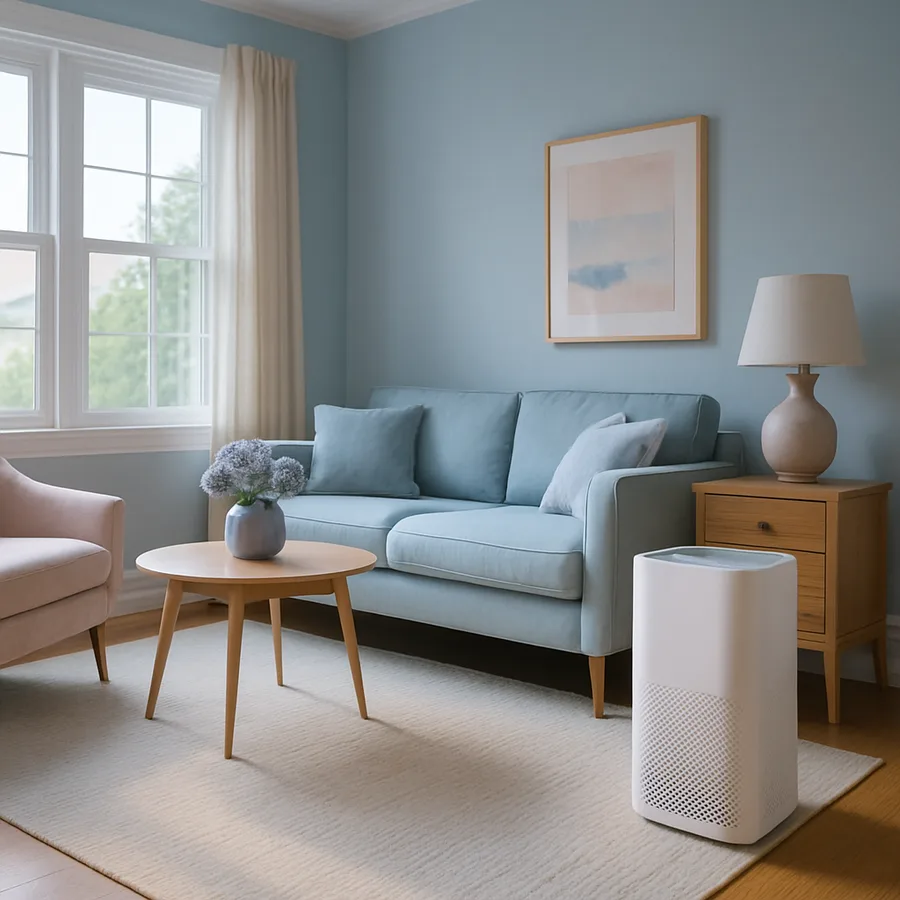
Walk into any big-box store and you will see a wall of air purifiers with capacity claims ranging from 200 square feet to 1,500 square feet, often on units that look almost identical. Those numbers are sometimes meaningful and sometimes marketing fiction. The actual question is not "what room size is this rated for" but "how many times per hour will this unit exchange the air in my specific room with the contaminants I actually care about." Answering that question properly produces a sizing decision that delivers real indoor air quality benefit rather than a placebo running quietly in the corner.
This guide explains the two metrics that matter, walks through the math you need to size correctly for bedrooms, living rooms, and open-plan spaces, and covers the maintenance routine that keeps a properly sized unit performing at the rated level. We will also address how to combine multiple smaller units versus running a single large unit, and how to integrate purifiers with whole-home HVAC filtration so they complement rather than duplicate each other.
The Two Numbers That Define Purifier Performance
The first number is Clean Air Delivery Rate, abbreviated CADR. It is a measurement of how many cubic feet of clean air per minute the unit produces for three specific particle types: smoke, dust, and pollen. CADR is verified by AHAM, the Association of Home Appliance Manufacturers, under a standardized test. A unit with a smoke CADR of 200 produces 200 cubic feet per minute of effectively smoke-free air under test conditions, which translates directly to a known volume of room treatment per hour.
The second number is Air Changes per Hour, or ACH. This is how many times per hour the purifier processes the full air volume of your room. ACH equals the unit's airflow rate divided by the room volume. The U.S. Environmental Protection Agency and most indoor air quality researchers recommend a minimum of 4 ACH for homes that want meaningful particle reduction, and 5 to 6 ACH for households with allergies, asthma, or wildfire-smoke concerns.
The relationship between CADR and ACH is straightforward. For a typical room with 8-foot ceilings, a CADR roughly equal to two-thirds of the room's square footage in feet produces 4 ACH. A 300 square foot room with 8-foot ceilings has a volume of 2,400 cubic feet. To achieve 4 ACH you need 9,600 cubic feet per hour, or 160 cubic feet per minute, which means a CADR of at least 160 for the contaminant you care about. AHAM's published sizing recommendation is the two-thirds-of-room-area rule, and it is a good starting point.
Why HEPA Specifically And What True HEPA Means
HEPA stands for High Efficiency Particulate Air, and the true HEPA certification requires the filter to remove at least 99.97 percent of particles at 0.3 micrometers in diameter. That specific particle size is the most-penetrating particle size, the size that is hardest for any filter to catch. Smaller and larger particles are actually easier to capture. A filter that meets the 99.97 percent standard at 0.3 micrometers performs even better at the size ranges that include most pollen, dust mite debris, mold spores, and wildfire smoke aggregates.
Many purifiers on the shelf advertise "HEPA-type" or "HEPA-like" filtration, which is not the same thing. These filters meet a lower efficiency standard and may catch only 95 percent or less of the test particle. For a real performance difference in your home, particularly during allergy season or in wildfire-affected regions, insist on certified true HEPA. Look for the actual specification on the box, not just the marketing copy on the front panel.
Some purifiers add a carbon prefilter or a dedicated activated carbon stage for gaseous pollutants like VOCs, cooking odors, and cigarette smoke. HEPA media itself does very little for gases, so if you are trying to address smell or chemical exposure you need an activated carbon section in addition to the HEPA. Carbon filters saturate over time and need replacement on a separate schedule from the HEPA, often every three to six months depending on your indoor air conditions.
Sizing For Common Room Types
Bedrooms are the highest-priority room because you spend roughly a third of your life there with your face inches from the bedding that traps and releases dust and allergens with every movement. A typical 12 by 14 foot bedroom is 168 square feet, requiring a CADR around 110 to 120 for 4 ACH. For an allergy-sensitive sleeper, target 6 ACH or higher, which moves the CADR target into the 170 to 180 range. Pick a unit with a quiet sleep mode at the high end of that range so the unit is not running loudly all night.
Living rooms vary widely in size and ceiling height. A 300 square foot family room with 9-foot ceilings has a volume of 2,700 cubic feet, requiring a CADR around 180 for 4 ACH. An open-plan great room with vaulted ceilings can easily exceed 600 square feet of floor area with 16-foot peaks, which makes a single small purifier hopelessly undersized. Two medium-capacity units placed at opposite ends of the room often perform better than one giant unit, because air mixing in a large room is imperfect and local capture beats remote brute force.
Kitchens deserve special attention because cooking generates ultrafine particles, smoke, and odors. A range hood is the right primary defense, but a HEPA-plus-carbon purifier in a nearby breakfast nook captures whatever escapes the hood. Have you ever measured PM2.5 in your kitchen during dinner? A consumer air quality monitor will show you the spike, and it will also confirm whether your purifier sizing is bringing the levels back down in a reasonable timeframe.
One Big Unit Versus Multiple Smaller Units
The single-big-unit approach has appeal: one outlet, one filter to remember, one device to clean. It works well in rooms with relatively even air mixing and modest furniture obstruction. A 250 square foot bedroom with the unit placed near the center wall and a ceiling fan running on low will reach near-uniform particle distribution within 20 minutes, and a single appropriately sized purifier handles the load efficiently.
The multiple-smaller-units approach makes sense in homes with several rooms, open floor plans with poor mixing, or layouts where furniture and walls create stagnant zones. Two purifiers each rated for 200 square feet often outperform one purifier rated for 400 square feet in a real-world 400 square foot space, because the two units create two zones of active capture rather than relying on bulk airflow to move every particle past one inlet.
Multi-unit setups also let you adjust by zone. A purifier in the bedroom runs quietly all night on a low setting. A purifier in the living room runs harder during cooking and lower during quiet evenings. Wildfire smoke events benefit from running every unit at maximum simultaneously, while routine background filtration only needs the bedroom unit on overnight. Smart purifiers with built-in air quality sensors automate this behavior without requiring you to think about it.
Integrating With Whole Home HVAC Filtration
Your central air system already moves air through a filter every time it runs, and upgrading the central filter is the most cost-effective particle-removal step in many homes. Look for a filter with a MERV 13 rating or higher, which captures a meaningful fraction of fine particles including most respiratory virus aerosols. Not every furnace can handle MERV 13 pressure drop, so consult your equipment specifications before stepping up filter density.
A standalone HEPA purifier complements the central filter rather than replacing it. The central filter cleans whenever the HVAC blower runs, which may be only a fraction of each hour during mild weather. A bedroom purifier cleans continuously regardless of HVAC operation. The two systems together produce much higher net particle removal than either alone, and the bedroom unit specifically addresses the localized particle generation from textiles, pets, and human shedding that never reaches the central return.
Some homeowners install a high-end media filter cabinet upstream of the air handler, which gives essentially HEPA-equivalent filtration for the whole home when the blower is running. Combined with a continuous fan setting and standalone bedroom units, this approach produces the lowest indoor particle counts that most homes can practically achieve. ENERGY STAR data on residential filtration suggests that homes with both whole-home media filtration and standalone HEPA units typically run PM2.5 levels well below 5 micrograms per cubic meter even during outdoor smoke events that push readings above 100.
Maintenance Schedules That Preserve Capacity
Filter replacement is the single most important maintenance task. A loaded HEPA filter has measurably lower airflow and therefore lower CADR than a fresh filter, even before it reaches end-of-life. Manufacturers typically recommend replacement every 6 to 12 months depending on usage and air conditions. Smart purifiers track filter life based on actual operating hours and air quality data, which is far more accurate than a fixed calendar interval.
Vacuum the prefilter monthly. Prefilters catch larger particles like pet hair and visible dust before they reach the main HEPA stage, and a loaded prefilter restricts airflow and shortens the life of the more expensive HEPA element. Many prefilters are washable, which means you only pay for the HEPA replacements over the life of the unit. Dry the prefilter completely before reinstalling because residual moisture can promote microbial growth.
Watch for the soft signals that a unit is past its prime. A purifier that used to clear cooking smoke in 15 minutes and now takes 45 minutes is telling you the filter is loaded. A unit that has started running its fan harder to maintain the same set speed is also working through reduced filter capacity. A study by Lawrence Berkeley National Laboratory on residential HEPA performance found that filter replacement at the manufacturer-recommended interval typically preserves more than 90 percent of rated CADR throughout the filter life, while extended use into the second year drops effective CADR to 60 percent or less.
Conclusion
Air purifier sizing is fundamentally arithmetic, not magic. Measure your room, calculate the volume, decide on your target air changes per hour, and choose a unit with a verified CADR that delivers that target. Insist on true HEPA certification, add activated carbon if you need gas-phase control, and integrate the standalone units with your central HVAC filtration so the two systems complement rather than duplicate each other. The result is a home that maintains low particle counts continuously, not just when the HVAC blower happens to be running.
The most common mistake homeowners make is buying a unit rated for the marketing maximum and running it in a much larger space than the actual CADR can handle. The second most common mistake is failing to replace filters on schedule, which silently turns a properly sized unit into an undersized one over the course of a year. Both mistakes are easy to avoid once you understand the underlying math, and both have outsized effects on the air you actually breathe.
Take an evening this week to measure your bedroom and your primary living space, calculate the CADR target for 4 to 6 ACH, and compare against the spec sheet of any purifier you currently own or are considering. If the gap is significant, plan an upgrade. If you are buying for the first time, prioritize the bedroom because that is where the most concentrated benefit lives. Have you thought about whether a smart unit with built-in air quality sensing would change how you interact with the appliance? Many homeowners who add sensors report running their purifiers more strategically and getting better outcomes for less energy.
If you live in a wildfire-prone region or downwind of a heavy traffic corridor, build a smoke-event plan ahead of time rather than scrambling during the first orange-sky afternoon. Identify a single room, usually the primary bedroom, that you can run as a clean-air refuge with the highest-CADR unit you own. Stock a spare HEPA filter in advance because retail shelves empty quickly when regional smoke events peak. Have the family practice closing exterior doors and windows, running the air conditioner on recirculate, and gathering in the refuge room so the response feels familiar when it matters.
For deeper technical reading, consult the EPA air cleaner guide, the AHAM Verifide program, and the ENERGY STAR air purifier resources. These references explain CADR testing in detail, list verified units by category, and provide free, regularly updated guidance you can trust as the foundation of your air quality strategy.


Comments
Post a Comment