Dining Room Chandelier Sizing Guide Based on Table Dimensions
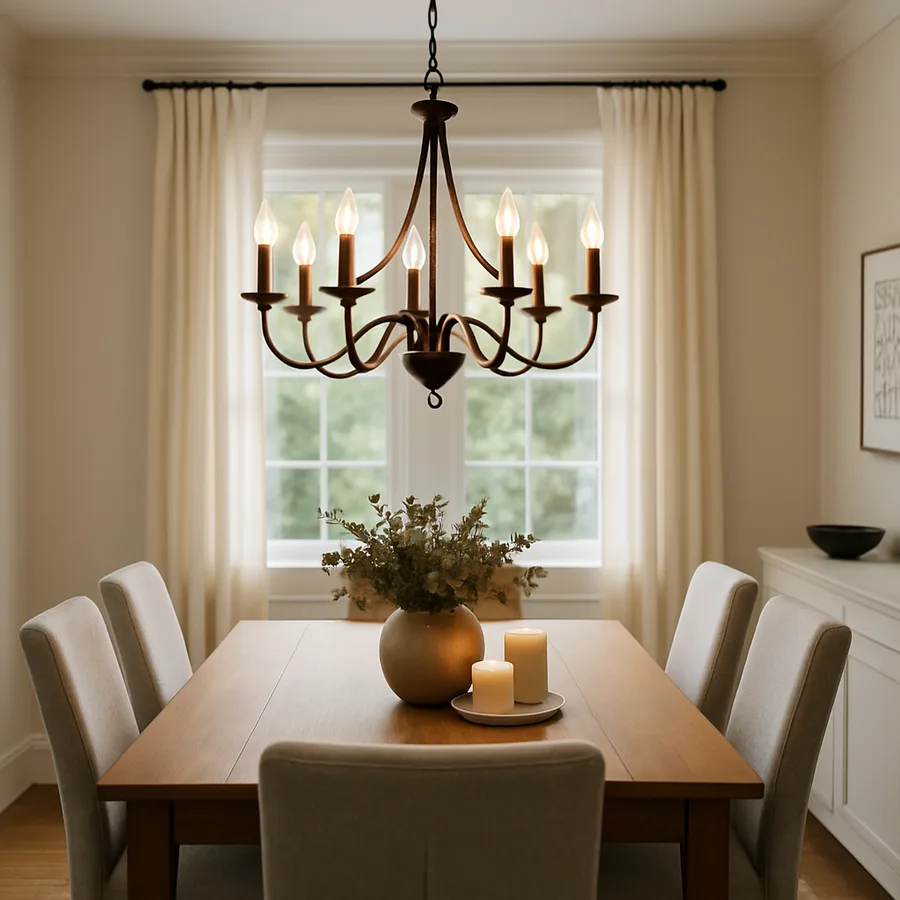
Few design decisions carry as much visual weight as the dining room chandelier, yet homeowners routinely pick a fixture that is two sizes too small or hangs at the wrong altitude. According to a consumer survey published by the American Lighting Association, roughly 62 percent of homeowners report that their dining fixture feels "off" after installation, with scale being the single most common regret. The solution is almost never more wattage or a trendier finish. The fix is proportional math, grounded in the actual dimensions of your table and room.
This guide turns sizing into a repeatable process. You will learn the inch-based formulas that ASID-credentialed designers use, the clearance heights recommended by the Illuminating Engineering Society (IES), and the adjustments that make a fixture feel intentional rather than improvised. Whether you are shopping for a round pedestal or a ten-foot rectangular plank, the same underlying principles apply.
Start With the Table, Not the Room
The first and most important measurement is the width of your dining table, not the square footage of your room. A 36-inch round pedestal in a cavernous loft still wants a fixture scaled to the table below it, because the chandelier's job is to anchor the eating surface visually. A lighting buyer's guide from Houzz notes that fixtures scaled to a room rather than a table read as "floating" in photographs and in person.
The working rule is simple. Measure the table width in inches. Your chandelier diameter should fall between one-half and two-thirds of that width. A 48-inch round table pairs cleanly with a 24- to 32-inch fixture. A 42-inch table wants something in the 21- to 28-inch range. Go smaller and the fixture looks like jewelry on the wrong neckline. Go larger and you risk guests bumping their heads when they stand.
Have you ever noticed how restaurant dining rooms almost always nail this ratio? That is not accident. Hospitality designers routinely specify fixtures at the upper end of the two-thirds rule because denser seating benefits from a larger visual anchor. In a home, where seating is looser, the lower end of the range is usually safer.
One more consideration: leaf-extendable tables. Size to the table's most common configuration, not its maximum. A family that eats at a 60-inch oval five nights a week and extends to 96 inches twice a year should size for 60.
Another overlooked factor is the chair profile of your dining set. Chairs with tall upholstered backs visually crowd the fixture from the sides, while armless modern chairs leave more breathing room. If your chairs exceed 42 inches in back height, lean toward the smaller end of the fixture-diameter range, because the upper portion of the room is already visually busy. Conversely, a set of low-back chairs under 36 inches leaves the upper room volume relatively empty and can accommodate a fixture at the top of the range.
Round versus pedestal bases also influence perception. A pedestal table reads visually lighter than a four-leg table of identical dimensions, because the negative space beneath the top is more open. This optical lightness means a pedestal can carry a slightly larger fixture than a four-leg table of the same width, though the math is a few inches, not a full size bracket. Designers who develop an eye for this distinction begin to trust the silhouette as much as the tape measure, and that intuition pays off across decades of projects.
The Two Formulas That Govern Everything
Professional lighting specifiers lean on two formulas to translate a room into a fixture size. Both are promoted in continuing-education materials from the American Lighting Association.
Formula one, the room-dimension rule. Add the length of the room in feet to the width of the room in feet. The sum, converted to inches, is the target diameter for your fixture. A 12-by-14 dining room totals 26, which translates to a 26-inch fixture. This approach works well in rooms where the table is genuinely centered and the room reads as a balanced cube.
Formula two, the table-width rule. Take the narrowest dimension of your table in inches and multiply by 0.5 to 0.66. This is the fixture diameter range. For rectangular tables, apply the multiplier to the shorter side. A 40-by-72 table calls for a 20- to 26-inch-wide fixture, or a linear suite that covers two-thirds of the table length.
When the two formulas disagree, trust the table rule. The table is the object you physically interact with every day, and its proportions govern how the fixture feels in use. The room rule is most useful as a sanity check. If formula one says 30 inches and formula two says 22, your room is larger than your table warrants, and you should either bump the fixture toward 26 or add perimeter lighting to balance the space.
When integrating both formulas, a useful discipline is to compute both answers independently, then check the midpoint. If the midpoint falls within two inches of both formulas, that midpoint is almost always the correct size. When the two answers diverge by more than five inches, you have a room-and-table mismatch that deserves a design conversation, not a compromise. A lighting specialist from a Houzz-featured firm once noted that roughly 40 percent of client consultations end with a recommendation to either resize the table or change the fixture location, rather than force the math on a mismatched room.
Clearance and Hanging Height
Even a perfectly sized fixture looks wrong if it hangs at the wrong elevation. The Illuminating Engineering Society recommends 30 to 36 inches between the bottom of the fixture and the top of the table surface in rooms with 8-foot ceilings. For every additional foot of ceiling height, add 3 inches of drop. A 10-foot ceiling pushes the lower bound to 36 inches and the upper bound to 42.
The ceiling-height adjustment exists because fixtures read smaller from farther away. A 28-inch chandelier at 42 inches above the table looks visually lighter than the same fixture at 32 inches. Raising a fixture in a tall room restores its proportional presence.
Do you entertain tall guests? Aim for the upper end of the clearance range. Do you have a table that doubles as a homework station? Drop toward the lower end so task light reaches the work surface. These small tweaks separate a functional install from a flawless one.
Never hang a chandelier so low that a standing guest can bump the bottom with a raised wine glass. The National Kitchen and Bath Association publishes a safety-minded rule of thumb: the bottom of the fixture should clear 6 feet 6 inches from the floor at its lowest point when measured independent of the table.
Sloped or vaulted ceilings require one additional step. Measure the ceiling height directly above the table centerpoint, not at the peak or at the wall. Hanging fixtures respond to their actual mount point, and a 14-foot peak with a 9-foot mount above the table should be treated as a 9-foot room for clearance purposes. Many installation errors come from assuming the highest point governs the fixture spec, when the actual mount elevation is what matters.
Rectangular, Oval, and Irregular Tables
Round tables are the easy case. Rectangular and oval tables demand a slightly different approach, because a single round fixture rarely covers the length. For tables longer than 72 inches, consider either a linear suspension or two matching pendants.
When using a single round chandelier above a rectangular table, size to the width, not the length. A 40-by-84 table still takes a 22- to 28-inch round fixture, not a 50-inch one. The length of the table is visually resolved by the fixture's presence above center, not by matching the table's footprint.
For linear fixtures above rectangular tables, aim for a length that is roughly two-thirds of the table length. An 84-inch table pairs with a 54- to 60-inch linear fixture. Two pendants work best when spaced so each pendant centers over one-third of the table, leaving a third of space between them and from each end.
Oval and boat-shaped tables split the difference. Use the two-pendant or linear approach when the oval is longer than 72 inches, and a single round fixture for anything shorter. Irregular live-edge or sculptural tables benefit from a fixture that echoes their silhouette, whether that means a freeform branch chandelier or a soft cluster of glass orbs.
For extending tables with leaves, consider specifying a fixture compatible with both the extended and compact configurations. A 48-inch round fixture above a 60-to-96-inch extending oval will look acceptable in both modes, whereas a 26-inch round fixture looks right at 60 inches and lost at 96. When in doubt, size to the configuration you use 80 percent of the year and accept minor visual tradeoffs in the other 20 percent.
Ceiling Height and Visual Weight
Ceiling height changes not only clearance but also the kind of fixture your room can carry. Under 8 feet, semi-flush drum or disc fixtures prevent head-strike risk and visual crowding. From 8 to 10 feet, traditional chandeliers shine. Above 10 feet, double-tier chandeliers and taller sculptural pieces become possible without overpowering the room.
Visual weight also depends on material. A crystal fixture reads heavier than a wire cage of the same diameter because light refracts through the crystal rather than passing through open volume. A Restoration Hardware-style iron chandelier will also read heavier than a rattan or capiz shell of identical proportions. When your room is already dense with upholstery and textile, lean toward a lighter fixture. When the room is minimal, allow the fixture to do more of the work.
A tip from Architectural Digest: photograph your dining room before buying, and use an image-editing app to overlay fixtures at scale. The eye is surprisingly bad at imagining fixtures in empty space, and a 15-minute mockup saves costly returns.
Finish choices also modulate weight. A polished chrome fixture reflects surrounding colors and can appear lighter than its dimensions suggest. A matte black or oil-rubbed bronze fixture absorbs light and reads heavier. For rooms with strong natural light, reflective finishes benefit from the play of daylight. For rooms with limited natural light, matte finishes avoid drawing the eye away from other features, while still anchoring the dining area.
Common Sizing Mistakes and How to Avoid Them
The most frequent mistake is buying the fixture you fell in love with in a showroom, then discovering it is three inches too small once installed. Showroom ceilings are typically 12 to 14 feet, which makes every fixture appear larger than it will in a residential dining room. Always compare showroom pieces against taped-out templates at home.
A second mistake is assuming symmetry requires a single fixture. A long table with two matched pendants is as formal, and often more photogenic, than a single oversized chandelier. A third is ignoring dimming. A fixture sized correctly but stuck at one brightness level will feel institutional. Smart dimmers rated by UL for the specific lamp type are essential.
Finally, do not forget the canopy, the small ceiling plate that covers the junction box. Oversized canopies on small ceilings crowd crown molding. Undersized canopies on tall vaulted ceilings look incidental. Ask your electrician about canopy extenders or custom mounting plates when your ceiling structure complicates the default install.
Another frequent oversight is neglecting the chain or rod length that ships with the fixture. Many chandeliers come with a fixed 48 inches of chain, adequate for 8- to 9-foot ceilings but insufficient for 10-plus-foot rooms. Confirm chain length at purchase, and budget for an extension kit if the ceiling is tall. The American Lighting Association publishes a quick-reference table of chain-length requirements by ceiling height that is worth bookmarking.
Do not forget the scale of surrounding art and wall sconces. A correctly sized chandelier can still feel off if the adjacent wall features are out of proportion. Walk through the whole dining room mentally before committing, and treat the chandelier as part of a composition rather than an isolated pick. The best installs emerge from this kind of whole-room thinking, not from chandelier-only obsession.
Conclusion
Sizing a dining room chandelier is not a matter of taste. It is a matter of following two compact formulas, honoring the clearance minimums set by the Illuminating Engineering Society, and adjusting for ceiling height and visual weight with a clear eye. Designers who make it look effortless are following the math in the background. You can too.
Start with the table. Multiply its width by 0.5 and 0.66 to bracket your target diameter. Confirm the number against the room-dimension rule. Set the bottom of the fixture 30 to 36 inches above the table for an 8-foot ceiling, adding 3 inches per additional foot of height. Cross-check the visual weight against the density of your room, and photograph the space for a quick digital mockup before you commit.
Get those four decisions right and your chandelier will feel inevitable rather than decorated-in. It will earn compliments from guests who cannot explain why the room works, and it will age with your furniture rather than demanding a replacement when tastes shift. For further reading, the American Lighting Association publishes an updated buyer's guide each cycle that covers fixture families, lamping, and dimming in depth.
Ready to put these rules to work? Measure your table width today, sketch the two-thirds range on paper, and browse our curated Interior Bliss chandelier collection with those numbers in hand. A ten-minute audit now will save you weeks of second-guessing once the fixture is hung.
For further authority reading, consult American Lighting Association, the Illuminating Engineering Society, and the design-curated lighting archives at Architectural Digest.
More Articles You May Like



Comments
Post a Comment