Heated Towel Rack Wattage Sizing for Bathroom Square Footage
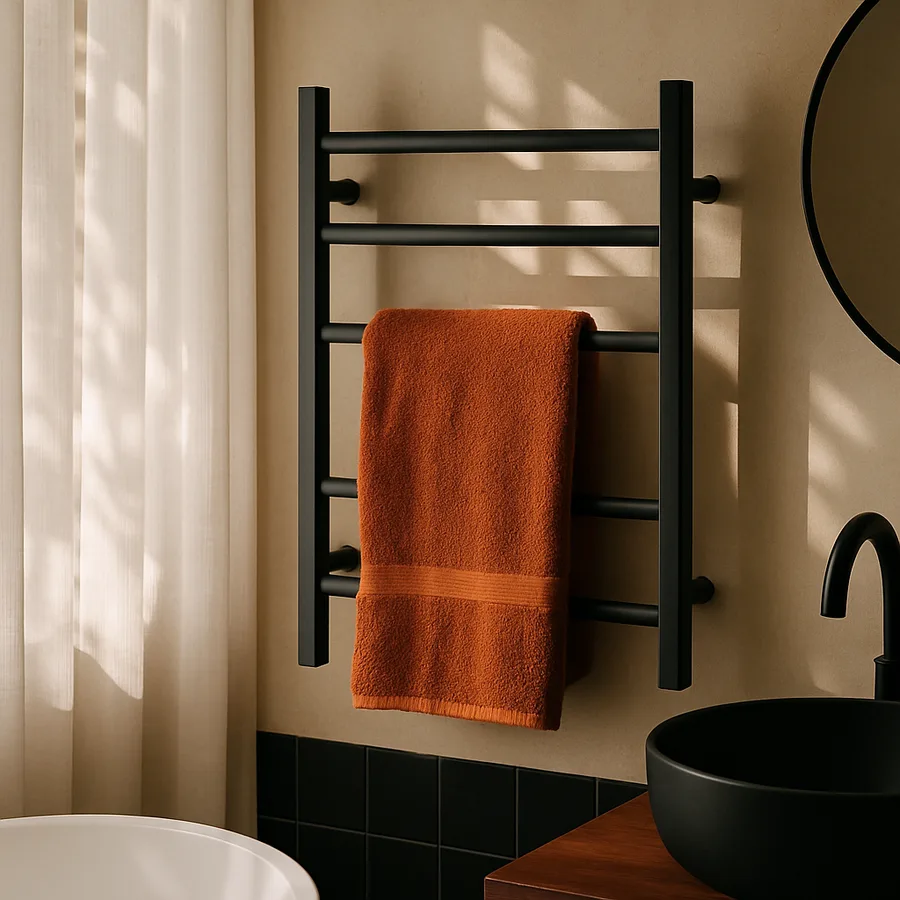
The single most common mistake homeowners make when specifying a heated towel rack is treating it as a fashion accessory rather than a thermal appliance. The catalogs encourage this. They lead with finish photos and architectural styling, and the wattage rating sits in a small footnote on the spec sheet, where the customer reads past it on the way to the order button. Two months later, the towel rack arrives, gets installed, and the homeowner discovers that it warms a single dry towel but cannot recover a wet towel between uses. The disappointment is structural, not aesthetic.
Sizing a heated towel rack to the bathroom it serves is fundamentally a thermodynamics problem, and the inputs are the room's square footage, the towel-drying load, the bathroom's thermal envelope, and the local climate. None of these are difficult to estimate, but they require a different mental model than picking a kitchen pendant or a bathroom faucet. This guide walks through the math, the practical sizing rules, and the climate adjustments that turn a well-intentioned purchase into a daily luxury that performs as advertised.
The Two Jobs a Towel Rack Has to Do
A heated towel rack performs two related but distinct functions, and clarifying which function dominates your usage drives the sizing decision more than any other variable. The first function is keeping a dry towel warm so that stepping out of the shower onto a heated towel is more pleasant than stepping onto a room-temperature one. The wattage required to do this is small, because the towel and the rack reach a steady-state temperature with the surrounding air and only need enough input to overcome ambient heat loss.
The second function is drying a wet towel between uses, returning a thoroughly damp post-shower towel to a usable dryness within a defined window. The wattage required to do this is substantially larger, because evaporating water requires roughly 2,260 joules per gram, and a typical wet bath towel holds 200 to 400 grams of absorbed water above its dry weight. Drying that towel in six hours, the typical overnight window, requires sustained heat input that a low-wattage warmer cannot deliver.
The mismatch between these two functions explains most of the disappointment in the towel-warmer category. A 75-watt warmer sized for a powder room performs the keep-warm function adequately and the drying function not at all. A 200-watt warmer performs both functions in a primary bath. According to U.S. Department of Energy appliance efficiency calculations, the wattage difference between these two performance tiers translates to roughly $4 to $7 per month in additional energy cost at average residential electricity rates, which is small relative to the experiential gap between a warmer that dries towels and one that does not.
The Square Footage Sizing Rule
The rule of thumb that has emerged from European installer practice, where heated towel racks have been mainstream for forty years, is to size at roughly 12 to 18 watts per square foot of bathroom area for the keep-warm function and 25 to 35 watts per square foot for full drying capability. The range reflects climate and thermal envelope variation. The lower end of each range applies to well-insulated bathrooms in temperate climates. The upper end applies to less-insulated bathrooms in colder climates or bathrooms with higher towel turnover.
For a 50-square-foot powder room, the keep-warm wattage is 600 to 900 watts of supplemental heat input from the entire room's heating system, and the dedicated towel rack contribution is a fraction of that. Most powder rooms are well-served by a 75 to 100-watt warmer because they rarely see wet towels. For a 100-square-foot secondary bath, the equivalent is a 100 to 150-watt warmer for keep-warm duty or 150 to 250 watts for occasional drying. For a 150-square-foot primary bath with two daily users, the warmer should be 200 to 300 watts to handle simultaneous wet towel drying.
The math is not literally that supplemental heat input matches square footage at the listed ratios, because the towel warmer is not the room's primary heat source. The ratio is a sizing heuristic that produces the right wattage band for the towel-drying job, accounting for the fact that the warmer operates intermittently and that the bathroom's primary HVAC handles general space heating. ENERGY STAR's residential efficiency resources include the formulas for calculating supplemental heat needs more precisely, which is useful for unusual bathroom geometries.
Climate and Thermal Envelope Adjustments
The square footage rule assumes a temperate climate and average insulation. Bathrooms in cold climates lose heat faster, particularly bathrooms on exterior walls or above unconditioned crawl spaces, and the warmer needs more wattage to overcome that loss. Bathrooms in warm climates lose heat more slowly, and a smaller warmer suffices.
The U.S. Department of Energy divides the country into eight climate zones based on heating and cooling degree days. Bathrooms in zones 1 and 2, which include most of Florida, southern Texas, and Hawaii, can be sized at the low end of the wattage range. Bathrooms in zones 6, 7, and 8, which include the upper Midwest, northern New England, and Alaska, should be sized at the high end. Bathrooms in zones 3 through 5, which cover most of the country, should be sized in the middle of the range.
The thermal envelope of the bathroom itself is the other variable. A bathroom with an exterior wall, an exterior window, and an exterior door loses far more heat than an interior bathroom surrounded by other heated rooms. A bathroom on the second floor over heated living space loses less heat than the same bathroom on a slab over an unheated garage. ASHRAE's residential energy standards include the heat loss calculation framework that more rigorous sizing exercises use, and a heating contractor performing a Manual J calculation can give precise numbers if the project warrants the engineering. For most homeowners, the climate-zone rule of thumb is sufficient.
Bar Count, Configuration, and Drying Capacity
The wattage rating tells you how much heat the warmer produces, but the bar count tells you how many towels it can dry simultaneously. A two-bar warmer holds one folded towel comfortably. A four-bar warmer holds two. A seven-bar ladder warmer holds three to four. The relationship between bar count and capacity is not linear because heated bars warm towels through both conduction and radiation, and densely packed towels block the radiation that would otherwise warm towels in inner positions.
For a primary bath used by two adults, a six to eight-bar ladder warmer in the 180 to 250-watt range is the durable answer. The configuration provides enough surface area to dry two large towels overnight without packing them so tightly that drying time doubles. For a guest bath used occasionally, a three to four-bar warmer in the 100 to 150-watt range is sufficient because the drying load is intermittent.
The mounting orientation matters too. Vertical ladder warmers occupy a tall, narrow footprint that fits behind a door or beside a vanity. Horizontal warmers occupy a wide, low footprint that suits a long blank wall. Wall-mounted warmers project four to six inches from the wall and require clearance for towel hanging. Freestanding warmers can move location but require a power cord or a floor-fed junction box. Have you mapped the wall available for the warmer against the towel volume the household generates? That mapping decides the bar count, and the wattage follows from it.
Recovery Time and Daily Use Patterns
Recovery time is the metric that matters most in daily use but appears least in marketing material. It is the time required for a wet towel hung on the warmer to return to a usable dryness, defined as no longer feeling damp on contact. For a typical bath towel of 600 to 800 grams dry weight that has absorbed 300 grams of water during use, recovery time depends on the warmer's wattage, the bathroom's ambient temperature, the humidity of the bathroom air during the drying window, and how densely the towel is folded over the bars.
The empirical recovery times from independent testing are roughly four to six hours for a 200-watt warmer in a 70-degree bathroom, six to eight hours for a 150-watt warmer in the same conditions, and ten to twelve hours for a 100-watt warmer. These numbers extend significantly if the bathroom air is itself humid because the warmer is competing against high ambient humidity. A bathroom without working exhaust ventilation can take twice as long to dry a towel because the evaporated water has nowhere to go and re-condenses on cooler surfaces.
The daily use pattern of the household drives the acceptable recovery time. A morning-shower household with a six-hour overnight window between evening hang and morning use needs faster recovery than an evening-shower household with a 14-hour overnight window. A guest bath that sees occasional weekend showers can accept slow recovery because the warmer has all week to catch up. Are you sizing for the easiest case or the worst case in your household? The wattage decision should be made for the worst case, because the warmer that meets the worst case automatically meets every easier case.
Energy Use and Operating Cost
The continuous operating cost of a heated towel rack at the U.S. average residential electricity rate is straightforward to calculate. A 200-watt warmer running continuously for 24 hours consumes 4.8 kilowatt-hours per day, which costs roughly 70 cents at the national average rate of 14 to 16 cents per kilowatt-hour. Over a 30-day month, that is approximately $21. Most warmers do not run continuously, however. Timer-controlled warmers typically operate four to six hours per day, which reduces monthly cost to $4 to $7.
The relevant comparison is the alternative. A bathroom heated to comfortable temperature for the duration of morning routines uses substantially more energy than a towel warmer running on a timer, because heating an entire room is a much larger thermal load than warming a few towels. The towel warmer is, in this sense, an efficient way to deliver localized comfort without overconditioning the room. According to ENERGY STAR appliance benchmarks, switching from whole-room space heating to a combination of normal bathroom HVAC plus a timer-controlled towel warmer typically reduces total bathroom-related energy use by 8 to 14 percent in cold climates.
The more interesting energy question is whether to leave the warmer on continuously or to schedule it on a timer. The answer depends on the warmer's recovery time relative to its idle time. A high-wattage warmer scheduled for two hours twice a day uses less energy than a low-wattage warmer running continuously, and it delivers warmer towels at the moments they are actually needed. The timer is the underrated accessory. Most premium installations include either a wall-mounted timer switch or a smart plug, and the timer typically pays for itself in reduced energy use within the first year.
Conclusion
Sizing a heated towel rack to the bathroom it serves is the difference between an appliance that performs as a daily luxury and one that disappoints quietly for a decade. The variables that drive the right sizing are bathroom square footage, climate zone, thermal envelope, towel-drying load, and operating schedule. None of these are difficult to estimate, but all of them should be considered before the catalog selection rather than after.
The framework worth carrying into the showroom is to start with the keep-warm wattage of 12 to 18 watts per square foot, add a drying premium of 50 to 100 percent if the warmer needs to handle wet towels, adjust upward by 15 to 25 percent for cold-climate or exterior-wall bathrooms, and select a warmer at the resulting wattage rather than at the wattage that matches the desired bar count. The bar count and finish are secondary to the wattage. A beautiful warmer that under-performs is a daily reminder of a sizing mistake. A correctly sized warmer in any reasonable finish is a daily pleasure.
If you are about to specify a towel warmer for a bathroom remodel or a retrofit, write down your bathroom's square footage, your climate zone, and your peak towel-drying load before opening the catalog. Filter the available models by wattage band first, finish second, and configuration third. Pair the warmer with a timer switch or smart plug from the same project, and commission the install with a documented schedule that matches household routines. Done this way, the warmer becomes one of those rare upgrades whose value compounds quietly across thousands of mornings, and the disappointment that defines so many under-sized warmers becomes someone else's problem.
More Articles You May Like



Comments
Post a Comment