Sliding Closet Door Mirror Front For Small Bedrooms
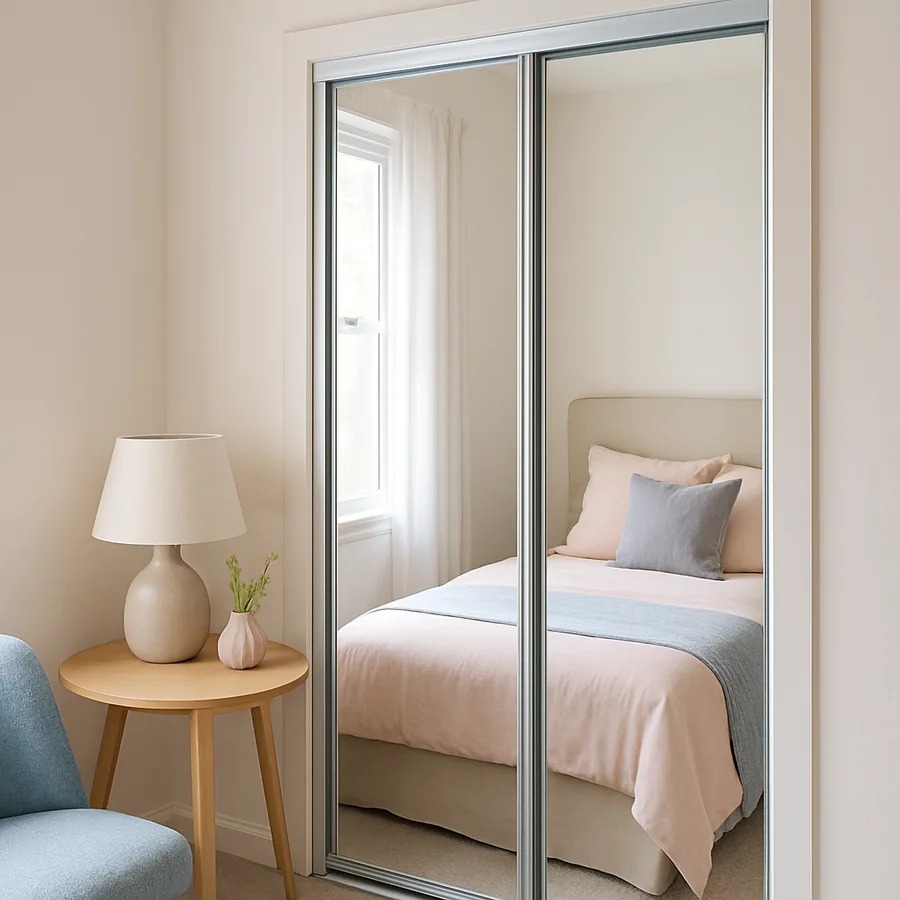
Small bedrooms force every surface to do double duty. The closet door, often six to eight feet of contiguous vertical real estate, is one of the largest contiguous planes in the room, and what you put on that plane changes how the room feels more than almost any other single choice. A sliding closet door with a mirror front is not just a closet solution; it is a light strategy, a spatial strategy, and a wardrobe-management strategy bundled into one fixture. Done well, it can make a 10x11 bedroom feel meaningfully larger. Done poorly, it produces glare, reflects a mess back at you every morning, and looks like a hotel-supply catalog from twenty years ago.
This guide walks through what professional designers consider when specifying mirror-front sliding closet doors in small bedrooms: the geometry of the reflection, the framing options, the structural and safety requirements, and the practical limits on what these doors can solve. According to an American Society of Interior Designers report on urban residential trends, roughly 61 percent of urban renovation projects involve at least one bedroom under 120 square feet, which means this is a problem a substantial portion of the design industry deals with regularly rather than an edge case.
Why Mirrors Change The Perception Of A Small Room
Mirrors do two things at once in a small space. They reflect the opposing wall, which doubles the apparent depth of the room in the reflective axis, and they reflect light, which raises the apparent brightness without adding any additional lumens. Both effects compound when the mirror runs floor-to-ceiling, which is exactly what a typical sliding closet door delivers. The combined effect is meaningfully larger than either component alone.
The geometric implication is precise. A 6-foot wide by 8-foot tall mirror on a closet door reflects roughly 48 square feet of opposing wall back into the room. If the bedroom is 110 square feet, the room appears to be roughly 158 square feet of visual area, even though the floor plan has not changed. This is not a trick the eye fully ignores, because depth cues from movement and binocular vision still register the wall as a wall, but the static visual impression of size is substantially larger. The brain accepts the reflection as additional spatial volume until the body tries to move through it.
The catch is that mirrors reflect what is in front of them. If the opposing wall holds clutter, a busy gallery wall, or an unmade bed, the mirror doubles that visual weight. Reader question: Does this mean mirror-front closet doors only work in disciplined households? Largely, yes. They reward order and punish disorder more visibly than almost any other design choice, which is part of why some designers love them and others avoid them.
Framed Versus Frameless Mirror Doors
Mirror sliding doors come in three framing categories: heavy-framed, narrow-framed, and frameless. Each carries a different visual register and different structural implications, and the right one depends on both the era of the building and the style of the rest of the bedroom.
Heavy-framed doors, typically 1.5 to 2.5 inches of visible aluminum or steel around the mirror perimeter, were the default from the 1970s through the early 2000s. They read as dated in most contemporary programs but can work in mid-century revival or industrial bedrooms where the heavier frame complements other built elements. Structurally, they are the most forgiving option because the frame carries the mirror and protects the edges from chipping during the bumps a sliding door inevitably absorbs.
Narrow-framed doors, with 0.5 to 1 inch of visible frame, are the current default in mid-market construction. They balance the structural protection of a frame with a more contemporary visual register. The National Kitchen and Bath Association (NKBA) notes in its design trends reporting that narrow-framed and bronze-finished sliding mirror doors have become a fixture of premium urban condo construction.
Frameless doors use polished mirror edges and a top and bottom track only. They produce the cleanest visual result and the largest effective reflection, since no frame interrupts the surface. They are also the most expensive and the most vulnerable to edge damage, because any impact on a polished mirror edge can chip the silvering and create a permanent dark spot at the corner.
Safety Glass And Code Requirements
Mirror closet doors are subject to safety glazing requirements in most North American jurisdictions because they sit in a location where occupants can walk into them, particularly children. The relevant standard is tempered safety glass meeting ANSI Z97.1 or CPSC 16 CFR 1201, and any sliding closet door installed in a residence after the early 2000s should bear an etched safety glazing mark in a lower corner. The mark is small and easy to miss; look in the corner closest to the floor on the room-facing side of the mirror.
Tempered glass, when it fails, breaks into small dulled cubes rather than long sharp shards. The probability of a child being seriously injured by a properly tempered mirror door is meaningfully lower than the probability of injury from an older annealed-glass mirror door. If you are buying or renting a property with existing mirror closet doors and cannot find the safety glazing mark, treat the mirrors as candidates for replacement during any planned remodel, because the cost of waiting for a failure that produces injury vastly exceeds the cost of replacing the panels preemptively.
Reader question: What about acrylic mirror doors as a lighter, child-friendlier alternative? They exist and they are lighter and shatter-resistant, but acrylic mirrors scratch much more easily than glass, distort slightly under temperature changes, and yellow over time. For a permanent installation in a primary bedroom, glass remains the dominant choice. Acrylic earns its place in temporary installations, rental upgrades you will remove later, and in homes with very young children where the shatter risk is the controlling concern.
Track Systems And Operational Smoothness
A sliding closet door is only as good as its track. Cheap top-hung tracks bind, stick, and produce the unmistakable rattle that signals dated construction. Quality bottom-rolling or top-hung systems from manufacturers like Häfele and similar specialty suppliers run smoothly for decades, and the cost premium for a premium track is rarely more than 15 percent of the total door system.
Top-hung systems suspend the door from rollers in an upper track and use a guide pin in a recessed bottom channel. They produce a cleaner floor line because there is no exposed bottom track, but they require the upper framing to carry the full door weight, which on a wide frameless mirror door can exceed 100 pounds per panel. The upper header must be sized to carry that load without sagging over the life of the installation.
Bottom-rolling systems place the rollers in a floor track and use a guide at the top. They are mechanically simpler and handle heavier panels gracefully but introduce a visible floor track that collects dust and breaks the visual line of the flooring. Floor tracks in bedrooms with hardwood flooring are visually more disruptive than the same tracks installed on tile or carpet.
Soft-close mechanisms, originally developed for kitchen drawers, have migrated to sliding door tracks and are worth specifying. The cost premium is modest, perhaps 8 to 15 percent of the door system price, and the daily experience of doors that close themselves quietly rather than slamming or bouncing is meaningful in a small bedroom where the closet operates within a few feet of the bed.
Common Pitfalls In Small Bedroom Applications
The single most common mistake is positioning the mirror across from the bed, so the first thing you see in the morning is yourself reflected in the closet door. This is jarring for most occupants and can disturb sleep for those sensitive to peripheral movement. The fix is straightforward: orient the mirror door so it does not face the bed directly, or use a bed configuration where the headboard wall is the same wall as the closet, making the mirror parallel to your line of sight rather than perpendicular to it.
The second common mistake is choosing a mirror finish without considering ambient lighting. Bedrooms with a single ceiling fixture overhead produce harsh downlighting that flatters no one in a closet-door mirror. The remedy is layered lighting: a wall sconce or bedside lamp positioned to provide some horizontal illumination toward the mirror plane corrects most of the unflattering shadowing. A mirror that looks great in a furniture showroom under flattering lighting may look very different in your bedroom under a single ceiling fixture.
The third common mistake is undersizing the closet opening itself. Sliding doors require an opening at least twice the width of a single door panel to allow each panel to slide fully behind the other. On a 6-foot closet opening, two 3-foot panels means only half the closet is accessible at any moment. For closets where you need full access, hinged doors or pocket doors are often a better answer than sliding mirrors, regardless of the light-and-space benefits.
Cost, Lifespan, And Resale Considerations
Mid-market mirror sliding closet doors run roughly $400 to $900 per opening installed for a standard 6-foot wide configuration. Frameless premium installations with soft-close tracks can run $1,500 to $3,500 per opening. Lifespan, with reasonable use, is 25 to 40 years for the mirror itself and 15 to 25 years for the track hardware, which is generally serviceable rather than requiring full door replacement.
Resale impact varies. In urban markets with high concentrations of small bedrooms, a well-specified mirror closet door is a neutral-to-positive feature. In markets where homes lean larger and traditional, hinged paneled closet doors are the cultural default and mirror sliders can read as compromise. Real estate data from NAHB on resale-relevant features consistently shows that storage solutions matched to the local market type outperform storage solutions imported from other market types, regardless of the absolute quality of the installation.
Conclusion
Mirror-front sliding closet doors are one of the highest-leverage choices available for small bedrooms. They expand the apparent room size, increase the perceived light level, and provide full-length dressing mirror function without sacrificing wall space to a separate fixture. When they are specified well, with quality tracks, safety glazing, appropriate framing, and thoughtful positioning relative to the bed, they age into the room and continue paying dividends for decades. The compound benefits across light, space, and storage make mirror sliders one of the few interior choices that genuinely earns its place by performing three jobs at once.
The downside is real. They reward order and punish disorder. They require positioning that does not face the bed directly. They impose safety glazing requirements that some older installations do not meet, and replacing those installations is a non-trivial cost. None of these are deal-breakers; they are simply the tradeoffs that distinguish a thoughtful specification from a defaulted one. Most failures of mirror sliding closet doors trace to one of these three issues rather than to anything wrong with the concept itself.
If your bedroom is under 130 square feet and the closet wall is not the wall you wake up facing, mirror sliding doors are likely the right answer. If your bedroom is larger or the geometry forces a direct bed-mirror confrontation, look at hinged paneled doors with a separate full-length mirror mounted on a side wall or behind a door. Either solution can be made beautiful; the wrong one for your room will fight you every morning for the rest of your time in the house.
Worth noting too: the type of mirror finish you choose interacts with the rest of the bedroom palette in ways that catalog photos often hide. A standard silver-backed mirror reads as cool-neutral; an antiqued or bronze-tinted mirror introduces a warmer tone that pairs better with warm wood floors and brass accents. The choice between finishes can be the difference between a closet door that integrates with the bedroom and one that always reads as a foreign object grafted onto the wall.
Considering an upgrade? Tape a full-size paper template of a mirror panel to your existing closet door for a week before committing. You will quickly learn whether the reflection lands where you want it to land, and that single experiment is worth more than any catalog comparison you could do online or any showroom visit you could schedule.
More Articles You May Like


Comments
Post a Comment