Linen Closet Sliding Door Versus Pocket Door Choice
Linen Closet Sliding Door Versus Pocket Door Choice
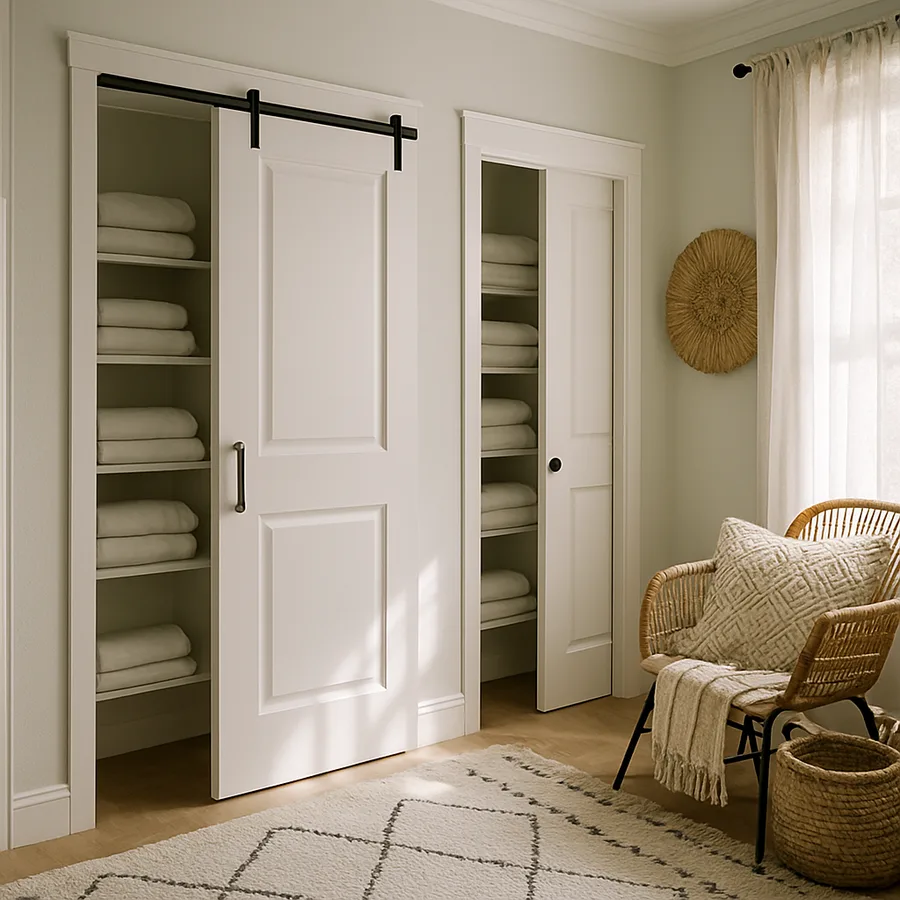
Linen closets are small, and the door that closes them off matters disproportionately. In a hallway scarcely four feet wide, a swinging linen closet door can block traffic, hit baseboards, and force a household choreography that nobody enjoys. The two leading alternatives are sliding doors, which travel along a surface-mounted or recessed track, and pocket doors, which slide into a cavity inside the wall itself. Each solves the swing-clearance problem in a different way, with sharply different cost, construction, and access profiles. The choice deserves more analysis than it usually gets.
This piece compares sliding doors versus pocket doors for linen closets across the dimensions that actually drive the decision: clear opening width, wall framing requirements, hardware quality, soft-close behavior, code considerations, repairability, and cost. By the end you should know which solution fits your hallway, your budget, and your tolerance for future maintenance, because the wrong choice here is not a wallpaper-level mistake; it is a framing-level mistake that costs serious money to undo once the drywall is closed up.
How Each Door Type Actually Works
A sliding linen closet door rides on a track mounted either above the opening (top-hung) or below it (bottom-rolling), with the door panel running along the face of the wall rather than into it. Barn-door style sliders are the most visible variant, but flush in-wall sliding hardware also exists for installations that want the sliding function without the rustic visual reference. When the door is open, the panel hangs alongside the opening, on the wall surface.
A pocket door, by contrast, slides into a hollow cavity inside the wall, called the pocket, which is framed during rough construction. When fully open, the door disappears entirely into the wall and you see only the opening itself. The door is invisible until you slide it back out, which is an elegant result but requires building the wall around it from the start.
The implication is immediate. A sliding door requires wall space adjacent to the opening, equal to or greater than the door's width, to receive the open panel. A pocket door requires no adjacent wall surface but requires double-thickness wall framing on at least one side of the opening to house the pocket. These are not the same engineering problem; they are not interchangeable solutions to the same need.
Clear Opening Width And Real Access
A pocket door, when fully retracted, gives you the entire framed opening as clear access. A 30-inch framed opening yields a 30-inch clear opening minus a small allowance for the jamb. For a linen closet packed with shelves, this is the maximum accessible width and matches what you would get from a fully-opened swinging door without any of the swing clearance demands on the surrounding hallway.
A sliding linen closet door is more complicated. If the opening is 30 inches wide and you install a single 30-inch door, the door slides to one side and exposes 30 inches of opening. But this requires 30 inches of clear adjacent wall to receive the door. If you do not have that wall space, you might install two 15-inch doors that bypass each other, in which case the maximum clear opening at any one time is 15 inches, half the framed opening width. This is functionally limiting for a linen closet, where the shelves usually span the full width and you want access to either end.
Reader question: Does that mean pocket doors always win on access? For full-width access, yes, but with one important exception. A pocket door has a stop near the leading edge of the pocket so the door cannot disappear entirely into the cavity, which means you lose roughly 2 inches of clear opening width compared to the bare framed dimension. A barn-style sliding door, by contrast, can pull fully clear of the opening, so the clear opening matches the framed opening exactly. For a 30-inch framing, the pocket gives you about 28 inches clear; a single-leaf slider gives you 30 inches clear, but only if you have the adjacent wall.
Wall Framing Requirements And The Hidden Cost
This is where pocket doors get expensive. Installing a pocket door in new construction adds modest cost, typically $200 to $500 above a standard hinged door for the pocket frame kit and the slightly more complex finishing. Installing a pocket door as a retrofit, into a wall that was not originally framed for it, is dramatically more expensive. You must open the wall, remove existing framing, install a manufactured pocket frame, re-route any electrical or plumbing inside the wall (which there often is, since walls adjacent to linen closets frequently carry circuits to bathrooms), and re-finish the wall on both sides.
Retrofit pocket door installations commonly run $1,800 to $4,500 when you account for framing modifications, electrical re-routing, drywall and finishing, and any code-required modifications to nearby plumbing. The National Association of Home Builders (NAHB) documents pocket door retrofits as one of the most underestimated costs in mid-scale renovation budgets because homeowners price the door and not the wall surgery surrounding it.
Sliding doors are dramatically cheaper as retrofits. A barn-style slider mounts to the existing wall surface with a header board that hides the track. Total installed cost for mid-market hardware and a basic flat-panel door runs $400 to $1,200. The wall does not get opened; the trim does not get modified; no electrical re-routing is required. The cost asymmetry between the two options in retrofit is the single largest factor in the decision for most homeowners.
Soft-Close, Hardware Quality, And Daily Operation
Pocket doors traditionally suffered from poor operation. The door would jump the track, the latch would fail, and the recessed pull would loosen. Modern pocket door hardware from Häfele, Johnson, and similar manufacturers has largely solved these problems, but only at the upper end of the hardware market. Cheap pocket door kits sold at discount retailers still produce the binding, jumping behavior that gave pocket doors their reputation for unreliability.
Soft-close mechanisms are now available on both door types. For sliding doors, the soft-close acts at the closing position, gently pulling the door the last few inches into the jamb. For pocket doors, soft-close can act at both ends of travel, slowing the door into the pocket when opening and into the jamb when closing. The premium for soft-close runs roughly $80 to $200 per door regardless of door type and is, in the consensus view of most working installers, money well spent.
According to the BHMA, residential pocket door hardware rated to ANSI/BHMA A156.14 Grade 1 standards is tested to 100,000 cycles, equivalent to roughly 27 years of average residential use. Sliding door hardware tested to the same Grade 1 standard meets comparable cycle counts, so longevity differences between the two door types come down to installation quality more than the hardware specification itself.
Code, Accessibility, And Sound Considerations
Building codes generally treat linen closet doors as non-egress, non-rated openings, so the code constraints are looser than for bedroom doors or fire-rated openings. However, two code-adjacent considerations matter and deserve explicit attention during specification.
First, accessibility codes in many jurisdictions require a minimum clear opening width for storage closets in accessible units. Pocket doors more easily achieve required clearances because they pull fully out of the opening. Sliding doors, particularly bypass configurations, often cannot meet accessibility minimums and may force a barn-style single-leaf slider in accessible installations. Plan for this if the home is being designed to universal-design or visitability standards.
Second, sound transmission through pocket doors is typically worse than through swinging or surface-sliding doors because the pocket cavity provides little mass and creates a sound path around the door rather than through it. For a linen closet, sound transmission rarely matters. For a closet that backs up to a bathroom or a bedroom wall, the pocket can become an acoustic shortcut, and adding sound batting inside the pocket cavity during construction is a small expense that prevents a real problem.
Reader question: What about humidity? Linen closets often sit near bathrooms. Pocket doors fare slightly worse here because the cavity inside the wall does not breathe and can trap moisture against the door's hidden face, leading to warping. Solid-core flush doors and properly sealed paint or finish on all six faces of the door, including the top and bottom edges, are the standard remedy. Surface-mounted sliders sit in the open hallway air and are less affected.
Repairability Over Twenty Years
This is where the long-term math diverges sharply. A sliding linen closet door, when its track fails after 15 to 20 years, can be replaced by unscrewing the track from the wall, installing a new one, and re-hanging the door. Total time, maybe two hours; total cost, often under $300 including new hardware. The repair is well within the skill range of an average handyman or even a careful homeowner.
A pocket door, when its track fails, requires opening the wall to access the pocket interior. The door must come out, the track must be replaced, and the wall must be re-finished. Total cost for a pocket door repair commonly runs $600 to $1,800 depending on the wall finish and the complexity of the surrounding trim. For this reason, professional installers tend to spec premium hardware on pocket doors, since the cost of failure is so much higher than on a surface-mounted slider. The decision logic is the same as specifying higher-grade plumbing fittings inside walls: the access cost dwarfs the component cost.
NKBA trend data shows that about 38 percent of mid-scale renovations that include any pocket door work also include premium hardware upgrades, reflecting awareness among design professionals that you do not want to do this work twice. Homeowners who insist on cutting hardware costs on pocket doors are typically the same homeowners who learn the lesson the hard way at year fifteen.
Conclusion
The choice between a sliding door and a pocket door for a linen closet ultimately depends on the construction context. In new construction, a pocket door is usually the better answer when the wall framing can be designed around it from the start. The clear opening is generous, the visual result is the cleanest possible, and the incremental cost over a standard hinged door is modest. In retrofit construction, sliding doors are almost always the better answer because the cost of opening the wall to install a pocket frame is rarely justified by the operational benefits over a quality surface-mounted slider.
The middle case, retrofit construction where you are already opening the wall for other reasons such as plumbing replacement or electrical upgrades, deserves careful analysis. If the wall is already open and the framing can be modified, the marginal cost of adding a pocket door is small compared to the standalone retrofit price. Coordinate with your contractor and have the pocket frame ready to install during the window when the wall is exposed, because that window does not stay open for long once tile or paint is going back on.
Across both options, premium hardware pays for itself in operational satisfaction and longevity. The hardware delta between a budget kit and a premium kit on a single linen closet door is rarely more than $200, and the daily experience of a door that operates smoothly for two decades is genuinely worth that premium. This is true on barn-style sliders, on flush sliders, and especially on pocket doors where the cost of replacement is high.
Planning a hallway upgrade? Walk your contractor through both options on site, measure your adjacent wall space, ask explicitly whether the wall behind the closet contains electrical or plumbing that would complicate a pocket retrofit, and make the call before drywall opens. The decision is much easier to make standing in the actual hallway than from a catalog or a floor plan, and the answer is almost always obvious once you have the dimensions in front of you.
Comments
Post a Comment