Closet Light Switch Door Activated Versus Motion Sensor
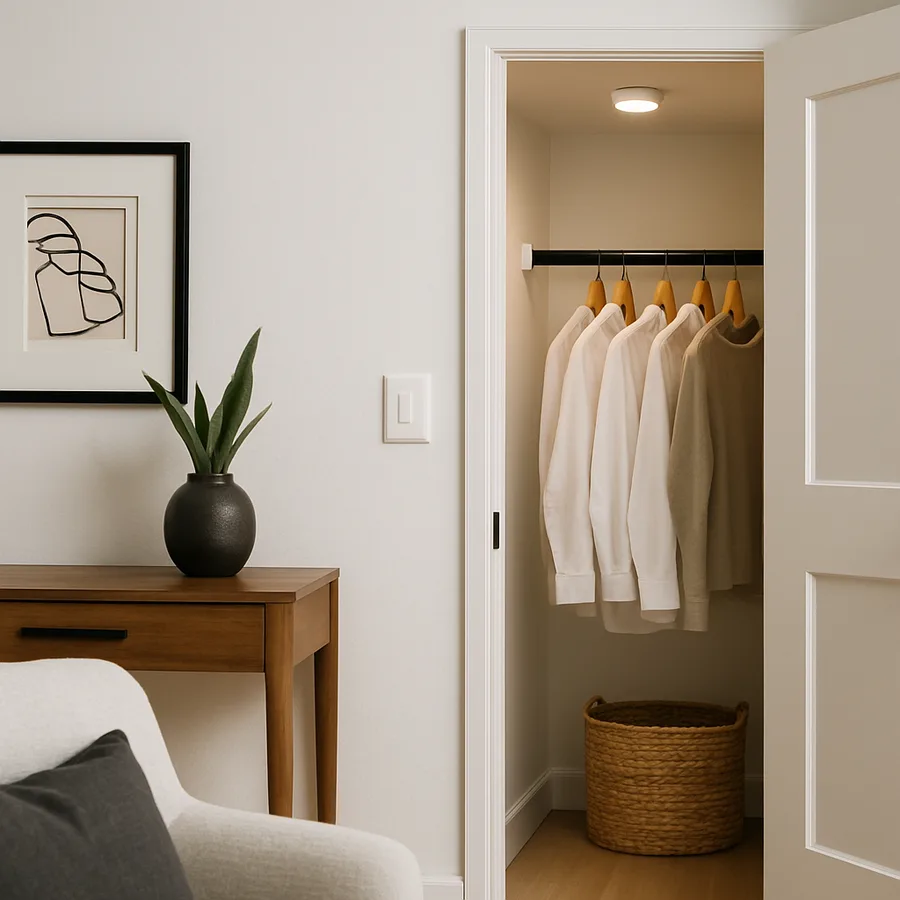
Walk into any well-designed closet today and the lights come on without a thought. Walk into one designed twenty years ago and you fumble for a wall switch in the dark, often after dropping a folded shirt in the doorway. The difference between those two experiences is a small, inexpensive control device, and the choice between the two dominant options, door activated switches and motion sensor switches, is one of the most consequential small decisions in modern closet design.
The right answer depends on closet geometry, how the space is used, who lives in the home, and how the lighting circuit was wired during construction. This guide walks through the trade-offs in detail, draws on standards from professional lighting bodies, and offers a clear framework for choosing between the two switch families for any closet you might be building or upgrading.
Two Mature Technologies, Two Different Mental Models
A door activated switch is a mechanical or magnetic device that closes the lighting circuit when the closet door opens and breaks the circuit when the door shuts. It is binary, instantaneous, and entirely indifferent to whether anyone is actually inside the closet. Open door equals lights on, closed door equals lights off. The behavior is so predictable that most people stop noticing the switch within a day of installation.
A motion sensor switch, by contrast, watches the closet itself rather than the door. Most modern units use passive infrared sensing to detect the heat signature of a person moving through the space and trigger the lights based on that signal. They include a built-in timer, typically adjustable between thirty seconds and thirty minutes, that holds the lights on after the last detected motion before shutting them off automatically. The American Lighting Association (ALA) notes in its educational materials that motion-controlled switches now account for a substantial and growing share of residential occupancy controls, driven by both energy code requirements and consumer convenience expectations.
The two technologies solve the same surface problem in fundamentally different ways. Understanding which mental model fits your closet usage is the first step toward picking the right switch.
Door Activated Switches: Simple, Cheap, and Quietly Reliable
Door activated switches come in two flavors. Plunger switches mount inside the doorjamb with a spring-loaded button that the door depresses when closed, opening the circuit. They are mechanical, inexpensive, and have been used in residential closets and refrigerators for decades. Magnetic reed switches use a sensor in the jamb and a small magnet on the door, eliminating moving parts and improving long-term durability.
The strengths are obvious. Response is instantaneous, with no warm-up delay and no false triggers from a pet wandering past the doorway. Power draw is essentially zero when the door is closed, since the switch is mechanically disconnecting the circuit rather than holding it open electronically. The hardware costs are low, often under thirty dollars for a quality plunger switch and not much more for a magnetic version.
The weaknesses are equally clear. The switch only works for closets that have an actual door that closes fully. Walk-in closets with no door, archways, curtain-divided dressing areas, and bypass closets that are routinely left half open all defeat the logic of the design. In a bypass closet, for example, the door may be open even when no one is inside, leaving the light burning indefinitely until someone notices and slides it shut.
Plunger switches also wear out, especially when door alignment shifts seasonally and the plunger no longer fully depresses or fully releases. The result is intermittent operation that can be maddening to diagnose. Magnetic reed switches eliminate this failure mode but are slightly more expensive and require careful initial alignment of magnet to sensor.
Motion Sensor Switches: Flexible, Smarter, and More Specifying-Sensitive
Motion sensor switches solve the doorless-closet problem cleanly. They also handle situations where the closet door is routinely propped open, where the closet shares a dressing area with no clear threshold, or where the user wants the lights to stay on while putting away laundry from a cart parked in the doorway.
The technology is mature. A quality residential PIR sensor can reliably detect human movement at distances up to roughly twenty feet under good conditions, with field-of-view angles between 110 and 180 degrees depending on the model. Detection is movement-based rather than presence-based, which matters: if you stand perfectly still in front of a mirror tying a tie for ninety seconds, a basic PIR sensor may decide the room is empty and turn the lights off mid-action. Premium units include dual-technology sensing, combining PIR with ultrasonic or microwave detection that can pick up small movements like breathing or finger motion.
Energy code is another factor. Many state and local building codes, drawing from the model frameworks issued by the U.S. Department of Energy Building Energy Codes Program, now require automatic shutoff controls for closet and storage room lighting in new construction. Motion sensor switches satisfy this requirement directly, while door switches typically do not because they cannot guarantee shutoff if the door is left open. Have you checked your local energy code before specifying hardware for a new build or major remodel? The answer determines whether door switches are even an option.
The drawbacks are real. Motion sensors draw a small standby current continuously, although the trade-off against the lights they turn off is overwhelmingly favorable. They occasionally trigger from pets, from HVAC airflow that disturbs hanging garments, or from sunlight patterns moving through skylights. They also age, with PIR sensitivity drifting slightly over many years, although replacement is straightforward.
Wiring, Code Compliance, and the Hidden Constraints
Both switch types require attention to the existing electrical layout. Door activated plunger switches are wired in series with the closet light, often inside the doorjamb in a recessed mortise that may need to be cut into existing trim. Magnetic reed switches can be surface mounted but still require a wire run from the switch to the lighting circuit.
Motion sensor switches typically replace an existing wall switch and require either a neutral wire at the switch box or a model designed for two-wire installation. Older homes often lack a neutral at the switch location, which restricts the available product choices. The National Electrical Code (NEC), published by the National Fire Protection Association, also imposes specific requirements on closet lighting fixture types and clearances from storage that apply regardless of which switch you choose. Recessed LED fixtures, surface-mounted LED panels, and certain low-profile fluorescent fixtures meet the clearance requirements; bare incandescent or pendant fixtures generally do not in modern code-compliant work.
For pantries, linen closets, and storage closets where automatic shutoff is mandated, the choice often defaults to motion sensors regardless of preference, simply because they integrate cleanly with the code-required behavior. For wardrobe closets in bedrooms, where energy code may be more permissive, the choice opens up.
Matching the Switch to the Closet Type
A useful way to think about the decision is to map switches to closet typologies rather than to abstract preferences.
Reach-in wardrobe closets with hinged doors are the natural home of door activated switches. The door is opened, used briefly, and closed; the binary logic of the switch matches the binary use of the closet exactly. A plunger or magnetic switch in the jamb costs little, installs quickly, and never requires recalibration.
Walk-in closets larger than approximately twenty square feet are far better served by motion sensors. Users typically spend longer inside, may close the door behind them, and benefit from lights that stay on for the duration of the visit and shut off cleanly afterward. Ceiling-mounted sensors with adjustable timers handle these spaces gracefully.
Doorless closets, archway-defined dressing areas, and shared dressing zones in primary suites require motion sensors by default, since there is no door to act on. A high-quality dual-technology sensor with a generous field of view and a long timer setting is the appropriate specification.
Linen closets, pantries, and utility storage sit somewhere in the middle. If the door reliably closes and code permits, a door switch works well. If the door is often left ajar to ventilate the space or if local code mandates automatic shutoff, the sensor is the better answer.
Cost, Service Life, and the Long-Term View
Hardware costs for both technologies are modest. A quality magnetic reed door switch installs for roughly $40 to $80 in materials. A residential motion sensor switch with adjustable timer and field-of-view masking runs $30 to $90 in materials, with premium dual-technology models reaching $150. Installation labor is comparable for both, typically one to two hours including any minor trim work, although a sensor replacement of an existing wall switch can be quicker if a neutral is already present.
Service life favors the magnetic and electronic options over the mechanical plunger. A plunger switch may need replacement after seven to ten years, often because the spring weakens or the plunger rod corrodes in humid environments. Magnetic reed switches and PIR sensors typically last fifteen to twenty years or more, with PIR units occasionally requiring sensitivity recalibration but rarely full replacement.
Energy savings are real but modest in absolute terms. A typical closet light burns roughly 10 to 15 watts in modern LED form, drawing perhaps 15 to 25 kilowatt-hours per year if left on by accident for hours at a time. Both switch types eliminate that waste effectively, with motion sensors edging ahead in walk-in closets where door switches simply cannot enforce shutoff. Have you reviewed your current closet lighting electricity usage to see whether the upgrade pays back in energy alone, or whether the value is purely in convenience? For most homeowners, the convenience case is decisively stronger than the energy case, and either is sufficient justification.
It is also worth noting that warranty terms differ meaningfully between the two product categories. Quality motion sensor switches from established manufacturers such as Lutron, Leviton, and similar firms typically carry warranties of three to five years on the electronic components, with the actual service life extending well beyond that period. Door activated switches, particularly the simpler plunger variants, often carry shorter explicit warranties because they are treated as commodity hardware, even though the magnetic reed versions can match or exceed sensor switch service life in practice. Reading the warranty terms before specification is a small step that occasionally surfaces important information about expected service life and replacement support, and it costs nothing.
One last consideration worth surfacing is the upgrade pathway. Door activated switches are difficult to upgrade in place because they are physically embedded in the doorjamb and the mechanism is purely binary. Motion sensor switches, by contrast, occupy a standard wall switch box and can be replaced over time with newer models that offer expanded features, such as Bluetooth or network connectivity, integration with home automation platforms, or improved sensitivity. For households planning to invest in connected home infrastructure over the next decade, the sensor approach offers a more graceful evolution path even if the immediate need is purely for automatic shutoff.
Conclusion
Door activated and motion sensor closet light switches are not really competitors. They are tools optimized for different closet typologies, and the smartest specifications match the tool to the space rather than picking a single favorite and forcing it into every opening. A reach-in wardrobe closet with a reliable hinged door is genuinely better served by a magnetic reed door switch than by an occupancy sensor; a walk-in dressing room with no door is genuinely better served by a high-quality dual-technology sensor than by any door switch on the market.
The questions to ask first are about the closet itself, not the hardware. How is the space entered? Does the door close consistently? Is the visit measured in seconds or minutes? Is automatic shutoff required by local energy code? Once those questions are answered, the right switch family becomes obvious, and the remaining decisions narrow down to selecting a reputable manufacturer, confirming the wiring infrastructure can support the chosen device, and installing the hardware with the alignment care it deserves.
Both technologies are mature, both are affordable, and both will outlast the paint job in the room around them. Specifying either one thoughtfully will improve the daily experience of the closet noticeably, and that small improvement, multiplied across thousands of openings over the years, is exactly the kind of design detail that quietly defines a well-considered home. Schedule a brief consultation with a licensed electrician or qualified closet designer before ordering hardware, walk through the typology of each closet in your home, and let the geometry of the space tell you which switch belongs there.
More Articles You May Like



Comments
Post a Comment