Glass Cabinet Doors Mullioned Versus Single Pane Compared
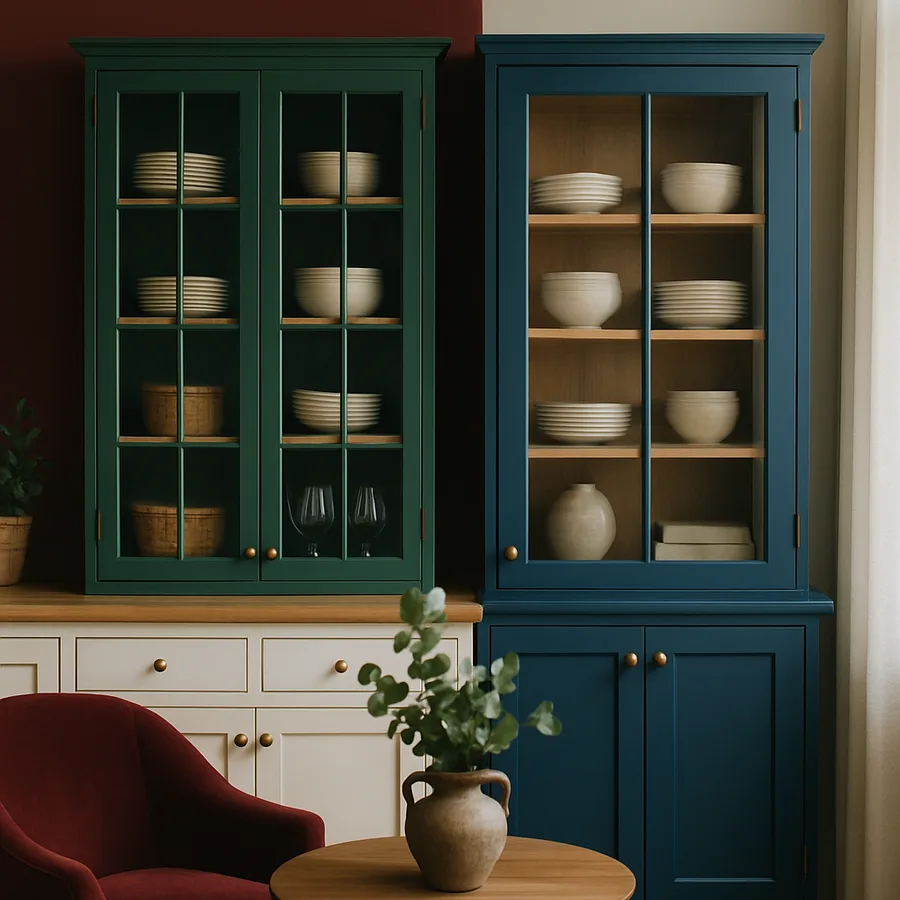
The decision between a mullioned glass cabinet door and a single-pane glass cabinet door looks like a styling choice on a finish board. In a finished kitchen, it shapes how the eye reads the entire upper cabinetry program. A mullioned door imposes a grid, partitioning the cabinet interior into orderly rectangles that the eye scans rather than absorbs at once. A single-pane door is a window; it shows you everything inside at a single glance and demands that the contents be arranged accordingly. Each is the correct answer for some kitchens and the wrong answer for others, and the cost difference can be significant on a multi-door cabinetry program.
This article compares the two options across visual weight, structural longevity, fabrication cost, glazing options, cleaning, and design register. The goal is to give you a defensible basis for the decision before you commit to a cabinetry order, because changing glass cabinet doors after fabrication is one of the more expensive corrections available in residential remodeling. According to NKBA trend reporting, roughly 31 percent of new mid-to-high-end kitchen renovations now include at least one glass-fronted cabinet door, a figure that has grown over the past decade as open shelving has receded in popularity.
The Visual Vocabulary Of Each Door Type
A mullioned door divides its glass into multiple panes with thin wooden or metal bars called mullions or muntins. Common configurations include two-over-two, four-pane, six-pane, and divided-light variants borrowed directly from window-making traditions. The visual effect is rhythmic: the eye moves across the door in distinct steps rather than as a single sweep, and the cabinet itself becomes a small composition.
A single-pane door uses one continuous sheet of glass framed only by the door's outer rails and stiles. The visual effect is open: the eye reads the cabinet interior as a single composition rather than as a partitioned display. The single-pane door is closer to a small window into the cabinet than to a styled architectural element.
The implication for kitchen design is straightforward. Mullioned doors pair naturally with traditional, English, French country, and certain transitional kitchens where the period vocabulary already includes divided-light windows and paneled millwork. Single-pane doors fit minimalist, contemporary, and many Scandinavian-influenced kitchens where horizontal and vertical lines are kept deliberately sparse and the design vocabulary avoids period references.
The American Society of Interior Designers (ASID), in its design trends reporting, notes that designers working in transitional kitchens, which sit between traditional and contemporary, increasingly choose simpler divided-light patterns such as two-over-two or single horizontal divisions rather than busy six-pane or eight-pane patterns, because the busier patterns now read as overtly historicist in many markets.
What Shows Through, And Why It Matters
A glass cabinet door, by definition, displays what is inside the cabinet. This is the controlling consideration in choosing between mullioned and single-pane, and it often gets dismissed at the spec stage as a problem to be solved after move-in.
A single-pane door shows everything. Every cup, every plate, every spice jar, every gap in the arrangement. It rewards households that keep cabinet interiors well-organized and beautifully styled, and it punishes households that do not. In practice, designers report that single-pane glass doors are most successful in upper cabinets dedicated to a single category of object, such as drinking glasses or stemware, where visual repetition does most of the styling work.
A mullioned door provides a degree of visual cover. The mullions break up the sight-line and create rhythm that the eye reads as intentional. Slight disorder behind a mullioned door registers as background; slight disorder behind a single-pane door registers as visible clutter. For households that want glass-fronted cabinets but cannot guarantee continuous styling discipline, mullions are the friendlier choice.
Reader question: What if I want the open look of single-pane but cannot commit to perfect styling? Two options. First, use reeded or fluted glass, which obscures contents while still admitting light and depth. Second, use frosted or sandblasted glass for the same effect with a different visual register. Both options sit between fully transparent single-pane and fully partitioned mullions, and they are growing in popularity precisely because they solve the styling-discipline problem.
Glazing Options And Their Tradeoffs
Beyond clear glass, the modern glazing palette for cabinet doors is wider than most homeowners realize, and the right glazing choice often does more for the finished result than the framing choice.
- Clear tempered glass is the default, providing full visibility and meeting safety glazing requirements where applicable.
- Reeded glass features vertical ribs that obscure detail while preserving light transmission. It has become one of the most-specified glazing options in transitional kitchens.
- Seeded glass contains intentional bubbles that mimic historical hand-blown glass, fitting traditional and farmhouse programs.
- Restoration glass has subtle distortion from period-style manufacturing techniques and is the most authentic choice for historically-correct restoration work.
- Mirrored glass turns the door into a reflective surface and is used in bar cabinets and dressing-room cabinetry.
Mullioned doors can mix glazing types within a single door, with one pane in reeded glass and an adjacent pane in clear, but this is a design risk that requires experienced execution. Single-pane doors are simpler to specify because there is only one piece of glass and one glazing choice per door, which removes a category of potential mistakes from the order process.
Fabrication Cost And Lead Time
This is where the comparison gets concrete. A single-pane glass cabinet door, in standard sizes with clear tempered glazing, typically adds $80 to $200 to the cost of an equivalent solid-panel door at mid-market cabinetry tiers.
A four-pane mullioned door, in the same size and tier, typically adds $180 to $400 over the solid-panel base. A six-pane mullioned door commonly runs $280 to $600 over the solid-panel base, and intricate divided-light patterns with curved or shaped mullions can run $700 and above per door. The cost driver is the mullion fabrication and assembly, which is genuinely skilled woodworking rather than off-the-shelf glazing.
Lead times follow the same pattern. Single-pane doors typically add no meaningful lead time to a cabinet order because the glass is cut and installed in a standardized process. Mullioned doors add 2 to 5 weeks at most semi-custom and custom cabinet shops because the mullions must be individually fabricated, fitted, and glazed.
The NAHB documents in its remodeling cost analyses that glass-fronted cabinetry, mullioned or single-pane, generally returns 60 to 80 percent of its incremental cost at resale in markets where the kitchen otherwise supports premium specifications. The return is higher in traditional markets that culturally expect mullioned upper cabinets and lower in contemporary markets where single-pane or solid panels are the default.
Cleaning And Long-Term Maintenance
Single-pane glass cabinet doors are dramatically easier to clean than mullioned doors. A single sweep with a glass cleaner and a microfiber cloth handles both faces of the glass and the surrounding wood frame. The cleaning effort scales linearly with the door's surface area, and the cleaning interval can stretch out without producing visible grime.
Mullioned doors require attention to every mullion intersection and every corner of every pane. Dust accumulates along the mullion edges and in the corners where mullions meet stiles. Cleaning a six-pane mullioned door takes roughly three to four times the time of cleaning a single-pane door of the same area, and the difference compounds across a kitchen with eight or ten mullioned doors. By the time you have wiped the last intersection of the last door, dust has begun settling on the first one again.
Reader question: Does this matter enough to drive the decision? For most households, no, but for households where someone in the home is responsible for the cleaning and that person has expressed strong preferences, the maintenance burden is real and deserves weight. Designers who ignore this conversation often find their mullioned cabinets resented within two years of installation.
Structural Durability And Failure Modes
Both door types are reliable when specified at appropriate quality tiers, but they fail differently when they fail, and understanding the failure modes helps with the specification decision.
Single-pane doors fail at the glass-to-frame seal or at the glass itself. A cracked single pane usually requires replacement of the entire glass sheet, which is typically a 1 to 2 hour shop visit if you have a spare door, or a multi-week wait if the door has to go back to the original cabinet manufacturer. The frame itself rarely fails because there are no internal joinery details under load.
Mullioned doors fail at the mullion intersections. Wood mullions expand and contract with humidity, and over time the small joints between mullion and stile can open, allowing dust and air infiltration. Modern construction with engineered wood mullions and quality finishes has substantially reduced this failure mode, but it has not eliminated it. A mullion joint that opens visibly is repairable but requires either a skilled finisher or, at worst, replacement of the entire door.
According to manufacturer testing referenced by Häfele and similar premium hardware specifiers, properly finished mullioned doors with quality engineered cores meet equivalent service-life expectations to single-pane doors, but the variation in mullion quality across the cabinet industry is wider than the variation in single-pane construction. Roughly two-thirds of premature mullion failures in field surveys trace to inadequate finishing of the unseen mullion faces rather than to wood movement itself.
Conclusion
The mullioned-versus-single-pane decision rests on three things: the visual register of the rest of the kitchen, the household's willingness to maintain styled cabinet interiors, and the budget available for cabinet door upgrades. Mullioned doors are the right answer for traditional, English, and farmhouse kitchens, for households that prefer the controlled visual rhythm of partitioned glazing, and for kitchens where the upper cabinets will not be subjected to constant restyling discipline. Single-pane doors are the right answer for contemporary kitchens, for households that maintain consistently beautiful cabinet interiors, and for kitchens where the design intent is to show off a particular collection of dishware or stemware as a focal point.
The middle ground, which is also the fastest-growing category in working kitchens, uses reeded or fluted single-pane glass in contemporary cabinetry programs. This option captures the cleaner visual register of a single sheet of glass while providing enough visual obscuration to forgive imperfect interior styling. It also tends to be roughly the same price as clear single-pane and significantly cheaper than mullioned alternatives, which makes it a defensible choice in budget-conscious projects that still want the texture of glazed cabinetry.
Whichever option you choose, specify safety-tempered glass, request fabrication samples or shop drawings before committing to the full cabinet order, and walk through the finished cabinets of completed projects from the same shop before you sign. Cabinetry is one of the longest-lived single investments in a kitchen renovation, and the glass door choice will outlive almost every other surface in the room. The difference between a thoughtful specification and a defaulted one will read every day for the next two decades.
One final practical note: the lighting inside the cabinet affects both door types differently. A single-pane door with interior LED strip lighting transforms the cabinet into a small lit display, which is the strongest argument for the single-pane format in contemporary kitchens. A mullioned door under the same lighting reads as a series of small lit windows, which can be magical in a traditional kitchen and visually busy in a contemporary one. Whichever door you specify, plan the interior cabinet lighting in the same conversation, because the two decisions are tightly coupled and changing one without the other tends to produce results that look unconsidered. Interior lighting also amplifies the styling-discipline problem, so households that already struggle with cabinet organization should think twice before adding lit interiors to single-pane glass.
Ready to make the call? Visit a cabinet showroom and stand at the same distance from a mullioned and a single-pane door that you would be from your own upper cabinets in normal kitchen use. The right answer for your eye and your household will be obvious within thirty seconds, and that visceral reaction is far more reliable than any spec-sheet comparison or showroom sales pitch.
More Articles You May Like



Comments
Post a Comment