Latch Hardware Versus Knob For Cabinet Doors Compared
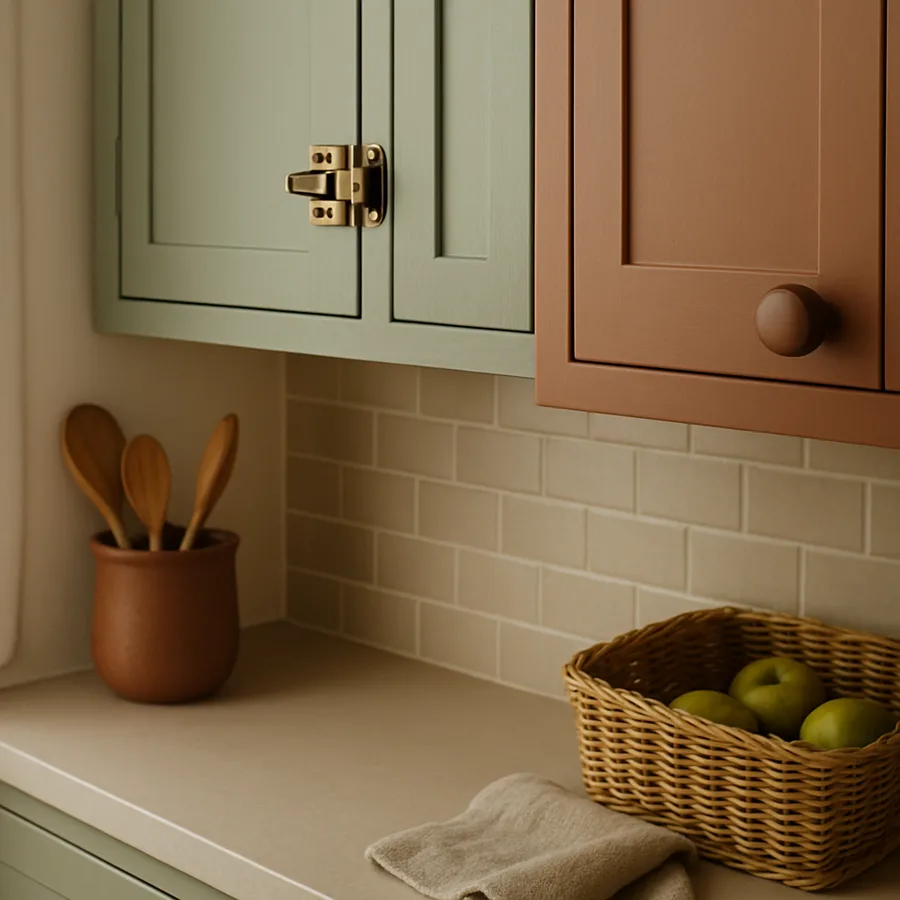
The choice between a latch and a knob on a cabinet door looks trivial on a spec sheet. In practice it changes the door's operation, the user's daily experience, the door's structural longevity, and the visual language of the entire room. A latch announces itself; a knob recedes. A knob requires only a pull motion; a latch requires a coordinated grip-and-rotate. Each option carries tradeoffs that compound across a 30-door kitchen, and the cost difference can run into four figures by the time you account for hardware, drilling, and the catch mechanism on the cabinet box. Skipping past this decision with a default choice means accepting whatever the cabinet showroom had on display.
This piece compares latch hardware versus knobs across the dimensions that actually matter: ergonomics, child accessibility, security against settling and warping, design register, maintenance, and cost. We will draw on data from the Builders Hardware Manufacturers Association (BHMA), observation from working cabinetry shops, and the manufacturer specs published by Häfele and Blum, two firms whose technical literature is the closest thing the residential cabinetry world has to canonical reference material. The goal is to give you a defensible basis for the choice rather than a preference dressed up as a recommendation.
What Each Mechanism Actually Does
A cabinet knob is a pure pulling device. It does not engage any mechanical latch on the cabinet box. The door is held closed by friction from a magnetic catch, a roller catch, or, in modern soft-close hinges, by spring tension built into the hinge cup itself. The knob's only job is to give your hand something to pull. Anything else, retention, alignment, dampening, is handled by other components in the cabinetry system.
A cabinet latch, by contrast, is a two-part mechanism. The visible faceplate on the door contains a rotating or sliding bolt; a matching strike plate is mortised into the cabinet face frame or box. Rotating the latch retracts the bolt and releases the door. This is the same conceptual mechanism as an entry door's mortise lock, scaled down and usually without a keyway. The latch keeps the door closed on its own, without help from a separate catch mechanism on the cabinet box.
The implication is mechanical: a knob relies on something else to keep the door shut, while a latch keeps itself shut. That difference matters most as cabinetry ages. A 15-year-old knob on a slightly warped door produces a door that flops open on its own. A 15-year-old latch on the same door stays positively closed until intentionally released. According to NAHB Remodeling surveys, doors that fail to stay closed rank among the top five complaints homeowners raise about kitchens older than ten years.
Ergonomics And Daily Use
Knobs win on speed. A single pull, no rotation, no coordination required. For a kitchen drawer or door that opens twenty times a day, the cumulative time savings is real, perhaps thirty seconds per door over a year, multiplied by every door in the kitchen. That is not a large number on any individual day, but across a household with two cooks and three meal prep sessions daily, the ergonomic friction of latch operation becomes a tax that some users notice and others do not.
Latches win on tactile satisfaction and feedback. The click of a well-machined cabinet latch is a small piece of daily feedback that some users genuinely enjoy, while others find it irritating. There is no universal answer here; it is a personality test for the household. Designers working with clients who have arthritis or limited grip strength tend to recommend knobs because the rotational force on a latch can exceed comfortable thresholds, particularly on stiff or new latches that have not yet broken in.
The American Society of Interior Designers (ASID) notes in its aging-in-place design guidance that hardware requiring a rotational motion should be replaced or supplemented in homes where any occupant has reduced hand strength. For those households, a knob with a soft-close hinge handles the function a latch would handle, without the rotation. This is a case where the right answer for a household at age 40 is the wrong answer for the same household at age 75, and forward-thinking specification accounts for that arc.
Child Safety And Inadvertent Opening
This is where the comparison gets interesting. A simple knob, with nothing else, is the easiest cabinet for a toddler to open because pulling is a single, intuitive motion. A traditional cabinet latch with a rotating bolt is meaningfully harder for small children to operate because the rotation step requires fine motor coordination that most children under three lack. The latch is not a child-proof device, but it is meaningfully more child-resistant than a bare knob.
Designers who specify latches in homes with small children often report fewer aftermarket child-locks installed, which preserves the visual cleanliness of the cabinetry. That said, dedicated child-safety latches sold separately are more effective than either standard knob or standard latch hardware, and the Consumer Product Safety Commission (CPSC) recommends them for any cabinet containing cleaning supplies or medication. The right answer for hazardous-material cabinets is rarely the same as the right answer for everyday-use cabinets in the same kitchen.
Reader question: Is there a knob design that offers the same child-resistance as a latch? Not from the visible hardware alone. The closest equivalent is a magnetic child-lock mounted inside the cabinet that disengages with an external magnetic key, which is invisible from the room but adds an operational step adults must learn. About 40 percent of pediatric poisoning cases involving household products begin with unsecured cabinet access, per CPSC injury data, which is why this question is worth a deliberate decision rather than a default.
Visual Register And Style Compatibility
Latches read as historical. Their visual vocabulary derives from 18th and 19th century cabinetry, and they pair most naturally with English-traditional, French country, farmhouse, and certain transitional kitchens. A latch on a flat-panel minimalist door creates productive visual tension if done well, or visual confusion if done poorly. Generally, the simpler the cabinetry, the more carefully a latch must be selected, because there is less visual context to absorb a piece of hardware that imposes a strong period reference.
Knobs are stylistically neutral. A round wooden knob fits a farmhouse; a polished nickel knob fits a transitional kitchen; a small machined-aluminum knob fits a modernist kitchen. Knobs do not impose a period on the design, which is why they remain the default specification across roughly 78 percent of residential kitchens per NKBA trend data, even as latch installations grow at the upper end of the market. That stylistic flexibility is part of why knobs hold their value in resale across more market types than latches do.
- Cup latches and bin latches work in farmhouse and English kitchens.
- Surface-mounted thumb latches fit Arts and Crafts and rustic programs.
- Concealed cabinet latches work in transitional kitchens where you want latch function without visible historical weight.
- Iron strap-style latches belong on rustic, lodge, and certain Mediterranean kitchens and look out of place anywhere else.
Maintenance, Adjustment, And Failure Modes
Knobs are essentially maintenance-free. The screw can loosen over years; a quarter-turn with a screwdriver fixes it. The catch mechanism, magnetic or roller, is a separate cabinetry component and can be swapped without touching the knob. Modern soft-close hinges absorb the heavy lifting of door retention, leaving the knob as a pure handle component with effectively no service life concerns.
Latches require more attention. The strike plate must remain precisely aligned with the bolt, and seasonal humidity changes can move a hardwood face frame enough to misalign a tight latch. Solid-brass latches develop a patina that some buyers value and others want to polish off. Spring-loaded latches eventually wear out their springs, typically after 15 to 25 years of daily use; replacement requires either matching a discontinued line or accepting a slightly different look. The maintenance burden is real but not crushing, and most households absorb it without complaint.
BHMA Grade 1 and Grade 2 testing under ANSI/BHMA A156.9 covers cycle counts for cabinet hardware, with Grade 1 latches rated for higher cycle thresholds. For a working kitchen, Grade 1 or 2 latches are worth the premium; for a butler's pantry or display cabinet, Grade 3 is usually adequate. The cycle ratings are real engineering data and worth checking on any latch specification you are considering for daily-use cabinets.
Cost Comparison Across A Full Kitchen
On a 30-door kitchen, a mid-grade knob program runs $150 to $600 in hardware plus the cost of magnetic catches at roughly $3 to $6 per door. A comparable mid-grade latch program runs $450 to $1,500 in hardware, plus the labor cost of mortising strike plates, which is meaningful: figure 15 to 25 minutes per door at shop rates. Custom finishes and high-end maker latches can multiply these numbers without much effort.
The total installed delta between a knob program and a latch program on a 30-door kitchen typically lands between $1,200 and $3,500. That is not trivial, but it is also not the largest line item on a kitchen budget, and many clients absorbing the latch premium find the daily tactile experience justifies the cost. Reader question: Does the latch premium hold its value at resale? Inconsistently. In markets that reward period-appropriate detailing on traditional homes, latches help. In markets that reward minimalist contemporary kitchens, latches can hurt, because the next buyer associates them with an aesthetic they may not want.
Conclusion
The knob-versus-latch question turns on three things: how the cabinetry will be used, who is using it, and what visual language the rest of the room speaks. A latch is the right answer for a period-correct traditional kitchen with adult occupants who enjoy the daily tactile feedback. A knob is the right answer for nearly everything else, and especially for households with reduced hand strength or for minimalist programs where added mechanical complexity reads as visual noise. The default choice for most projects, by both volume and resale data, is the knob.
The strongest argument against latches in modern construction is that high-quality soft-close hinges have absorbed most of the door-retention function that latches historically provided. A door that closes itself softly and stays closed under spring tension does not need a mechanical latch to behave properly. The strongest argument for latches is the one designers cannot put on a spreadsheet: the satisfaction of operating a piece of hardware that does its job with audible, tactile confidence, every time, for decades.
If you are building or remodeling now, walk through the kitchens and butler's pantries of friends who installed each option three to five years ago. The hardware that has aged well in real use, not in catalog photos, is the hardware you want. Most designers who specify both can point to projects where the choice landed perfectly and projects where it did not, and the difference almost always traces back to a mismatch between the hardware and the household's daily rhythm rather than to anything intrinsic about the hardware itself.
One more consideration deserves mention: hardware compatibility across the household. A kitchen that uses latches throughout creates an internal consistency that is satisfying to live with, but it also commits the homeowner to that vocabulary in adjacent spaces like the butler's pantry and laundry room. Many designers report that clients who specify latches in the kitchen then struggle with the decision in adjacent rooms, where the latch may not fit as gracefully. Knobs travel easily between rooms; latches do not. This is worth thinking through before the kitchen order goes in, because the cabinetry program rarely stops at the kitchen door.
Want to test the difference before you commit? Order a single latch and a single knob in the finish you are considering, mount each on a sample door from your cabinet shop, and live with both for a week of normal use. The right answer will be obvious by day three, and you will have spent under $100 on a decision that affects the next 20 years of your kitchen experience.
More Articles You May Like



Comments
Post a Comment