Swivel Bar Stools With Memory Return for Front Facing
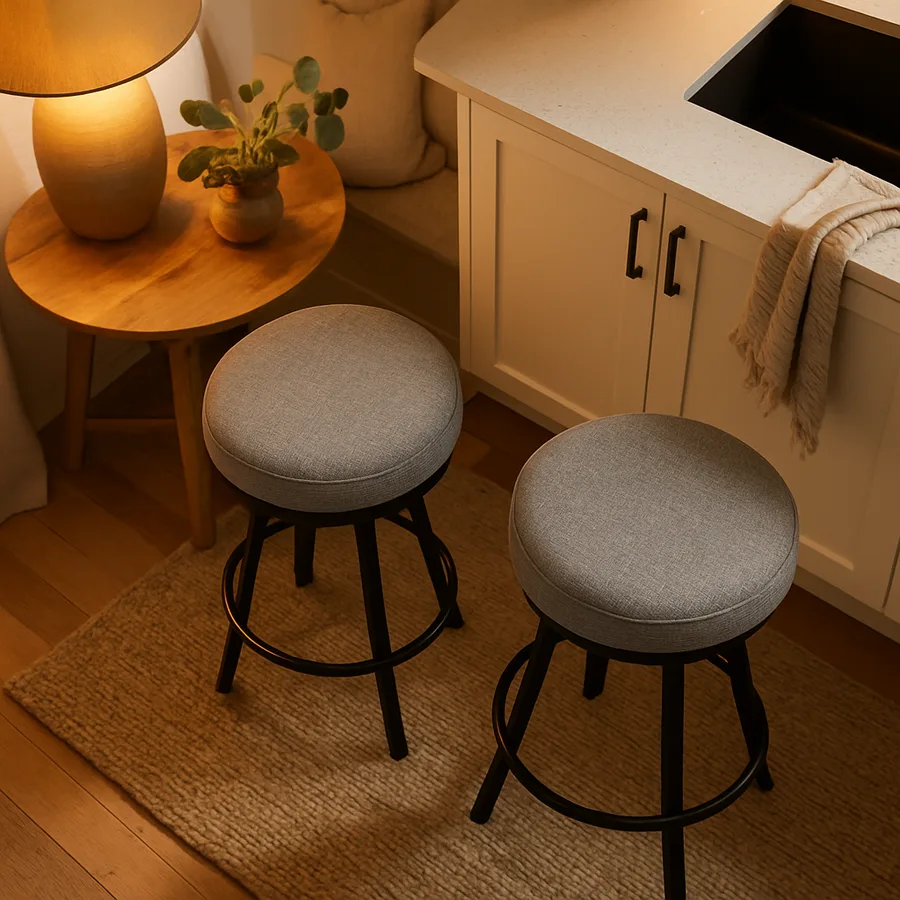
Walk into a kitchen with four swivel stools at the island and look at them before anyone has touched them. If they are ordinary swivels, they will be sitting at four different angles, each rotated to wherever the last person left it. The room reads as faintly chaotic even though everything else is tidy. Now picture the same kitchen with memory-return swivels: every stool faces forward, perfectly aligned, like a row of soldiers at parade rest. The visual difference is small. The psychological difference is enormous.
Memory-return swivel stools, sometimes called auto-return or self-centering swivels, have quietly become one of the most requested upgrades in high-end kitchen design. They solve a problem most homeowners never realized was a problem: the slow visual entropy of furniture that never resets itself. This guide explains how they work, why designers are specifying them in greater numbers, and what to look for so you do not waste money on a mechanism that fails within a year.
What Memory Return Actually Means
A standard swivel stool rotates freely on a bearing. Push it left, it stays left. Push it right, it stays right. A memory-return swivel uses a calibrated spring or weighted gimbal mechanism that gently rotates the seat back to a preset front-facing position whenever the sitter stands up. The user feels no resistance during normal use, but the moment weight leaves the seat, the mechanism quietly resets the orientation.
The mechanism itself comes in two main flavors. Spring-return systems use a coiled torsion spring tuned to apply just enough force to recenter the seat without making the rotation feel stiff during use. Gravity-return systems use a weighted, slightly conical bearing that always seeks the lowest point of its rotation arc, which the manufacturer aligns to the front-facing position during assembly. Both work well when properly engineered, though gravity systems tend to last longer because they have fewer moving parts to fatigue.
The American Home Furnishings Alliance has noted in trade publications that memory-return mechanisms have moved from a niche luxury feature to a mid-market expectation in the last five years, driven largely by social media kitchen photography and the increasing prevalence of open-plan layouts where stool orientation is constantly visible from multiple rooms.
Why Front Facing Matters Visually
The eye is remarkably sensitive to alignment. A row of stools all facing forward reads as designed; the same row at random angles reads as occupied or abandoned. In an open-plan home, the kitchen island is often visible from the living room, the dining room, the entryway, and even the home office. Every glance from any of those rooms registers the alignment, consciously or not.
Architectural Digest editors have observed that the most photographed kitchens of the past few years almost universally feature stools in perfect alignment, and stylists routinely spend several minutes adjusting stool angles before any shoot. Memory-return mechanisms eliminate this manual reset entirely. The kitchen photographs itself, every minute of every day, without intervention.
This matters even if you never plan to photograph your kitchen. The cumulative psychological cost of a room that always looks slightly disordered is real. Visual designers sometimes call this ambient tidiness, the background sense that a space is cared for. Memory-return stools deliver ambient tidiness for free, which is part of why their popularity has accelerated. Have you noticed how often you instinctively straighten chairs and pillows in your own home without thinking about it?
Safety, Stability, And Mounting
Beyond aesthetics, memory-return stools improve safety in subtle but meaningful ways. A stool that always faces forward presents a predictable seating target. A stool rotated unpredictably can surprise a sitter mid-mount, particularly an older adult or a small child, who may attempt to sit on what they expect to be a forward-facing seat and instead land on a side-rotated one with the footrest in the wrong position.
The American Society of Interior Designers has flagged unpredictable swivel orientation as a minor but consistent contributor to kitchen falls, particularly when the stool is at bar height rather than counter height. The added safety margin of a self-returning seat is small for any single sit, but accumulated over thousands of uses across a household's lifetime, the difference is non-trivial.
The mounting experience also improves. A memory-return stool sits where you expect it to sit, which means you can approach the island with a coffee cup in one hand and a phone in the other and trust that the seat will be in its expected position. Standard swivels demand a glance and a small course correction every time, a tiny cognitive tax that adds up across a busy morning.
The Mechanical Quality Spectrum
Not all memory-return mechanisms are created equal, and the difference between a well-engineered system and a poorly engineered one shows up within months of regular use. Cheap spring returns lose their tension within the first year, leaving the stool partially returning or jerking unpleasantly during rotation. Quality spring systems use steel springs rated for tens of thousands of cycles and remain calibrated for the life of the furniture.
Gravity-return mechanisms vary even more widely. A precisely machined conical bearing on a heavy steel base feels almost magical, rotating smoothly under load and gliding back to center the moment you stand. A poorly machined version sticks at certain angles, returns only partway, or develops noticeable wobble within months. The Illuminating Engineering Society's ergonomics research notes that mechanism failure in swivel furniture is one of the most common reasons for early replacement in residential settings.
Look for stools with at least a five-year mechanical warranty on the swivel mechanism, separate from the warranty on the upholstery or finish. Reputable manufacturers will publish the cycle rating of their bearings and springs, often in the range of fifty thousand to two hundred thousand rotations. Anything below thirty thousand cycles is unlikely to survive a decade of family use.
Integration With Footrests And Cabinetry
A memory-return stool needs more design coordination with the surrounding cabinetry than a fixed-position stool. Because the seat will reliably face forward when empty, the footrest, the toe-kick, and the under-counter clearance must all align with that consistent front-facing orientation. Misalignment between the stool's resting position and the kitchen architecture produces a subtle but persistent visual irritation.
Most quality manufacturers allow the front-facing position to be field-adjusted during installation, typically through a small set screw on the underside of the seat or via a calibrated collar at the base of the swivel column. Confirm this adjustability before purchasing, particularly if your island is asymmetric or your cabinetry geometry is unusual.
The footrest itself deserves attention. A 360-degree footrest ring works with any orientation, while a single-bar footrest at the front of the stool only works when the seat is genuinely facing forward. Memory-return mechanisms make single-bar footrests viable in residential settings for the first time, which opens up sleeker, more architectural stool designs that would otherwise feel impractical.
Even the best memory-return mechanism eventually drifts out of calibration, which is why integration planning should also account for long-term care. After thousands of cycles, springs lose a small amount of tension, bearings develop microscopic wear patterns, and the resting position can shift by a few degrees from where it started. The good news is that most quality mechanisms are designed to be recalibrated by the homeowner without specialized tools, typically through a small adjustment screw or a rotating collar at the base of the column.
Recalibration takes only a few minutes per stool and should be performed every twelve to eighteen months in heavy-use households. Apply a drop of furniture-grade lubricant to the bearing surface during recalibration to extend the mechanical life. The American Home Furnishings Alliance recommends keeping the original assembly hardware and instructions for the life of the furniture, since manufacturers occasionally change supplier mechanisms and replacement parts may differ from the original. Watch for early warning signs of mechanism failure: sticking at certain angles, partial returns, audible clicking, or sudden jerks during rotation all indicate that the bearing or spring is approaching the end of its calibrated life.
Cost, Brands, And Buying Confidence
Memory-return mechanisms add roughly fifteen to thirty percent to the cost of a swivel stool at most price points. At the entry level, this means roughly fifty to one hundred dollars per stool more than a standard swivel. At the mid and high end, the premium can run several hundred dollars per stool, though the mechanisms at that level are dramatically more durable and refined.
According to industry surveys cited by the American Home Furnishings Alliance, more than half of new bar and counter stools sold in the premium residential category now include some form of return mechanism, up from a small minority a decade ago. The trend reflects both consumer demand and manufacturer recognition that the feature dramatically reduces post-purchase complaints about alignment and visual disorder.
When evaluating brands, look for transparency about the mechanism type, the cycle rating, the warranty terms, and the ability to repair or replace the mechanism without scrapping the entire stool. The best manufacturers design the swivel module as a serviceable component that can be swapped out by a moderately handy homeowner or local upholsterer. The worst encase the mechanism in a sealed welded base that requires throwing away the entire stool when the spring fails. Are you confident you could service this stool in ten years, or are you buying a disposable? A serviceable mechanism also protects the rest of your investment, since the upholstery, the seat shell, and the metalwork above the swivel module typically outlast the bearing itself by decades when properly maintained.
Conclusion
Memory-return swivel stools solve a problem most kitchen owners did not know they had: the slow accumulation of visual disorder that comes from furniture that never resets itself. By quietly recentering every stool the moment it is vacated, these mechanisms maintain a level of ambient tidiness that no amount of manual straightening can match. The result is a kitchen that always looks composed, photographs well at any moment, and welcomes new sitters with predictable seating geometry.
The premium over standard swivels is real but modest, particularly when amortized over the decade or more these stools should last. The quality of the mechanism matters far more than the brand cachet, and the best manufacturers will tell you exactly how their springs or gravity bearings are engineered, how many cycles they are rated for, and how to service them when the time comes. Treat the mechanism as the most important component you are buying, not as a forgettable feature in the product description.
If you are renovating a kitchen visible from the rest of the home, working in an open-plan layout, or simply tired of straightening stools every time you walk past the island, memory-return swivels deserve a place at the top of your shortlist. They are the kind of upgrade that disappears into the background of daily life and quietly earns its keep every single morning.
Take ten minutes this weekend to look at your current stools, count how many are facing forward, and ask yourself how often you instinctively straighten them. If the number surprises you, memory return is almost certainly worth the upgrade. Reference the American Home Furnishings Alliance resources on furniture mechanisms, browse coverage on Architectural Digest for inspiration, and request mechanism specifications from any manufacturer you are considering before placing an order.
The broader lesson behind memory-return stools is that small mechanical refinements can have outsized effects on daily life. The mechanism itself is invisible, the cost premium is modest, and the benefit reveals itself only after weeks of use, when you notice that you have stopped reflexively straightening furniture every time you walk past the island. Many of the most beloved features in modern interior design share this quiet, accumulative quality. They do not announce themselves. They just remove a small friction from each day, and the cumulative relief over years adds up to a home that simply feels easier to live in than the alternatives.
More Articles You May Like



Comments
Post a Comment