Foot Rest Under Desk For Posture and Circulation
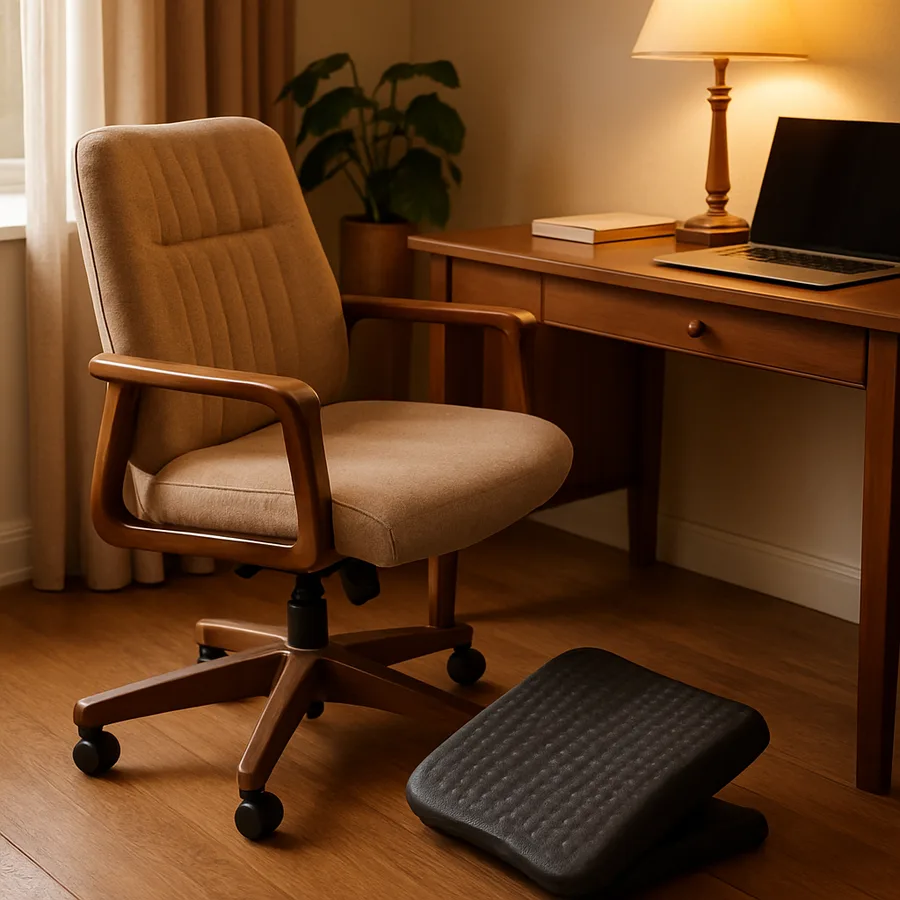
A footrest is the piece of office equipment that nobody expects to need, until they install one and realise their lower back has been quietly unhappy for years. The premise is almost insultingly simple: a small platform under the desk that lifts the feet a few centimetres above the floor and gives them a stable, slightly tilted surface to rest on. The effect on posture, lower-leg circulation, and end-of-day fatigue is far out of proportion to the hardware involved. For workers whose chairs cannot drop low enough, whose desks cannot rise high enough, or whose feet simply do not naturally reach the floor, a footrest is not a luxury; it is a missing link in the workstation.
This article walks through why a footrest matters, who specifically benefits most, what to look for in the hardware, and how to integrate it into a working day without it becoming an obstacle you trip over. We will end with a short framework for deciding whether a static, rocking, or movement-oriented footrest suits your work style. The hardware itself is cheap; the decision is about which kind to pick and why.
The Geometry Problem A Footrest Solves
The seated workstation is a system of three heights stacked together: the floor, the seat, and the desk. For everything to sit at the right relationship, the chair must be high enough to put the elbows at desk height, but the seat must be low enough to let the feet rest flat on the floor. For a meaningful percentage of workers, particularly those shorter than roughly 5'7", these two constraints fight each other. The chair has to come up to make the desk usable, which lifts the feet off the floor.
Feet that do not reach the floor have no stable base. The body responds by either dangling the legs (which constricts circulation behind the knee) or by sliding forward in the chair to make contact (which collapses lumbar support). Both compensations are documented contributors to lower-back fatigue and lower-leg discomfort. According to U.S. Occupational Safety and Health Administration guidance on computer workstation setup (see OSHA computer workstation eTool), the entire seated posture chain depends on a stable foot base, and a footrest is the recommended intervention when the chair cannot drop low enough.
The same problem affects taller users with low desks; raising the chair is not the answer there, but the underlying issue (feet that do not load the floor naturally because the geometry is wrong) is identical. A footrest does not fix the desk-height problem, but it does provide the missing stable base, which is enough to restore most of the postural chain.
Circulation: The Reason Your Calves Burn By 4 PM
Sitting still for hours with feet resting on a hard floor or, worse, dangling without support, gradually impedes venous return from the lower legs. The muscles of the calf normally act as a secondary pump that pushes blood back up toward the heart; a static seated posture disables this pump, and over the course of an afternoon the result is the dull burning sensation in the calves that many desk workers know intimately. A footrest does not fix this entirely, because nothing fixes it entirely except periodic standing and walking, but a footrest with even a small amount of motion or rocking action keeps the ankle joint moving enough to maintain meaningful pump action.
This is the case for the rocking footrest specifically rather than a static block. A platform that pivots gently under the feet, allowing the ankles to flex through 10 to 20 degrees of motion, encourages micro-movement throughout the day without requiring you to stand up or interrupt your work. The ankle pump activates dozens of times an hour without conscious effort, which is precisely the pattern that supports lower-leg circulation in long sitting periods. According to Mayo Clinic guidance on prolonged sitting and circulation (see Mayo Clinic prolonged sitting guidance), even small amounts of regular movement during sitting periods produce measurable circulation benefits.
Have you ever stood up after three hours at your desk and felt that strange, slightly numb sensation in one foot? That is venous pooling, and it is the visible sign of a problem that has been developing invisibly for the previous three hours. A rocking footrest meaningfully reduces the frequency of that sensation; standing up and walking for two minutes every hour reduces it more. Combine the two and the problem largely disappears.
Sizing And Surface: What Actually Matters In The Hardware
A footrest needs to be wide enough that both feet can rest comfortably without crowding, and deep enough that your full foot from heel to toe lands on the surface. For most users, that translates to at least 450 millimetres wide and 300 millimetres deep. Smaller platforms force one foot or the other off the edge, which defeats the purpose. Larger platforms are awkward to push around with your feet and may collide with the chair base.
The surface itself should be slightly textured to keep your feet from sliding forward, especially if you wear socks or smooth-soled slippers. A rubberised top surface is the most common solution and works well; a textured plastic or fabric-covered surface also works. Avoid completely smooth surfaces, particularly hard plastic, which become frustrating within a week. Some footrests offer a removable foot-massage roller surface, which is genuinely pleasant for some users and immediately annoying for others; this is a personal preference rather than a critical feature.
The angle of the surface matters less than people imagine. A fixed angle of 10 to 30 degrees is fine for most users, and adjustable-tilt models are mostly worth the modest premium for users who like to vary the angle through the day. The flat-platform style, with no tilt at all, is actually the worst option ergonomically because it does not encourage the slight forward-and-down knee position that opens the hip angle and reduces lower-back compression.
Static Versus Rocking Versus Movement-Encouraging
Footrests fall into three broad categories. The static footrest is a simple angled wedge, often wood or moulded plastic, with no moving parts. It supports the feet at a fixed tilt and is essentially indestructible. The rocking footrest pivots on a central axis and lets the platform tilt forward and back as the user shifts weight. The movement-encouraging footrest goes further; it incorporates a roller, a curved base, or even an active balance disc to require constant micro-adjustments.
For most office workers, the rocking footrest is the right answer. It provides the geometric correction of a static rest, the ankle motion that supports circulation, and is comfortable enough to use all day without consciously thinking about it. Static rests are a fine budget option but leave the circulation benefit on the table. Movement-encouraging rests are great for users who can engage with them deliberately but tend to be more distracting than helpful for users doing focused cognitive work; they belong on the standing-desk side of a sit-stand workflow rather than under the seated desk.
For users who are already health-conscious and want maximum benefit, a footrest with a textured massage surface can substitute for a foam roller treatment over the course of a day. According to the American Society of Interior Designers in their workplace ergonomics guidance (see ASID workplace resources), small-scale movement aids in office workstations have demonstrable benefit when they are integrated into the daily routine rather than treated as occasional novelty items.
Integration With The Chair And Desk: Avoiding The Dance
A common complaint with footrests is that they end up kicked under the desk, forgotten, and not actually used. This usually happens because the footrest does not have a defined home position, and the user has to fish for it with their feet at the start of every work session. Solve this by giving the footrest a stable home position that puts it precisely under the feet when the chair is at its normal position, and by choosing a footrest heavy enough not to skid sideways when bumped.
The base material matters here. A rubberised or weighted base stays put; a lightweight plastic base wanders around the floor over the course of a day. For carpeted floors, almost any footrest stays put; for hardwood or tile, choose either a rubberised base or add stick-on rubber feet to whatever you buy. The annoyance of a wandering footrest is small per occurrence but cumulatively significant; the right base solves this in the purchase decision.
Coordinate the footrest with the rest of the workstation. If you have a sit-stand desk that you alternate between sitting and standing, choose a footrest that is small enough to push fully out of the way for the standing periods, or designate a specific resting spot for it next to the desk leg. Per Cornell University Ergonomics workstation guidance (see Cornell Ergonomics workstation guidance), the elements of an ergonomic workstation should work together as a system rather than independently; a footrest that conflicts with the desk's primary use mode will gradually be abandoned.
Who Specifically Benefits Most From A Footrest
The clearest beneficiaries are users shorter than 5'7" working at standard-height desks. The geometry simply does not allow these users to keep their feet flat on the floor while keeping their elbows at desk height; a footrest is the cleanest fix. Industry surveys from the American Home Furnishings Alliance suggest that workers in this height range report end-of-day lower-back fatigue at significantly higher rates than taller workers using identical workstations, and a footrest is one of the few interventions that closes this gap without changing the rest of the setup.
Pregnant workers benefit substantially, because the elevated leg position reduces lower-leg swelling that develops over a long sitting day. Workers recovering from lower-extremity surgery or injury also benefit, both for the elevation and for the option to vary leg position throughout the day. Workers with circulation conditions or a history of deep vein issues should treat a rocking footrest as a baseline part of their workstation rather than an optional accessory; consult your physician for specific guidance, but the general direction is established.
Even workers who do not strictly need a footrest geometrically often discover one improves their day once they try it. The slight elevation of the feet opens the hip angle, which reduces lower-back compression even for taller users; the option to shift between resting on the footrest and resting on the floor adds a small but useful posture variation. Have you ever wondered why business-class airline seats include a footrest even when leg length is not the issue? This is why.
Conclusion: Small Hardware, Outsized Daily Effect
A footrest is one of the cheapest, smallest, and most underestimated additions to a home office. The hardware costs between $25 and $80 for the vast majority of options, the installation takes about ten seconds, and the cumulative effect on posture, circulation, and end-of-day fatigue is meaningful enough that most people who try one keep it. The decision framework is short. If your feet do not naturally rest flat on the floor when your elbows are at desk height, you need one. If they do, but you spend more than four hours a day at the desk, you probably want one anyway for the circulation benefit.
The choice between static, rocking, and movement-encouraging models is mostly about how engaged you want to be with the device. A static rest is fine for casual use; a rocking rest is the best general-purpose answer for most office workers; a movement-encouraging rest belongs in a deliberate active-sitting routine rather than a focused-work setup. The hardware quality matters less than the surface texture, the base stability, and whether the angle suits your specific body geometry, all of which are easy to evaluate in person and easy to return for refund if not.
The integration question deserves more attention than it usually gets. A footrest that wanders around the floor is a footrest that will be ignored within a month; a footrest with a stable home position under the desk is a footrest that quietly does its job for a decade. Rubberised base, defined home position, and matching size to your feet: get those three right and the rest of the decision is straightforward.
If you are reading this in the middle of a long workday, with your feet either dangling above the floor or pressed flat against a hard surface that is becoming uncomfortable, you already have your answer. Order a mid-tier rocking footrest this afternoon, install it the moment it arrives, and give it the standard two-week break-in period before judging the result. The hardware is small, the cost is modest, and the daily benefit is the kind of background improvement you stop noticing only because it has fixed something you previously assumed was unfixable.
More Articles You May Like


Comments
Post a Comment