Dimmable LED Edison Bulbs For Vintage Fixture Updates
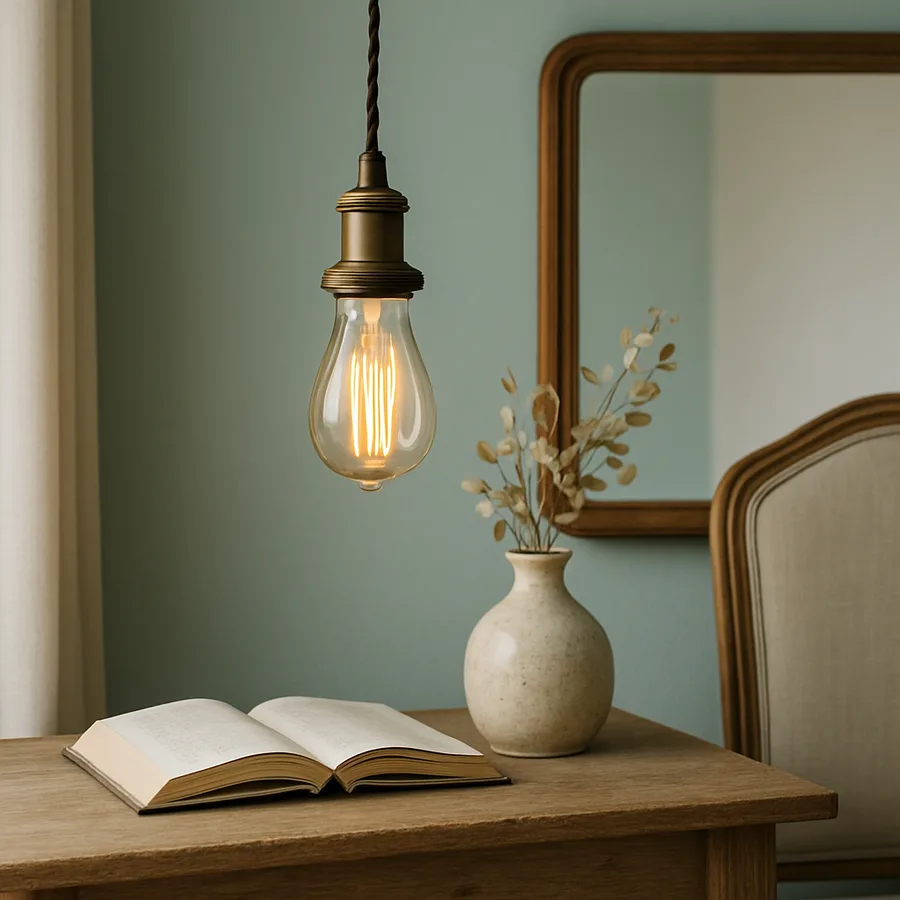
Few lighting elements deliver as much character per dollar as a well-chosen Edison-style bulb glowing inside a vintage brass fixture or a turn-of-the-century pendant. For decades, that warm filament glow could only be achieved with energy-guzzling incandescent reproductions. Today, dimmable LED Edison bulbs reproduce the visual character of the original carbon-filament lamps while consuming roughly 85 percent less energy and lasting 20 to 30 times longer. The catch, as anyone who has tried a hasty swap will tell you, is that not every LED Edison bulb pairs gracefully with every vintage fixture or wall dimmer.
Why The Visual Character Of An Edison Bulb Matters
The aesthetic appeal of an Edison bulb is not just nostalgia for early electrification. It is grounded in the way the human eye responds to long-wavelength amber light at low brightness levels: pupil dilation increases, color saturation softens, and the overall scene takes on the relaxed quality we associate with firelight and candle flames. This is the same biological response that draws diners to restaurants lit with dim warm lamps over harshly lit fast-food chains, and it is the same response that makes an Edison-bulb living room feel welcoming rather than merely illuminated.
The original carbon-filament lamps that Thomas Edison commercialized in the 1880s emitted a remarkably warm, amber-tinted light, the kind of glow that photographers now call "golden hour" in a bottle. The color temperature hovered around 2200 to 2400 Kelvin, dramatically warmer than the 2700K of a standard incandescent A19 bulb and worlds away from the 5000K daylight LEDs that dominate big-box store shelves. That warm bias is the entire aesthetic point of an Edison-style installation, and a successful LED replacement has to honor it.
Beyond color temperature, the filament structure itself contributes to the look. Spiral filaments, hairpin filaments, and squirrel-cage filaments all produce different patterns of bright lines visible through clear glass. Modern LED Edison bulbs use thin LED filament strips on transparent substrates to mimic this effect convincingly. Hold a quality LED Edison bulb next to a real carbon-filament reproduction at the same dimmed level and the casual observer will rarely tell them apart.
According to the U.S. Department of Energy, residential LED adoption now exceeds 50 percent of installed lamps in the United States, but decorative segments lag behind because homeowners worry about losing the warmth and dimming behavior they remember from incandescents. The good news is that the technology has matured to the point where those worries are largely unfounded.
A useful mental shortcut: think of an Edison-style fixture not as a light source but as a visible object. The fixture itself is the design element; the light it casts is secondary. This reframing helps when specifying replacement bulbs because the priority shifts toward how the bulb looks when illuminated rather than how much light it puts into the room. Lumen output should serve the fixture, not the other way around.
Matching Lumen Output To The Original Fixture Design
Vintage fixtures were almost always designed around the lumen output of incandescent bulbs available at the time the fixture was manufactured. A 40-watt incandescent produced roughly 450 lumens, a 60-watt incandescent about 800 lumens, and a 100-watt incandescent about 1600 lumens. When you specify a modern LED Edison replacement, you are not matching wattage, you are matching lumens. A 5-watt LED Edison bulb produces approximately the same visible light as a 40-watt incandescent.
This distinction matters because vintage fixtures often have wattage labels that read "Maximum 60 watts" or similar. Those labels refer to heat dissipation and electrical capacity for incandescent lamps. LED Edison bulbs generate roughly one-fifth the heat of an equivalent incandescent, which means a fixture rated for 60 watts incandescent can easily accept a 9-watt LED producing 800 lumens, the equivalent of a 60-watt incandescent. You gain headroom rather than losing it.
Are you replacing one bulb in a single-socket pendant, or six bulbs in a chandelier? Total lumen budgets scale linearly. A six-light dining room chandelier with 40-watt-equivalent LED Edisons in each socket produces around 2700 lumens combined, which is appropriate for a 12-by-14-foot dining room according to Illuminating Engineering Society recommendations of 15 to 20 lumens per square foot for general ambient dining illumination.
If your dining room or living room needs more total lumens than Edison-style fixtures can comfortably provide, the answer is not to oversize the Edison bulbs but to add a second light layer. Recessed downlights on a separate dimmer, a discreet floor lamp in a corner, or wall sconces with conventional A19 bulbs all complement an Edison-bulb statement fixture without competing visually. The Edison fixture handles the aesthetic; the supplemental layer handles the task lighting.
The Dimming Challenge And Why Some LEDs Flicker
Dimming is where the marriage between modern LEDs and vintage fixtures most often goes wrong. Traditional wall dimmers were designed for resistive incandescent loads that draw 40 to 100 watts apiece. An LED Edison bulb draws 5 to 10 watts, and six of them combined still total only 30 to 60 watts. Some older dimmers refuse to operate below a minimum load threshold, causing the bulbs to flicker, buzz, or fail to dim below 30 percent brightness.
The solution is a dimmer specifically rated for LED loads, ideally one that supports trailing-edge (also called reverse-phase) dimming. Trailing-edge dimmers handle low-wattage capacitive LED drivers far more gracefully than the leading-edge triac dimmers designed for incandescents. Lutron's Caseta line, Leviton's Decora SureSlide, and similar products from Legrand are well-regarded examples. Expect to pay $25 to $50 per dimmer, which is money well spent given that a cheap dimmer can destroy bulbs prematurely.
Even with the right dimmer, compatibility varies bulb-by-bulb. Reputable manufacturers publish dimmer compatibility charts on their websites listing which dimmer models pair flicker-free with their LED Edison bulbs. Always consult these charts before bulk-ordering bulbs for a large installation. A 30-second download can save hours of return trips to the hardware store.
If you cannot find a published compatibility chart for a specific bulb-dimmer combination, the next best step is to buy a single bulb and a single dimmer and test them together before committing to the full installation. Dim through the entire range slowly, listen for buzz or hum, and watch carefully for flicker at the bottom 10 to 20 percent of the dimming range where most compatibility issues manifest. A 20-minute bench test catches almost all compatibility problems before they become a six-bulb chandelier disaster.
Color Rendering, CRI, And The Warm Dimming Effect
Color Rendering Index, abbreviated CRI, measures how accurately a light source reproduces the colors of objects compared to a reference source. A perfect CRI is 100. Incandescent bulbs sit at 100 by definition. The first generation of LED bulbs in the early 2010s often measured CRI 70 or 75, which made skin tones look pallid and food look unappetizing. Modern LED Edison bulbs from quality manufacturers achieve CRI 90 or higher, which is the threshold the IES considers necessary for residential ambient lighting.
An even more important specification for Edison-style installations is the warm dim behavior. Traditional incandescent bulbs shift toward 2000K or even 1800K as they dim, producing the candle-flame glow we associate with intimate dinner lighting. Standard LED bulbs hold a constant color temperature regardless of dimming level, which looks technically clean but emotionally cold. Warm-dim LED Edison bulbs are engineered to mimic the incandescent color shift, dropping from 2700K at full brightness to 1800K at 10 percent.
Look for the warm-dim feature explicitly called out on the packaging. Brands like Soraa, Philips Master, and certain Hudson Valley product lines lead this category. The premium is roughly $5 to $10 per bulb, but for a dining chandelier or bedroom pendant where ambiance is the entire point, the upcharge is worth every penny.
Installing And Wiring Considerations For Antique Fixtures
If your vintage fixture is more than 40 or 50 years old, it almost certainly needs a wiring inspection before any new bulbs go in. Old cloth-insulated cord, brittle rubber-jacketed conductors, and undersized sockets all pose safety risks that LED upgrades do nothing to mitigate. The National Electrical Code requires that any fixture installed today meet current standards regardless of its age.
Common issues in antique fixtures include cracked porcelain sockets, missing ground conductors, and undersized canopy boxes. A qualified electrician can rewire a vintage fixture for around $75 to $200 depending on complexity, and the work typically extends the safe operating life of the fixture by another 30 to 50 years. Do not skip this step on a fixture you intend to live with long-term.
When installing the new LED Edison bulbs, handle them by the metal base rather than the glass envelope. Modern filament LEDs are robust but the long glass tubes can crack under torsional stress if you grip them improperly while screwing them in. Tighten only until snug; over-tightening can damage the threaded base and reduce contact reliability inside the socket.
Cost, Lifespan, And Long-Term Value
The cost analysis below assumes residential rates and typical usage patterns. Commercial and hospitality installations have different math because the bulbs run longer hours per day, the labor cost of bulb replacement is significantly higher, and the aesthetic stakes around consistent dimming performance are amplified by the customer-facing context. Restaurants, boutique hotels, and event venues should specify higher-grade LED Edison bulbs (typically $15 to $30 per bulb) and pair them with commercial-rated trailing-edge dimmers regardless of the bulb count.
The economics of LED Edison bulbs have shifted dramatically over the past decade. In 2014, a single dimmable LED Edison bulb retailed for $25 to $35. Today, the same bulb from a reputable brand sells for $8 to $15. Bulk packs from established manufacturers can drop the per-bulb cost below $6. Compared to the ongoing cost of 60-watt incandescent reproductions at $4 each but a 1,000-hour rated life, the LED replacement pays for itself in roughly 14 months under typical residential use.
ENERGY STAR certified LED Edison bulbs are rated for 15,000 to 25,000 hours of operation. At an average of 3 hours per day, that translates to 13 to 22 years of service before the bulb noticeably degrades. Carbon-filament incandescent reproductions, by contrast, typically last 1,500 to 3,000 hours, requiring multiple replacements over the same interval.
One stat worth knowing: the National Electrical Manufacturers Association reports that residential lighting accounts for roughly 15 percent of household electricity use. Converting decorative incandescent fixtures to LED Edison equivalents can trim that figure by 10 to 12 percentage points in households with many vintage fixtures, which translates to measurable savings on the monthly utility bill.
Conclusion
Updating a vintage fixture with modern dimmable LED Edison bulbs is one of the most satisfying small projects in residential lighting. The visual character of the original installation is preserved or even enhanced, the energy bill drops noticeably, and the maintenance burden of replacing burned-out incandescents largely disappears for the next two decades. The key is choosing the right bulb, the right dimmer, and verifying compatibility before committing to a full fixture conversion.
Start with one fixture, ideally one that is on a dedicated dimmer and easily accessible for testing. Try two or three different bulb brands at the same lumen output and dim them through their full range before deciding which to standardize on across your home. A small upfront investment in testing saves significant frustration later, particularly in multi-bulb chandeliers where mismatched bulbs are visually obvious.
Pay particular attention to color temperature, warm-dim behavior, and CRI when selecting bulbs for spaces where you spend long evening hours. Dining rooms, bedrooms, and reading nooks all benefit from the most carefully specified bulbs you can afford. Hallways and utility spaces can use less premium products without anyone noticing the difference. Match your budget to the rooms where the lighting matters most.
This week, take an inventory of every Edison-style fixture in your home, count the sockets, note the current bulb wattage and color temperature, and order a small test batch of warm-dim LED Edison replacements for your most-used fixture. Live with the upgrade for two weeks before deciding whether to convert the rest of the house. The methodical approach pays off in both aesthetic consistency and long-term satisfaction with the result.
A final consideration for homeowners with character-rich older homes: the conversion to LED Edison bulbs is reversible. If you ever decide to sell the home and the buyer specifically prefers original incandescent reproductions for some reason, you can swap the bulbs back in less than an hour. The decision is low-risk in either direction, which makes it an easy starting point for anyone considering broader lighting upgrades but unsure where to begin.
More Articles You May Like



Comments
Post a Comment