Workshop Dust Collection System for Table Saw and Sanders
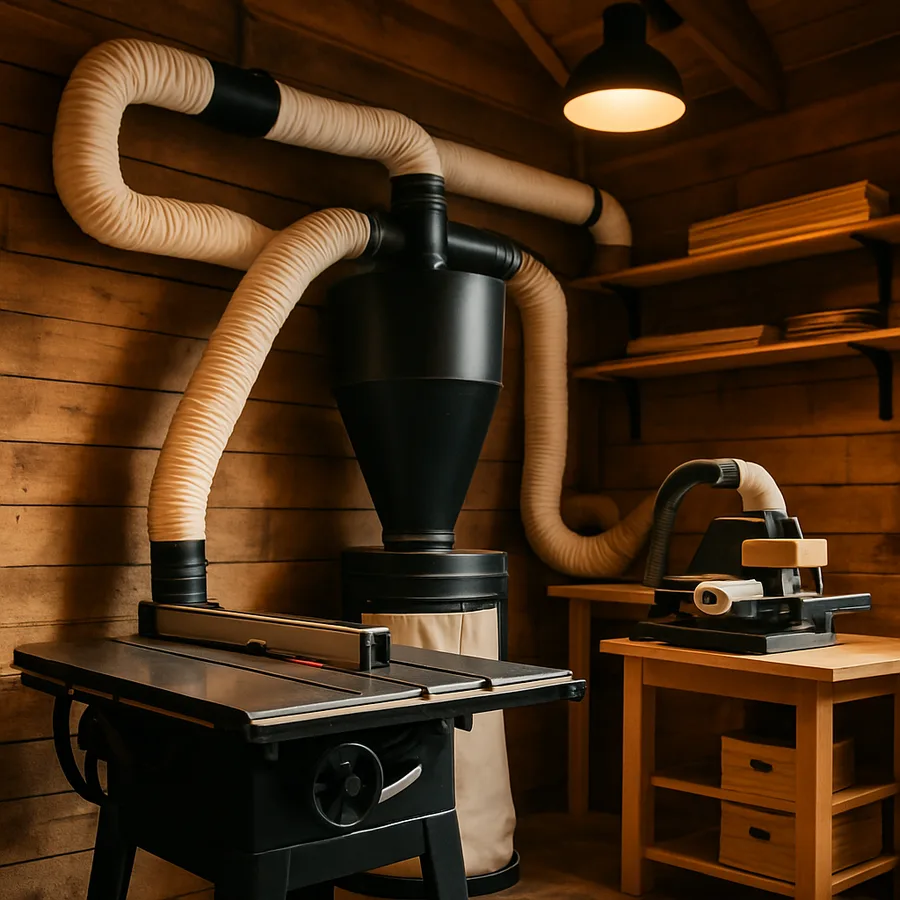
Wood dust is the invisible cost of every project that comes out of a home workshop. The chips and shavings on the floor are the visible portion; the fine particulate suspended in the air is the part that matters for your lungs, your finishes, and the long-term value of every electronic and mechanical tool in the space. A dust collection system is no longer an upgrade reserved for professional shops. It is the baseline equipment for any garage or basement that hosts a table saw, a planer, or a stationary sander.
The challenge for home woodworkers is that dust collection is the most over-specified and under-explained category in shop equipment. Manufacturers quote airflow numbers in the most flattering test conditions, ductwork advice ranges from rigorous to dangerous, and the difference between collecting chips and capturing the fine dust that actually causes lung damage is rarely made clear. This guide treats the system as a whole and walks through the specifications that genuinely affect what you breathe.
Understanding CFM and Why It Is Not the Whole Story
Cubic feet per minute, abbreviated CFM, is the headline number for dust collectors and the one most easily misread. The CFM rating measures how much air the collector can move under ideal, no-restriction conditions. Real-world performance, with ductwork, filters, and machine ports in the path, is dramatically lower. A collector rated at twelve hundred CFM at the inlet often delivers six hundred to seven hundred CFM at a table saw twenty feet away through six-inch ductwork, and far less if any portion of the run is undersized.
The minimum CFM for effective fine-dust capture at a table saw is generally considered to be around six hundred fifty to eight hundred CFM at the machine. Stationary disc sanders and drum sanders need similar volumes because they produce extraordinary quantities of fine particulate. Belt sanders and small bench tools can be served with three hundred to four hundred CFM and still collect adequately, which is why a smaller dedicated extractor often handles those tools better than a central system run on the same trunk line.
Static pressure is the companion specification that gets ignored. A collector with high CFM but low static pressure will lose performance rapidly when ductwork bends or filters load up. Look for collectors that publish both CFM and static pressure curves, and choose a unit that maintains rated airflow at six to eight inches of water column resistance. The National Institute for Occupational Safety and Health publishes industrial dust capture guidance at CDC.gov/NIOSH that translates well to woodshop applications, including the static pressure logic.
Single-Stage vs Two-Stage Collectors
Single-stage collectors pull material directly through the impeller and into a collection bag. They are inexpensive, mechanically simple, and work fine for chip collection from large machines. The drawback is that everything passes through the impeller, including the occasional screw that found its way onto a board or the steel staple from a pallet repurposed as project wood. Impeller damage is the most common failure mode in single-stage units, and the repair often involves a replacement impeller and rebalancing.
Two-stage collectors, sometimes called cyclonic or pre-separator systems, drop the bulk of the chips into a separate bin before the air reaches the impeller. The cyclonic action also reduces the particulate load on the final filter, dramatically extending filter life. Two-stage systems are the dominant choice for serious home shops because they protect both the impeller and the filter, and they make emptying the collector far cleaner because the chips live in a sealed drum rather than a hanging bag.
Have you ever opened a chip bag and watched a cloud of fine dust escape into the room? That is the moment that captures why pre-separation matters. The bag bypasses none of the dust; it just relocates it from a sealed system to your breathing zone. Family Handyman covers two-stage retrofit kits in their archive at FamilyHandyman.com, and a thirty-gallon cyclone separator is one of the highest-impact upgrades available to a single-stage owner.
Ductwork Design That Does Not Strangle the System
Ductwork is where most home dust collection systems quietly fail. The collector is fine, the machine is fine, and the dust still ends up on the floor because the ducting choked the airflow somewhere in between. The two most common errors are undersizing the trunk line and using too many flexible hose segments instead of rigid metal pipe.
For a single-collector system serving a small shop, the trunk line should be at least five inches in diameter for short runs and six inches for runs longer than fifteen feet. Branch lines can step down to four inches for individual machines, but the trunk should never be smaller than the largest branch. Flexible hose adds resistance equivalent to several feet of straight pipe per foot of hose, so flex segments should be limited to the final connection between the branch and the machine port.
Metal ducting is preferred over PVC for two reasons. Metal grounds easily, which prevents static buildup that can ignite fine dust under specific conditions. Metal also resists collapse under high suction better than thin-wall plastic. The static-discharge fire risk in home shops is debated, with some experts arguing it is overstated for typical home volumes, but the grounding is essentially free with metal duct and offers measurable reassurance.
Filter Quality and What Actually Reaches Your Lungs
The filter is the last line of defense, and it is where lower-priced collectors compromise most aggressively. Bag filters made from felted polyester or open-weave fabric capture chips fine but pass huge amounts of fine dust back into the shop air. Pleated cartridge filters with a MERV rating equivalent to fifteen or higher capture particles down to one micron and below, which covers the size range that medical research links to chronic respiratory damage.
The Occupational Safety and Health Administration sets permissible exposure limits for wood dust, and the relevant standards live at OSHA.gov. The general permissible exposure for wood dust is five milligrams per cubic meter for an eight-hour day, and well-designed home collection systems aim to stay an order of magnitude below that ceiling. According to industry research summarized in Fine Woodworking publications, hardwood dust is classified as a Group 1 human carcinogen by the International Agency for Research on Cancer, primarily linked to long-term sinonasal cancer risk in workers with high cumulative exposure.
A statistic worth knowing comes from CDC data: an estimated five hundred thousand U.S. workers face occupational wood dust exposure annually, and home woodworkers can easily reach equivalent exposure during heavy project periods if the collection system is inadequate. Filter quality is not a place to economize. Replace cartridge filters every two to three years even if they look clean, because the captured particulate gradually compromises the filter media beyond what visual inspection reveals.
Air Filtration and Respirator Backup
Even the best dust collection system cannot capture every particle. Sanding always releases some dust into the room air, machine ports are imperfectly sealed, and the act of cleaning itself stirs settled dust back into suspension. A ceiling-mounted air filtration unit, sometimes called an ambient air cleaner, runs continuously during shop sessions and traps the fine particulate that escapes primary collection.
Look for an ambient air cleaner rated to filter the entire shop volume at least eight to ten times per hour. A typical two-car garage at four hundred fifty square feet with eight-foot ceilings is around thirty-six hundred cubic feet, which calls for an air cleaner moving five hundred CFM or more on its medium setting. Run the cleaner during the entire work session and for an additional thirty to sixty minutes after the last machine stops, because suspended fine dust takes that long to settle out.
A respirator is the personal-protective backup that no shop should be without. A half-face respirator with P100 cartridges captures more than ninety-nine percent of airborne particulate down to point three microns and costs around forty dollars for a unit that lasts years with replacement cartridges. Wear it during sanding, cleanup, and any operation that generates visible dust, even if the collection system is running. This Old House covers shop ventilation extensively at ThisOldHouse.com, and they consistently rank dust collection plus ambient filtration plus respirator as the three-layer baseline for serious home shops.
Maintenance and Operational Habits
A dust collection system that gets ignored loses performance fast. The chip bin or drum should be emptied before it reaches half full, because cyclone separation efficiency drops as the bin loads up. Filters should be cleaned monthly during heavy use, either by tapping the cartridge gently with the system off or by using the integrated paddle if the unit includes one. Compressed air blow-down works but should be done outdoors because it ejects all the captured dust back into the air.
Blast gates at each machine branch let you concentrate airflow at the active tool. Open the gate at the saw, close the gates at the jointer and sander, and the full CFM of the collector reaches the active machine. Leaving multiple gates open splits the airflow and starves all the tools simultaneously. Mark the gates clearly and develop the habit of opening one and closing the others as part of the tool start-up routine.
How often does dust accumulate on the back of the table saw or under the sander even with collection running? That is your diagnostic. Visible dust accumulation downstream of a machine port indicates a leak, an undersized port, or insufficient airflow at the branch. Trace the system from the collector forward, looking for the first place where the duct geometry forces a loss. Most home shops can recover ten to fifteen percent of effective CFM by sealing leaks and replacing flex segments with rigid pipe.
Noise is the often-ignored cost of running a serious dust collection system. A two-horsepower collector running at full draw produces around eighty-five decibels at three feet, which exceeds the level at which sustained hearing protection becomes important. Foam-lined cabinet enclosures around the collector cut measured noise by ten to fifteen decibels, and the difference between a shop you tolerate and a shop you enjoy often comes down to whether you can hold a conversation with the system running. Pair the cabinet enclosure with hearing protection rated to twenty-five-decibel reduction, and a long Saturday at the bench becomes far less fatiguing.
Conclusion
A workshop dust collection system is the single most important piece of safety equipment in a home wood shop, and the one most easily under-engineered. Start with a collector sized to deliver at least six hundred fifty CFM at the table saw through your specific ductwork, choose a two-stage configuration with a cyclonic pre-separator, and finish with a cartridge filter rated to one micron or better. Those three specifications, properly matched, capture the bulk of the dust that matters.
Ductwork is where good systems become great or where adequate systems quietly fail. Use rigid metal pipe sized appropriately for the run length, limit flex hose to the final machine connection, and install blast gates at each branch so airflow concentrates at the active tool. Static pressure losses compound across long runs, and the difference between a five-inch trunk and a four-inch trunk can be the difference between collecting fine dust and just relocating it.
Filtration and air cleaning are the layers that protect your lungs even when primary collection is imperfect. A ceiling-mounted ambient air cleaner running through and after every work session, paired with a P100 respirator during sanding and cleanup, brings the personal exposure level down into a range that supports decades of safe woodworking. Wood dust is a cumulative hazard, and the small habits that lower exposure today protect lung function thirty years from now.
If you are designing a system this season, start with the table saw because it sets the CFM floor, then add machines in order of dust production. Build the collection system before the bench top is finished, not after the first project taught you why it matters, and the workshop becomes a place where every long Saturday leaves you with a finished piece and clean air to breathe. Open the blast gate at the saw, fire up the collector, and let the next cut be the first one in a workshop you can use for a lifetime.
More Articles You May Like



Comments
Post a Comment