Window Seat Storage With Hinged Lids vs Pull-Out Drawers
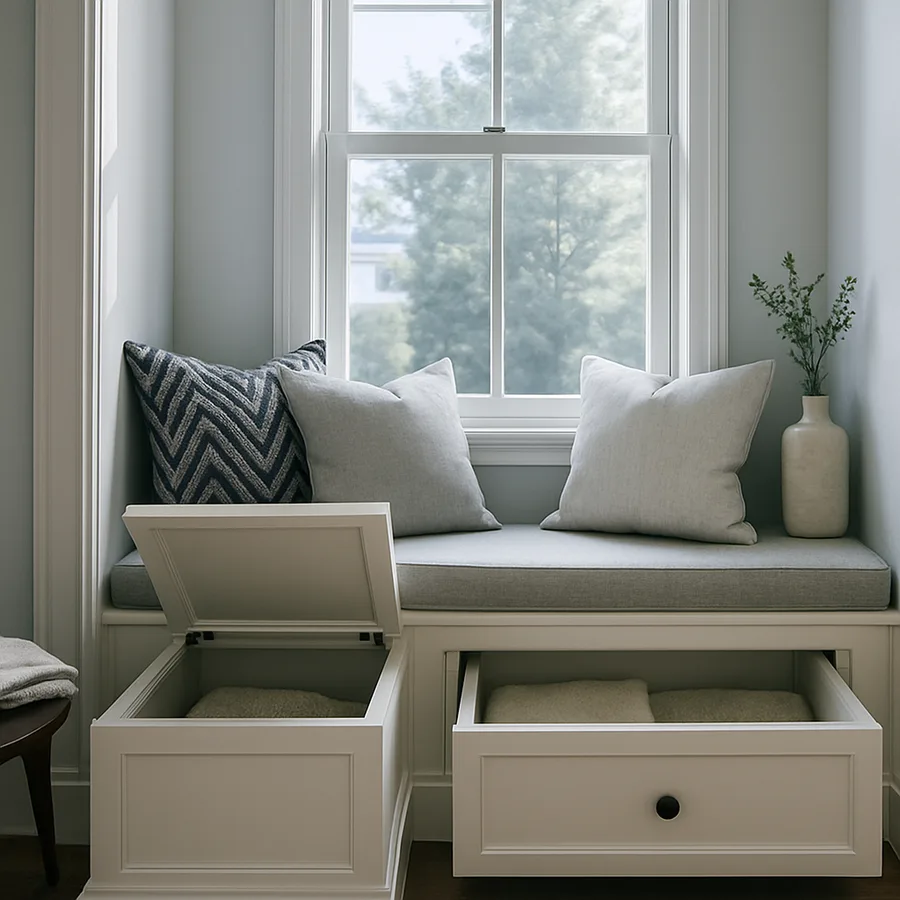
The space inside a window seat is one of the most under-used storage volumes in the average home. A standard six-foot-long, 18-inch-deep, 16-inch-tall bench encloses roughly 20 cubic feet of hidden storage, comparable to a small armoire or two large suitcases. Yet most window seats either ignore the volume entirely with solid construction or treat it as an afterthought with a flimsy hinged top that nobody opens after the first month. The choice between a hinged lid and pull-out drawers determines whether that storage becomes daily-use real estate or a forgotten cavity.
This article unpacks the trade-offs in detail. Both solutions can be done well, both can be done badly, and the right answer depends on what you intend to store, how often you need it, and how much you are willing to spend on hardware and millwork. We will cover access ergonomics, capacity efficiency, hardware durability, cost ranges, and the construction details that separate a long-lived built-in from a sagging weekend project. By the end you should be able to make this decision with confidence and brief a contractor on the right specification before framing begins.
How Each System Actually Works
A hinged lid system treats the seat itself as the access door. A piano hinge, butt hinges, or concealed European hinges run along the back edge of the seat panel, and the entire panel pivots up to reveal the storage cavity below. The cushion either stays loose on top (you lift it off before opening) or attaches to the seat panel and rises with it. Lid stays or torsion hinges hold the lid open hands-free during loading. The construction is structurally simple, with a single moving part and minimal hardware, and a competent woodworker can fabricate one over a long weekend.
A pull-out drawer system treats the bench front as a cabinet face. Heavy-duty drawer slides mounted to internal supports allow one or more drawers to extend forward into the room. The seat surface remains stationary, the cushion never moves, and storage is available without disturbing whoever might be sitting on the bench. Construction complexity is significantly higher, requiring face-frame or frameless cabinet boxes, accurate slide installation, and drawer fronts that align with adjacent millwork. National Association of Home Builders data suggests cabinet-grade window seats with drawers cost 2.5 to 3.5 times what hinged-lid versions cost on a per-linear-foot basis.
A third hybrid option exists and is worth mentioning: a combination bench with a hinged-lid section flanked by drawer banks, often used in mudrooms and sunroom seating. This approach trades fabrication complexity for storage versatility, dedicating drawers to high-frequency items and the lift-top to seasonal or oversize gear. It is the most expensive of the three options, but it is also the most flexible.
Access Ergonomics: How Often Will You Actually Open It?
The single biggest factor in this decision is access frequency. A hinged lid requires a clear path to the cushion: nobody seated on the bench, no pillows piled against the wall, no laptop on the cushion. In real-world use, that means a hinged lid is opened only when no one is using the seat, which for most families translates to a handful of times per month. The storage thus defaults to long-cycle items: holiday decorations, off-season blankets, suitcases, board games played twice a year.
Pull-out drawers can be opened with the bench fully occupied. Children sit reading on the seat while a parent pulls a drawer below to retrieve a toy. Guests perch on the bench while you fish a tablecloth from the drawer beneath. The drawer can be accessed in seconds without disturbing cushions or pillows, which means the storage starts behaving like a dresser drawer rather than a seasonal box. How often will you realistically need to access the items inside? If the answer is more than once a week, drawers nearly always win on lifestyle grounds.
Children deserve a special note. A hinged lid is a documented pinch hazard if the lid stays fail or are not specified at all. The Better Homes and Gardens editorial team and the U.S. Consumer Product Safety Commission both recommend torsion-controlled or pneumatic lid stays with a soft-close action for any toy chest or hinged seat in a household with children under age eight. Drawers eliminate the pinch risk entirely but introduce tip-over risk if a child climbs on an extended drawer. Neither is inherently safer; both require thoughtful hardware choices.
Capacity Efficiency: Where the Cubic Feet Actually Live
On paper, a hinged-lid bench delivers more storage volume because the entire interior is one open box with no internal divisions to consume space. A 6-by-1.5-by-1.33-foot bench yields close to 12 cubic feet of usable storage with a hinged lid (after subtracting framing). The same bench with three pull-out drawers yields roughly 8 to 9 cubic feet of usable space because drawer slides, drawer-box walls, and the toe-kick recess each subtract usable volume.
That said, raw cubic feet are misleading. A hinged-lid box quickly becomes a black hole into which items get tossed and lost. Without internal organization, the bottom layer becomes inaccessible without unpacking everything above it. Drawers force the storage into discrete compartments, each of which can be specialized: shallow drawers for linens, deep drawers for toys, file-rated drawers for paperwork. The National Kitchen and Bath Association (NKBA) notes in its planning guidelines that organized drawer storage typically yields 30 to 40 percent higher daily-use efficiency than equivalent open-box storage, even though the raw cubic footage is lower.
Drawer dividers, fitted trays, and labeled bins push that efficiency further. A 24-inch drawer fitted with adjustable dividers can simultaneously hold scarves, gloves, and hats in winter and switch over to sunscreen, beach towels, and pool toys in summer. The hinged-lid box, by contrast, usually ends up housing whatever was most recently shoved in. Are you willing to maintain an organization system, or do you want the storage to organize itself? Drawers do more of the work for you.
Hardware Choices That Determine Lifespan
Both systems live or die on hardware. For a hinged lid, the critical components are the hinges themselves, the lid stay, and the seat-panel substrate. Choose a continuous piano hinge in a stainless or brass-plated finish; cheaper steel hinges develop play within months of regular use, which causes the lid to sag visibly. The lid stay should be a soft-close gas piston rated for the lid weight, not a friction stay. Blum, Hafele, and Sugatsune all manufacture residential lid stays with multi-position hold and integrated soft-close, typically priced between 35 and 75 dollars per side.
Drawer hardware is more demanding because each drawer must support its full loaded weight across thousands of cycles. Specify full-extension, soft-close ball-bearing slides rated for 100 pounds minimum on every drawer. Brands like Blum Tandem, Salice Futura, and Accuride 3832 carry lifetime warranties under residential use. Skip the budget side-mount slides bundled into IKEA hacks and box-store kits; they introduce racking, the drawer fronts misalign, and the entire bench starts looking sloppy within a year. Hardware accounts for 15 to 25 percent of total drawer-bench cost and is not where to economize.
Substrate matters too. A hinged seat panel made from three-quarter inch plywood with hardwood edge banding stays flat across decades. A particleboard or MDF panel sags under the cushion weight and the daily compression cycle, eventually catching on the front edge of the bench when opened. The American Home Furnishings Alliance reports that plywood substrates outlast particleboard equivalents by roughly 11 years on average in built-in millwork applications.
Cost, Build Time, and Contractor Considerations
Budget is usually what tilts the decision for homeowners. A basic hinged-lid window seat in painted poplar with a piano hinge and a single lid stay runs roughly 600 to 1,200 dollars in materials and labor for a six-foot run, depending on regional labor rates and finish complexity. A comparable three-drawer pull-out bench in the same finish with quality slides and integrated pulls runs 2,200 to 4,500 dollars for the same footprint. The premium covers cabinet-box construction, drawer-front fabrication, hardware, and significantly more installation time.
Build time differs proportionally. A skilled finish carpenter can frame, panel, and hinge a window seat in two to three days on site. A drawer bench typically takes a millwork shop a week of off-site cabinet-box fabrication plus two to four days of on-site installation, scribing, and finish work. If your project is on a tight timeline, hinged construction can be the only realistic option even when budget would support drawers.
Brief your contractor with explicit hardware specifications, not just "drawers" or "hinged lid." Insist on named brands and model numbers for slides and hinges, ask to see hardware samples before approval, and confirm that the cushion support panel is plywood rather than particleboard. The American Society of Interior Designers (ASID) recommends including a hardware schedule as a separate document in any millwork bid package, which prevents contractors from substituting cheaper components mid-project. What questions has your contractor asked you about how you plan to use the storage? If the answer is none, the resulting design will likely match anyone's bench rather than yours.
Style Integration With Surrounding Architecture
Visually, the two systems read very differently and should be chosen partly on architectural fit. A hinged-lid bench presents as a continuous panel from floor to seat with no visible interruptions. This clean front pairs naturally with traditional, cottage, and Shaker-style interiors where seamless millwork is part of the visual language. A simple bead detail at the seat edge or a subtle inset panel below adds interest without breaking the continuity.
A drawer bench reads as cabinetry. The drawer fronts, pulls or finger pulls, and reveal lines all introduce visual rhythm to the bench front. This works beautifully in modern, transitional, and contemporary spaces where deliberate joinery is celebrated. Match the drawer-front style to adjacent cabinetry: flat-panel modern in a contemporary kitchen, Shaker-style in a transitional family room, or beaded inset in a traditional library. Architectural Digest consistently shows drawer benches as built-ins that read as designed furniture rather than utility storage, an aesthetic shift that adds significant perceived value.
Pull selection is where many drawer benches go wrong. Oversized cup pulls or distracting hardware fight with the seat cushion above. Choose understated finger pulls, integrated touch-latch openings, or recessed lip pulls that disappear visually. The bench should read as a bench first and a storage piece second; reverse that hierarchy and the room reads as a furniture showroom rather than a livable space.
Conclusion
The hinged-lid versus pull-out drawer decision rewards homeowners who think clearly about how they will actually use the storage. Hinged lids excel for low-frequency, large-volume, low-cost storage of seasonal and oversize items. Pull-out drawers excel for high-frequency, organized, daily-use storage where the cushion above stays comfortable and undisturbed. Neither is universally better; both can be done elegantly or shabbily depending on hardware quality and construction substrate.
The mistake to avoid is treating either solution as a default. Many built window seats are hinged-lid by accident, because the carpenter knew how to build them and nobody asked the deeper question. Many pull-out drawer projects are over-specified, with three deep drawers built for storage that ends up holding two pillowcases and a dust bunny. Match the system to your real use pattern, not to a Pinterest reference image.
If you are still weighing the two, the practical path is to inventory what you would actually store inside the bench right now. Pull every candidate item out of its current storage location, pile it on the floor where the bench will live, and ask whether you would access that pile weekly or seasonally. Whichever answer applies, build the system that matches, brief your contractor with named hardware brands, and protect your cushion budget separately. A well-built window seat with the right access strategy will serve your household for two decades; a poorly chosen one becomes an expensive cushion shelf within months.
More Articles You May Like



Comments
Post a Comment