Under-Stair Pantry Conversion With Pull-Out Drawers Inside
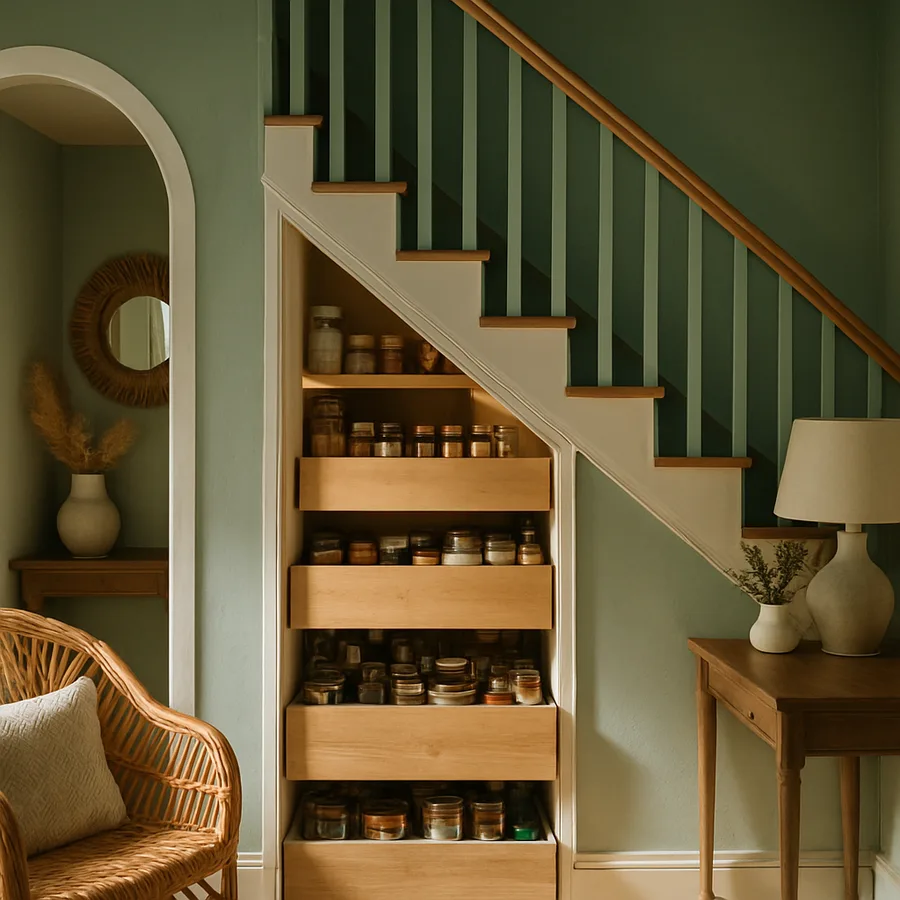
The triangle of dead space beneath a staircase has long been one of the most underused zones in the average American home, and a thoughtfully engineered under-stair pantry with full-extension pull-out drawers turns that void into one of the hardest-working square footages in the house. According to a National Kitchen and Bath Association (NKBA) member survey published in late 2025, roughly 38% of remodeling clients now request expanded pantry storage as a top-three priority, a meaningful jump from the 24% reported in their 2022 trends report. That demand is colliding with shrinking kitchen footprints in new construction, where the National Association of Home Builders (NAHB) noted average kitchen sizes have contracted nearly 9% since 2018. Repurposing the under-stair cavity is one of the cleanest ways to recover that lost capacity without expanding the building envelope.
What makes the pull-out approach so compelling is visibility. Traditional walk-in pantries hide their contents behind doors, while shelf-only conversions force you to crouch and dig past the front rows. Full-extension soft-close drawers bring every item to the user. You see the contents from above, you reach without bending, and you stop buying duplicates of items already pushed to the back. This article walks through every decision a homeowner or designer needs to make before committing to the build, including structural checks, drawer sizing logic, hardware quality tiers, lighting, ventilation, and the budget envelope you should expect.
Why the Under-Stair Cavity Is Ideal for a Drawer Pantry
The geometry of a typical staircase rise produces a wedge-shaped cavity that climbs from roughly 8 inches at the toe to ceiling height at the back wall. That sloped ceiling has scared off many homeowners, but it is actually an asset. The deepest part of the cavity, where drawers can be tallest, is exactly where you want bulk goods and small appliances. The shallow front, just inside the access opening, is the natural home for narrow spice and condiment drawers. A well-planned conversion respects this slope rather than fighting it, which is also why generic stock cabinets rarely fit without major modification.
Have you ever stood in your kitchen and realized the closest pantry shelf is fifteen feet away across a busy traffic lane? That friction is exactly what under-stair conversions solve when the staircase sits adjacent to the kitchen, hallway, or breakfast area. The American Society of Interior Designers (ASID) has emphasized in its 2025 Outlook report that the most successful renovations measurably reduce daily steps between food prep zones and storage. A six-foot reduction in walk distance, repeated dozens of times per day, accumulates into hours of saved time across a year.
Cavity depth matters as well. Most residential staircases yield between 36 and 60 inches of usable depth measured from the access opening to the back stringer. Anything beyond 28 inches becomes impractical for shelves but ideal for drawers because full-extension slides let you pull the entire drawer body forward into the room. You access the back of a 30-inch drawer as easily as the front, which simply is not possible on a fixed shelf at the same depth.
Structural and Code Considerations Before You Cut
Before any drawer hardware enters the conversation, you have to confirm the cavity is actually available. A surprising number of staircases conceal structural elements that are not negotiable. Look first for any load-bearing walls, knee walls supporting intermediate landings, or steel posts tied into the stair carriage. The International Residential Code (IRC), which is referenced by most municipal building departments, requires fire-rated separation between an enclosed under-stair space and the stair itself when the area is used for storage. In practice, that often means a layer of 1/2-inch Type X gypsum board on the underside of the stringers and on the back wall of the cavity.
If your home was built after 2009 in most jurisdictions, the under-stair space may also conceal HVAC chases, plumbing drains, or electrical junction boxes. Mechanical equipment cannot simply be boxed in. Verify that any junction boxes remain accessible, that dryer vents are not buried, and that supply registers serving rooms above are not strangled. The National Association of the Remodeling Industry (NARI) recommends at minimum a permit consultation for any structural opening cut into an existing stair enclosure, and in many cities the wall opening itself requires a permit even if the framing remains untouched.
One question that comes up often: do you need a header above the new pantry opening? If the wall under the stair runs parallel to the stringers and is non-bearing, the answer is usually no, and you can frame a simple opening with king and jack studs. If the wall runs perpendicular and supports the stair stringers, you absolutely need a properly sized header, and that calculation should be left to a structural engineer or a licensed contractor who can pull a sealed detail. Skipping this step has caused stair sag in more than one DIY conversion documented in remodeling forums hosted by Houzz.
Designing the Drawer Stack to Match the Stair Slope
The signature move in a great under-stair pantry is a graduated drawer stack where each drawer matches the available height at its position along the slope. At the tall back wall you might fit two 14-inch deep drawers stacked above a 22-inch deep tall drawer for cereal boxes and oils. As the ceiling drops, the drawers shrink in height. Near the toe of the stair you may only have room for a 4-inch deep spice drawer, which is still useful and often the most-loved drawer in the finished pantry.
Width is generally limited by the cavity itself, but the rule of thumb is that any drawer wider than 36 inches needs heavy-duty slides and a center support, or it will sag and bind under load. Better Homes and Gardens (BHG) ran a kitchen storage survey in 2024 that found the most frequently cited complaint about deep drawers was content shifting and toppling, which is solved with simple wood dividers, silicone drawer mats, or modular bin inserts sized to the drawer interior. Plan the dividers before you finalize drawer dimensions so the math works out.
Capacity planning is the unsexy but critical step most homeowners skip. Walk your existing pantry and inventory what actually lives there. Count the cans, measure the tallest cereal box, weigh the heaviest sack of flour. A typical family of four stores between 90 and 140 pounds of dry goods at any given time. Distribute that load so the heaviest drawers sit lowest and the slides are rated appropriately, which we cover in the hardware section below.
Hardware: Slides, Pulls, and the Soft-Close Question
The single most important purchase decision in this entire project is the drawer slide. Cheap slides will fail within two years under pantry loads, dragging the whole conversion down with them. The market is dominated by two engineering camps: ball-bearing slides from Accuride and similar manufacturers, and undermount slides from Blum and Salice. Undermount slides hide completely beneath the drawer box, deliver a cleaner look when the drawer is open, and almost universally include integrated soft-close. Ball-bearing slides are typically less expensive, easier for a DIY installer to align, and available in higher weight ratings up to 220 pounds per pair.
For a pantry application, a 100-pound rating per pair is the practical minimum and 150-pound is comfortable. Soft-close is not a luxury here. Pantry drawers get slammed shut by hurried hands holding hot pots, and a hard slam will eventually loosen joinery and crack jar contents. The upcharge for soft-close in 2026 pricing typically runs 18 to 30 dollars per drawer, which is trivial against the lifetime of the cabinet.
Pull selection deserves more attention than it usually gets. Tall narrow drawers benefit from vertical bar pulls that let you grip anywhere along the height. Shallow drawers feel best with a horizontal pull centered on the face. If the pantry is in a high-traffic hall, consider integrated finger pulls or push-to-open hardware to eliminate protruding handles that snag clothing. The NKBA Trends Report has flagged push-to-open mechanisms as one of the fastest-growing hardware categories, with adoption up 41% among surveyed designers between 2023 and 2025.
Lighting, Ventilation, and Climate Inside the Cavity
An enclosed under-stair space without lighting is a frustrating place to find anything. The fix is simple but often forgotten until late in the build. Motion-activated LED strip lighting mounted to the underside of each shelf or to the cabinet ceiling transforms usability. Modern strip kits draw negligible power, run on rechargeable battery packs or a single hardwired transformer, and switch on automatically when the door opens. Choose a color temperature in the 3000K to 3500K range for accurate label reading without the harsh blue cast of higher-Kelvin strips.
Ventilation is the more subtle issue. A sealed cavity adjacent to an exterior wall can trap humidity, and dry goods do not store well above 60% relative humidity. If the pantry sits against an exterior wall in a humid climate, install passive vents at the top and bottom of the access door to encourage airflow, or add a small low-watt computer-style fan on a humidistat. The Whole Building Design Guide and several extension service publications cited by NAHB note that flour, rice, and crackers lose quality measurably above 70°F combined with high humidity, so a thermometer-hygrometer inside the pantry is a five-dollar accessory worth installing.
What about pests? An under-stair pantry sometimes shares wall cavities with garages or attached structures where mice can enter. Seal every penetration, including the slide mounting holes, with steel wool and silicone before final assembly. Glass or hard-plastic containers for opened goods give you a second line of defense and let you see at a glance what is running low.
Budget, Timeline, and the Build-Versus-Buy Decision
Realistic budget ranges for a finished under-stair pantry conversion span a wide spectrum depending on materials and labor source. A confident DIY build using birch plywood drawer boxes, mid-tier Blum slides, and IKEA-style flat fronts typically lands between 1,200 and 2,500 dollars in materials. A semi-custom build through a local cabinet shop runs 4,500 to 8,500 dollars in most metro markets. Full custom millwork with hardwood drawer faces, integrated lighting, and pull-out spice racks can exceed 14,000 dollars, particularly in coastal cities where cabinetry labor rates are highest.
Houzz has published cost data for related kitchen storage upgrades suggesting the average homeowner recoups roughly 70 to 80% of investment in resale value when the work is professionally executed and visually integrated with the surrounding kitchen. The under-stair pantry has a particular appeal in real estate listings because it reads as bonus storage that does not exist in comparable homes, which can shorten time on market.
Timeline expectations vary wildly. A homeowner working weekends should budget six to ten weekends from demolition to final hardware install, assuming the cavity is straightforward and no permit-triggering structural work is required. A professional crew can complete the entire conversion in four to seven working days once materials are on site. Order drawer slides and any custom drawer fronts at least three weeks ahead because supply chains for hardware have improved since the 2022 disruptions but can still surprise you on lead times.
Conclusion
Reclaiming the wedge of space beneath your staircase is one of the highest-return storage projects available to a typical homeowner, and the pull-out drawer approach dramatically outperforms fixed shelves on usability, capacity visibility, and long-term satisfaction. The combination of full-extension slides, graduated drawer heights matched to the stair slope, and motion-activated lighting transforms a dusty triangle into a daily-use pantry that feels engineered rather than improvised. Get the structural and code questions answered before you commit to a design, then invest in hardware that will outlast the rest of the kitchen.
Start by measuring your cavity tonight: take the height at the front opening, the depth to the back wall, and the height at the back wall. Sketch the slope on graph paper. Walk your current pantry and inventory what really lives there. Those three steps will tell you within an hour whether this project is realistic for your home and which drawer configuration will serve your household best. The homeowners who treat this as a precision storage project rather than a quick organizing fix end up with a pantry they actively show off to guests.
If you are still on the fence, browse a few finished examples in the Houzz photo library and the NKBA inspiration gallery, then reach out to two or three local cabinet shops for rough estimates. Most will quote a free in-home consultation, and the conversation alone will surface details you had not considered, from soft-close upgrades to integrated charging shelves for handheld vacuums. The detail work is what separates a good conversion from one that disappoints within a year, so take the planning time and choose your trades carefully.
Ready to start sketching your own conversion? Pull out a tape measure tonight, photograph the cavity from multiple angles, and post your dimensions in our reader community for design feedback before you cut a single board. The collective experience of fellow homeowners who have already lived with their conversions for a year or more is the single best filter against the avoidable mistakes that plague this category. For deeper reference reading, the NKBA publishes regular trend updates on pantry design, the Better Homes and Gardens archive contains dozens of finished case studies with photos, and the Houzz professional directory can help you locate vetted local cabinet makers in any market.
More Articles You May Like



Comments
Post a Comment