Vessel Sink Faucet Height Selection for Drama and Function
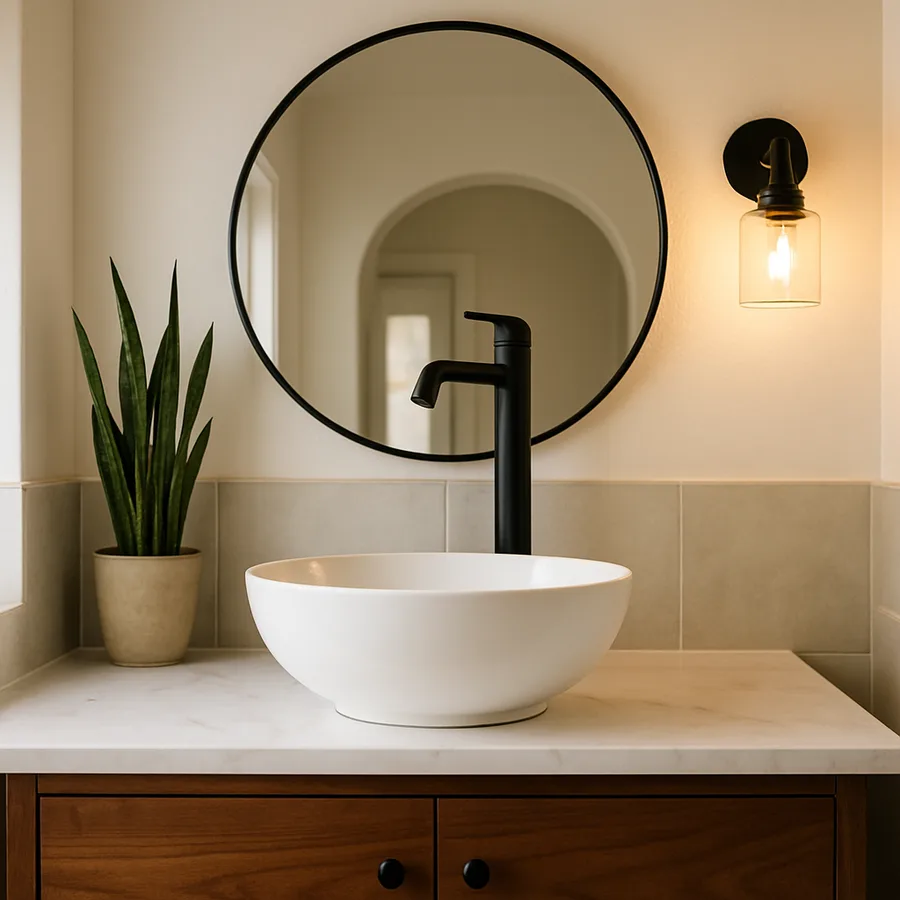
The vessel sink is one of the most photogenic objects in modern bath design, but it is also one of the most temperamental. Unlike a drop-in or undermount sink that recedes into the counter, a vessel sits proudly on top, creating a sculptural moment that the rest of the bathroom reacts to. The faucet that serves it is the partner in that composition, and the wrong faucet height can flatten the drama or, worse, make the basin functionally annoying to use. Choosing a vessel sink faucet is not the casual decision the catalog photography suggests.
The math is simple in principle. The faucet spout needs to clear the rim of the vessel by enough margin to allow handwashing and cleaning without splashing onto the counter, while still feeling proportioned to the basin's size. The complication is that vessel basins vary in height from three inches to nearly twelve, and faucet heights vary similarly, and the right combination depends on counter height, user height, basin shape, and water pressure. Treating the choice as a styling exercise alone leads to either a faucet that drowns the vessel visually or a vessel that sits on the counter like an unhappy bowl waiting to be filled.
The Geometry Of A Vessel And Its Faucet
Start with the numbers that matter. The relevant measurements are the counter height, the vessel height, the spout height above the counter, and the spout reach from the faucet center to the water exit. A standard bathroom counter is thirty-two to thirty-six inches tall. A typical vessel basin is four to seven inches tall, with sculptural models running shorter or considerably taller. The combined surface where you wash hands sits at roughly thirty-eight to forty-three inches above the floor, which is meaningfully higher than a conventional drop-in sink and changes the ergonomics of the faucet entirely.
The spout needs to clear the rim by a minimum of four inches to allow comfortable hand placement, with six to eight inches preferred in most installations. According to ergonomic guidance from the National Kitchen and Bath Association, the optimal spout-to-rim clearance depends on user height; taller users tolerate higher clearances comfortably, while shorter users can find a tall vessel-and-faucet combination requiring shoulder elevation to wash. If your household includes children or shorter adults, the comfortable upper limit for combined counter-plus-vessel-plus-clearance is roughly forty-two inches above the floor, which constrains the design considerably.
How does this translate to faucet specification? Faucets designed for vessels are typically marketed at three height categories: short vessel faucets at eight to ten inches tall, standard vessel faucets at eleven to thirteen inches, and tall vessel faucets at fourteen inches and up. Each category corresponds to a vessel basin height range, and matching them is the first ergonomic decision. A short faucet on a tall basin makes hand washing awkward; a tall faucet on a short basin creates excessive splash and visually overwhelms the composition.
Splash Physics And Why Spout Reach Matters As Much As Height
Spout reach is the horizontal distance from the faucet body to the point where water exits, and in vessel installations it is at least as important as height. A faucet with insufficient reach delivers water near the back of the basin, where the wall of the vessel deflects it upward and outward, throwing droplets onto the counter and the user. A faucet with excessive reach delivers water near the front lip, where it splashes outward when it hits the basin floor.
The optimal water-exit position is over the center of the basin, ideally aligned with the drain. Measure the distance from the faucet's intended mounting hole to the center of the vessel and select a faucet whose reach matches that dimension within an inch. Splash testing matters more than aesthetics here; a beautiful faucet that throws water onto the counter every time it runs is a daily annoyance that no styling can compensate for. The American Society of Plumbing Engineers has published guidance on residential fixture splash containment that recommends a minimum two-inch margin between the water exit point and the nearest basin wall.
Water pressure interacts with reach in ways that surprise homeowners. In high-pressure homes, even a well-positioned faucet can throw splash because the water exits with too much velocity. In low-pressure homes, the water arcs less than expected and may not reach the basin center. If you live in a high-pressure area, look for faucets with integrated aerators that reduce velocity without restricting flow, and consider a faucet with adjustable flow rather than a fixed-rate model. NSF International certifies aerators for residential plumbing, and the certification mark is worth looking for on faucet specifications.
Wall-Mounted Versus Counter-Mounted Faucets For Vessels
Wall-mounted vessel faucets eliminate the geometry problem of finding a faucet tall enough to reach over the basin, since the spout comes out of the wall above the basin rather than from the counter beside it. They also free counter space, which in a small bathroom can be the deciding factor. The tradeoff is that wall-mounted faucets require in-wall plumbing rough-in, which means the decision must be made before the wall is closed up, and changing course later is a substantial repair.
Wall-mount installations require careful coordination of three heights: the bottom of the faucet trim, the spout's water exit point, and the rim of the vessel. The water exit should be six to eight inches above the rim, which typically places the spout twelve to fourteen inches above the counter, and the trim plate another three inches above that. Houzz survey data on bath remodels indicated that wall-mount vessel installations have higher post-installation satisfaction scores than counter-mount equivalents, though the rough-in coordination adds complexity to the construction phase.
Counter-mounted faucets remain the more common choice because they install with standard plumbing rough-in and accommodate vessel changes more easily. If you might swap the vessel in a few years, counter-mount keeps your options open. The visual relationship is different too; counter-mount faucets stand alongside the vessel as a separate sculptural element, while wall-mount faucets read as part of the wall composition above. Neither is objectively better, but the visual reading is one of the design tensions to resolve early.
Matching Faucet Style To Vessel Material
Vessel basins come in glass, stone, ceramic, copper, hammered metal, and increasingly in cast resin and composite materials, and each interacts differently with faucet styling. A clear glass vessel is essentially invisible, which means the faucet does the visual work and a sculptural arched faucet is justified. A heavy stone vessel like polished marble or rough travertine has presence of its own, and a quieter, more linear faucet keeps the composition balanced rather than competing.
Hammered copper and brushed bronze vessels often pair best with faucets in matching or coordinating finishes, but the matching does not need to be exact. A slightly different metal tone reads as intentional, while an exact match can read as catalog-page styling. Designers featured in American Society of Interior Designers project showcases consistently mix finishes within a deliberate palette rather than matching everything, with the tonal relationship between vessel and faucet being one of the most carefully chosen pairings in a luxury bath.
Ceramic vessels in white or cream tend to disappear into white counters and lighter wall finishes, and the faucet often becomes the dominant visual element. A black or matte-bronze faucet against a white ceramic vessel creates contrast that draws the eye and gives the composition a focal point. The reverse, a pale faucet against a white vessel, tends to look unfinished and washes out in photographs. If your bathroom has a strong wall color or backsplash, the faucet finish should respond to that color rather than to the vessel alone.
Ergonomic And Accessibility Considerations
The combined height of counter and vessel determines how comfortable the sink is to use, and tall combinations create real accessibility problems for some users. The Americans with Disabilities Act guidelines for accessible lavatories specify a maximum rim height of thirty-four inches, which is incompatible with most vessel installations on standard counters. A vessel-style basin can be installed within ADA guidance only with a counter cut to twenty-eight or thirty inches in height, which is unusual in residential bathrooms.
Households with children face a different ergonomic question. The reach to a vessel basin from a child's height is substantial, and even with a step stool, the depth of the basin can make handwashing awkward. Some families prefer a vessel in a primary or guest bath while keeping a conventional drop-in or undermount in the children's bath. Houzz published bath usage data showing that vessel sinks are concentrated in primary and powder bathrooms rather than in family or children's baths, which reflects this practical reality.
If accessibility matters in your home but you still want the vessel aesthetic, consider a semi-recessed vessel that drops the basin partially into the counter. The rim still rises above the counter for visual presence, but the working height of the basin is closer to a conventional sink. Faucet selection for semi-recessed vessels follows the same height logic as full vessels, but the relevant measurement is the rim height above the counter rather than the full basin height.
Lever Versus Cross And Joystick Handle Choices
Handle style on a vessel faucet affects daily use almost as much as spout height, and the choice involves both aesthetics and function. Lever handles are the most ergonomic for users with limited hand strength or arthritis, since they can be operated with the back of the hand or a wrist. Cross handles are more traditional and pair well with classical or transitional bath styling, but they require a grip-and-twist motion that some users find difficult.
Joystick or single-handle faucets combine hot and cold control into one motion and are the most space-efficient choice. They suit minimalist contemporary baths and small powder rooms where the simplicity of a single handle reads cleanly against a sculptural vessel. The drawback is that single-handle faucets require careful temperature memory; users learn the angle that produces their preferred warmth, and that learned position is specific to each faucet model.
Have you considered how your faucet handles will be operated when your hands are wet, soapy, or full? The handle that looks elegant in a showroom may be slippery in daily use, and a textured or knurled finish on the handle helps grip. NKBA's lavatory design guidance has noted that handle ergonomics is one of the most underrated decisions in bath design, with most homeowners selecting based on appearance alone and discovering the ergonomic mismatch only after living with the faucet for several months.
Conclusion
A vessel sink installation is a small composition with high stakes for the room. The basin commands attention by its very position above the counter, and every other element in the bath reacts to it. The faucet is the most consequential of those reacting elements, and matching its height, reach, mounting type, and finish to the basin transforms a potentially awkward installation into the sculptural moment the design is reaching for.
The single most reliable way to evaluate a faucet-and-vessel pairing before purchase is to template both at full size. Cut a paper or cardboard outline of the vessel at its true height, place it on the actual counter, and hold a paper outline of the faucet at its specified height beside it. Stand at the counter at your normal posture and pretend to wash your hands. The visual and ergonomic problems that the catalog photography hides become obvious in seconds. This template exercise costs nothing and saves the expensive mistake of mounting a beautiful faucet at the wrong height for the basin.
Plan also for the long horizon. Vessels chip, faucets corrode, and finishes fade at different rates, and the pairing you select today is one you may need to renew in pieces five or ten years out. Choosing a vessel and faucet from manufacturers with continuing product lines makes the renewal easier; choosing limited-edition or boutique pieces accepts the possibility that the next sink or faucet will require a fresh design conversation. Both choices are valid, but they should be made deliberately rather than by accident.
Before you finalize your vessel and faucet selection, build a paper template, measure the dimensions against your real counter and your real height, and consult NKBA design references on the National Kitchen and Bath Association site, accessibility guidance through the American Society of Interior Designers, and inspiration galleries on Houzz for project photographs that show the height relationships clearly.
More Articles You May Like



Comments
Post a Comment