Roman Shade Style Selection From Flat Fold to Hobbled Cascade
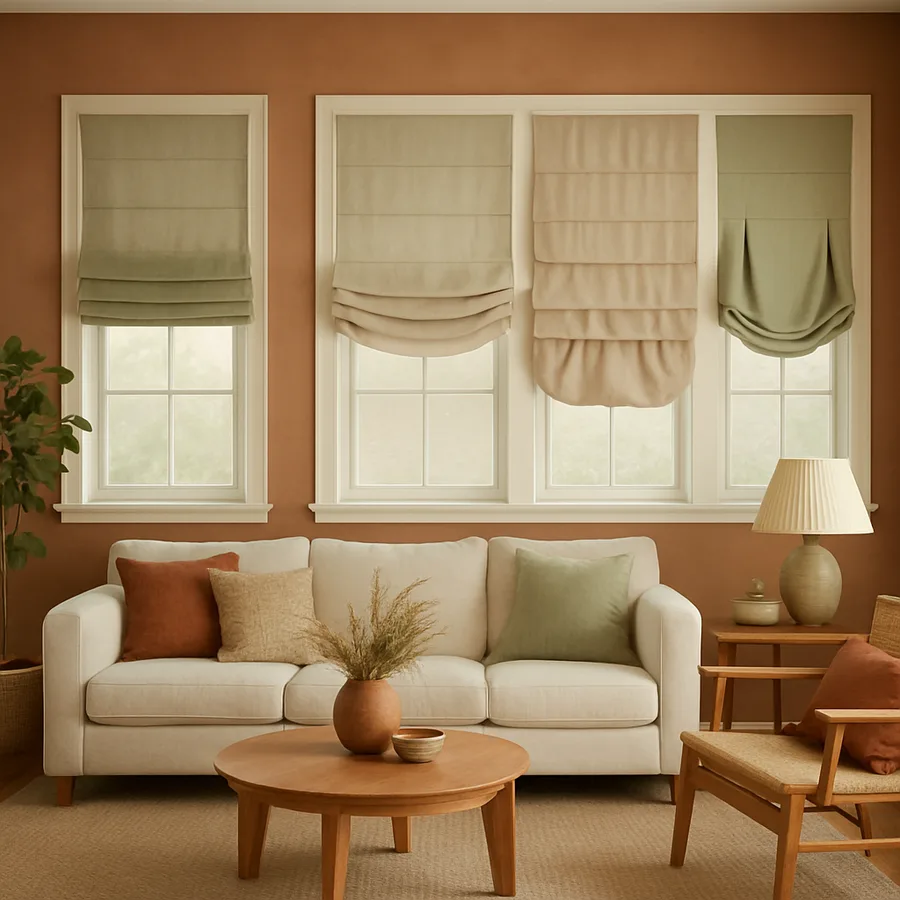
Few window treatments offer the design range that Roman shades do, and few are as easy to specify incorrectly. The category includes silhouettes that read crisp and architectural, others that read soft and feminine, and still others that border on theatrical. Each of those personalities comes from a different fold geometry, a different relationship between fabric weight and pleat structure, and a different installation approach. The shade that looks perfect in a magazine spread will fail in your own room if the fabric drape, the window proportion, or the surrounding furniture style fights against the silhouette you chose.
This guide moves through the five Roman shade families that show up in most residential design work, explains what makes each one succeed or fail, and gives you a decision framework based on fabric, function, and room mood. By the end you should be able to look at a window and know which fold style will make it sing, and which would turn it into a regrettable purchase you live with for ten years.
Flat Fold, the Modern Architectural Default
The flat fold Roman, sometimes called a tailored Roman or a plain-fold Roman, raises in clean horizontal pleats that stack directly on top of each other when lifted. When fully lowered the shade hangs as a single flat panel with no visible folds, which is the cleanest possible window treatment short of a roller shade. This silhouette suits modern, contemporary, and Scandinavian interiors where the goal is to show off the fabric pattern rather than the construction of the shade.
The flat fold demands a fabric with enough body to hold a crisp horizontal line when stacked. Linen-cotton blends in the 8 to 12 ounce range, medium-weight cottons, and most decorator-weight prints behave well. Sheer voiles, silks, and very loose-weave linens tend to droop between the pleat battens and produce a wavy edge that ruins the architectural effect. The American Society of Interior Designers, in materials available through ASID's professional resources, describes flat-fold Romans as the safest entry point for designers new to soft window treatments precisely because the construction is forgiving of small fabrication errors.
One drawback of flat fold is that pattern matching becomes critical. Because the fabric reads as a single flat plane, any seam, repeat misalignment, or pattern interruption is immediately visible. If you are using a wide-repeat patterned fabric, confirm that your fabricator is railroading or pattern-matching the goods before construction begins. The Better Homes and Gardens window treatment design guides recommend ordering fabric with at least one full pattern repeat of overage to handle matching at the seams.
Relaxed Roman, the Casual Cousin
A relaxed Roman, sometimes called a casual Roman or a soft fold Roman, omits the internal battens that give a flat fold its precise horizontal lines. Without battens, the bottom edge of the shade dips into a gentle smile shape when raised, and the fabric falls in soft, irregular folds rather than crisp pleats. The look is informal, slightly imperfect, and well suited to coastal, cottage, and farmhouse interiors where machined precision would feel out of place.
The fabric requirements are nearly opposite those of a flat fold. Relaxed Romans want softer hand and lighter weight, often in the 5 to 8 ounce range. Loose-weave linens, slubby cottons, washed linens, and lightweight decorator fabrics produce the most appealing drape. Stiff fabrics fight the silhouette and create awkward right-angle creases instead of flowing curves.
One installation note that catches buyers off guard is the relationship between width and depth of the smile. A relaxed shade on a window that is wider than 36 inches needs intermediate cords to prevent the smile from sagging into a deep U. Without those cords, the bottom can dip three or four inches below the side edges, which most viewers read as a defect rather than a stylistic choice. Are you specifying a relaxed Roman for a wider window, and have you confirmed with your fabricator that intermediate cords or rings are part of the construction?
Hobbled Roman, the Continuous Cascade
The hobbled Roman, sometimes called a teardrop Roman or a waterfall Roman, is the most fabric-rich silhouette in the category. Where flat-fold and relaxed Romans hang as a single flat plane when lowered, a hobbled Roman maintains visible horizontal folds along the entire length of the shade, even when fully extended. Each fold cascades into the next in a continuous undulating wave, which is the source of the cascade name.
This silhouette works because the shade carries roughly twice the fabric of a flat fold. A 60 inch hobbled shade uses about 120 inches of fabric, with the extra length captured in the permanent folds. The visual effect is luxurious, soft, and unmistakably traditional. Hobbled Romans suit formal living rooms, primary bedrooms, and any setting where the fabric itself is meant to be a major design element rather than a backdrop.
The trade-offs are real. Hobbled Romans cost roughly 40 to 60 percent more than flat-fold Romans of the same fabric and size, simply because of the additional fabric and labor. They are also more difficult to dust, since each fold collects particulate matter on its upper surface. Light filtration is excellent due to the layered fabric, but room darkening is not, because cord paths and fold gaps still admit small amounts of light. If true darkening is a goal, plan for a separate blackout layer behind the hobbled shade.
Balloon and Tulip Variants for Decorative Windows
The balloon Roman and the tulip Roman share a common DNA: both gather fabric into rounded pouches at the bottom edge, producing a fuller, more decorative silhouette than the three styles above. A balloon Roman has rounded scallops along the bottom hem when raised, like a series of inverted half-circles. A tulip Roman exaggerates this with deeper, more vertical folds that resemble the petals of an upturned tulip.
These silhouettes are decorative rather than utilitarian. They suit dining rooms, sitting rooms, powder rooms, and any setting where the window treatment is meant to be a small theatrical element. They are uncommon as a primary treatment for bedrooms or living rooms because the gathered fabric looks busy when extended over a tall window. As accents on a single transom or above a kitchen sink, however, they can be charming and period-appropriate.
Fabric choice is critical for balloon and tulip variants. Light to medium weights with a soft hand and good drape produce the best pouches. Stiff fabrics fight the gathering and create awkward folds that look more like accidents than design. Patterned fabrics with small repeats, florals, ginghams, small geometrics, work beautifully because the gathered fabric breaks up the pattern in ways that hide minor matching errors.
Function, Lining, and Operational Hardware
Style aside, every Roman shade has to do a job. The four functional dimensions to specify are privacy, light filtering, insulation, and operating hardware. Privacy is determined mostly by fabric opacity and lining choice. A standard cotton lining behind a medium-weight face fabric provides daytime privacy and partial light filtering. Interlining, an additional flannel layer between the face and the lining, adds visual depth, smooths small wrinkles, and improves both privacy and insulation, though it adds 25 to 40 percent to the cost.
For room darkening, specify a blackout lining. This is a coated fabric that blocks essentially all visible light through the field of the shade, though some light still escapes around the perimeter unless the shade is mounted with a generous overlap onto the casing. The American Furniture Hall of Fame Foundation, through the AHFA industry resources, has documented that interior shades with proper lining can reduce solar heat gain through windows by roughly 33 percent, which is meaningful for west-facing rooms in summer.
Operating hardware deserves its own paragraph because cord safety standards have changed significantly. The Window Coverings Manufacturers Association has phased out continuous-loop corded systems for new installations in homes with young children. Modern Romans use cordless lift mechanisms, motorized lift, or wand-operated systems with hidden cords. The Consumer Product Safety Commission has issued safety guidance on this topic, and any new shade installed in a child's bedroom or playroom should be specified cordless by default.
Matching Style to Room and Window
The most useful way to choose among these five families is to start with the room's overall design temperature. Crisp, modern, and architectural rooms call for flat-fold Romans, often in solid linen or a small geometric. Casual, coastal, and farmhouse rooms call for relaxed Romans in washed linen or a soft cotton. Traditional, formal, and luxurious rooms call for hobbled Romans in patterned linen, silk-blend, or printed cotton. Decorative accent windows in any room style can take balloon or tulip variants if the rest of the window treatments are restrained enough to let the accent stand out.
Window proportion matters almost as much as room style. Tall, narrow windows look best with flat fold or relaxed Romans because vertical lines emphasize their existing height. Wide, low windows benefit from hobbled Romans because the horizontal cascade visually expands the apparent width of the opening. Awkwardly small windows, transoms over doors, half-windows above a kitchen counter, often look best with balloon or tulip variants that turn the small window into an intentional accent rather than an apologetic afterthought.
Have you considered how the shade will look from outside the house? Roman shades are often visible through the window from the street, particularly at night with interior lights on. A hobbled Roman in a bold pattern reads beautifully from the street, while a relaxed Roman in a subtle linen reads almost invisible. Neither is wrong, but the exterior reading should match the design intent of the home as a whole.
Conclusion
The five Roman shade families, flat fold, relaxed, hobbled, balloon, and tulip, cover essentially every residential application, but they are not interchangeable. Each silhouette demands a specific fabric weight and hand, supports a specific room mood, and carries a specific cost. The decision sequence that prevents most mistakes is room style first, fabric drape second, function third, and decorative variation last. In that order, you almost always arrive at the right answer.
If you are torn between two styles, default to flat fold. It is the most forgiving silhouette, works in the widest range of rooms, costs the least, and reads as appropriate to nearly every era of interior design. The hobbled Roman is the most beautiful when correctly specified, but it is also the most likely to feel dated or overworked if the fabric is wrong. Reserve the hobbled style for rooms where the fabric itself is the story and the rest of the décor is restrained enough to let it perform.
Finally, do not skip the lining decision. A face fabric you love, paired with the wrong lining, will look thin from inside and translucent at night from outside. A modest face fabric with a quality lining and interlining looks substantial, hangs better, and lasts longer. Lining is the single best money you can spend on a Roman shade after the fabric itself.
Budget realism is the last variable worth mentioning. A custom flat-fold Roman in mid-grade decorator linen, fully lined, runs roughly $250 to $450 per shade for a standard residential window. A relaxed Roman in similar fabric runs slightly more because of the extra hand-finishing on the bottom hem. A hobbled Roman in the same fabric typically lands at $400 to $700 per shade, sometimes higher with interlining and decorative trim. Balloon and tulip variants are usually quoted as custom one-offs and pricing varies widely based on workroom and fabric. Allocate budget for the full window count before committing to a single shade in your most expensive style, because the room as a whole reads better with consistent treatment than with one showcase shade and three apologetic ones.
Take a weekend before you order. Pull fabric samples in your top three styles, drape them over the window in afternoon light and again at night, and live with each one for forty-eight hours before you commit. Your eye will tell you which silhouette belongs to the room more reliably than any swatch board on a designer's table, and you will avoid the regret of a beautiful shade in the wrong fabric weight.
More Articles You May Like



Comments
Post a Comment